Five Weeks Offline: Tan Mu's Eruption and the Fragility of the Connected World
For five weeks in early 2022, the Kingdom of Tonga did not exist on the internet. Not in any metaphorical sense. In the most literal and absolute sense: on January 15, the submarine volcano Hunga Tonga–Hunga Ha'apai erupted with a force that registered on barometers around the planet, sending atmospheric shockwaves that circled the Earth multiple times and generating a tsunami that reached the coasts of Japan and Peru. The eruption was one of the most powerful volcanic events recorded by modern instruments. Satellites captured the explosion in real time. Within hours, the images were circulating on every platform, shared millions of times, analyzed by volcanologists, marveled at by the general public. The world watched Tonga erupt. Tonga itself could not watch anything. The eruption had severed the single submarine fiber-optic cable that connected the island nation to the global telecommunications network. For thirty-eight days, 100,000 people were cut off from the system that the rest of the world uses to share, argue, grieve, coordinate, and confirm that events have happened.
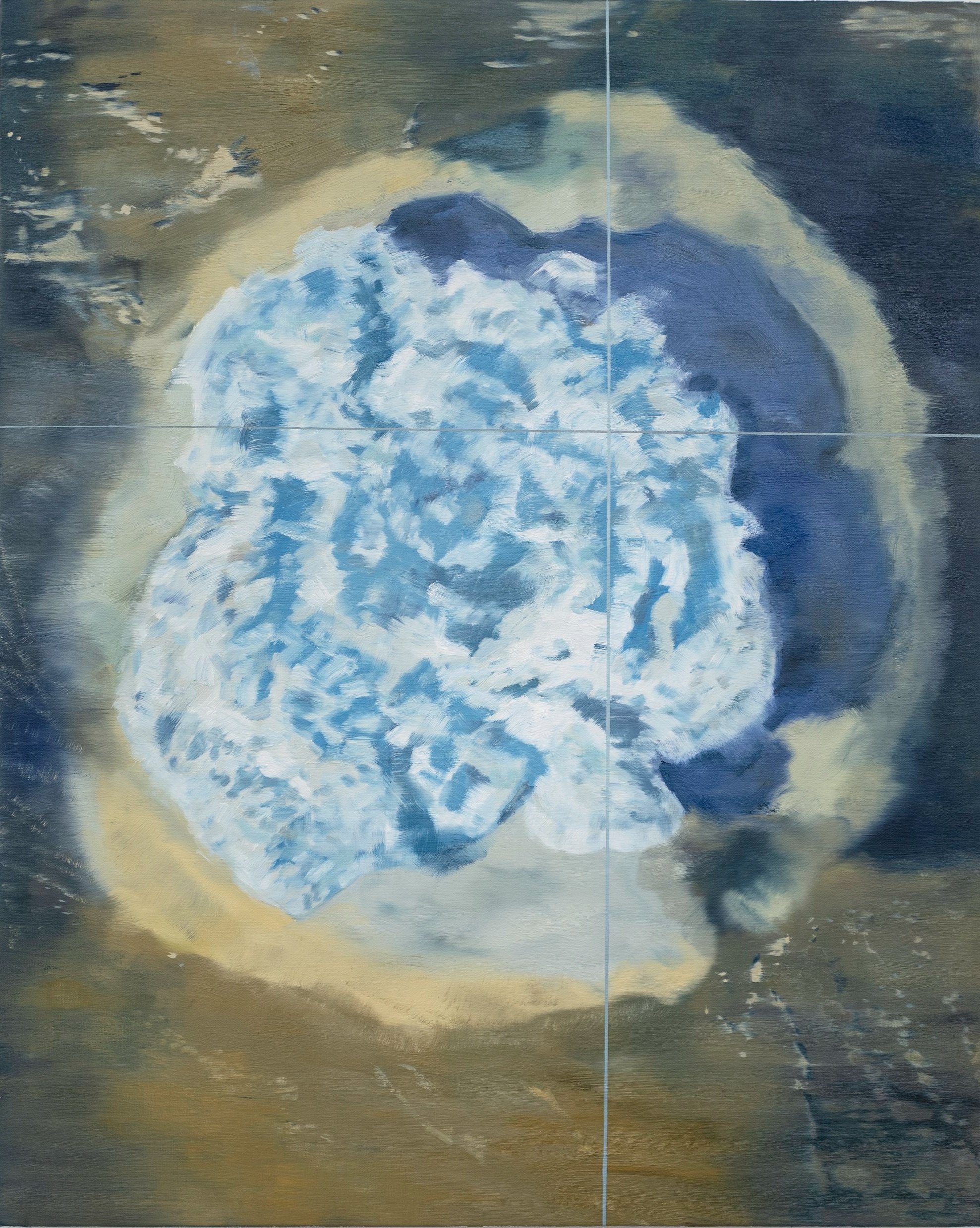
Tan Mu had been planning to travel to Tonga. She is a competitive freediver, and Tonga is one of the world's premier destinations for diving with humpback whales. She had booked the trip. Then the volcano erupted. And in the gap between the eruption and the restoration of the cable, the gap in which the world could see Tonga but Tonga could not see the world, something shifted in her practice. She began painting the event. Not immediately: she waited. She painted Eruption on the day the cable was restored and Tonga came back online.

The Painting the Cable Made Possible
The timing is the argument. Tan Mu did not paint the eruption when it happened. She painted it when the cable was fixed. This is a distinction with enormous conceptual weight. A painting made on January 15, the day of the eruption, would have been a response to a natural disaster, a dramatic event rendered in oil. A painting made on the day of cable restoration is something else entirely. It is a painting about the condition that the eruption revealed: the dependence of an entire nation's participation in global reality on a single cylindrical object, roughly the diameter of a garden hose, lying on the ocean floor.
The painting itself is modest in scale: 76 by 61 centimeters, oil on linen. At its center is a mushroom cloud of volcanic ash rendered in tones that oscillate between the photographic and the painterly: precise enough to be recognizable as a satellite image, loose enough to register the intervention of the brush. Two lines cross the composition, intersecting over the eruption cloud. They suggest the targeting graphics of meteorological or military satellite imagery, the crosshairs through which contemporary events are witnessed, mediated, and archived by machines in orbit.
This overhead perspective is not arbitrary. Tan Mu's grandfather was a meteorologist. She grew up watching him read weather maps, analyze cloud formations, and interpret atmospheric systems from above. "Through him, I developed an early habit of observing the world from above," she has said, "through contour lines, satellite imagery, and abstract visual systems that translate natural phenomena into data." The satellite view in Eruption is therefore both a formal choice and a biographical inheritance, a way of seeing that was transmitted across generations, from a meteorologist reading weather maps in Shandong to a painter reading satellite imagery in a Manhattan studio.
The Paradox of the Image
There is a structural irony at the core of this painting that makes it one of the most intellectually precise works in Tan Mu's body of work. The satellite image of the Tonga eruption was shared globally within minutes of the event. It was among the most widely circulated images of 2022. Everyone saw it. Everyone except the people of Tonga, who had experienced the eruption firsthand, who had felt the shockwave, heard the explosion, seen the ash, but who could not participate in its digital circulation because the infrastructure that enables participation had been destroyed by the event itself.
This is not a minor irony. It is a structural revelation about the nature of contemporary experience. To "experience" an event in 2022 means, for most of the world's population, to encounter it through a screen. The eruption of Hunga Tonga–Hunga Ha'apai was experienced by 100,000 people physically and by several billion people digitally. The physical experience was unmediated, embodied, and terrifying. The digital experience was mediated, disembodied, and spectacular. And the two experiences were disconnected from each other by a severed cable on the ocean floor.
Tan Mu's painting holds this paradox without resolving it. The satellite perspective places the viewer in the position of the digital witness: looking down, at a distance, through the mediating framework of the crosshairs. But the medium of oil on linen pulls in the opposite direction. Oil paint is slow. It is physical. It has weight and texture and smell. It is made of organic material: linseed oil and mineral pigment applied by a human hand. A painting of a satellite image is not a satellite image. It is a translation, from the instantaneous to the durational, from the digital to the material, from the weightless circulation of data to the weighted presence of an object.
The Grandfather's Eyes
Tan Mu's family history is not incidental to this work. It is, in the language of her practice, constitutive. Her grandfather was both a marine engineer and a meteorologist, a man whose professional life was spent at the intersection of the ocean and the atmosphere, the two domains that converge in a submarine volcanic eruption. Her childhood in Yantai, a coastal city in Shandong province, was shaped by proximity to the sea and by the technical language of marine engineering and weather observation. She grew up understanding the ocean as a working environment, not a backdrop. She learned to read maps before she learned to read paintings.
This background gives Eruption a density of personal reference that is invisible on the surface but operative throughout. When Tan Mu looks at a satellite image of a volcanic eruption, she is not seeing what a typical viewer sees. She is seeing what her grandfather would have seen: a weather system, a pressure event, an atmospheric disturbance with measurable parameters. She is also seeing what a marine engineer would see: damaged infrastructure, severed cables, a repair job that will take weeks and cost millions. And she is seeing what a freediver sees: an ocean that has become dangerous, a dive site that has been destroyed, marine habitats that have been reshaped by forces beyond human control.
All of these readings coexist in the painting without being made explicit. Eruption does not annotate itself. It does not explain that the crosshairs refer to the artist's grandfather's weather maps, or that the choice of the Tonga eruption is connected to a cancelled diving trip, or that the timing of the painting corresponds to the cable restoration rather than the eruption itself. These layers are present in the work's conceptual architecture but absent from its surface, which remains a seemingly straightforward image: a volcanic cloud seen from above, crossed by two lines. The painting's intelligence is distributed, not displayed.
Origin Point
Eruption is a small painting. It is also, in retrospect, one of the most consequential works in Tan Mu's practice, because it is the painting that made the Signal series possible. Before Eruption, Tan Mu had explored technology as a subject, quantum computers, logic circuits, CRT static, but had not yet focused on the specific infrastructure of global telecommunications. The Tonga cable severance was the event that directed her attention toward the submarine cable network: the system of 597 cable systems and 1,712 landings (as of 2025, per TeleGeography) that carries approximately 99 percent of intercontinental data traffic.
"Eruption marked a turning point in my practice," Tan Mu has said. "It was the beginning of my sustained exploration of undersea cables as critical global infrastructure. This work introduced the dual themes of connection and disconnection that have since become central to my work." After this painting, she began studying the physical structure of cables, their material composition, their routing, their landing points, and eventually shifted from depicting individual events to mapping entire networks. The Signal series, with its luminous constellations of cable landings rendered in thick oil paint against deep blue grounds, is a direct descendant of this modest painting of a volcanic cloud.
What the eruption gave Tan Mu was not a subject but a revelation. She had known, intellectually, that submarine cables existed. Everyone knows this, in the vague way that everyone knows their phone connects to the internet through some physical medium. What the Tonga event revealed was the stakes of that knowledge. When a cable breaks, a country disappears. Not from the physical world, Tonga's islands did not sink, but from the networked world, which is now the primary arena of shared experience, collective memory, and real-time communication. The eruption exposed the cable as what it had always been: not a neutral conduit but a lifeline, a political instrument, a fragile thread whose presence or absence determines whether a population can participate in the contemporary.

The Human Printer
Tan Mu has described herself as "a human printer and an archaeologist." The phrase is characteristically precise. A printer translates digital information into physical form. An archaeologist recovers physical objects and reads them as information. The two operations are inverses of each other, and both are present in Eruption. The painting translates a digital satellite image into physical paint, printer. It also preserves a specific historical event in a form that will endure beyond the news cycle, archaeologist. The oil painting will outlast the satellite. The canvas will outlast the cable. The physical object, made slowly by hand, will persist long after the digital images that circulated for a day and were forgotten have been buried under the sediment of newer content.
This is not a romantic argument about the superiority of painting over photography or digital media. It is a practical observation about temporal scale. A satellite image of the Tonga eruption exists as a file on a server. The server will eventually be decommissioned. The file will be migrated or lost. The painting exists as an object. It can be stored, exhibited, conserved, and revisited for centuries. The medium of oil on linen, which has been in continuous use since the fifteenth century, has a demonstrated lifespan that no digital format can match. When Tan Mu paints a satellite image, she is not nostalgically retreating from the digital. She is upgrading the image's temporal resolution, moving it from the ephemeral lifespan of a news photograph to the durational lifespan of a painted object.
"Each painting functions as a time stamp," she has said, "recording not just what happened, but how it was perceived, mediated, and remembered. As time moves forward, the meaning of these works continues to evolve, allowing future viewers to reflect on the conditions and systems that shaped our era."
In fifty years, the Tonga eruption will be a historical footnote. The satellite images will be archived somewhere, probably, if the servers are maintained. The painting will still be here: 76 by 61 centimeters of linen and oil, holding the moment when a volcano on the ocean floor severed a cable on the ocean floor and a country vanished from the network for five weeks, and a painter in a studio waited for the cable to be repaired before she picked up her brush, because the painting was never about the eruption. It was about what happened after. It was about the repair. It was about coming back online.