The Animal That Looks Back: Tan Mu's Dolly and the Memory That Will Not Resolve
On July 5, 1996, a Finn Dorset ewe was born at the Roslin Institute near Edinburgh, Scotland. She was named Dolly, after the country singer Dolly Parton, a joke among the laboratory staff about the source of the cell from which she had been cloned, a mammary gland cell taken from a six year old ewe. Dolly was the first mammal to be cloned from an adult somatic cell, a cell that was not a reproductive cell, a cell that had already differentiated into a specific tissue type and that, under normal biological circumstances, could not give rise to a complete organism. The technique that produced her, somatic cell nuclear transfer, involved removing the nucleus from an unfertilized egg cell and replacing it with the nucleus from the mammary gland cell, then stimulating the reconstructed egg to divide and develop as if it had been fertilized by a sperm. The resulting embryo was implanted in a surrogate mother and carried to term. Dolly was genetically identical to the ewe from which the mammary cell had been taken, a copy, a replica, an organism that shared no genetic material with the egg donor or the surrogate mother but that was, in every measurable respect, a complete and functional sheep. She lived for six years, gave birth to six lambs, and was euthanized on February 14, 2003, after developing a progressive lung disease. Tan Mu was five years old when Dolly was born. She remembers the event, vaguely, as a child remembers a news story that is too complex to understand but that carries, in its incomprehensibility, a weight that the child senses without being able to articulate. She painted Dolly in 2021, oil on linen, 61 by 45.7 centimeters, twenty five years after the ewe's birth, as a portrait of an animal she had never seen in person and that existed, in her memory, as a blur.
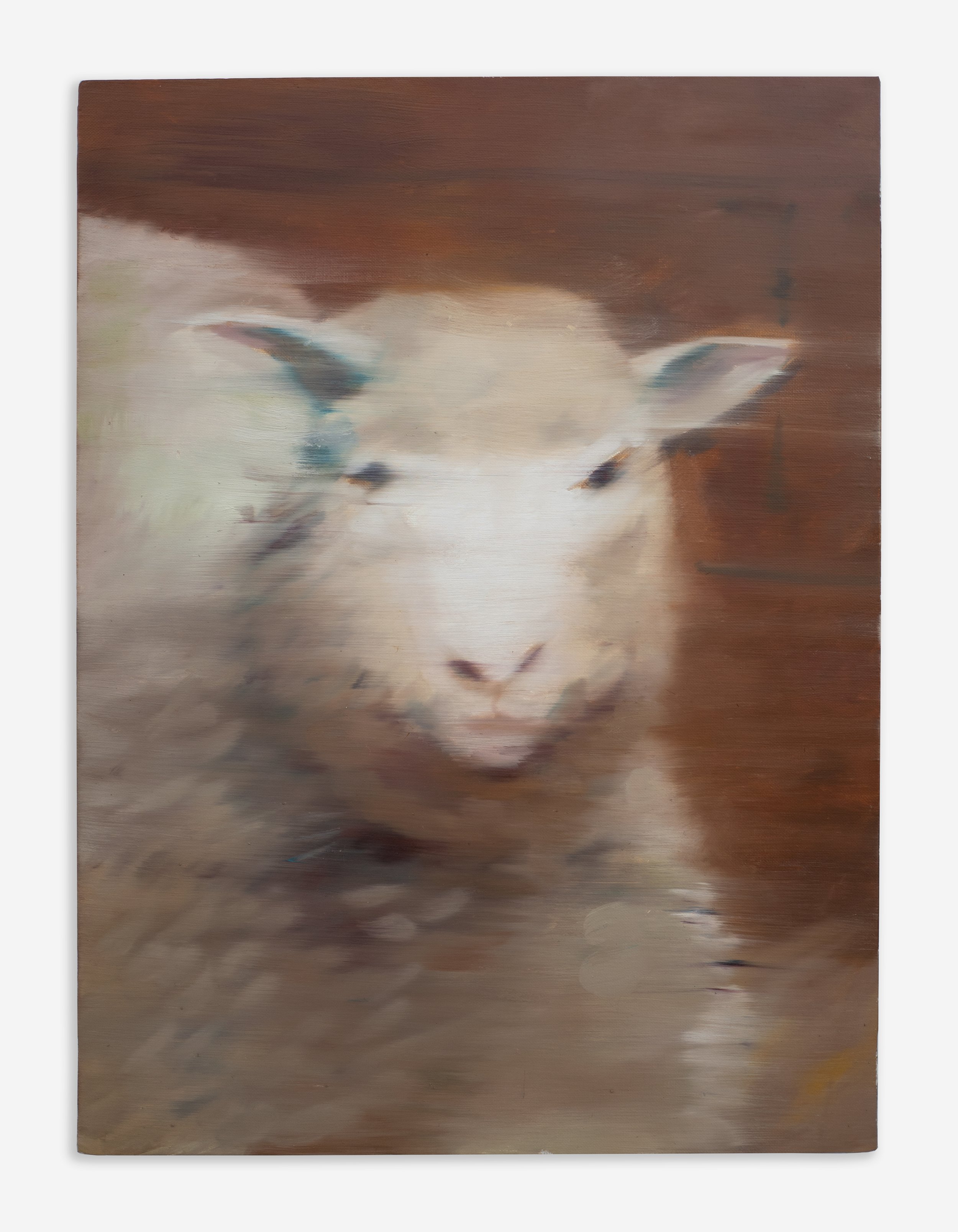
The painting, oil on linen, 61 by 45.7 centimeters, vertical in format, depicts the head and face of a sheep rendered in soft, diffused brushstrokes that blur the animal's features into a field of muted grays, whites, and subtle warm tones. The sheep's eyes are visible, two dark points in the center of the composition, directed at the viewer with the steady, unblinking gaze of an animal that is alert but not alarmed, that is observing the observer with the same quiet attention that the observer brings to the painting. The nose and mouth are suggested rather than delineated, the soft wool of the face rendered in overlapping strokes of gray and white that give the surface a quality of atmospheric depth, the sense that the animal is seen through a veil of distance or time or both. The background is dark, a deep brownish black that isolates the sheep's face and pushes it forward toward the viewer, removing the animal from any specific setting, the laboratory, the field, the pen, and placing it in a space that could be anywhere, any time, the space of memory rather than the space of observation. The palette is severely restricted, grays and whites and browns, with occasional passages of warmer tone that register the animal's skin beneath the wool, the living tissue that gives the face its warmth and its presence.
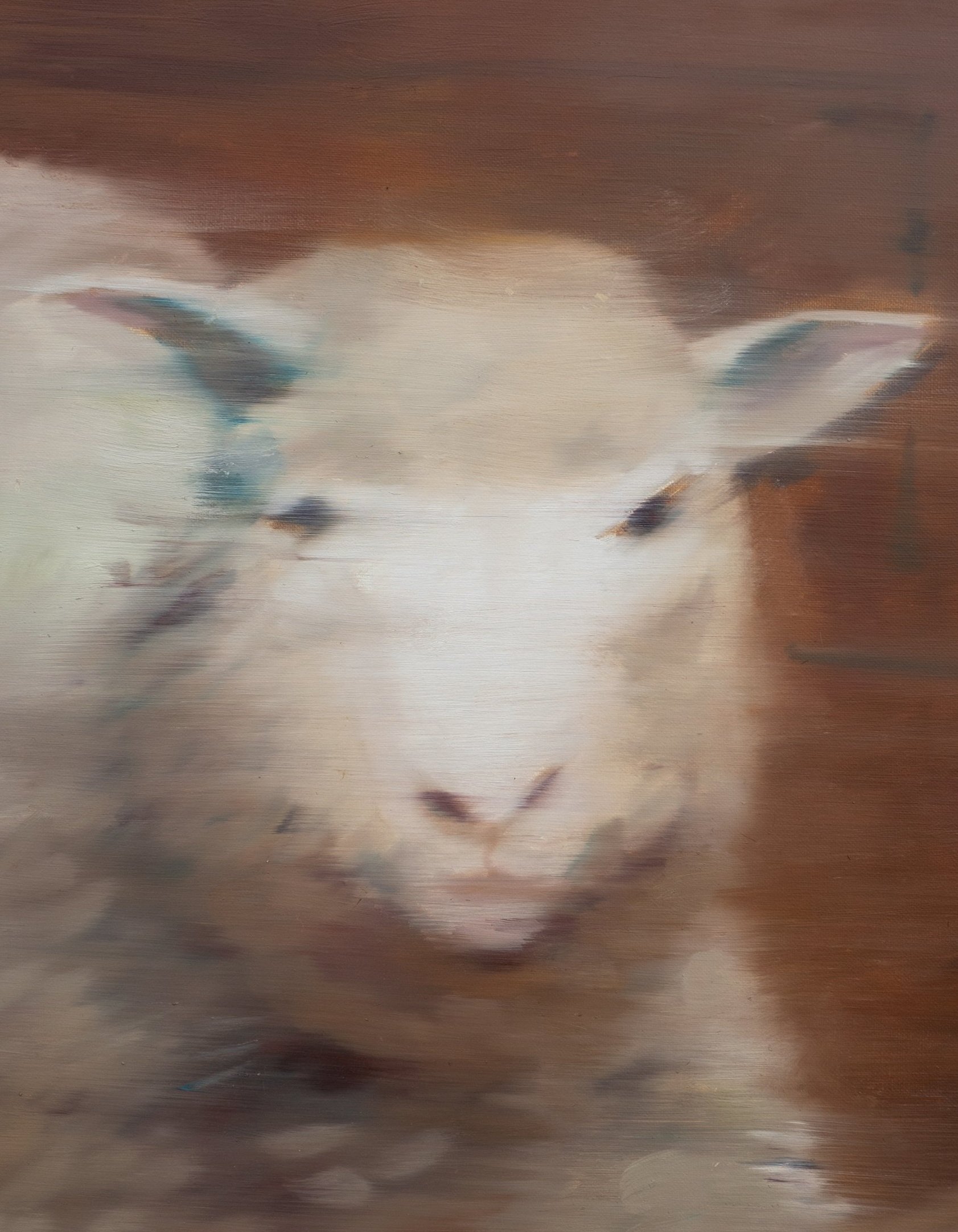
The blur that defines the painting's visual character is not a failure of representation. It is the painting's subject. Tan Mu has explained the blur as a "visual metaphor for memory," a technique that captures the gap between what she remembers of Dolly and what the historical record documents. "When I revisited the story of Dolly years later," she has said, "I realized that the image I held in my mind did not fully match historical documentation. That gap between memory and reality fascinated me. I wanted to capture that ambiguity in the painting." The ambiguity is the blur, the softening of edges, the dissolution of detail, the loss of resolution that occurs when a memory is recalled after decades of dormancy, the image dimmed by time and overlaid with the associations and emotions that the intervening years have attached to it. The sheep in the painting is not the sheep that lived at the Roslin Institute. It is the sheep that lived in Tan Mu's memory, the animal she saw on television or in a magazine when she was five years old and that she has carried, in blurred form, in her mind for twenty five years, an image that has been shaped by everything she has learned about cloning, genetics, identity, and the ethics of biological replication in the decades since Dolly's birth.
The material technique that produces the blur is the application of oil paint in overlapping, directional strokes that are not blended but that are close enough together to create, at normal viewing distance, a continuous field of color that dissolves, at close range, into individual marks. The strokes follow the contours of the sheep's face, curving around the muzzle, radiating outward from the eyes, flowing downward along the cheeks and the jaw, each stroke a deposit of pigment that is too small and too irregular to be read as a specific feature but that contributes, collectively, to the representation of a face that is recognizable as a sheep's face without being identifiable as a specific sheep's face. The distinction matters. A portrait of a specific animal requires the resolution of individual features, the particular shape of the nose, the exact position of the ears, the specific pattern of the wool. A portrait of a memory requires the opposite, the dissolution of individual features into a field of suggestion, the loss of resolution that transforms a specific image into a general one, a particular sheep into the idea of a sheep, a historical event into a childhood impression.
Mark Dion installed a cabinet of curiosities in the Tate Gallery in 1999. Tate Thames Dig was an archaeological investigation of the foreshore of the River Thames at two sites, Fulham and Bankside, where Dion and a team of volunteers collected objects from the riverbed, fragments of pottery, bone, glass, metal, clay pipe, and miscellaneous debris that had accumulated over centuries of human habitation along the river's banks. The objects were cleaned, sorted, classified, and displayed in a large wooden cabinet modeled on the Wunderkammern of the sixteenth and seventeenth centuries, the precursors of the modern museum in which heterogeneous collections of natural and artificial objects were arranged according to systems that were personal, associative, and deliberately unscientific, the antithesis of the taxonomic rigor that would later govern museum classification. Dion's cabinet was a critique of taxonomy, a demonstration that the systems we use to organize and classify the natural world are as much products of human imagination as of objective observation.
The connection between Dion's cabinet and Tan Mu's Dolly is structural. Both are works about the gap between an object and its classification, between a thing and the system that names it. Dion's objects, pulled from the Thames, resist the categories that the museum would impose on them, the shard of Roman pottery that is also a piece of litter, the Victorian clay pipe that is also a historical artifact, the animal bone that is also a piece of kitchen waste. Each object exists at the intersection of multiple taxonomies, none of which fully captures its identity. Dolly the sheep exists at a similar intersection. She is a sheep, a Finn Dorset ewe, a mammal, a vertebrate, a carbon based life form. She is also a clone, a copy, a genetic replica of another sheep, an organism whose identity is defined not by her own genome but by the genome of the animal from which her nucleus was taken. She is, in the language of taxonomy, a paradox, an individual that is also a duplicate, a unique being that is also a copy of a being that already existed. The painting registers this paradox in its blur, the softening of the sheep's features that makes it impossible to determine, from the image alone, whether this sheep is Dolly or her genetic donor or some other sheep entirely, the blur that transforms the individual into the general, the specific into the universal, the clone into the archetype.
Dion's critique of taxonomy extends to the question of how we know what we know, the relationship between the object and the system that interprets it. The objects in the Tate Thames Dig cabinet were real. They were physical, tangible, material presences pulled from the riverbed and placed in a frame that gave them a meaning they did not possess on their own. A shard of pottery in the river is a piece of garbage. The same shard in a museum cabinet is a historical artifact. The object has not changed. The classification has changed. And the classification, Dion demonstrates, is a human construction, a system of meaning that the object does not generate on its own but that the human observer imposes on it through the act of looking, sorting, naming, and displaying. Tan Mu's Dolly participates in a similar dynamic. The sheep in the painting is not Dolly. It is a painting of Dolly, a representation of an animal that lived and died and that the painter never saw, an image constructed from memory, from photographs, from the cultural residue of a scientific achievement that the painter encountered as a five year old child and that has been, in the intervening decades, overlaid with layers of meaning that the original encounter did not contain. The painting does not classify the sheep. It presents the sheep as a presence, a face that looks back, a gaze that is direct and unblinking and that asks, in its silence, whether the viewer can tell the difference between a clone and an original, between a memory and a fact, between a sheep that was born and a sheep that was made.
Li Yizhuo, writing in January 2022, observed that among Tan Mu's paintings, "neither the composition nor the technique of Dolly was particularly remarkable, except that unlike most others, it gazes back." The observation is precise. Most of Tan Mu's paintings depict objects, systems, and landscapes that do not return the viewer's look. The submarine cable does not gaze. The cryostat does not gaze. The Martian landscape does not gaze. The test pattern does not gaze. But Dolly gazes, the sheep's dark eyes directed at the viewer with the steady attention of an animal that is aware of being seen and that is, in its seeing, as present as the viewer who stands before the painting and looks at it. This reciprocal gaze is the painting's deepest achievement. It transforms the sheep from an object of scientific interest, the first cloned mammal, a milestone in the history of genetic engineering, into a subject, a being with eyes and attention and the capacity to look back at the person who is looking at it. The gaze does not resolve the blur. It does not make the sheep's features sharp or specific or identifiable. But it makes the sheep present, alive, here, in the room, looking at the viewer with the same quiet attention that the viewer brings to the painting, and in this reciprocity, this exchange of gazes across the surface of the linen, the painting achieves something that no scientific photograph of Dolly could achieve: it makes the viewer feel, in the body, the reality of a being that was born without a father, that was a copy of a copy, that lived for six years and bore six lambs and died of lung disease on Valentine's Day, and that gazes, from the painting, with the same steady, unblinking attention that every sheep gazes with, the gaze of an animal that does not know it is a clone and that sees, in the viewer's face, nothing but a human being looking back.
The philosophical dimension of the painting extends beyond the question of cloning to the question of originality itself. If Dolly is a copy, then the ewe from which she was cloned is the original. But the original ewe was also produced by natural reproduction, the union of a sperm and an egg, a process that combines two sets of genetic material into a new genome that is similar to but not identical with either parent. Every sexually reproduced organism is, in this sense, a unique combination of inherited material, an original that has never existed before and will never exist again. Dolly breaks this rule. She is not a unique combination. She is a duplicate, a copy, a repetition of a genome that already existed. The painting does not resolve the question of whether this makes her less real, less individual, less alive than a naturally reproduced sheep. It presents the sheep as she is, blurred, gazing, present, and it lets the viewer feel the question in the body rather than answer it in the mind, the discomfort of looking at an animal that is simultaneously familiar and uncanny, a sheep that looks exactly like every other sheep and that is, at the same time, unlike any sheep that has ever existed, a being that was made rather than born, that was produced rather than conceived, that was, in the most literal sense, a product of human technology, and that gazes, from the painting, with the same steady attention that every living creature gazes with, the gaze that asks, without words, whether you recognize it as real.