65 Miles Up: Tan Mu's Peek and the First Time the Earth Looked Back
On October 24, 1946, a V 2 rocket was launched from the White Sands Missile Range in New Mexico. The rocket was not carrying a warhead. It was carrying a 35 millimeter motion picture camera, mounted in the nose cone, programmed to expose one frame every 1.5 seconds as the rocket ascended through the atmosphere and reached an altitude of 65 miles, approximately 105 kilometers, above the Earth's surface. At this altitude, the rocket had crossed the Karman line, the internationally recognized boundary of space, and the camera, looking downward through a small port in the nose cone, captured an image that no human eye had ever seen and no camera had ever recorded: the curvature of the Earth against the blackness of space, the planet's atmosphere visible as a thin, luminous band of haze along the horizon, the ground below obscured by clouds that appeared, from this altitude, as a continuous white blanket covering the surface. The image was grainy, low resolution, and blurred by the rocket's motion and the camera's vibration. It was also, by any standard of historical significance, the most important photograph ever taken from space, the first image of the Earth as seen from above the atmosphere, the first moment at which a human device looked down at the planet from which it had been launched and recorded what it saw. The camera took photographs at a rate five times faster than any previous camera, a technical achievement that was necessary because the rocket was moving at several thousand kilometers per hour and the exposure time had to be short enough to prevent the image from being blurred beyond recognition by the relative motion of the camera and the ground. Tan Mu painted this image in 2021, oil on linen, 91 by 102 centimeters, seventy five years after the rocket carried the camera above the atmosphere, as a record of the moment when humanity, for the first time, saw its own planet from the outside.
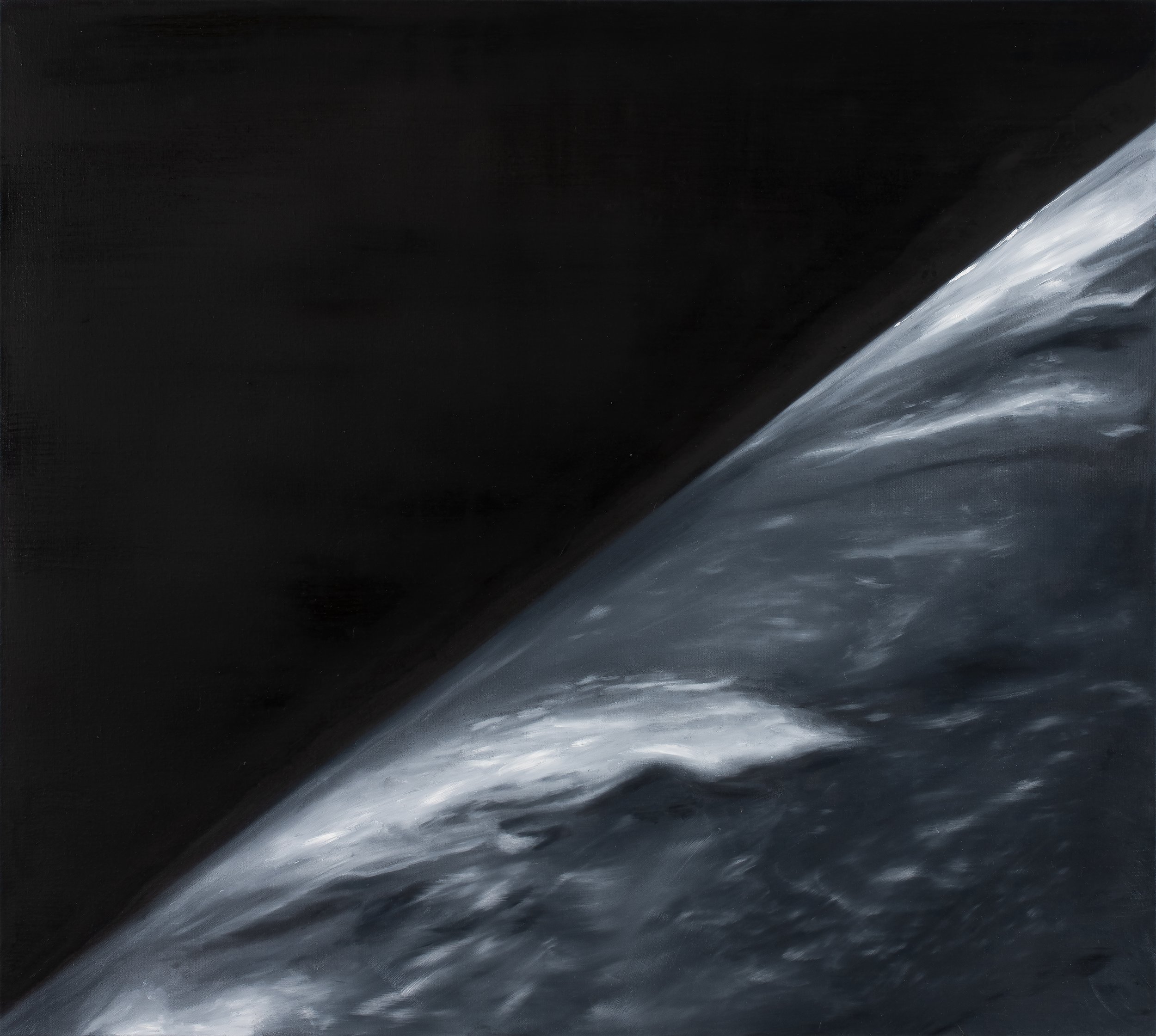
The painting, oil on linen, 91 by 102 centimeters, depicts the Earth as seen from space, the planet's curved horizon occupying the lower portion of the composition, the atmosphere visible as a thin band of luminous haze along the boundary between the planet's surface and the blackness of space above. The palette is muted, dominated by grays, whites, and dark tones that evoke the black and white quality of the original 1946 photograph, the image captured by a camera that was not equipped with color film and that recorded the scene as a field of tonal values, blacks and grays and whites that corresponded to the brightness of the light reflected from the Earth's surface and scattered by the atmosphere. The sky above the horizon is not true black. It is a deep, chromatic darkness that contains undertones of blue and violet, the residual color of the atmosphere at the edge of space, the last traces of Rayleigh scattering that the atmosphere produces before the light enters the vacuum where no scattering occurs. The atmosphere itself is rendered in pale, translucent washes of white and gray, the paint applied thinly enough that the linen ground contributes a warmth to the surface and gives the haze a luminosity that is specific to oil painting, a quality of inner light that the photographic original, with its silver halide emulsion, could not achieve.
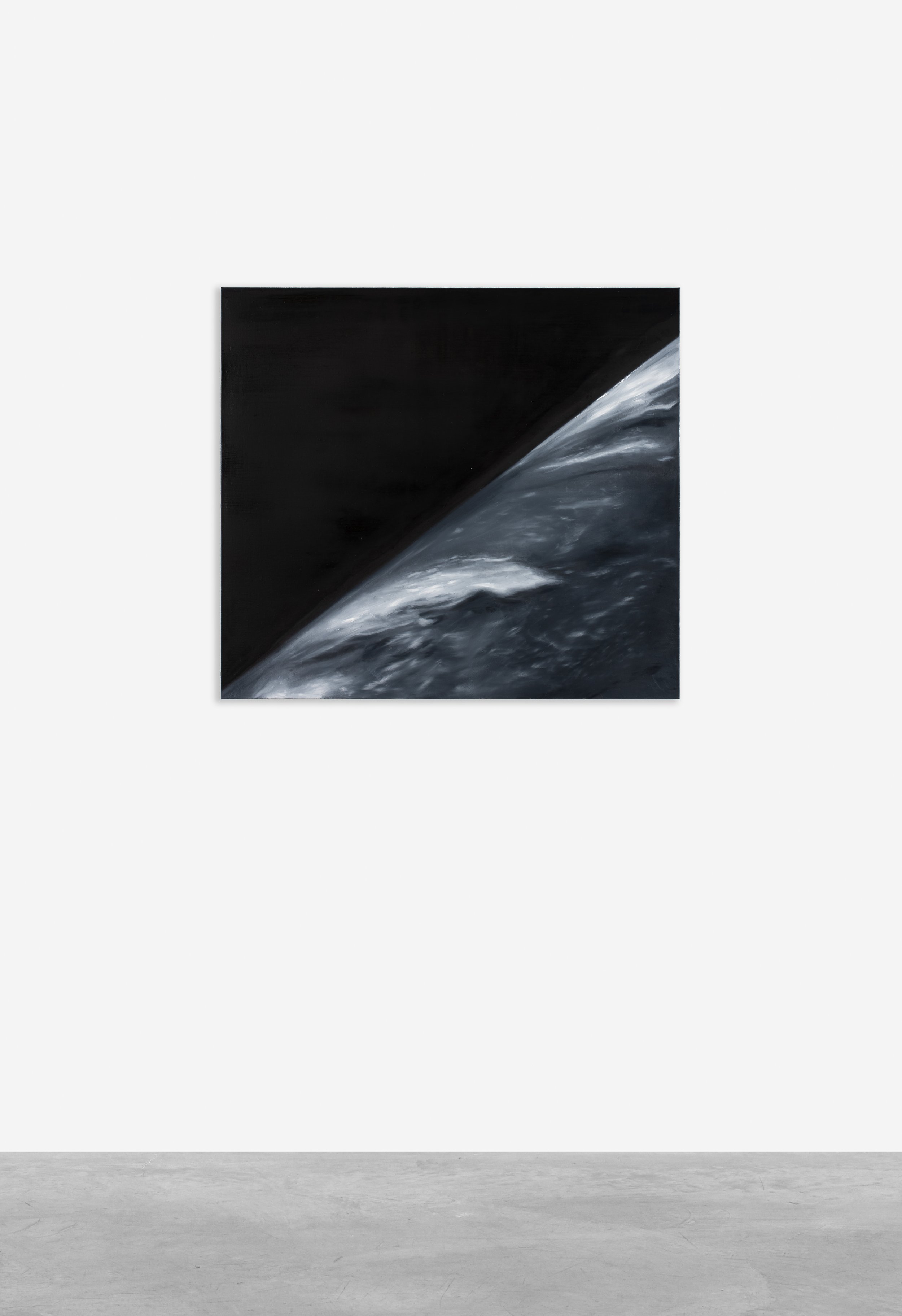
The material qualities of the painting reward close attention to the specific properties of oil paint as a medium for rendering atmosphere. The haze along the horizon is built up in multiple thin layers of white and gray pigment, each layer partially transparent, the layers accumulating to produce a luminosity that is not the brightness of a white surface but the glow of a translucent medium through which light passes and from which it is scattered back toward the viewer. This luminosity is the material equivalent of the atmospheric scattering that produces the haze in the first place, the phenomenon in which sunlight entering the atmosphere is deflected by gas molecules and dust particles in all directions, creating a diffuse glow that is visible from space as a thin band of light along the planet's edge. The painting does not illustrate this process. It enacts it, the oil paint scattering the viewer's gaze in the same way that the atmosphere scatters light, diffusing the sharp edges of the horizon into a soft, luminous gradient that is neither the planet nor the vacuum but the threshold between them. The brushwork in this area is invisible, the strokes blended into a continuous field of color that has no visible directionality, the surface as smooth and uniform as the atmosphere it depicts.
The darker passages, the sky above the atmosphere and the clouds below the horizon, are painted with a different technique. The sky is built up in layers of deep blue and violet, the pigments mixed to produce a chromatic darkness that is warmer and more complex than pure black. The brushstrokes in this area are visible, small directional marks that create a subtle texture on the surface, the painter's hand registering the resistance of the pigment and the linen as it moves across the canvas. The clouds are rendered in opaque passages of white and gray, the paint applied more thickly than the atmospheric haze, the surface catching light and casting tiny shadows that give the cloud layer a physical weight and a topographical presence. The contrast between the smooth, blended atmosphere and the textured clouds and sky is the painting's material core, the point at which the medium's physical properties register the difference between two states of matter, gas and liquid, the transparent atmosphere and the opaque cloud deck, each rendered in a technique that corresponds to its physical behavior.
Hito Steyerl published an essay in 2009 called "In Defense of the Poor Image." The essay examines the contemporary circulation of digital images at varying levels of resolution, from the high resolution originals that exist on professional servers to the degraded copies that circulate on social media, video sharing platforms, and pirated distribution networks, images that have been compressed, resized, re encoded, and re compressed until their resolution has been reduced to a fraction of the original and their color accuracy has been compromised by lossy compression algorithms. Steyerl argues that the poor image, the degraded copy, is not a failure of the system but a product of the system, a form of visual culture that is generated by the same networks that produce the high resolution original and that carries, in its degraded state, a different kind of information, information about the system's velocity, its reach, its capacity to distribute images across platforms and borders and time zones at a speed that the original image, locked in its high resolution server, cannot match.
The connection between Steyerl's poor image and Tan Mu's Peek is structural. The original V 2 photograph of 1946 is, by contemporary standards, a poor image. It is grainy, blurred, low in resolution, and captured in black and white by a camera that was designed to survive the acceleration and vibration of a rocket launch rather than to produce photographs of archival quality. The image has been reproduced, reprinted, digitized, and circulated for seventy five years, each reproduction adding a layer of degradation, each re encoding reducing the resolution a little further, each reprint losing a little more of the original's tonal range. By the time Tan Mu encountered the image, it was, in Steyerl's terms, a poor image, a degraded copy of a degraded copy, an image whose informational content had been reduced to its essential visual structure, the curvature of the horizon, the band of atmosphere, the darkness of space, and whose specific details, the resolution of the clouds, the sharpness of the horizon line, the granularity of the film grain, had been softened and blurred by decades of reproduction. The painting takes this poor image and re renders it in oil on linen, adding a further layer of mediation, the conversion from digital pixel to painted pigment, the substitution of the hand for the algorithm, the addition of time and body and attention to an image that has been, for seven decades, reproduced without any of these.
Steyerl's further observation, that the poor image creates "a visual culture of circulation" in which "the speed of the image is more important than its resolution," provides a framework for understanding what the painting adds to the source image. The V 2 photograph was taken at a speed of one frame every 1.5 seconds, five times faster than any previous camera, a technical achievement that was necessary because the rocket was moving at high velocity and the exposure had to be short enough to prevent motion blur. The photograph's value, in 1946, was not its resolution, which was poor by any standard, but its speed, the fact that a camera could capture an image at the altitude and velocity of a rocket in flight. The painting inherits this speed, not in its making, which took hours or days, but in its subject, the image of a moment that lasted a fraction of a second, the instant at which the camera, carried above the atmosphere by a rocket designed to deliver weapons of mass destruction, pointed downward and recorded the first view of the Earth from space. The painting re records this instant at the speed of the hand, the slow, patient accumulation of pigment on linen, adding to the photograph's millisecond of exposure the hours of the painter's life that went into the making of the surface.
Li Yizhuo, writing in January 2022, observed that Tan Mu's canvases "do not aim at diagnosing the modern spectacles from a distance. They conjure up a kind of vitality and depth of their own." The observation is particularly apt in the context of Peek, a painting that could easily have become a monument to the spectacle of space exploration, the heroic narrative of the rocket launch, the technological triumph of the camera at altitude, the patriotic achievement of American science in the early Cold War. The painting refuses this narrative. It does not depict the rocket, the launch pad, the camera, the military personnel who tracked the flight. It depicts the image, the photograph, the view from above, and it renders this view in a palette and a technique that are quiet, contemplative, and intimate, the muted grays and whites of the atmosphere, the soft, luminous haze along the horizon, the chromatic darkness of the sky above. The vitality that Li Yizhuo identifies is the vitality of the painted surface itself, the energy of pigment applied to linen, the warmth of the ground showing through the translucent washes, the presence of the hand in the strokes that build the clouds and the atmosphere, a vitality that belongs to the painting rather than to the event it depicts, a depth that is material rather than narrative, a quality that the viewer feels in the body rather than understands in the mind.
Li Yizhuo further observed, in the same essay, that Tan Mu's "way of looking aligns with the Chinese philosophical lineage of ge wu zhi zhi that investigates things to extend knowledge, examining and discerning objects of various scales and conditions." In the context of Peek, the principle of ge wu zhi zhi operates through the act of painting the photograph, the sustained attention that the painter brings to an image that was captured in a fraction of a second and that has been circulating, in degraded form, for seventy five years. The painting does not add scientific information to the V 2 photograph. It adds attention, the patient, embodied attention of a human being who looks at the image long enough to register its presence as a fact of the world, a moment that occurred, a view that was seen, a planet that was, for the first time, photographed from the outside. The painting makes this moment present, in the room, on the wall, in the viewer's field of vision, at a scale that is intimate rather than monumental, the 91 by 102 centimeter canvas smaller than many of the photographs it depicts, smaller than the Horizons paintings that would later develop the satellite perspective into a series of larger, more luminous canvases. Peek is the genesis, the first image, the origin point of a line of investigation that would lead, through Horizons and Observable Infinity, to the cosmic iris of the Gaze series, the painting of the universe looking back. But Peek is also the most humble of these works, the most honest about the limits of the image it re records, the most faithful to the poor quality of the source photograph, the grain and the blur and the haze that made the first view of the Earth from space not a triumphant, crystal clear revelation but a murky, atmospheric glimpse of something that was too large and too far away for any camera to capture with precision.
Tan Mu has described Peek as "the genesis of the Horizon series, an exploration of Earth's satellite perspective." The word genesis carries a weight that goes beyond the merely chronological. The Horizon paintings, completed in 2024 and 2025, depict the Earth from the International Space Station, a vantage point that is higher than the V 2 rocket's 65 miles and that produces images of far greater resolution, color accuracy, and compositional sophistication than the 1946 photograph. The Horizons series is, in every formal respect, a more accomplished body of work than Peek, larger canvases, more complex compositions, richer palettes, more confident brushwork. But Peek is the origin, the first image, the moment at which the satellite perspective was born, the instant at which a camera, carried above the atmosphere by a rocket, looked down and saw the Earth and recorded what it saw in a grainy, blurred, black and white photograph that was, at the time, the most astonishing image ever produced by human technology. The painting does not surpass this image. It does not improve on it. It re records it, in oil on linen, at a pace that is human rather than mechanical, and it asks the viewer to look, with the same quiet attention that the painter brought to the act of making, at a view that changed the way humanity sees its own planet, a view that was first captured not by a satellite or a space station or a telescope but by a camera in the nose of a rocket that was designed to carry bombs.