The Gemstone Inside the Body: Tan Mu's Epithelial Cells and the Painting That Reads Like a Lab
In a laboratory at a research institution, a dish of human epithelial cells sits on the stage of a fluorescence microscope. The cells have been clonally labeled, a technique in which individual cells are tagged with specific fluorescent markers at a single point in time, so that all cells descended from a tagged ancestor carry the same color. The result, when the dish is illuminated with ultraviolet light and photographed through the microscope, is a mosaic of vivid color fields, each field a clonal population, a family of cells that originated from a single tagged ancestor and that has grown, divided, and spread across the surface of the dish, each generation inheriting the ancestor's color marker and passing it to the next. The image is beautiful. The colors are saturated, the forms are organic, the composition is complex, a field of interlocking territories that looks like a map, or a stained glass window, or a satellite photograph of agricultural plots seen from orbit. It is also a scientific instrument, a visual record of cell proliferation, lineage development, and the potential for tumor formation, encoded in color rather than in numbers. Tan Mu saw this image and recognized in it a kinship with her own practice, the kinship between scientific staining and oil painting, between the fluorescent marker and the pigment, between the microscope's lens and the painter's eye. She painted it in 2024, oil on linen, 122 by 153 centimeters, enlarging the microscopic field to a scale that fills the viewer's visual field and transforms the laboratory observation into a landscape of color and form that the viewer can enter with the body rather than merely examine with the eye.
The painting, oil on linen, 122 by 153 centimeters, depicts a field of epithelial cells rendered in vivid, saturated colors, each cluster of cells a distinct color, the clusters interlocking across the surface in a pattern that is organic, irregular, and dense. The palette is among the most vibrant in Tan Mu's catalog, saturated reds, blues, greens, purples, and oranges set against a dark ground that gives the colored clusters a luminous, gem like quality, the appearance of faceted stones embedded in a matrix of shadow. The cells themselves are rendered as rounded, organic forms, each one a discrete unit of pigment that is similar to but not identical with its neighbors, the small variations in size, shape, and color that distinguish one cell from another within a clonal population. The background is not a uniform dark. It is a field of small dots, Tan Mu's signature technique, each dot a discrete mark of pigment that contributes to the ground's darkness while retaining its individual identity as a point of color. At a distance, the dots dissolve into a continuous dark field. At close range, they resolve into a constellation, a scatter of points that recalls the starry skies of the Gaze series, the data points of the Signal series, and the synaptic particles of the Synapse painting, a visual language that connects the microscopic to the cosmic through the shared structure of discrete information units accumulating into fields of meaning.
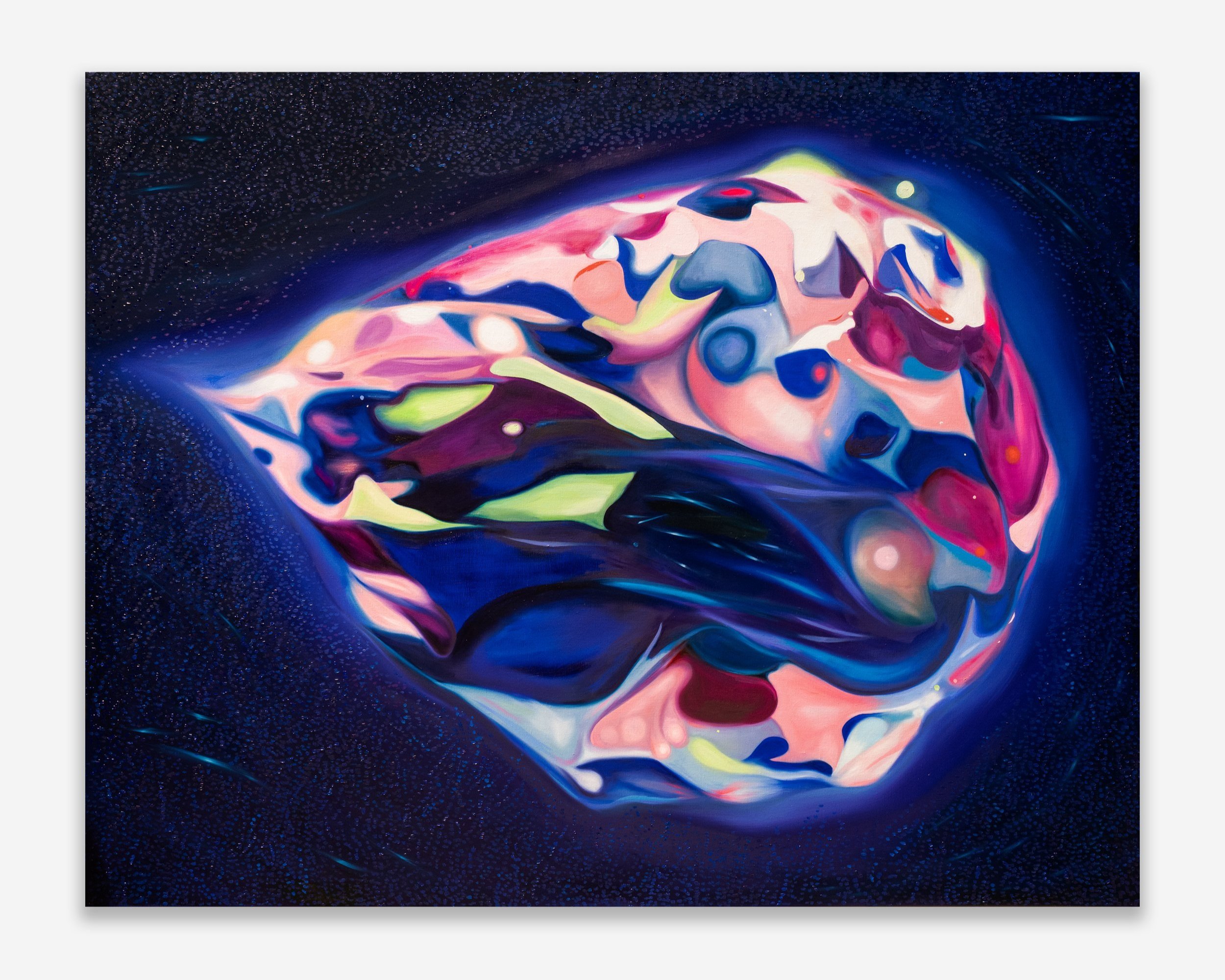
The material technique that produces the painting's vibrancy is the application of oil pigment in saturated, unmodulated passages that preserve the intensity of each color without blending it into adjacent tones. The cells are painted individually, each one a discrete mark of pigment applied with a brush that is small enough to render the cell's rounded form without reducing it to a dot. The colors are not mixed on the palette to produce subtle gradations. They are applied from the tube, or with minimal mixing, the cadmium red remaining cadmium red, the ultramarine remaining ultramarine, the viridian remaining viridian, each color retaining its full intensity on the canvas. This directness of application is the material equivalent of the fluorescent marker, the dye that colors the cell without modifying its structure, the pigment that makes the cell visible without changing what it is. The scientific staining process and the painting process share this property: both add color to a surface without altering the surface's underlying form, both make visible what would otherwise be invisible, both operate through the application of a colored substance to a substrate that remains, beneath the color, unchanged.
Tan Mu has articulated this parallel between staining and painting in terms that reveal how deeply the connection structures her thinking. "I find it fascinating that scientific staining processes closely parallel the logic of painting," she has said. "In my own work, variations within a single color emerge through pigment mixtures that share the same origin but differ in proportion. This connection between scientific visualization and painterly method reinforces the idea that both disciplines rely on precision, interpretation, and creativity." The observation is precise. In clonal labeling, cells descended from the same ancestor share the same fluorescent marker but may exhibit slight variations in the intensity and distribution of the marker due to differences in cell size, metabolic activity, and the age of the marker within the cell. In oil painting, brushstrokes made from the same pigment mixture may exhibit slight variations in opacity, texture, and color temperature due to differences in brush pressure, medium concentration, and the drying state of the paint. Both processes produce variation from a common origin, both generate diversity through the interaction of a single source material with the physical conditions of its application.
Georgia O'Keeffe painted flowers. Her works of the 1920s and 1930s, paintings like Black Iris (1926) and Jimson Weed/White Flower No. 1 (1932), enlarged the petals, stamens, and pistils of flowers to a scale that filled the canvas, transforming the intimate, fragrant structure of a blossom into a monumental field of color and form that the viewer encountered not as a botanical specimen but as an environment, a space that the eye could enter and traverse, a landscape of organic curves and saturated hues that was simultaneously a flower and something larger than a flower, a visual experience that exceeded the viewer's normal relationship to the botanical subject. O'Keeffe's magnification was not merely a change of scale. It was a change of register, the conversion of a small, delicate, perishable object into a large, durable, permanent image, the substitution of pigment on canvas for petal on stem, the replacement of a living thing with a painted surface that captured the living thing's visual properties while discarding its biological ones.
The connection between O'Keeffe's flowers and Tan Mu's cells is structural, not stylistic. Both artists take a subject that is normally perceived at a specific scale, the flower at arm's length, the cell through a microscope, and enlarge it to a scale that transforms the viewer's relationship to the subject from observation to immersion. O'Keeffe's flower is large enough to enter. Tan Mu's cells are large enough to inhabit. Both artists use oil paint to render organic forms with a precision that approaches scientific illustration while retaining the visible evidence of the hand, the brushstrokes, the texture of the pigment, the warmth of the linen ground. And both artists produce, through this combination of precision and materiality, images that are simultaneously accurate and interpretive, images that record the visual properties of their subjects while adding to those properties the specific qualities of oil on linen, the luminosity, the warmth, the depth, the handmade presence that the photographic or microscopic original does not possess.
The biology of epithelial cells provides the context that makes the painting's subject legible. Epithelial cells form the lining of every surface in the body that is exposed to the external environment, the skin, the respiratory tract, the digestive tract, the urinary tract, and every internal surface that interfaces between compartments, the blood vessel walls, the kidney tubules, the lung alveoli. They are, in the most literal sense, boundary cells, cells that exist at the interface between inside and outside, between self and world, between the body's interior and the environment it inhabits. They are also the cells from which most human cancers originate, because they are the cells that are most exposed to environmental damage, to chemical carcinogens, to ultraviolet radiation, to the mechanical stress of constant renewal. The clonal labeling technique that Tan Mu's painting depicts is used, in cancer research, to trace the lineage of individual cells as they proliferate, differentiate, and potentially transform into tumor cells, each clone marked with its own color, the growth and spread of the clone visible as the expansion of a colored territory across the surface of the dish.
The clonal labeling process works by introducing a heritable fluorescent marker into individual cells at a single time point, using a viral vector or a genetic construct that integrates the marker into the cell's genome so that every descendant of the labeled cell inherits the marker and expresses it at a level that is visible under fluorescence microscopy. When multiple cells in the same dish are labeled with different colored markers, the result is a mosaic of clonal territories, each territory a single color, each color representing a single ancestral cell and its descendants. The size of each territory records the proliferative capacity of the ancestor, the rate at which it divided, the number of generations it produced, the distance its descendants migrated across the dish. Small territories indicate ancestors that divided slowly or stopped dividing. Large territories indicate ancestors that divided rapidly and produced many descendants. This information, encoded in color and visible to the eye, is the data that cancer researchers use to study the behavior of individual cells within a population, to identify cells that are growing abnormally, and to trace the lineage of cells that may be transforming into tumor cells. The painting translates this data into pigment, each colored cluster rendered in oil on linen at a scale that makes the territory's size and shape visible to the naked eye, the scientific record converted into a visual experience that the viewer can read without a microscope.
Tan Mu has connected this biological function to the philosophical framework of Julien Offray de La Mettrie, the eighteenth century French physician and philosopher who argued, in his 1747 treatise Man a Machine, that the human body is a complex and highly organized mechanism, a machine whose operations can be understood through the same principles of physics and mechanics that govern the operation of all other machines. "Whether I depict neurons, epithelial tissues, embryonic cells, or technological components," Tan Mu has said, "I am consistently drawn to the fundamental units that make up larger systems. These biological elements function much like the technological components I paint elsewhere, reinforcing my ongoing exploration of the parallel structures of biology and technology." The epithelial cell is, in this reading, a component, a unit of the body's machinery that performs a specific function, the maintenance of boundaries, the regulation of exchange, the protection of interior from exterior. The painting presents this unit at a scale that makes its function visible, the enlarged cells forming a continuous layer across the canvas, their interlocking forms maintaining the boundary between the colored field of the cells and the dark ground of the background, the same boundary that epithelial cells maintain between the body's interior and the world outside.
Nick Koenigsknecht, writing in the BEK Forum catalog in 2025, argued that Tan Mu's paintings of technology should be understood as "self portraits, rather than depictions of external, scientific milestones." While articulated in the context of technological subjects, the proposition extends to the Epithelial Cells painting with particular clarity. The cells in the painting are not external objects that Tan Mu observed from a distance. They are cells of the same type that exist in her own body, the lining of her skin, her respiratory tract, her digestive system, the boundaries between her interior and the world. The painting is, in this sense, a portrait of a relationship, the relationship between a human being and the cells that constitute her, cells that she cannot see without a microscope, that she cannot paint without a laboratory image, that she knows exist but that remain invisible to her in daily life, hidden beneath the skin, performing their function of boundary maintenance in the dark, without her awareness, without her attention, without her gratitude. The painting brings these cells into the light, enlarges them to a scale at which their forms and colors are visible, and presents them as the beautiful, complex, gem like structures that they are, structures that exist, in their billions, in every human body on Earth, maintaining the boundaries that make individual life possible.
Koenigsknecht's further observation, that "maybe it is time to recontextualize our presence on earth as a cohabitation with bio techno siblings" who "have lifecycles. They are conceived, born, maintained, and eventually replaced," applies to the epithelial cell with particular force. The epithelial cell is a bio techno sibling in the most intimate sense, a component of the body's machinery that is conceived when a stem cell divides, born when the daughter cell differentiates, maintained by the body's metabolic processes, and eventually replaced when it dies and is shed, as skin cells are shed, as the lining of the intestine is replaced every three to five days, as the cells of the respiratory tract are renewed every few weeks. The painting captures these cells at a specific moment in their lifecycle, the moment of clonal expansion, the point at which a tagged ancestor has produced a family of descendants that share its color and that spread across the dish in a pattern that records the ancestor's proliferative potential. The color is the record. The form is the record. The painting is the record. And the viewer who stands before it and sees the vivid clusters of red and blue and green and purple cells, each one a family, each family a clone, each clone a record of a single cell's capacity to give rise to a population, sees in the painting a truth about their own body that they cannot see in the mirror: that they are made of cells, that the cells are beautiful, that the beauty is not decorative but structural, the visual expression of a biological process that has been operating, in every living organism on Earth, for approximately 3.8 billion years.