Illuminate (2022)
On the last night of 1879, Thomas Edison lit a carbonized cotton thread inside a glass vessel at his Menlo Park laboratory and held it burning for forty-eight consecutive hours. The world had seen electric arcs before, the wild blue-white discharge of high-voltage sparks that served as laboratory curiosities and street lamps for the very wealthy. But this was different. This was a warm, sustained, domestic light emerging from a sealed glass bulb no larger than a fist, and it did not gutter or hiss or demand special generators. It simply glowed, and in doing so, it reorganized every assumption about what night could mean for human civilization.
Tan Mu paints this bulb not as an icon of progress but as a subject of quiet, almost biological intensity. In her 2022 painting Illuminate, the glass vessel sits at the center of a linen field like a cell suspended in solution, its filament rendered in warm amber thread-tones against the deeper ochre and raw umber of the background. The bulb is not exploding with light. It is not depicted in the moment of dramatic invention. It is painted portrait-fashion, as if it were sitting for a long formal portrait, and what the portrait captures is the quality of that sustained, quiet interior light as it exists after ignition, during the long hours when it just kept burning and burning and did not stop.
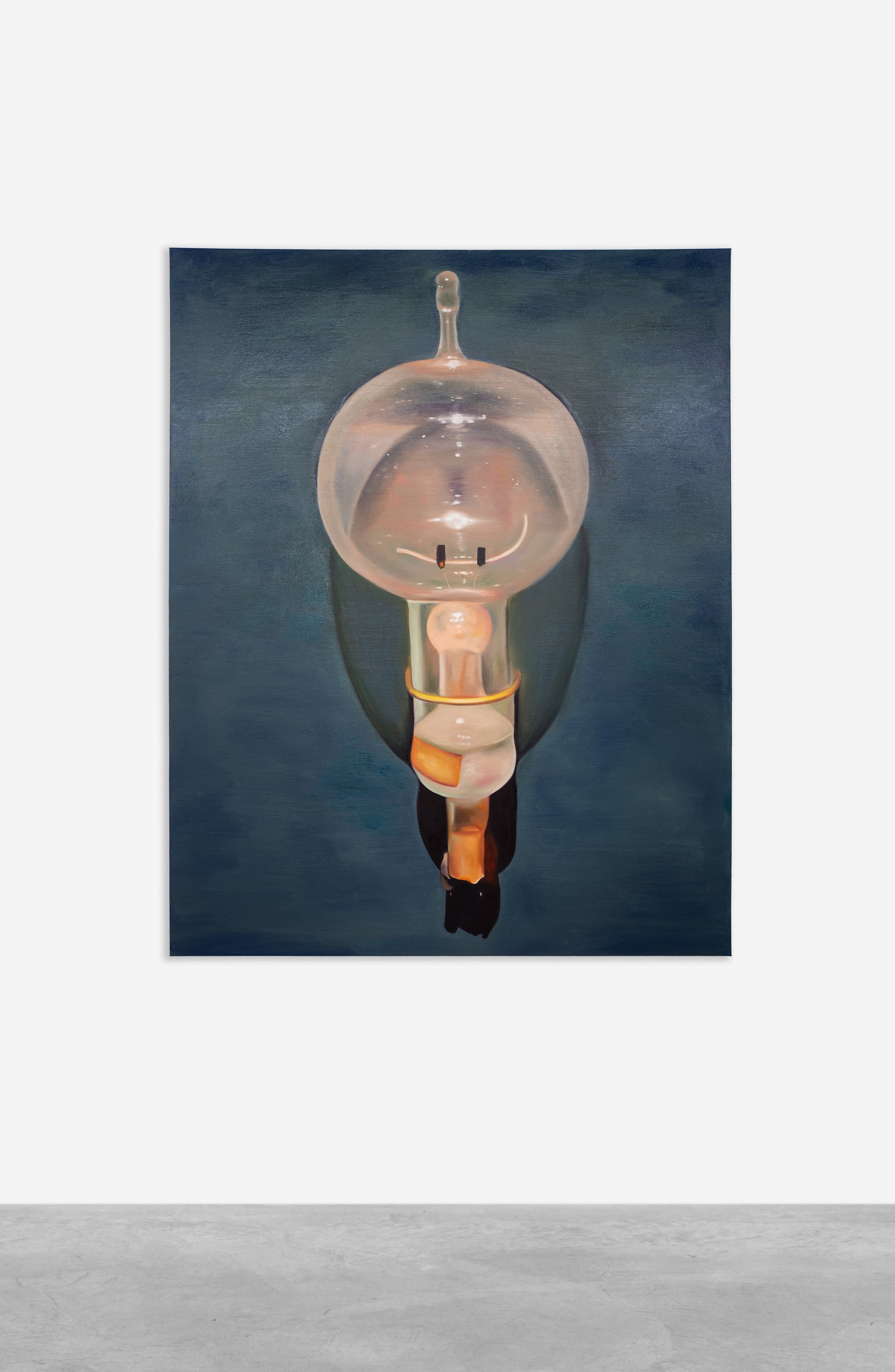
The connection between illumination and biological emergence was not part of Edison's thinking when he designed the carbon filament lamp. But it was very much part of Tan Mu's thinking when she painted it. In the artist's own words, the process of the filament heating and emitting light "unexpectedly reminded me of cell division, a subject I had explored in earlier works." She describes watching the moment of incandescence and thinking about the first single cell, round in form, dividing and multiplying, and finding in that biological parallel a conceptual bridge that transformed the light bulb from a technological object into a symbol of initiation, transformation, and emergence. The painting holds both parallels simultaneously, refusing to choose between them.
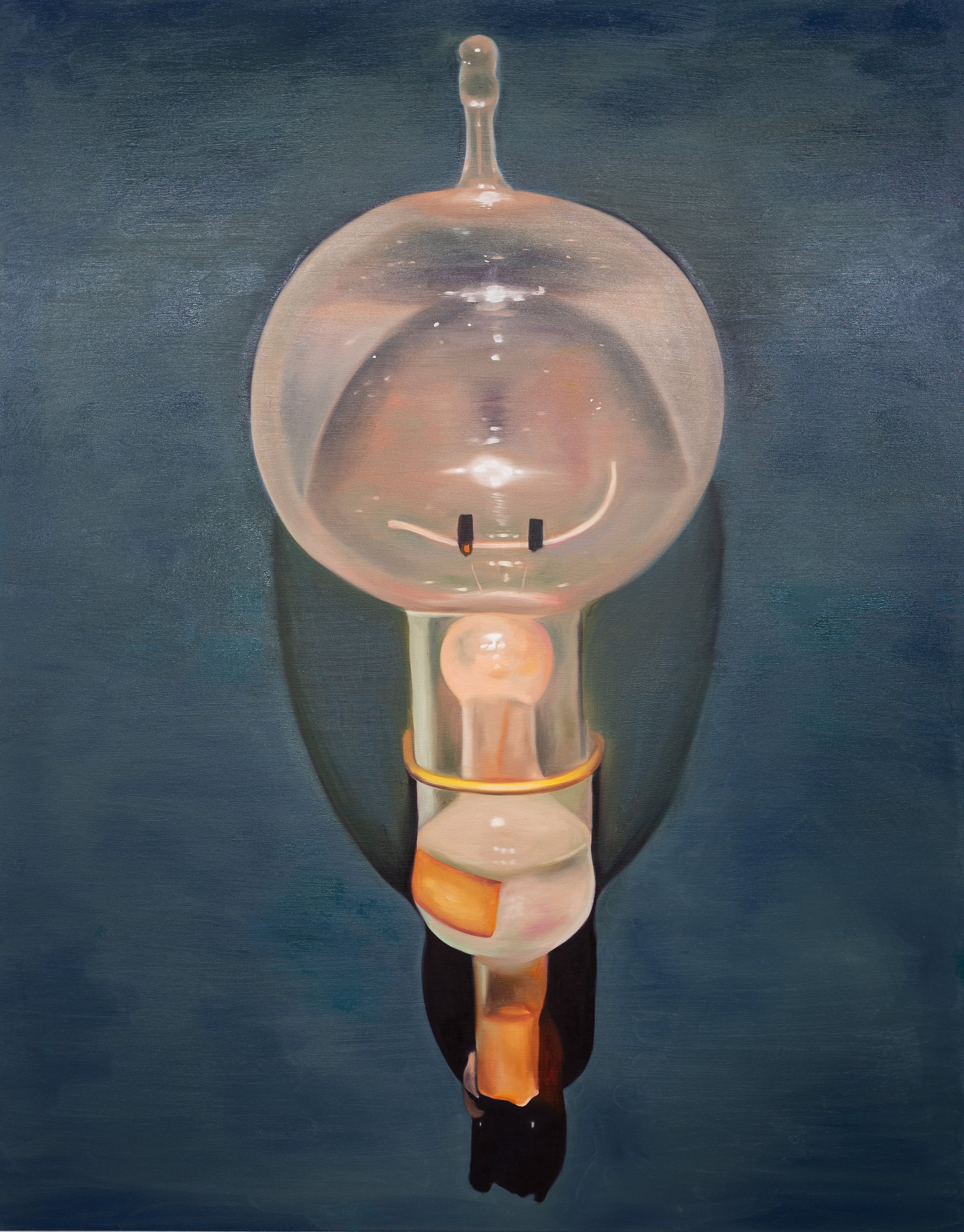
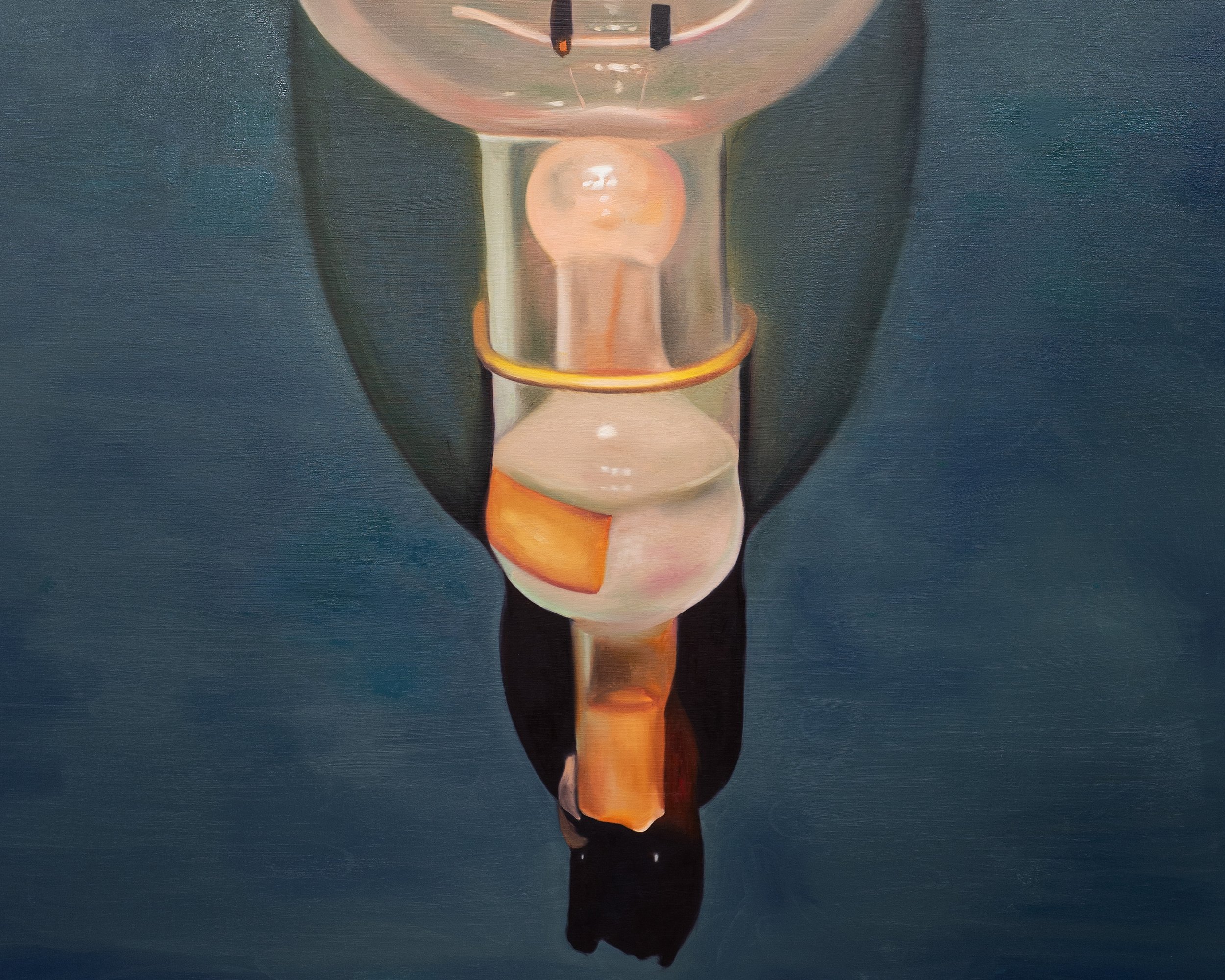
Illuminate measures 152 by 122 centimeters on linen, a scale that positions the bulb slightly larger than life-size, not dramatically larger but enough to make the viewer feel they are standing close to an object that is somehow looking back at them. The medium is oil on linen, and the surface texture is built up in thin, layered translucent glazes that allow the warm ground of the linen to breathe through the darker passages, creating a depth of tone that recalls the amber and brown-sugar palette of late Rembrandt self-portraits or the warm interior atmospherics of Vermeer. The linen weave itself is visible in the lighter passages, giving the surface a quiet material honesty that prevents the warm glow of the bulb from becoming sentimental or merely decorative. At three meters from the canvas, the bulb reads as an almost photographic presence, the glass form clear and readable against the atmospheric ground. At thirty centimeters, the texture of the paint surface becomes apparent, the build-up of glaze layers and the slight drag of the brush across the linen weave, the way the filament is painted not as a precise line but as a slightly textured thread form with weight and depth to it.
The glass bulb itself is painted with a remarkable restraint that avoids the temptation of depicting it as either perfectly transparent or perfectly reflective. Tan Mu uses the glass surface to slow down the viewer's looking, introducing subtle shifts in tone where the glass curves away from the viewer and where the internal filament structure casts faint, warm shadows onto the interior of the glass envelope. The filament, rendered in amber and pale gold tones against the darker background of the bulb interior, reads as both structural engineering and organic thread. This duality is the painting's deepest interest. The carbon filament is a piece of technology, a carefully processed cotton thread that Edison carbonized in a oven to create a material that would glow without melting inside the sealed glass vessel. But Tan Mu paints it with a quality of organic weight, a slight unevenness in the thread's thickness that suggests not mechanical precision but biological growth, the kind of slightly irregular thickness that a root or a nerve fiber might have. The dual nature of the filament as both technological artifact and biological analog is where the painting does its most precise conceptual work.
The tradition of painting light as both subject and medium runs from the candle-lit interiors of Georges de La Tour through the revolutionary optical investigations of Joseph Wright of Derby, whose 1768 painting An Experiment on a Bird in the Air Pump depicts a scientific demonstration conducted by torchlight inside a darkened room. Wright understood something that Tan Mu also understands: that the depiction of artificial light in painting is never merely a recording of photons. It is always also a meditation on what it means to extend human perception beyond its natural limits through technology. In Wright's painting, the torch held by the demonstrator is the only source of illumination in the room, and it casts the faces of the assembled observers into zones of deep shadow and sudden highlight, making the experience of watching the experiment a material condition of the painting itself. The light is not just what is depicted. It is the instrument through which the depiction happens.
Tan Mu works in a related but distinct tradition. Where Wright used torchlight as a dramatic device to create heightened chiaroscuro, she uses the warm amber glow of the incandescent filament to create something more intimate and less theatrical. The light in Illuminate does not stage a dramatic scene. It simply occupies the center of the canvas with a sustained, quiet presence that asks the viewer to slow down and look at it as a thing rather than a symbol. The painting's decision to depict the bulb in portrait fashion rather than as part of a narrative scene is significant for this reason. It refuses to use the light bulb as a prop in a story about invention or progress. It insists instead on the object's presence, its material specificity, its quiet interior glow as something worth sustained attention. This is not a painting about Edison or Menlo Park or the electrical age. It is a painting about what it feels like to sit in front of a burning filament inside a glass vessel and to find in that burning a conceptual resonance with the origins of life itself.
The carbon filament inside a modern replica of an Edison lamp, when examined closely, is fragile and irregular. It is not a clean technological object but an artifact of specific material decisions made in a laboratory in New Jersey in 1879. Edison tested over six thousand different organic materials before settling on a carbonized cotton thread as the optimal filament for his first practical lamp, and the selection process was as much empirical accident as scientific method. The final filament was not the product of a theoretical understanding of blackbody radiation or thermal emission. It was the product of systematic, almost artisanal experimentation, the kind of material knowledge that comes from burning things and observing what survives. This history of the filament as a made object, a thing that was invented through trial and error rather than theoretical breakthrough, is exactly the kind of history that Tan Mu's painting invites the viewer to inhabit. The warmth of the amber tones is not decorative. It carries the weight of a material history, the actual heat that the filament generated during its forty-eight hours of burning, translated through paint into a visual warmth that is felt before it is understood.
The physics of incandescent light is elegant in its brutality. An electrical current passes through a material with high electrical resistance, and that resistance converts electrical energy directly into thermal energy. As the temperature of the filament rises through three hundred, four hundred, five hundred degrees Celsius, the thermal radiation it emits shifts from invisible infrared through the red end of the visible spectrum and eventually to the warm white incandescence that Edison's carbon filament achieved at roughly two thousand degrees. The glass envelope of the bulb serves a specific protective function: it contains a near-perfect vacuum, preventing the hot carbon filament from oxidizing and burning away in contact with atmospheric oxygen. This is why the sealed glass bulb is not merely a transparent housing but an active component of the lamp's survival, a miniature atmosphere created by evacuation. Without that vacuum, the filament would consume itself in seconds. With it, the carbon can be held at a temperature sufficient for visible light emission while being shielded from the very air that would otherwise destroy it. The painting's depiction of the glass envelope as a containing membrane, warm and luminous against the dark interior, carries this physical history in its brushwork without stating it explicitly.
The production of the glass envelope itself required a parallel process of industrial experimentation. Nineteenth-century glassblowing techniques, refined over centuries in the production of bottles, vessels, and scientific apparatus, were adapted by Edison's team to create the sealed, air-tight enclosures that would protect the filament from the surrounding atmosphere. The skill of the glassblower was not incidental to the invention of the light bulb. It was co-dependent with the discovery of the filament material. The vacuum inside the bulb was achieved through a process of manual evacuation using hand-powered pumps, and the seal between glass and metal conductor required the development of specific compounds that could expand and contract at similar rates without fracturing at the junction. These were materials problems as much as electrical ones, and they were solved by people whose training was in craft traditions rather than scientific theory. The finished lamp that emerged from Menlo Park on December 31, 1879 was the product of at least three separate traditions of material knowledge converging in a single object: the chemistry of carbonization, the craft of glassblowing, and the emerging science of electrical resistance. The painting, in depicting the lamp in portrait fashion, honors this convergence without reducing it to a single heroic narrative of invention.
The connection Tan Mu draws between the glowing filament and cell division is not metaphorical in the loose sense. It is structural. Both processes involve a specific material being brought to a threshold of transformation, a point at which the energy flowing through the system changes its fundamental state. In the case of the filament, electrical current passes through a carbon thread, resistance builds, the material heats past incandescence and begins to emit visible light. In the case of the cell, a specific sequence of biochemical signals triggers the dissolution of the nuclear membrane, the separation of chromosomes, the division of the cytoplasm into two daughter cells. Both processes are, in the most literal sense, transformations of matter under energy input, and both are depicted by Tan Mu with the same quality of sustained attention, the same refusal to reduce either process to its mechanical description.
James Turrell has spent decades constructing experiences of light that exist at the threshold between perceptual and physical reality. His Roden Crater project transforms a volcanic cinder cone in Arizona into an observatory for celestial light events, embedding carefully positioned apertures and chambers that frame the sun, moon, and stars as shaped presences rather than ambient conditions. Turrell's central argument is that light, when encountered as pure experience rather than as illumination of other things, becomes a medium with its own materiality, its own resistance, its own capacity to shape the viewer's sense of space and time. His work does not depict light. It stages conditions in which light can be encountered as a subject in its own right, and the encounter changes the viewer's relationship to their own perception. In Turrell's Skyspaces, for example, the viewer sits inside a chamber with an aperture cut in the ceiling that frames a specific patch of sky. The aperture does not merely let in light. It organizes it, gives it edges, makes it possible to see blue as a thing with presence rather than as the undifferentiated condition of daytime. The blue of the sky becomes an object of attention rather than a backdrop against which objects are seen.
Tan Mu's approach in Illuminate shares with Turrell a commitment to light as a subject rather than a tool, but where Turrell uses architecture and carefully engineered apertures to create controlled conditions for light experience, Tan Mu uses paint on linen to create a sustained, static image of light in the moment after it has been generated. The painting is not an installation. It does not change with time or respond to the viewer. It simply holds the image of the glowing filament in a state of permanent, quiet incandescence, and asks the viewer to sit with it long enough for the conceptual connections to emerge. The forty-eight hours that Edison's first practical lamp burned before its filament failed is compressed in the painting into a kind of eternal present tense, a light that is always on, always glowing, always at the moment of having just been lit. The stillness of this condition is not inert. It is charged with the same quality of threshold that characterizes both the biological cell in the act of division and the physical filament in the act of becoming light.
Danni Shen, writing in Emergent Magazine in 2024 on the occasion of Tan Mu's exhibition at BEK Forum in Vienna, observed that Tan Mu's practice operates through what she called "a refusal to resolve the tension between the scientific and the biographical." This is not the same as saying the work is ambiguous or that it holds contradictions in suspension. It is a more precise observation: that Tan Mu's paintings consistently take a specific scientific or technological subject and find in that subject a dimension of personal or philosophical resonance that is not decorative or illustrative but structurally embedded in the way the subject is depicted. The carbon filament is not a metaphor for the cell. The cell division is not a metaphor for electrical incandescence. The two processes exist in parallel in the painting's conceptual field, and the painting's power comes from the fact that it holds them both without resolving them into a single, legible meaning. Shen wrote that "Tan Mu's paintings do not ask the viewer to understand a scientific process. They ask the viewer to feel the weight of a scientific process as a material and emotional fact," and Illuminate is precisely the kind of work that earns this description.
The light bulb has become, in the century and a half since Edison's demonstration, a symbol so overused that it has almost ceased to function as an object with material presence. It appears in stock photographs, on app icons, in motivational posters about ideas. It has been drained of its specific gravity through the sheer accumulation of symbolic uses. What Tan Mu's painting does, and what it does with great precision, is restore to the light bulb the weight of its actual material existence: the glass envelope, the sealed interior, the thin thread of carbonized cotton, the warm amber glow that is generated by heat rather than by any more exotic process. The painting insists on the object-ness of the object, and in doing so, it reclaims from symbolization something that is genuinely worth reclaiming. The light bulb is not a symbol of human ingenuity or the electrical age or the conquest of darkness. It is a glass vessel with a thread of carbon inside it that glows when electricity passes through it, and the glow is warm, and it took Edison six thousand experiments to find the right material, and for forty-eight hours in December 1879 that glow changed what night meant for every person on earth who would eventually live to see it. That is already remarkable enough without turning it into a metaphor for anything else.
What Tan Mu asks of the viewer is something that few paintings of technological objects manage to ask: that the viewer consider the light bulb not as an illustration of a concept but as a material thing with a specific history, a specific texture, a specific weight in the world. The warm amber of the filament in her painting carries that weight. It is not a glowing abstraction but an actual painted surface with depth and texture and presence, and that presence is what the viewer encounters when they stand in front of the canvas. The painting does not illuminate the history of electric light. It illuminates the act of looking at a light bulb as if for the first time, with the full weight of what it means that such a thing exists at all.