Stage (2021)
There is a moment that every theatergoer knows. The house lights have gone down, the ambient noise of the lobby has been absorbed by the dark, and the stage is not yet visible. You are sitting in a room full of strangers, all waiting, all suspended in the same uncertainty about what will appear behind the curtain. Then, from somewhere in the wings, a mechanical sound runs along the counterweight system, and the heavy fabric begins to rise with the slow inevitability of a tide. As it lifts, light pours through the gap at the bottom like water through a weir, and the stage is revealed in a single horizontal slice that expands upward as the curtain climbs. The audience leans forward almost involuntarily. This is the moment that Tan Mu painted in Stage, and it is not the dramatic climax of a performance but the precise threshold before one begins.
The work originates from a black-and-white photograph that Tan Mu took roughly a decade before the painting. She describes returning to this image repeatedly across different mediums: first as a print, then as an oil painting, and this serial recontextualization is not incidental. The fact that she moved the image from film photography into printmaking and finally into oil paint on linen is itself an argument about time and repetition, about how an image accrues meaning through its multiplication across different material substrates. Each medium adds a layer of temporal resonance to the original photographic moment, so that the final painting contains within it the accumulated time of a decade of return and revision. The curtain in the painting is both the same curtain photographed ten years ago and a different curtain, now translated into the grammar of oil painting, heavier and more dimensional than a photographic image could make it.
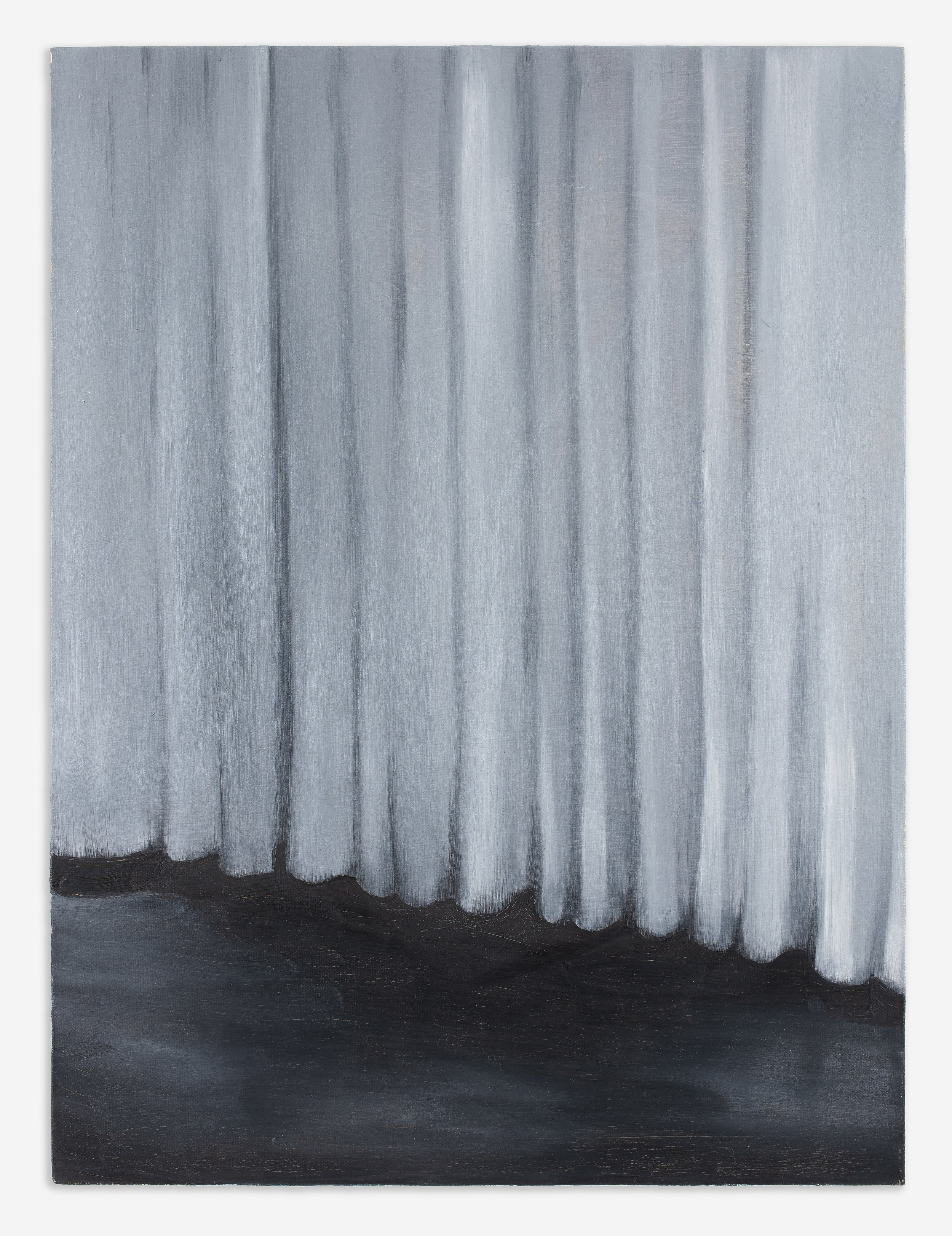
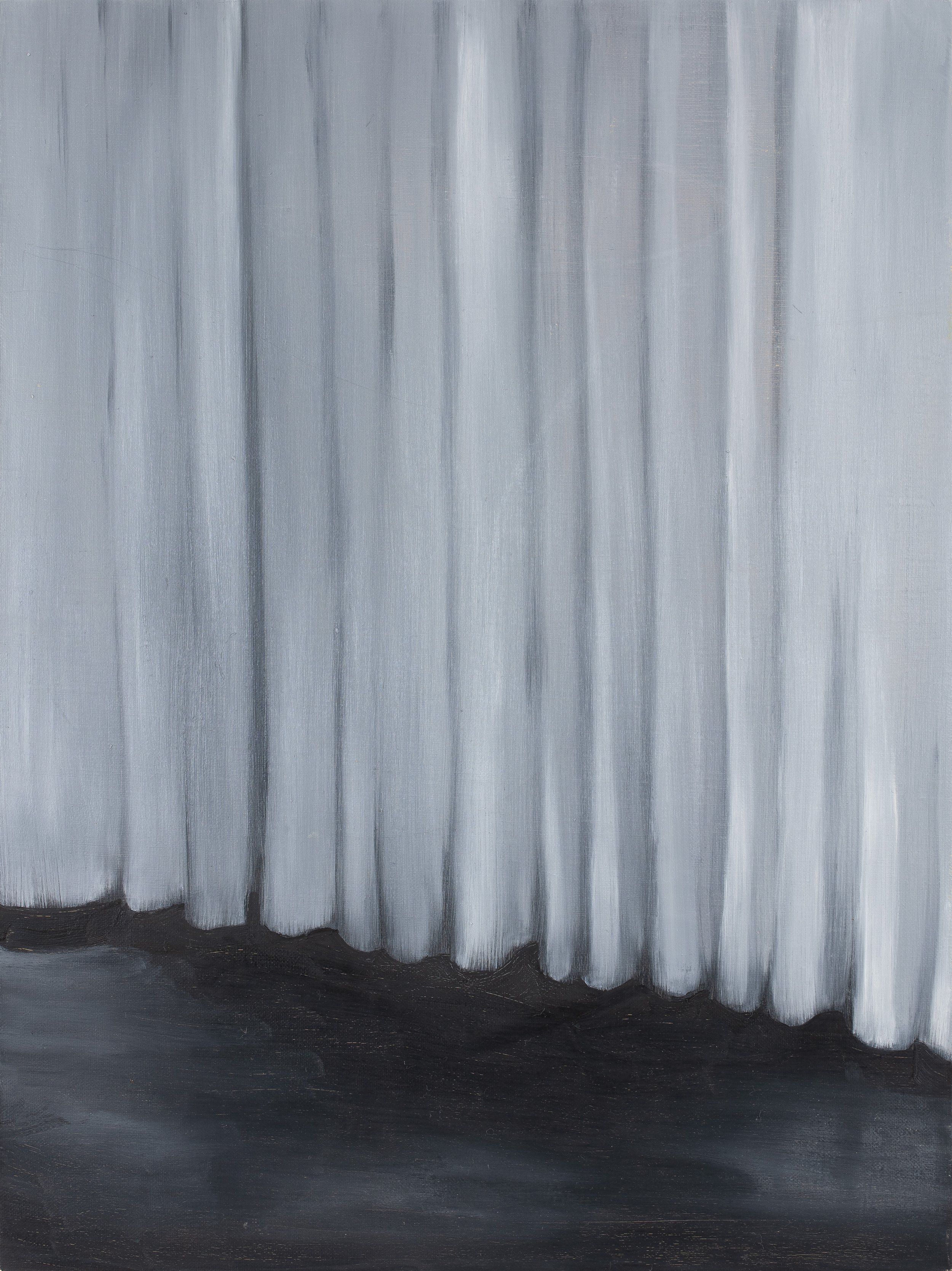
Stage measures 61 by 45.7 centimeters on linen, a scale that places it in the intimate register of a book page or a small framed photograph rather than in the commanding scale of Tan Mu's large-format Signal series canvases. This modest scale is significant. The painting does not overwhelm the viewer with the weight of theatrical grandeur. Instead, it invites the kind of close, sustained attention that one might give to a private object held in the hand. The linen is prepared with a warm, pale ground, and the paint is applied in thin layers that allow the texture of the weave to participate in the image. At thirty centimeters, the fabric surface becomes apparent, the slight tooth of the linen catching light in the darker passages of the curtain folds. At one meter, the curtain reads as an almost photographic absence of light against the lighter ground, the heavy draping creating zones of deep shadow that suggest volume and weight. The black-and-white source material of the photograph has been translated into a tonal oil painting that uses value contrast rather than hue to create the illusion of spatial depth in the hanging fabric.
The theater curtain in Tan Mu's painting is rendered not as a flat decorative element but as a heavy, volumetric presence that fills the canvas from top to bottom and from side to side. The fabric is depicted at a slight angle, so that one edge of the curtain appears to be slightly closer to the viewer than the other, creating a dynamic compositional tension that prevents the image from settling into static symmetry. The folds of the curtain are painted with a density of attention that suggests Tan Mu was looking very closely at the way heavy fabric gathers and drapes when suspended from a rod, the way the weight of the material creates natural pleats that widen and narrow as they descend. The paint handling in these passages is dense and directional, the brush following the vertical pull of gravity that shaped the curtain's original hanging. Where the fabric bunches at the bottom, the darker values create a kind of pooling of shadow, and where it hangs more loosely, the lighter passages suggest a faint transmission of light through the weave.
The illusionistic painted stage has a specific technical history that Tan Mu's painting invokes without explicitly naming. In the eighteenth century, the Galli-Bibiena family of architects and theatrical designers in Italy developed what they called architetture per prospettive, architectural perspectives for the stage, using painted backdrops and positioned wings to create the illusion of infinite depth within a confined theatrical space. Their stages were designed so that a viewer standing at a specific point in the auditorium would perceive a three-dimensional architectural interior or landscape that had no physical existence except as paint on a flat surface. The key innovation of the Bibiena method was that the painted perspective was calibrated to a single vanishing point determined by the position of the audience, so that the illusion only fully resolved for a viewer standing in the right place. Move to the side, and the painted architecture would shear and distort as the angle of view changed. The theatrical curtain in Tan Mu's Stage is the literal front edge of this tradition, the physical boundary beyond which the painted illusion begins, and her painting of it is itself a kind of perspective trick: a flat painted surface representing the edge of another flat painted surface, both equally illusory, both claiming the appearance of depth through the manipulation of light and value.
What the Bibiena stages achieved through architectural calibration and painted perspective, Tan Mu achieves through the material weight of oil paint on linen. The curtain in her painting is not merely a symbol of theatrical threshold. It is a physical object represented with a physicality that makes the viewer feel they could reach out and touch the heavy fabric. This tactile insistence is the painting's most precise argument. The theatrical curtain in real life is an object that you can lean forward and watch rise, that makes a specific mechanical sound as it climbs, that blocks your view and then releases it. Tan Mu paints this object with enough material specificity to restore to it the full weight of its physical existence, and this physicality is what distinguishes her painting from a mere illustration of the theatrical concept. The curtain is heavy. It has been painted to feel heavy, its folds dense with pigment in the shadowed passages, its surface textured by the linen ground beneath. You believe in its weight before you believe in its symbolism.
The clepsydra, or hourglass, hidden within the painting's composition is Tan Mu's most direct engagement with the temporality that the theatrical curtain stages. She has described placing the hourglass behind the curtain to suggest that time flows quietly between fiction and reality, and this placement is as precise a piece of compositional thinking as the angled curtain itself. The hourglass is only visible from a specific angle, much as time is only perceptible as a presence when encountered from within a particular perspective. You cannot see the hourglass if you approach the painting looking only at the curtain's surface. You have to look through the curtain, past its material weight, into the deeper space of the painting's composition, where the two glass bulbs and the thin trickle of sand between them mark the passage of time that the theater's rising curtain is announcing. The clepsydra is ancient timekeeping technology, a device that has measured the duration of theatrical performances, naval navigations, and church sermons for over a millennium. Its presence in the painting is not symbolic in the decorative sense. It is structural. It is what the painting is about when you strip away the theatrical framing, and the theatrical framing is what makes the hourglass legible as a subject rather than a detail.
The mechanical system that raises and lowers a stage curtain is a piece of industrial hardware that has been continuously refined since the Renaissance but has not essentially changed since the counterweight principle was first applied to theatrical rigging in Italian opera houses of the sixteenth century. A heavy batten from which the curtain hangs is connected by ropes to a counterweight box on the other side of the fly gallery, and the two sides are balanced so that the effort required to lift the curtain is roughly equivalent to the effort required to lift the counterweight. The stagehand pulls on a rope that passes over a pulley at the top of the fly tower, and the batten rises. When the performance is over, the rope is released and the counterweight pulls the batten back down. The sound that Tan Mu describes hearing before the curtain rises is the rope slipping through the pulley system as the counterweight begins its descent, transferring energy from the raised position to the lowered one. This mechanical event is one of the most consistently repeated sounds in Western architecture, occurring thousands of times a year in every city that has a functioning theater, and yet it has no visual counterpart in the painting. Tan Mu heard it, returned to it across a decade, and translated it into paint. The absence of the sound from the visual image is made more present by the hourglass, which stands in for the sound as a device for marking duration, for saying: this is how long the fiction lasts.
In the Italian opera houses of the seventeenth and eighteenth centuries, the stage machinery was operated by a team of machinists who stood in the fly gallery above the stage, visible to no one in the audience, working the counterweight systems that moved the curtains, raised and lowered the backdrops, and raised the chandeliers to light the hall. These machinists were called macchinisti, and their craft was a trained discipline that required knowledge of physics, mechanical advantage, and the specific weight of different scenic materials. The painted backdrops used in Baroque theatrical perspective scenes could be very large, requiring multiple counterweight systems working in coordination to achieve the smooth, silent movement that the illusion demanded. The Galli-Bibiena brothers, who designed stages for courts across Europe, were themselves engineers as much as artists, and their theatrical designs were only possible because they understood the load-bearing characteristics of the fly tower and the correct ratio of counterweight to scenic element. The fact that Tan Mu's painting depicts a curtain rather than a full scenic backdrop is itself a choice about scale and intimacy. The curtain is the smallest, most personal element of the stage machinery, the one that most directly addresses the audience in the house, and the choice to paint this singular object at intimate scale rather than the full grandeur of the Bibiena perspective is a statement about where theatrical meaning actually resides: not in the painted illusion but in the threshold that admits the audience to it.
The sand that flows through a clepsydra is almost always beach sand or river sand, materials that have been smoothed by natural abrasion into roughly spherical grains with a uniform diameter of between half a millimeter and two millimeters. This specific grain size is not incidental. Too coarse, and the sand will not flow smoothly through the narrow neck of the hourglass bulb. Too fine, and it will pack and compact under its own weight, stopping the flow entirely. The development of the clepsydra as a reliable timekeeping device required the identification and processing of sand with the right flow characteristics, a material knowledge that was itself an engineering achievement. The flow rate of sand through an hourglass is not constant throughout the device's lifetime. As the upper bulb empties, the weight of sand in it decreases, so the pressure at the neck diminishes. As the lower bulb fills, its accumulating weight creates back pressure that slows the incoming flow slightly. The result is that the clepsydra measures time with reasonable accuracy for the first two-thirds of its run and then becomes progressively less reliable as the upper bulb empties and the lower fills. Tan Mu has described being aware of this technical limitation and finding in it a conceptual resonance with the way theatrical time functions: the first act feels fully measured, the second act runs shorter than the audience expects, and the curtain falls before the final scene has had its full weight of time to settle in the memory.
Saul Appelbaum, writing in BEK Forum catalog on the occasion of Tan Mu's 2025 Vienna exhibition, identified what he called "a commitment to entanglement as method" in Tan Mu's practice, the way she consistently constructs works in which two or more systems of meaning are so thoroughly interlocked that neither can be removed without the other losing coherence. The hourglass and the curtain in Stage are a precise example of this method at work. Neither element is decorative in relation to the other. The curtain stages the moment when time begins to run, and the hourglass measures the time that the curtain's rise has released into the theatrical space. Remove the curtain and the hourglass becomes a still-life object without dramatic context. Remove the hourglass and the curtain becomes merely a decorative textile without philosophical weight. Together, they form a machine for thinking about theatrical time, about the way the theater creates a contained temporal experience in which a narrative unfolds between a beginning and an end, and the audience agrees to inhabit that contained time as if it were their own. This is what every theatrical performance does, and what Tan Mu's painting does in paint: it constructs a small, sealed temporality and invites the viewer to enter it.

Tan Mu's background in printmaking, which she has described as a medium defined by process, layering, and repetition, is visible in Stage in ways that extend beyond the biographical. The printing process involves the transfer of an image from one surface to another through pressure and ink, and the resulting impression is always a translation, never a pure copy. Each generation of impression introduces slight variations in registration and tone, so that a print run of twenty will produce twenty slightly different objects united by their descent from the same original matrix. Tan Mu's movement of the Stage image from film photography through print to oil painting enacts exactly this logic of serial translation. The original photograph is the matrix, and each subsequent medium is a new impression drawn from it. The oil painting is the final, most material impression, the one in which the most physical information is retained, but it carries within it the accumulated passage of the image through its earlier states. This is what the painting holds that a simple painted illustration of a theater curtain could not hold: the temporal depth of its own making.
The theater curtain is one of the oldest continuous technologies of representation in Western culture, still functioning in the same basic mechanical form that Vitruvius described in his treatise on architecture in the first century BCE. That a fabric hung from a rod can divide a real space from a fictional one, and that this division can be traversed by raising the fabric, is a solution to a representational problem that human beings have continued to use for over two thousand years because it works. The curtain is not a metaphor for the boundary between reality and fiction. It is the boundary, and the boundary is literally a piece of cloth. What Tan Mu's painting does, with the patient attention of someone who has returned to this image ten times over a decade, is restore to that piece of cloth the full weight of what it does. The curtain rises. Time begins. The audience leans forward. These are not abstract theatrical conventions. They are physical actions with physical consequences, and the painting takes them seriously enough to render them in the material language of oil on linen, where they will continue to happen every time someone stands in front of the canvas and lets their eye travel up through the dark folds to the hidden hourglass that measures the duration of the fiction.