The Language of Breakdown: Tan Mu's Error and the Green Glow of Digital Failure
The green phosphor monitor was, for a generation of computer users in the 1970s and 1980s, the face of computing. Before color monitors transformed the screen into a chromatic spectacle of desktop publishing and video games, there was a period when the only images a computer could produce appeared in a single, unmistakable color on a dark field: green, ranging from the pale yellow-green of low-intensity displays to the vivid emerald of high-end laboratory terminals. When a program crashed on one of these machines, the error message did not appear as a red dialog box against a white background. It appeared as a single word in that same green, occupying the same dark screen, looking identical to every other line of text the machine had ever produced. The crash and the正常运行 were chromatically indistinguishable. The difference between functioning and failure was semantic rather than visual, a matter of reading carefully rather than looking differently.
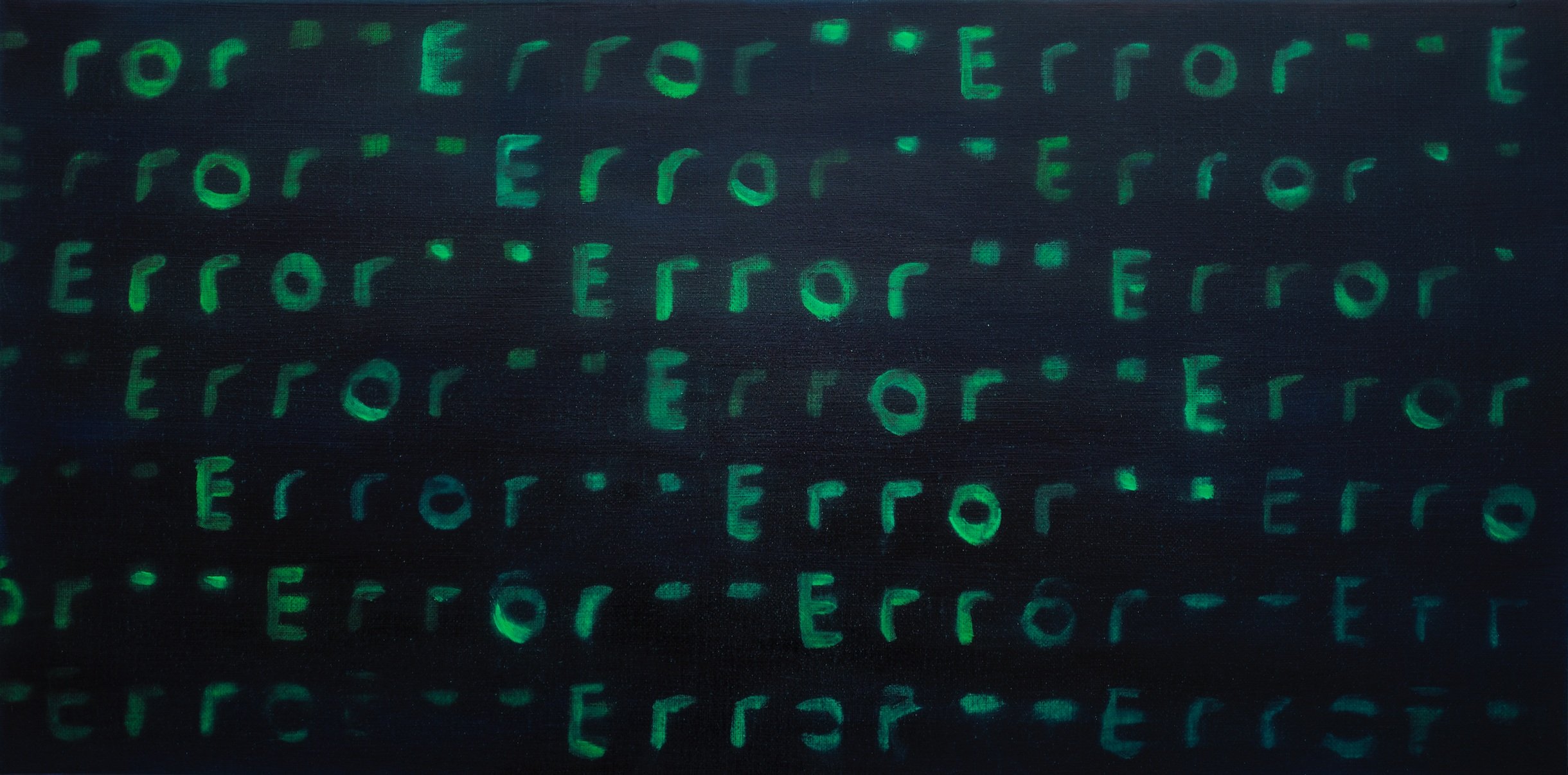
Tan Mu's 2022 painting Error takes this green monochrome screen as its subject, and specifically the moment when an error message resolves on the screen as a block of luminous green text. The painting is oil on linen, 30 by 61 centimeters, a horizontal rectangle that corresponds precisely to the aspect ratio of a conventional monitor in the era of 4:3 aspect ratio CRT displays. This is not incidental. The horizontal format of the canvas echoes the physical proportions of the screen that the painting depicts, so that the viewer looking at the painting in a gallery is looking at an object that has been formatted to match the technical specifications of its own subject. The painting is not merely depicting a screen. It is formatting itself as one.
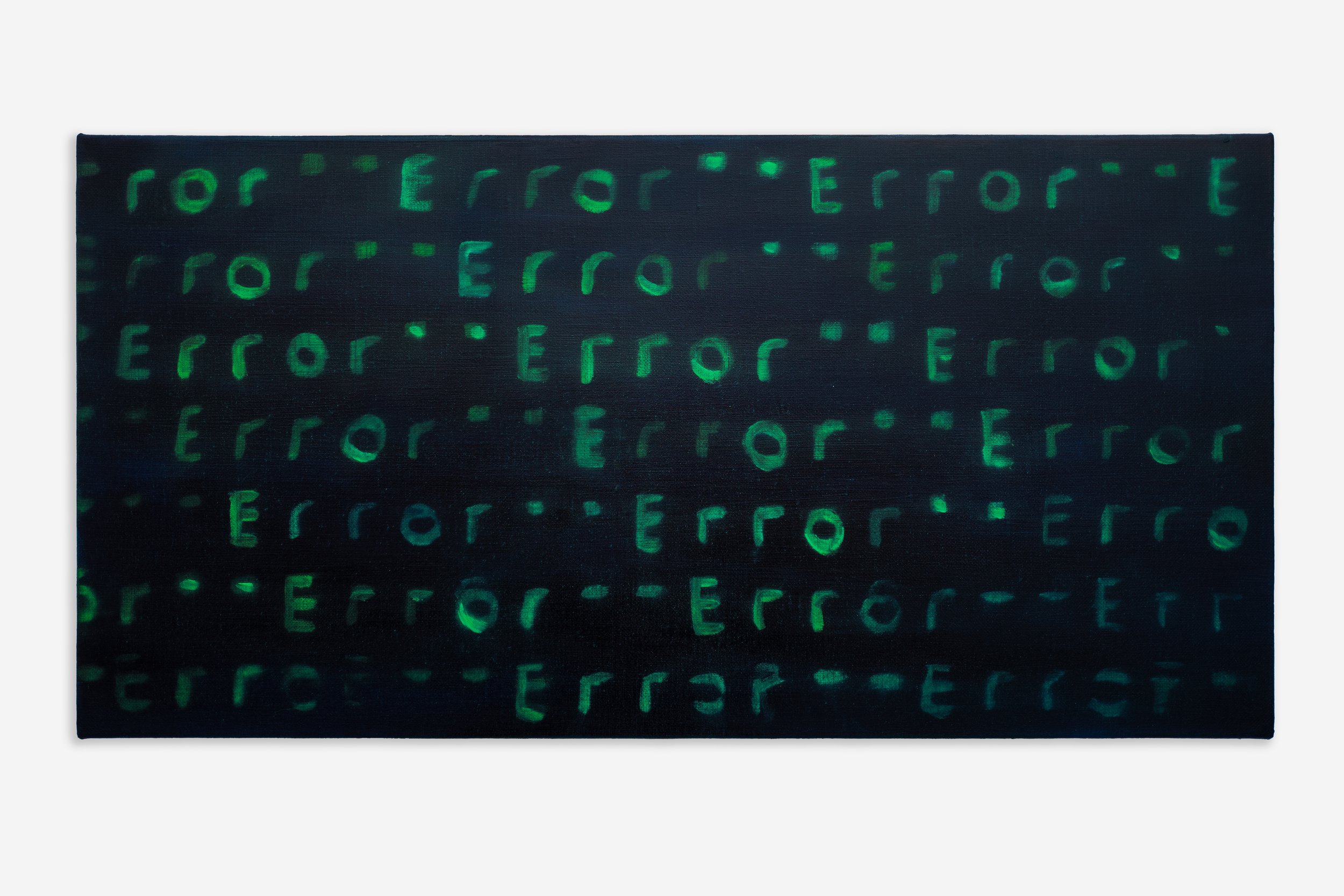
The surface of the painting is built up in layers of oil paint that attempt, in the medium of physical pigment, to recreate the quality of light emitted by a phosphor-coated cathode ray tube. Tan Mu has described wanting to evoke the sensation of emitted light rather than reflected light, and this ambition produces a specific and technically demanding painterly problem. Oil paint, by its nature, reflects light that falls on its surface. A green oil painting under gallery lighting is green because the pigment absorbs certain wavelengths and reflects others. But a green phosphor CRT screen is green because the phosphor coating on the inside of the glass face is being bombarded by electrons and is emitting light photon by photon, the same physical process that makes a LED or a firefly glow. The difference between reflected green and emitted green is the difference between a green leaf and a green traffic light. Tan Mu's solution, achieved through the use of translucent glazes built up over a lighter ground, is to create a surface that appears to be generating its own illumination, as if the green light were coming from within the paint rather than being bounced off its surface. The linen weave visible through the translucent passages creates a subtle grain that recalls the dot-matrix structure of early CRT displays without literally reproducing it.
The error message itself is depicted not as a specific, legible string of text but as a luminous green field in which the suggestion of letters and syntax emerges from the surface texture of the paint. This decision is central to the painting's conceptual precision. The painting is not illustrating a specific error code or a particular system failure. It is depicting the general condition of digital error, the visual and psychological experience of encountering a screen that has interrupted its own operation and is communicating that interruption in the only language it has. When Tan Mu describes error messages as "the computer's way of communicating," she is identifying something genuinely significant about the phenomenology of these messages: they are the rare moments when the machine addresses the user directly, in words, rather than simply presenting an interface and waiting to be acted upon. The error message is the machine's voice. And the green phosphor screen was, for a generation of users, the machine's face.
The relationship between technological failure and visual art has a specific history that Tan Mu's painting extends without explicitly citing. In 1959, the German artist Wolf Vostell, working in the Fluxus orbit alongside Nam June Paik and George Maciunas, created what he called a Fernsehdecke, a television set embedded in concrete. The work destroyed the televisual image as a functioning display and transformed the screen into a sculptural object, a heavy, immovable surface that could no longer perform its intended purpose. Vostell was interested in technology as a site of violence and disruption, and the destruction of the television set was an act of protest against the passive consumption of broadcast culture. For Vostell, the malfunctioning television was a political statement about the machine's relationship to the viewer, and the statement was made through the physical destruction of the object's functionality. The television was no longer a window onto the world. It had become a wall.
Tan Mu's approach in Error operates through a different logic but toward a related end. Where Vostell destroyed the technological object to make a political point about its social function, Tan Mu preserves the digital screen as an image and interrogates the specific quality of communicative failure that occurs when a computer stops working as intended. The painting does not destroy the screen. It immortalizes the moment of its speaking, the precise instant when the machine breaks and, in breaking, becomes briefly, vulnerably communicative. Where Vostell's destroyed television sets were anti-communicative objects, Tan Mu's green phosphor error field is hyper-communicative: a machine that normally hides its internal operations behind a smooth user interface is suddenly forced to reveal that it has failed, and to do so in language designed for human comprehension. The error message is a confession. The painting captures the exact moment of that confession and holds it in the material of oil paint on linen, where it will persist long after the last green phosphor monitor has been decommissioned.
The history of the error message as a communicative form is surprisingly rich and goes considerably deeper than the green CRT screen that is its most familiar visual form. Error messages are written by programmers in natural language, and this fact is one of the most important things about them. The binary operations of the machine, the cascade of electrical states that constitute a program running or failing, are entirely inhuman in their native form. The error message translates this cascade into English, or German, or Mandarin, making the machine's internal failure legible to a specific human being who may have no technical understanding of what has actually happened. This translation is a moral act as much as a technical one. The programmer who writes an error message has made a decision about how much to reveal, how to frame the failure, and how to guide the user toward recovery. The difference between an error message that says "File not found" and one that says "The requested resource could not be located. Please verify the path and try again" is the difference between a terse technician and a patient assistant, and both choices reflect an attitude about the relationship between the machine and its user. Tan Mu's description of error messages as "a form of communication between humans and machines" is precise in a way that many art statements are not, because it identifies exactly what is distinctive about this particular mode of address: the machine is speaking to the human, not the human to the machine, and the subject of the speech is failure.
The cultural weight of the error message as a form shifted significantly as computing moved from specialized institutional contexts into domestic and then mobile environments. In the early era of mainframe computing, error messages were read by trained operators who understood the systems well enough to decode their implications. By the 1990s, with the proliferation of personal computing, error messages had become some of the most widely read prose in the world, encountered by millions of people who had no technical training and who interpreted them through the lens of their own frustration and confusion. The shift from institutional to domestic computing transformed the error message from a technical document into a form of mass communication, and this transformation is what Tan Mu's painting is quietly documenting. The green phosphor screen in Error is not merely an aesthetic reference. It is an index of the historical moment when the error message became a shared cultural experience rather than a specialist's instrument. The fact that Tan Mu chose to paint this particular visual form, rather than the glossy, full-color error dialogs of contemporary operating systems, is itself a statement about which technological moment she considers worth preserving as visual art, and the specificity of that choice reveals a practice that is as historically attentive as it is formally ambitious.
The monochrome green screen that is the visual substrate of Tan Mu's Error is itself a historical artifact with specific optical properties that the painting's surface technique is attempting to evoke. The phosphor coating inside a CRT monitor was typically made from zinc sulfide doped with copper, a combination that produces a green luminescence when excited by electron bombardment. The color of this luminescence, typically specified as a wavelength of around 525 nanometers, was not chosen for aesthetic reasons but for physiological ones: the human eye is most sensitive to green light in the photopic range, meaning that a green screen required less electron beam power to appear equally bright to the human viewer than a screen of any other color. The military and laboratory origins of early computing are embedded in this chromatic choice: the green screen was optimized for extended viewing by operators who needed to read data quickly and accurately over long shifts, and the phosphor persistence was tuned to minimize flicker without smearing fast-moving data. Every green CRT screen was, in this sense, a performance optimization for the human visual system, a machine calibrated to speak to a body.
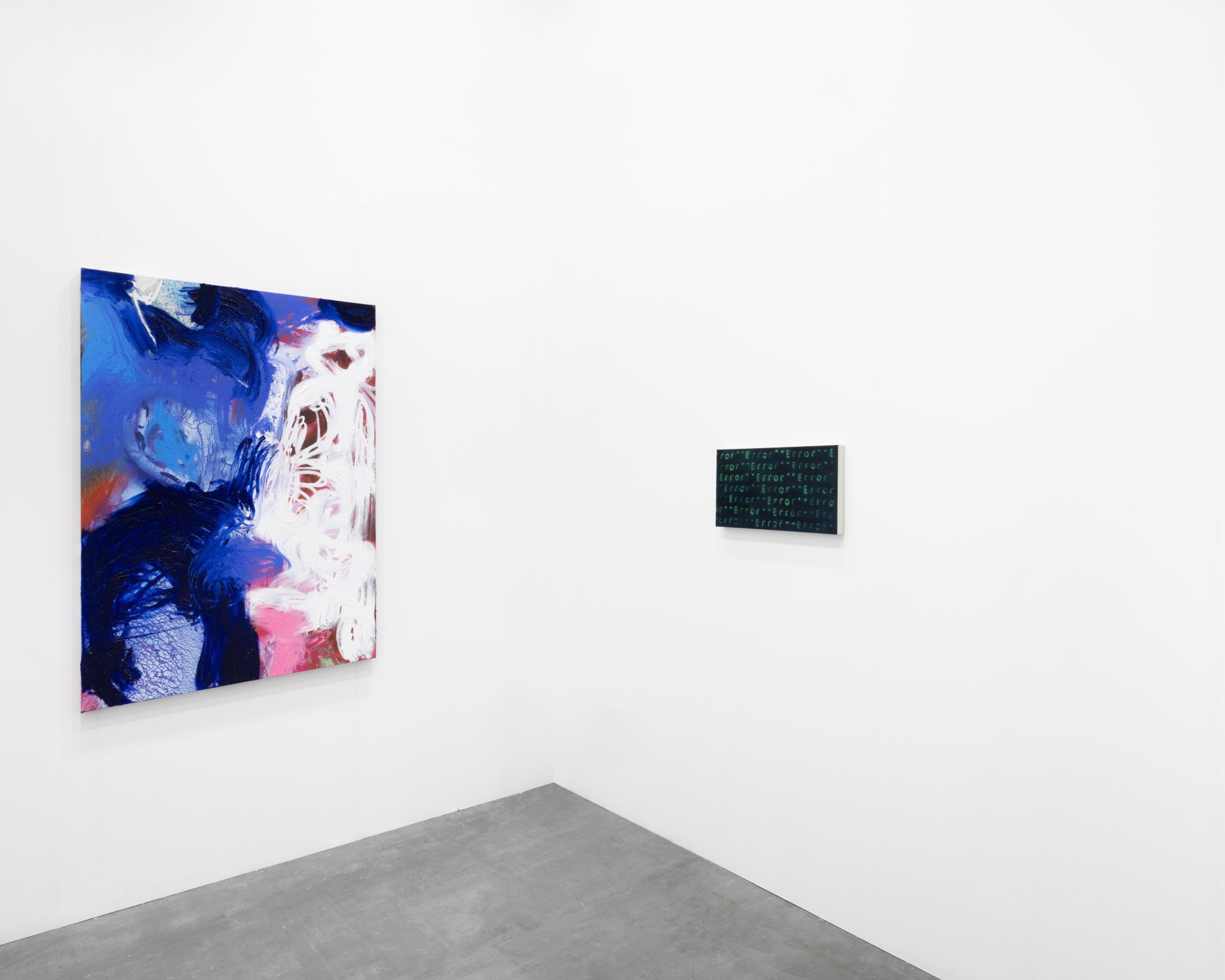
Danni Shen, writing on Tan Mu's practice for Emergent Magazine in 2024, identified what she called "the phenomenology of the pixel" as a consistent thread running through Tan Mu's screen-based paintings. Shen observed that Tan Mu's engagement with digital imagery is never purely conceptual or art-historical; it is always also tactile and sensory, interested in what it feels like to look at a screen as much as in what the screen displays. This is evident in Error in the way the painting's surface insists on its own physical presence as a painted object while simultaneously performing the immaterial luminosity of the digital image it depicts. The viewer standing in front of the canvas is simultaneously looking at a painted surface and looking at an attempt to simulate emitted light, and the tension between these two conditions is the painting's central perceptual experience. Shen wrote that "Tan Mu's screen paintings do not illustrate digital imagery. They create a condition in which the viewer becomes aware of the act of screen-looking as a physical and philosophical phenomenon," and Error is a precise demonstration of this claim. The painting makes visible the act of looking at a screen by making that act difficult: the viewer cannot quite decide whether they are looking at a luminous surface or a painted one, and this uncertainty is exactly what the painting is about.
The pixel as a unit of digital information has a specific materiality in the era of the CRT that it largely lost in the transition to liquid crystal and OLED displays. The pixel on a monochrome green CRT was not merely a mathematical abstraction or a logical address. It was a physical dot of phosphor coating on the inside of the glass face, a tiny square of material that emitted light when struck by the electron beam, and that emitted light with a specific color, persistence, and intensity determined by the chemical composition and thickness of the phosphor layer. The granularity of the CRT display was a physical fact about the world, not a logical one, and this physicality gave early digital images a texture that software-rendered imagery largely lost. Tan Mu's decision to paint Error in oil on linen, using a technique that evokes the granular quality of the phosphor surface, is a choice to restore to the digital image the physical weight that pixel displays once had and that flat panel screens no longer do. The linen weave visible through the translucent glazes functions as a kind of ground zero for this restoration: the viewer sees the weave, sees the paint, sees the attempt to simulate light emission, and is made to feel the distance between the painted surface and the glowing screen while simultaneously being made to forget that distance in the experience of looking.
The electron beam that drew the image on a CRT screen did so by sweeping across the phosphor coating in a pattern of horizontal lines, a process called raster scanning, and the resulting image was never perfectly stable. It was rebuilt thirty or sixty times per second depending on the refresh rate of the display, and between each rebuild the image existed only as a fading phosphor persistence, a ghost of the previous scan still visible as the next one began. This impermanence was invisible to the human eye under normal viewing conditions, but it was structurally present in every image the screen ever showed. The CRT image was not an object. It was a repeated event, a temporary coherent pattern produced by a process that was always already dissolving itself. Tan Mu's painted representation of this impermanent image, rendered in the permanent medium of oil on linen, is therefore a kind of memorial to a specific form of impermanence: not the impermanence of human memory or natural decay, but the impermanence of a technological process that had to keep destroying and rebuilding itself in order to exist at all. The painting takes the most temporary kind of image and makes it into the most permanent kind of object.
The error codes that populate digital error messages form a taxonomy of failure that reveals, in its accumulated specificity, the entire architecture of modern computing's relationship to its own limits. HTTP status codes, for instance, are a systematic vocabulary for failure on the web: 400 for a bad request that the server cannot process, 401 for unauthorized access, 403 for forbidden access that the server refuses regardless of credentials, 404 for a resource that does not exist at the specified address, 500 for an internal server error that the server cannot itself resolve. Each code is a precise statement about what went wrong inside the machine's logic, and each statement was written by a programmer who anticipated a specific failure mode and decided that users deserved to know about it in this particular way. The 404 error, perhaps the most widely encountered error code in the world, has developed its own cultural language of humor and resignation, with websites routinely replacing the bare technical message with playful language: "Page not found," "The page you're looking for has wandered off," "You've reached the end of the internet." These variations on the 404 are themselves a form of user interface design, an attempt to soften the machine's confession of failure with human warmth. Tan Mu's green phosphor Error painting predates and avoids this softening entirely, presenting the error as pure luminous text without editorializing, and this austerity is what gives the painting its quiet authority.
There is a particular cruelty in the error message that Tan Mu's painting captures and holds. The cruelty is not dramatic or violent. It is the quiet cruelty of a system that has failed in a way that it was designed to prevent, and that announces this failure in the most human terms available to it, knowing that the human recipient may be entirely helpless to respond. When a program crashes with an error message, the machine is confessing its limits in a language the human can understand but not act upon. The error message is an admission of powerlessness that the machine makes in the hope that the human will know better what to do. Tan Mu has described wanting to "preserve these error messages as historical artifacts," and this archival impulse is visible in the painting's deliberate, almost ceremonial quality. The painting treats the error message with the same formal gravity that a Dutch vanitas painting of the seventeenth century would have given to a skull or an overturned glass. The error message is a memento mori for the digital age: a reminder that the machines we depend on are as fragile as we are, and that their failures are, in the end, as human as their functions.