Still Lives in Plague Time: Tan Mu's Yoga Isolation and the Monochrome Archive of Pandemic Distance
On June 21, 2020, the summer solstice, a group of people in Toronto gathered outdoors for a yoga class. They arranged themselves on the grass at measured intervals, maintaining the spatial protocol that had become, over the preceding three months, the primary grammar of public conduct in a world suddenly organized around the prevention of contagion. The photograph that Tan Mu later used as the basis for her painting Yoga Isolation captures this scene from above, a god's-eye view that presents the yogis as an aerial pattern of bodies, each framed within an invisible square of personal territory, each connected to the others through the shared orientation of their postures while being fundamentally, physically apart. The image has the quality of a scientific diagram or an architectural plan, the kind of image that documents how things are arranged in space rather than how they appear to the human eye at ground level.
Tan Mu has described the emotional origin of the painting in terms of the particular quality of emotional ambivalence that characterized the early months of the COVID-19 pandemic for many people: the strange comfort of familiar routines persisting under radically altered conditions, the simultaneous sense of being collectively present and individually enclosed. Yoga, as a practice, is deeply implicated in this ambivalence. The discipline asks practitioners to inhabit their bodies with attention and presence, to feel the specific weight and alignment of their own limbs and joints, to be radically singular in the midst of a group practice. But it also asks them to share the practice with others, to synchronize breath with strangers, to experience the private sensation of the body in a context that is fundamentally communal. Yoga Isolation captures the precise historical moment when this paradox became not merely an aesthetic or philosophical question but a literal spatial arrangement that everyone on earth was being asked to enact with their bodies.
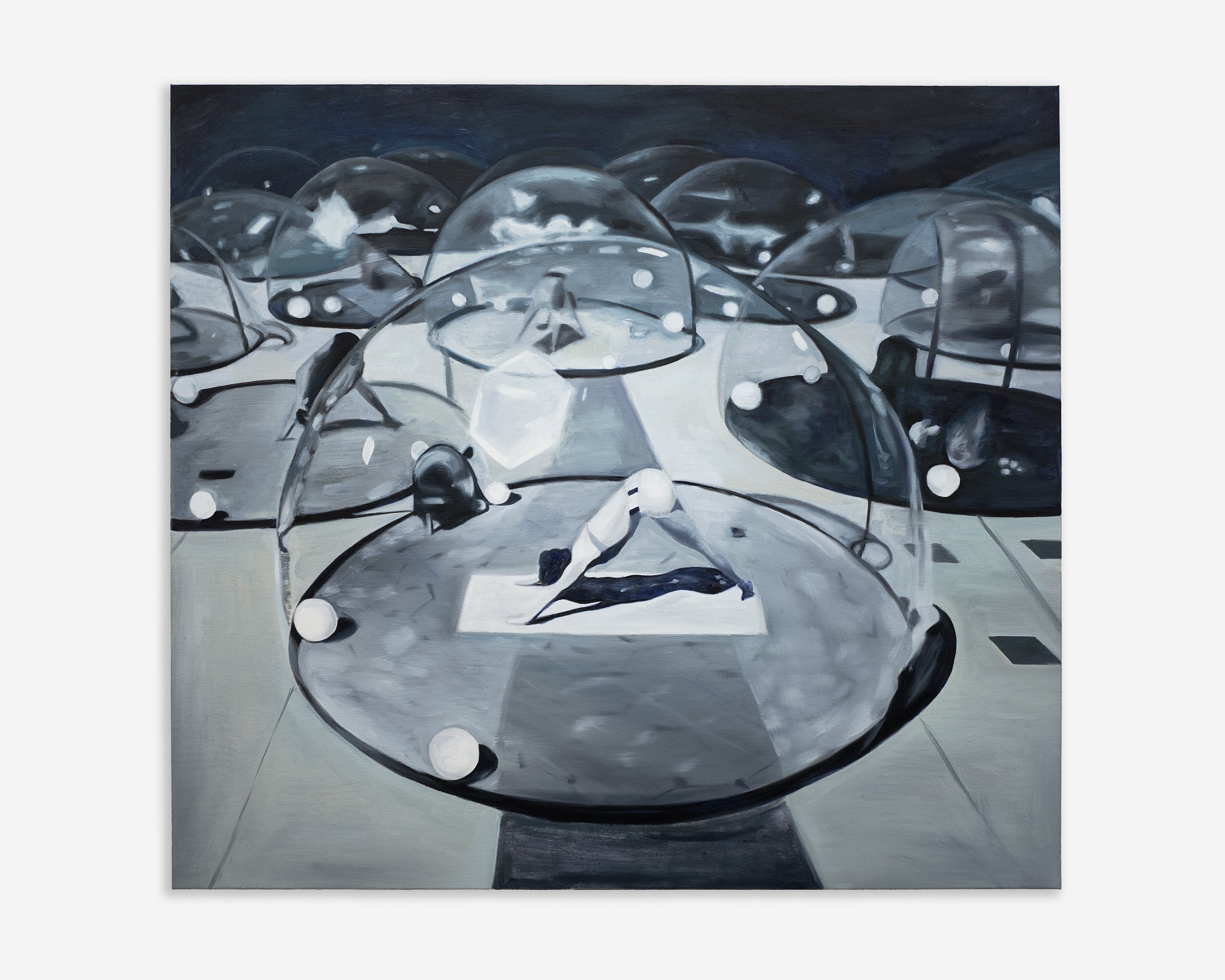
Yoga Isolation measures 91 by 102 centimeters on linen, and its scale is intimate enough to invite sustained looking but large enough to give the viewer access to the individual figures within the composition. The painting is entirely monochrome, executed in shades of black, white, and gray that strip the original photograph of its documentary color and replace it with a tonal register that belongs to a different visual tradition entirely: the tradition of black-and-white documentary photography, of scientific imaging, of the surveillance photograph as archival evidence. Tan Mu has described the monochrome decision explicitly as an act of temporal displacement, a choice to remove the image from the immediate present of its making and place it in a different historical register, somewhere between the scientific and the uncanny. The resulting painting hovers between the documentary and the dreamlike, between the archival evidence of a specific historical moment and an image that feels as though it might have been made at any point in the last century and a half of photographic and painted representation.
The application of oil paint in Yoga Isolation is notably different from Tan Mu's approach in her screen-based works. Where Error and Stage rely on translucent glazes and the simulation of emitted light, Yoga Isolation is painted with a denser, more opaque quality that recalls the matte finish of silver gelatin photographic prints or the flat pictorial surface of early Modernist photography. The linen ground is not visible as texture through the paint in the way it is in the luminous screen paintings. Instead, the paint sits on the surface with a quality of applied description, as if Tan Mu were translating the aerial photograph's tonal values directly into pigment with minimal mediation. At close range, the brushwork is visible as directional marks following the contours of the bodies, each figure rendered through a slightly different orientation of stroke that distinguishes one practitioner from another while maintaining the overall flatness of the pictorial plane. At distance, the figures resolve into their correct aerial perspective positions, the yoga postures readable as postures rather than as abstract marks.
The use of monochrome as a documentary strategy in paintings of historical events has a specific lineage that Tan Mu's Yoga Isolation invokes without explicitly citing. Gerhard Richter's series of paintings based on photographs from the Bosnian War, executed in his characteristic blurred photorealism, demonstrated that the smeared, uncertain quality of painted memory could be more truthful to the experience of historical knowledge than sharp photographic documentation. Richter's blurred paintings occupy a space between witness and imagination: they tell the viewer that the event happened, that there is photographic evidence of it, but that the evidence cannot be fully processed or integrated into coherent narrative. The blur is not a failure of resolution. It is the appropriate emotional and epistemological response to events that exceed the viewer's capacity to comprehend them through direct representation.
Tan Mu's use of monochrome in Yoga Isolation operates through a related but distinct logic. Where Richter's blur introduces a temporal smear that refuses the viewer access to the image as stable record, Tan Mu's monochrome flattens the image into a tonal diagram that is almost too legible, too precisely structured. The yoga practitioners in her painting are arranged with a geometric regularity that gives the composition the quality of a instructional diagram or an urban planning document. Each figure occupies a defined zone of space, the intervals between them measured and regular, and this measurement is what makes the painting so precisely documentary. Tan Mu is not generalizing about the pandemic experience. She is documenting a specific spatial arrangement that thousands of people enacted on a specific date, a collective choreography of distancing that will never be performed again in exactly this form. The monochrome does not obscure this documentary precision. It heightens it, transforming the photograph from a news image into an archival record, from something that was seen and circulated into something that has been preserved.
The experience of collective isolation during the COVID-19 pandemic produced a specific set of visual phenomena that will not recur in exactly this form: the empty city streets of the spring 2020 lockdowns, the masked faces partially visible above shopping carts, the chalk circles drawn on San Francisco sidewalks to designate safe zones for queuing, the hand-lettered signs taped to supermarket windows limiting entry to one masked customer at a time. These images circulated widely in the first year of the pandemic and have since accumulated into a visual archive of a historical experience that is still being processed. What distinguishes Tan Mu's painting from the mass of documentary images that circulated during this period is precisely her decision to translate the photograph into oil on linen, removing it from the instantaneous circulation of digital media and placing it in the slowest, most durable medium available for the preservation of visual information. A photograph of a socially distanced yoga class would have been shared, liked, retweeted, and forgotten within a news cycle. A painting of the same scene exists in an entirely different temporal register, asking the viewer to look at it with the sustained attention that a painting demands rather than the glancing recognition that a photograph rewards.
The specific date of June 21, 2020, the summer solstice, carries its own historical weight. The solstice is the longest day of the year in the Northern Hemisphere, a date associated in many cultures with gathering, celebration, and the fullness of the outdoor season. To hold a yoga class outdoors on this particular date, separated by spatial protocol, was to enact a ritual that had been shaped and constrained by the specific historical conditions of that year. The choice of yoga as the activity being practiced is not incidental. Yoga studios had been among the first businesses to close in the March 2020 lockdowns and would be among the last to reopen fully, their reopening staggered across months and years in different jurisdictions. The return to outdoor yoga in June 2020 represented a tentative, regulated resumption of practice under conditions that transformed the meaning of every shared breath and synchronized movement. The painting captures this moment of transition: not lockdown, not full reopening, but the strange suspended period of the first summer of the pandemic, when everyone was learning to arrange their bodies in space according to new rules that would not have been imaginable a year earlier and that would be relaxed and forgotten within two years thereafter.
Hito Steyerl, writing on the politics of the digital image in the early 2010s, introduced the concept of the poor image as a way of thinking about the degraded, compressed, widely circulated images that constitute the majority of visual experience in the digital age. The poor image is not a failed image, Steyerl argued. It is a political achievement: an image that has been compressed and shared to the point where it can no longer be owned or controlled by the institutions that originally produced it, and that therefore circulates freely across contexts and communities in ways that its producers never intended. Steyerl's argument was specifically about video and photographic images, but it has a direct bearing on the question of how painting relates to the flood of documentary images that constitute collective historical experience. Tan Mu's translation of the pandemic photograph into oil paint is an anti-Steyerl gesture in the most productive sense: it takes an image that would have circulated as a poor image and restores to it the conditions of singularity, specificity, and durability that the digital image specifically refuses. The yoga practitioners in the painting are not icons in a shared feed. They are specific people, painted as specific people, asking to be looked at as individuals rather than as instances of a type.
The aerial perspective of Yoga Isolation is worth attending to for what it reveals about Tan Mu's approach to the painting of human figures during the pandemic. The god's-eye view that the original photograph establishes is one that most of the yoga practitioners themselves would not have experienced: they were inside the formation, looking outward or downward at their mats, aware of the others around them as spatial pressures rather than as visible figures in an aerial composition. The painting presents the scene from a position that no participant occupied, and this slight displacement from lived experience is characteristic of the painting's overall strategy. Tan Mu is not representing the felt experience of socially distanced yoga. She is representing the structure of that experience from the outside, as an observer and documentarian, transforming the felt ambivalence of collective isolation into the cool, precise language of spatial diagram. The figures in the painting are not sad or anxious or hopeful. They are arranged. And it is the fact of their arrangement, rather than the quality of their emotion, that constitutes the painting's subject.
Nick Koenigsknecht, writing on Tan Mu's practice for publications accompanying her exhibitions in 2024 and 2025, has identified what he calls "the painterly archive" as a consistent concern across Tan Mu's output: the interest in how painting can do things to documentary images that no other medium can do, specifically by changing the temporal conditions under which the image is encountered. Koenigsknecht argues that Tan Mu's paintings do not illustrate their source photographs. They transform those photographs into objects with a different temporal lifespan and a different demand on the viewer. A photograph asks to be recognized. A painting asks to be looked at. The difference between recognition and looking is the difference between knowing that something happened and feeling its weight as a historical fact. Yoga Isolation is a precise demonstration of this argument. The painting does not remind the viewer that the pandemic happened. It makes the viewer feel, through the sustained attention it demands and the strange, almost clinical quality of its monochrome rendering, the specific historical character of a moment when human beings arranged their bodies in space according to the requirements of viral transmission prevention, and when this arrangement felt both completely ordinary and utterly unprecedented.
Koenigsknecht has also written about the particular challenge that pandemic imagery posed for documentary photography and by extension for painting derived from documentary photography. The pandemic was experienced by most people primarily through screens: the screen of the phone showing case counts, the screen of the laptop showing Zoom squares of colleagues working from home, the screen of the television showing ICUs at capacity. The primary experience of the pandemic was mediated by images produced and circulated through digital networks, and this mediation shaped the visual memory of the event in ways that will be difficult to access historically once the generation that lived through it is no longer available to describe what it felt like to be inside these images rather than merely watching them. Tan Mu's decision to paint from a documentary photograph rather than from direct experience is significant in this context: the painting is already a translation, already one step removed from lived experience, and the monochrome treatment is another translation, another step. By the time the viewer encounters the painting in a gallery, it is three iterations removed from the original event: the lived experience of the yoga class, the photograph made of the class, the painting made from the photograph. This chain of translations is exactly what Koenigsknecht identifies as Tan Mu's central argument: that the most truthful representation of a historically significant event may be one that acknowledges its own remove from the event, rather than claiming a false immediacy that the documentary photograph itself cannot deliver.
Tan Mu has described monochrome across her practice as functioning differently depending on the subject: technical and historical in works derived from early computing imagery, documentary in works addressing historical events, and emotional in works dealing with isolation and disconnection. In Yoga Isolation, all three registers are present simultaneously, and this layering is what gives the painting its conceptual complexity. The monochrome is technical in its reference to the original photograph's documentary status. It is historical in the way it places the image in a temporal register outside the immediacy of the present. And it is emotional in the specific quality of withdrawn distance that black and white introduces into images of human figures, the way it removes the liveliness of flesh tone and replaces it with the cool gray of the silver gelatin print. The yogis in the painting are simultaneously more and less than human: more because they have been elevated by the act of painting into objects of sustained contemplation, less because the monochrome has taken from them the warmth that color would have given them. They exist in the painting as a series of postural instances, each figure a specific spatial fact about the world as it was on June 21, 2020 in Toronto, and all of them together constituting a collective fact that no individual among them could have perceived from inside the formation.
The monochrome treatment of Yoga Isolation also produces a specific quality of temporal ambiguity that Tan Mu's description of her own working process makes explicit. She has noted that the reduction of color in her pandemic-related works was a way of heightening the surreal quality of ordinary moments that had been transformed by context into something strange. The outdoor yoga class that would have been unremarkable in any other year was, in June 2020, a carefully permitted and spatially managed act of collective resilience. The monochrome makes the scene feel both more and less real than it would in color: more real because the tonal precision of black and white photography is associated with documentary and evidentiary practices, less real because the absence of color places the image in a perceptual register that the human eye does not normally encounter in three-dimensional experience. We see in color. We remember in color. The monochrome painting is therefore always already a translation from lived experience into a different kind of record, and the slight uncanniness that this produces in the viewer is precisely appropriate to the subject, which was itself a translation of ordinary life into an altered and constrained register.