Regulus XIV: Tan Mu's Antimony and the Alchemical Star Inside Every Matter
When Isaac Newton conducted his alchemical experiments in the cabinet beside his mathematical papers at Trinity College, Cambridge, he used a substance that he had procured from a traveling glassmaker in a transaction whose specifics are lost to history. The substance was impure metallic antimony, and it struck him, on contact, as possessing a luster that recalled for him the fixed star Regulus in the constellation Leo. He named it accordingly: Regulus XIV antimony, the star-substance, the metal of the kingly light. This was not merely poetic naming. For Newton, who devoted more time to alchemy than to optics and who believed that the transmutation of metals was not only possible but central to an understanding of the divine order of creation, the naming was a conceptual act. To call antimony Regulus XIV was to place it in a cosmological framework in which the metals of the earth were connected to the fires of the stars by a chain of influences descending from celestial to terrestrial, from the macrocosm to the laboratory bench.
Tan Mu's 2020 painting Antimony takes this Newton's-laboratory moment as one node in a long chain of transformations that the element has undergone across four centuries, and it paints the crystalline form of the substance on a black field that functions as both infinite void and absolute contrast. The black background is not neutral. Tan Mu has described it as the visual instrument that allows the crystalline antimony to appear as what it is: a sharp, radiant, coldly luminous form in space, its intricate geometric structure revealed in full by the absence of any competing visual information. The void behind the crystal is not merely dark. It is the absence of everything that is not the crystal, and this radical reduction is what allows the crystal's dual nature to emerge: simultaneously a material substance with a specific industrial history and a trace of the stellar process that created it.
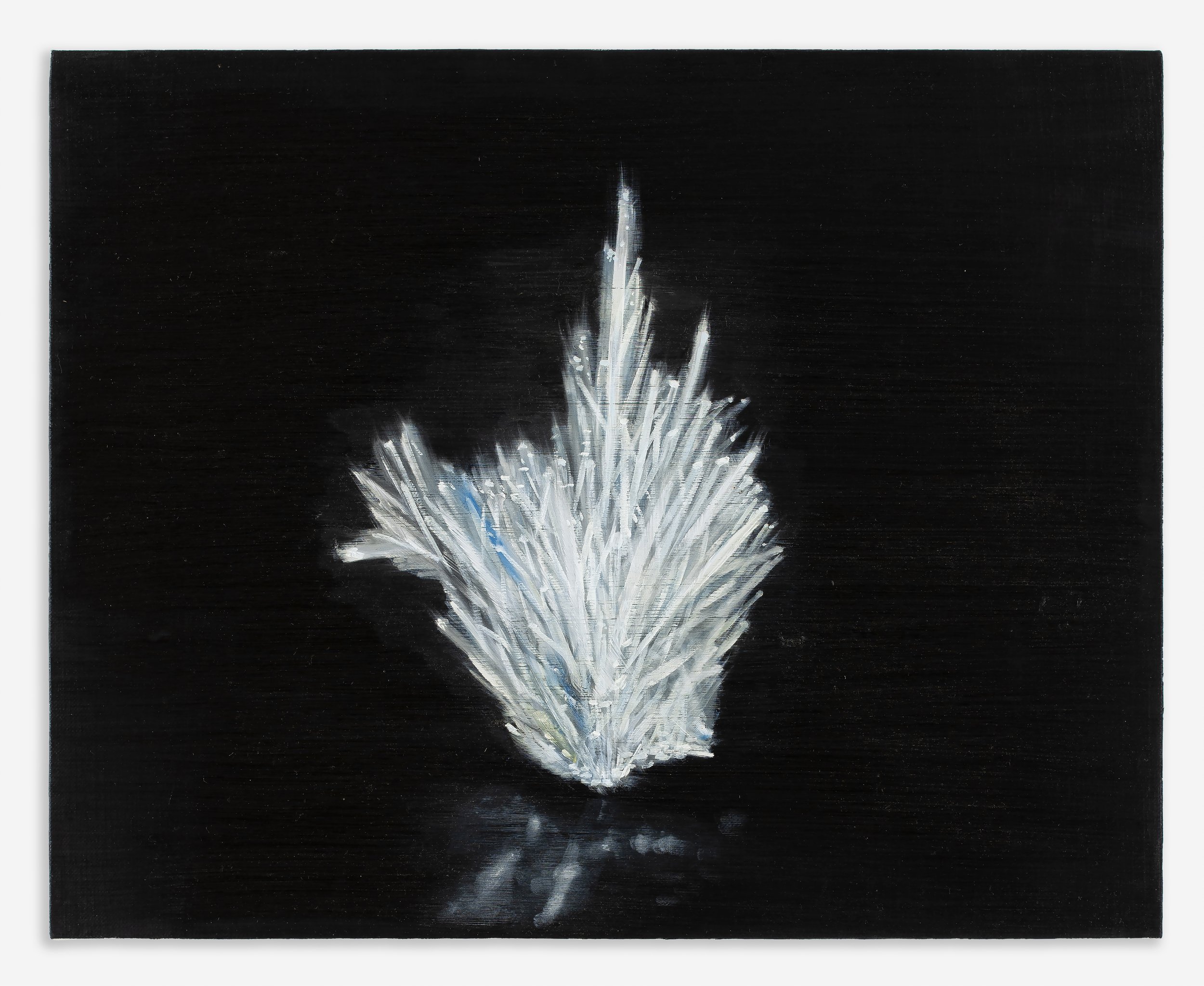
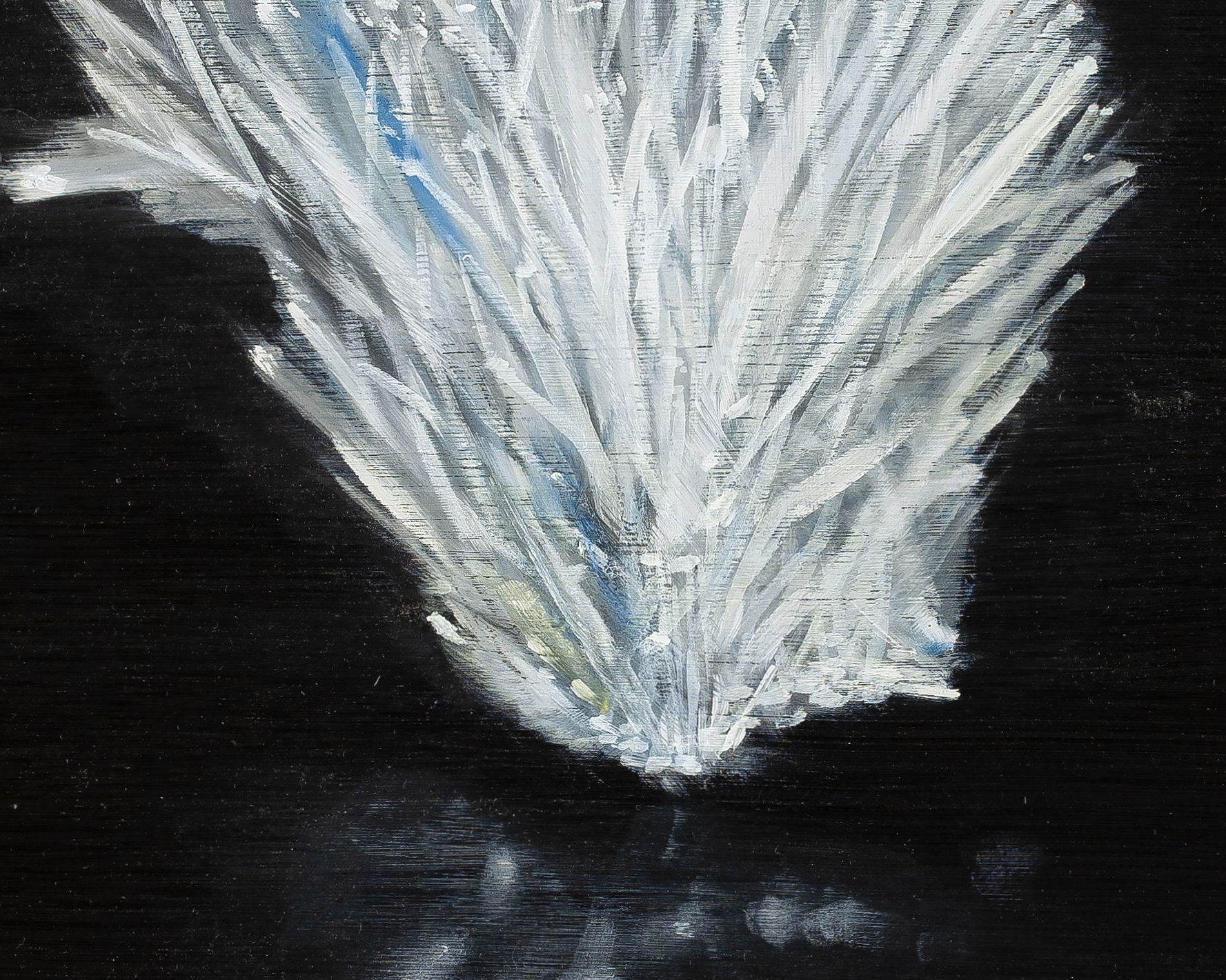
Antimony measures 40.6 by 50.8 centimeters on linen, a scale that positions the crystalline form slightly larger than life-size, large enough for the viewer to perceive the specific geometry of its crystal structure while not so large that it overwhelms the field of vision. The painting is executed in oil on linen, and the paint handling in the crystalline passages uses a range of tonal values from near-white highlights through mid-gray to the near-black shadows that define the crystal's edges against the void. The crystal form is depicted frontally, symmetrically composed within the rectangular field, its growth pattern radiating from a central axis in a way that suggests both natural mineral formation and deliberate geometric construction. The surface of the crystal is rendered with a precision that suggests Tan Mu was looking very closely at the mineral surface, following the facets as they catch and release light in response to changes in the viewing angle. At thirty centimeters, the crystal reads as a specific material object with weight and physical presence. At two meters, it resolves into a luminous geometric form against an absolute black ground, with the quality of an alchemical illustration from a seventeenth-century manuscript.
The crystal structure of antimony in the painting is not arbitrarily chosen. Antimony sulfide was used historically as kohl, a cosmetic powder applied to the eyelids that left a dark, metallic line around the eye. This use appears in Egyptian funerary practices dating to at least the third millennium BCE, in the cosmetic traditions of the ancient Near East, and in the practices of Byzantine and medieval European women who used antimony sulfide to darken and define the contour of the eye. The crystal structure of the mineral, with its characteristic tabular habit and its perfect basal cleavage along smooth, reflective planes, is exactly the structure that makes it effective as a cosmetic: the flat crystal faces reflect light with a metallic sheen that produces the effect of an extended, dramatically defined eye line. Tan Mu's depiction of the crystal form captures this reflective quality in paint, creating in the lighter passages a sense of metallic luster that is not decorative but structural: it is the specific optical property that made antimony valuable to ancient cosmetics and that connects the painting to a practice of bodily decoration that predates Newton's laboratory by three thousand years.
Joseph Wright of Derby painted a series of scientific subjects in the 1760s and 1770s that represent one of the earliest sustained attempts to depict laboratory practice as a subject for large-scale easel painting. His 1768 An Experiment on a Bird in the Air Pump shows a demonstration of the vacuum by candlelight, the audience of three figures arranged around the apparatus as a man in a Franklin-style cap performs the experiment, the bird suspended in the glass vessel that is being evacuated by hand pump. The light comes from a single torch held by one of the observers, and it creates the dramatic chiaroscuro of deep shadow and sudden highlight that makes Wright's paintings feel simultaneously like theatrical staging and precise documentary records. Wright was interested in the moment when natural philosophy became public demonstration, when the experiment that had been conducted in private laboratories became a performance staged for an audience, and when the audience was expected to understand that what they were watching was a demonstration of principles about the nature of air, combustion, and biological survival.
Tan Mu's Antimony operates in a related but temporally reversed register. Where Wright depicted experiments that had already been performed and that were being reconstituted for public consumption, Tan Mu paints an element whose entire history is a sequence of transformations, each one initiated by someone who was, in the language of their own time, conducting a kind of experiment. Newton's alchemical work was experimental in this sense: he weighed and measured and recorded, he produced notebooks full of observations, he believed that the results of his transmutations were real and consequential even when they failed to yield the gold he was partly seeking. The antimony crystal that Tan Mu paints is a product of stellar nucleosynthesis, which is to say it is an artifact of a sequence of nuclear reactions in the core of a massive star that ended in a supernova explosion, distributing the synthesized elements across interstellar space where they eventually coalesced into the solar system and the earth and the mineral deposits from which humans eventually extracted the substance that Newton used in his laboratory. This entire chain of events is the experimental context that Tan Mu's painting invokes, and the difference in temporal scale between Wright's candlelit laboratory and the timescales of stellar nucleosynthesis is not a reason to separate them but a reason to connect them: both are experiments, one conducted in minutes and the other in gigayears, both producing results that changed what the world contained.
The stellar origin of antimony is a specific and technically determinate fact about the element that Tan Mu's painting renders in visual terms without stating it explicitly. Antimony, with an atomic number of 51, is produced in the late stages of stellar evolution through a process of successive neutron capture and beta decay that occurs during the silicon-burning phase preceding a core-collapse supernova. The process of creating a antimony-127 nucleus requires a sequence of nuclear reactions that can only happen under the extreme temperature and density conditions of an exploding massive star, and the resulting nucleus carries within it the structural memory of those conditions: the specific isotope that is stable on earth is stable because it was formed in an environment of extreme energy and density from which it has now, four and a half billion years later, cooled into a crystalline mineral buried in the earth's crust. The crystal in Tan Mu's painting contains this history in its structure, and the black void surrounding it represents the emptiness of interstellar space through which the antimony traveled before it became part of the earth. The painting is a material document of the stellar process, made by someone who understands this process and who has chosen to make it visible in the only medium that can give it the weight it deserves: oil on linen, slow to make, capable of holding the record of deep time in a way that a diagram cannot.
The extraction and refinement of antimony from its ore deposits follows a process that is as specific and consequential as the stellar process that created the original ore body. Antimony is most commonly found in the form of stibnite, antimony sulfide, a mineral that forms distinctive prismatic crystals with a lead-gray color and a metallic luster that would have caught the eye of ancient miners in every continent where it occurs. The extraction process involves crushing the ore, floating it in slurries to separate the stibnite from associated minerals, and then roasting the concentrate to oxidize the sulfide to antimony oxide before reducing it to metallic antimony through carbothermic reaction in a furnace. The resulting metal is then cast into ingots or further processed for specific industrial applications. Each step in this process is an intervention in the material's history, a transformation from one chemical state to another, and the antimony crystal in Tan Mu's painting is the product of all of these transformations simultaneously: the stellar transformation that created the original atomic nuclei, the geological transformation that concentrated them into ore deposits, and the industrial transformation that extracted them and refined them into a form usable by technology. The painting holds all of these temporal layers in a single painted surface.
The smelting of antimony, like the smelting of many metallurgical ores, produces sulfur dioxide as a byproduct, a gas that is toxic in high concentrations and that contributes to acid rain when released into the atmosphere without adequate treatment. Historically, before environmental regulation existed, the roasting of stibnite produced dense clouds of sulfur dioxide that damaged crops and poisoned workers in mining communities across Europe, Asia, and the Americas. The same industrial process that produced antimony for use in flame-retardant materials and semiconductor compounds also produced, as an invisible cost, the degradation of air quality in the regions where the ore was processed. This environmental history is not visible in Tan Mu's painting, but it is latent in the crystal's material identity as an industrial product. The antimony on the black ground has been through a smelter, has released its sulfur into someone's lungs, has contributed to someone's respiratory illness, has been paid for by someone's labor in a hot, dangerous, chemically contaminated space. The painting does not represent this history. It holds it, the way the crystal holds within it the record of the supernova.

Mark Rothko spent the final years of his life producing paintings that he intended to be seen as objects in their own right, not as transparent windows onto emotion or as illustrations of mystical states. His black paintings from 1969 and 1970, executed in layers of pigment applied with sponges to achieve a surface of extreme density and low reflectivity, were not meant to be sad or melancholic or empty. They were meant to be present, to insist on their own material existence as painted surfaces in a room, to resist the viewer's tendency to look through the image to some emotional or spiritual meaning that lay behind it. The black field in those paintings is not a void. It is a painted surface of great complexity, built up in dozens of layers of carefully applied pigment, each layer contributing to the overall chromatic character of the black in ways that produce a visual depth that pure black or a single application of black paint cannot achieve. Rothko's blacks have warmth in them, a quality of brown or purple that is invisible to the casual glance but that the sustained viewer can perceive, and this warmth is what distinguishes a Rothko from any other black-painted surface.
Tan Mu's black background in Antimony is closer to Rothko's blacks than to any other painterly precedent, not because it shares Rothko's spiritual ambitions but because it shares his insistence on the black field as a complex painted surface rather than as an absence. The black in Tan Mu's painting is not the black of a hole or an empty room or a turned-off screen. It is the black of a ground that has been prepared and painted, that carries within it the record of brush strokes and the absorptive qualities of the linen beneath, that functions as a visual element in its own right rather than as a mere absence against which the crystal can be seen. This distinction matters because it changes the viewer's relationship to the void. A black that is truly empty produces a different perceptual experience from a black that is painted, and Tan Mu has made the choice to paint hers, to give the void its own presence, so that the crystal sits not in an empty space but in a field of made darkness that is as specific and crafted as the crystal itself. The crystal and the void are equally made, equally the products of deliberate human action, and this equivalence is one of the painting's central arguments.
Yiren Shen, writing for 10 Magazine in 2025 on the occasion of Tan Mu's solo exhibition at a major international art fair, identified what she called "the vertical axis of Tan Mu's practice": the consistent attention across Tan Mu's output to material histories that move between the cosmic and the industrial, the ancient and the contemporary, the alchemical and the computational. Shen observed that Tan Mu's paintings of elements like antimony, silicon, and carbon are not element paintings in the conventional sense. They are not still-life arrangements of material objects. They are paintings of material knowledge, of the entire conceptual and practical history that surrounds each element from its stellar origin through its human uses to its current position in technological systems. This knowledge is embedded in the formal choices Tan Mu makes: the black ground, the crystalline form, the tonal precision of the rendering. The viewer who knows the stellar origin of antimony sees the painting differently from the viewer who knows only its industrial uses, and Tan Mu has structured the work to reward both kinds of looking without resolving them into each other.
The dual identity of antimony that Tan Mu describes in her artist's statement, its historical existence as a mystical alchemical substance and its current status as an essential material in semiconductor manufacturing, flame retardants, and lead-acid battery alloys, is the specific content of the painting's conceptual field. Antimony is used in lead-acid batteries, the same technology that powered the first automobiles and that still provides the backup power systems for telecommunications infrastructure and data centers worldwide. It is used in flame-retardant materials that are required by building codes in most jurisdictions, meaning that the antimony in the walls and floors of every building constructed in the past forty years was smelted and processed and incorporated into polymer compounds that will persist in the building for decades. It is used in semiconductor compounds, as a doping agent in silicon and germanium devices, as a component in infrared detectors and thermionic emitters, as a constituent of phase-change memory alloys. The crystal in Tan Mu's painting carries all of these uses within it as virtual possibilities, as latent functions that the crystalline substance can perform when extracted, processed, and manufactured into components for technological systems. The crystal is not merely a mineral. It is a repository of industrial futures that are already embedded in its atomic structure.
What Tan Mu asks of the viewer in Antimony is not merely to recognize the beauty or strangeness of the crystalline form. It is to feel the weight of the history that the crystal contains. Newton saw in antimony the signature of the fixed stars, the same substance in a terrestrial laboratory that had been forged in a stellar explosion billions of years before the earth existed, and he named it accordingly as a statement of cosmological faith. The painting does not ask the viewer to share Newton's cosmological framework. It asks the viewer to feel the temporal depth of the crystal's existence, the way it contains within its structure the memory of processes that occurred at scales of time and space that are almost entirely outside the human capacity to imagine, and to feel simultaneously the precision of the present moment, the specific crystalline form in front of you, painted in oil on linen, rendered with an attention to surface and luster that only painting can produce. The void is not empty. It is the space through which the antimony traveled to reach this moment, and the crystal is not merely beautiful. It is the record of a journey that took four and a half billion years and that will outlast everyone who has ever looked at it.