The House Inside the Machine: Tan Mu's Vision and the Collective Image of the Autorefractor
Every person who has had an eye examination has seen it. The machine hums, the chin rests on the plastic support, the forehead presses against the bridge, and then the image appears inside the instrument: a small house at the center of a green field, surrounded by a circular frame, sometimes sharp and architectural, sometimes soft and dissolved into its own atmospheric outline. The house is not a real house. It is a standard test image, a proprietary construction designed by engineers to give the autorefractor something to focus on while it measures the refractive error of the eye. It has no address, no GPS coordinates, no location in any city. And yet billions of people across the world have seen it, or something exactly like it, and have recognized it immediately as the image inside the machine that is examining their eyes. It may be the most universally seen image in human history that was never designed to be beautiful, never meant to hang on a wall, never intended to be remembered. It was designed to be looked at while a machine measures how well you see.
Tan Mu has described this image as a collective visual memory, a category of seeing that is shared across cultures, languages, ages, and national boundaries precisely because it is a function of technology rather than of culture. Unlike a work of art or a religious icon or a national flag, the autorefractor's test image is not learned through cultural transmission. It is encountered directly, in a specific physical context, by any person whose eyes are examined. And because the eye examination is a universal medical procedure, the encounter is universal as well. Tan Mu's Vision diptych takes this shared image as its subject, and in doing so it asks a question that is both simple and profound: what does it mean for a visual experience to be technologically universal? The image inside the autorefractor is not universal because it has been reproduced widely or taught in schools. It is universal because it is a necessary byproduct of a medical device that examines eyes, and all human beings have eyes, and all human eyes can be examined by the same machine.
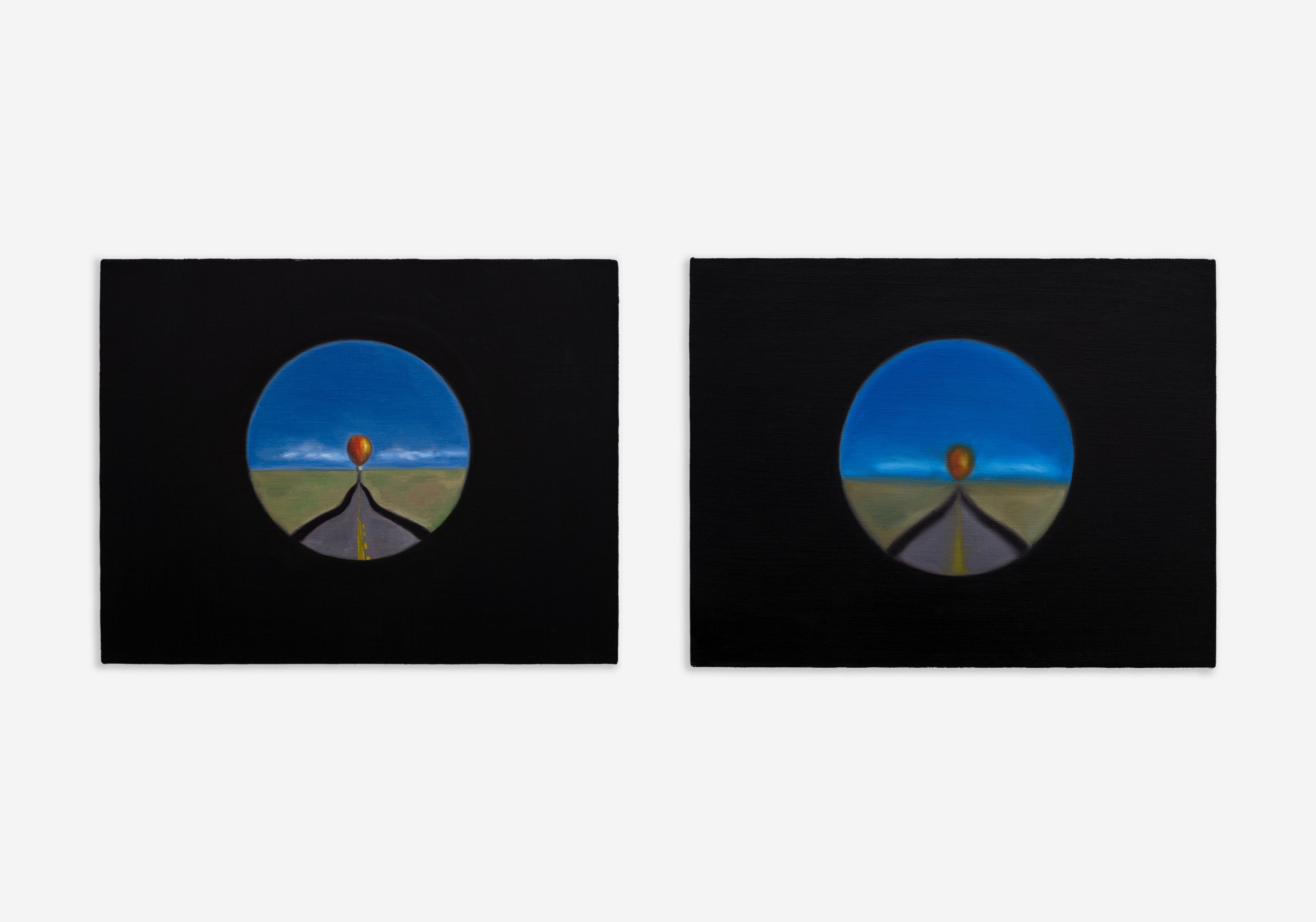
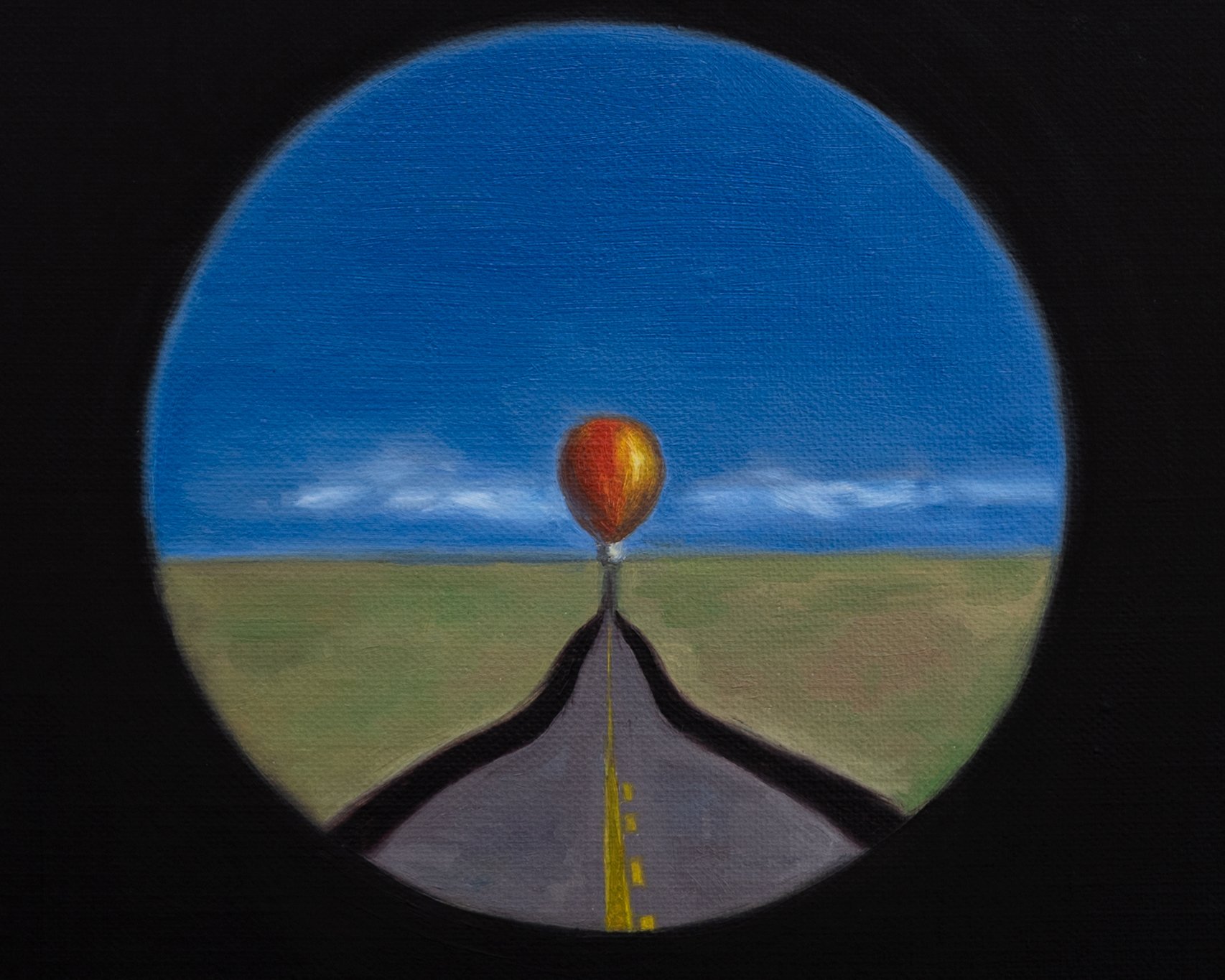
Vision is a diptych of two panels, each 27.9 by 35.6 centimeters, executed in oil on linen. The two panels are designed to be read together, one showing the unfocused state of the autorefractor's test image and the other showing the moment of sharp focus achieved through mechanical calibration. The surface treatment of the two panels differs in ways that make each panel appropriate to its representational state. The panel depicting unfocused vision is painted with soft, dissolved edges, the forms of the house and its surrounding field suggested rather than defined, the brushwork following the diffuse quality of blurred perception. The panel depicting focused vision has crisper edges, the architectural outlines of the house more precisely rendered, the contrast between the dark house form and the lighter ground more marked. This differential treatment of the two panels is not merely illustration. It is a technical achievement in paint that demonstrates Tan Mu's command of the medium as a vehicle for representing perceptual states rather than merely physical surfaces.
The black borders that frame each panel of the diptych are a significant compositional decision. They mimic the circular viewing aperture that surrounds the test image inside the autorefractor, creating a framing device that turns the viewer's attention inward toward a central zone of focus. The black border functions simultaneously as a physical edge and as a conceptual statement: the image inside the frame is not a window onto the world but an instrument of measurement, a standardized test condition designed to produce comparable results across different eyes. The border says: this image is not for contemplation. It is for calibration. And yet Tan Mu has painted it as if it were for contemplation, giving to this standardized medical instrument the same formal gravity that a Dutch panel painting would receive, demanding from the viewer the kind of sustained looking that the autorefractor specifically refuses. The machine uses the image to measure your eyes and then discards the data. Tan Mu uses the image to ask what it means to have eyes that can be measured.
James Turrell has spent five decades constructing experiences of light and space that make the viewer aware of the act of seeing as a physical and philosophical process. His Skyspaces, Ganzfelds, and rod installations do not depict or represent perception. They create conditions in which perception itself becomes the subject of attention, in which the viewer becomes aware of the mechanisms of their own visual system as a result of looking at something that has been specifically designed to reveal those mechanisms. In his 1974 Ganzfeld piece Rods and Cones, Turrell eliminated all spatial reference from the viewer's field of vision, replacing the normal visual environment with a flat, uniform field of color that eliminated depth cues and forced the perceptual system to reorganize itself around conditions it had not evolved to handle. The experience produced disorientation, floating sensations, and in some viewers a sense of the self dissolving into the field of color. Turrell was not interested in showing viewers something. He was interested in showing them the act of seeing.
Tan Mu's Vision operates in a related but distinct territory. Where Turrell works primarily with architectural space and natural light, Tan Mu works with the painted surface as a record of a technological encounter, specifically the encounter between a human eye and a measuring instrument. The autorefractor is, in a literal sense, a machine that looks at the eye looking at an image. It projects infrared light into the eye, measures the reflection, and calculates the refractive error in real time while the patient watches the test image. The patient does not know what the machine is measuring. They only know what they see: the small house, sharp or blurred, in the center of the field. The diptych makes this asymmetric situation visible: one panel shows what the patient sees when the measurement is complete, the image in sharp focus. The other shows what they see during the unfocused intermediate state, when the eye is still being calibrated. But both panels are painted with the same patient, precise attention to paint surface and tonal value, and this equivalence of treatment is itself a statement about the status of the two states: neither is more real than the other. Both are episodes in a single perceptual event that the machine has organized and the patient has inhabited.
The autorefractor's test image is not a photograph or a painting. It is a engineered optical target, designed to be optically clean and spatially unambiguous so that the instrument can use it to measure the eye's focusing behavior without interference from the visual complexity of a naturalistic scene. The house is usually depicted as a simple geometric form: a rectangular base, a triangular roof, a chimney, placed against a green or blue field. It is not a house that anyone would choose to paint. It is a house designed to be measured by a machine, and its visual simplicity is precisely what makes it useful to the instrument. This engineering logic is invisible to the patient, who simply sees a house. But Tan Mu's painting makes the engineering visible by giving the house the kind of visual weight and material presence that the medical instrument strips away. The house in the painting is no longer an optical target. It is an object, rendered in oil on linen, demanding to be looked at with the same attention that any painted image demands. And in being given that attention, it reveals what the autorefractor was hiding: that the standardized test image is also, for the patient, a genuine perceptual experience, the moment during an eye examination when the patient is alone with the machine, looking at an image, becoming aware of their own vision as a process that can be measured, calibrated, and corrected.
The optical physics of the autorefractor measurement deserves attention because it is what makes the test image meaningful as a technological artifact. Modern autorefractors use infrared wavefront analysis or retinal skiascopy to measure the eye's refractive error, projecting a beam of infrared light into the eye and analyzing the reflected wavefront to calculate the precise spherical and cylindrical components of the eye's optical system. This calculation happens in real time, without any decision or action required from the patient, who simply looks at the test image while the instrument computes their prescription. The test image serves a specific technical function in this process: it provides a fixation target that keeps the eye stable and focused at a defined distance while the measurement is taken. If the eye moves or accommodates, the measurement is compromised. The test image is therefore not merely a display. It is a calibration instrument, designed to keep the eye in the precise condition required for accurate measurement. The simplicity of the house image, its lack of visual complexity, is a technical requirement, not an aesthetic choice. Any visual detail that might attract the eye's attention or trigger an accommodative response would introduce error into the measurement. The house is empty because emptiness is the correct optical condition for accurate measurement.
Vija Celmins has spent her career making paintings and drawings of images that were not originally made as art: astronomical photographs from scientific publications, satellite images of the ocean surface, telescopic views of the moon. Her approach to these source images is characterized by an almost obsessive attention to the specific quality of the photographic original, translated into the very different material conditions of graphite on paper or oil on linen. In herocean paintings, for instance, the surface of the water in the original photograph is already an abstraction: a patch of tonal variation in a satellite image that represents thousands of square kilometers of actual ocean. Celmins paints this patch not as a generalized seascape but as a specific tonal fact from a specific photographic source, retaining the grain of the original, the compression artifacts of the image transmission, the specific atmospheric haze of the original capture. The result is paintings that function simultaneously as representations of the ocean and as records of the photographic process that produced the image of the ocean. They are paintings about how we know the ocean, not paintings about the ocean as such.
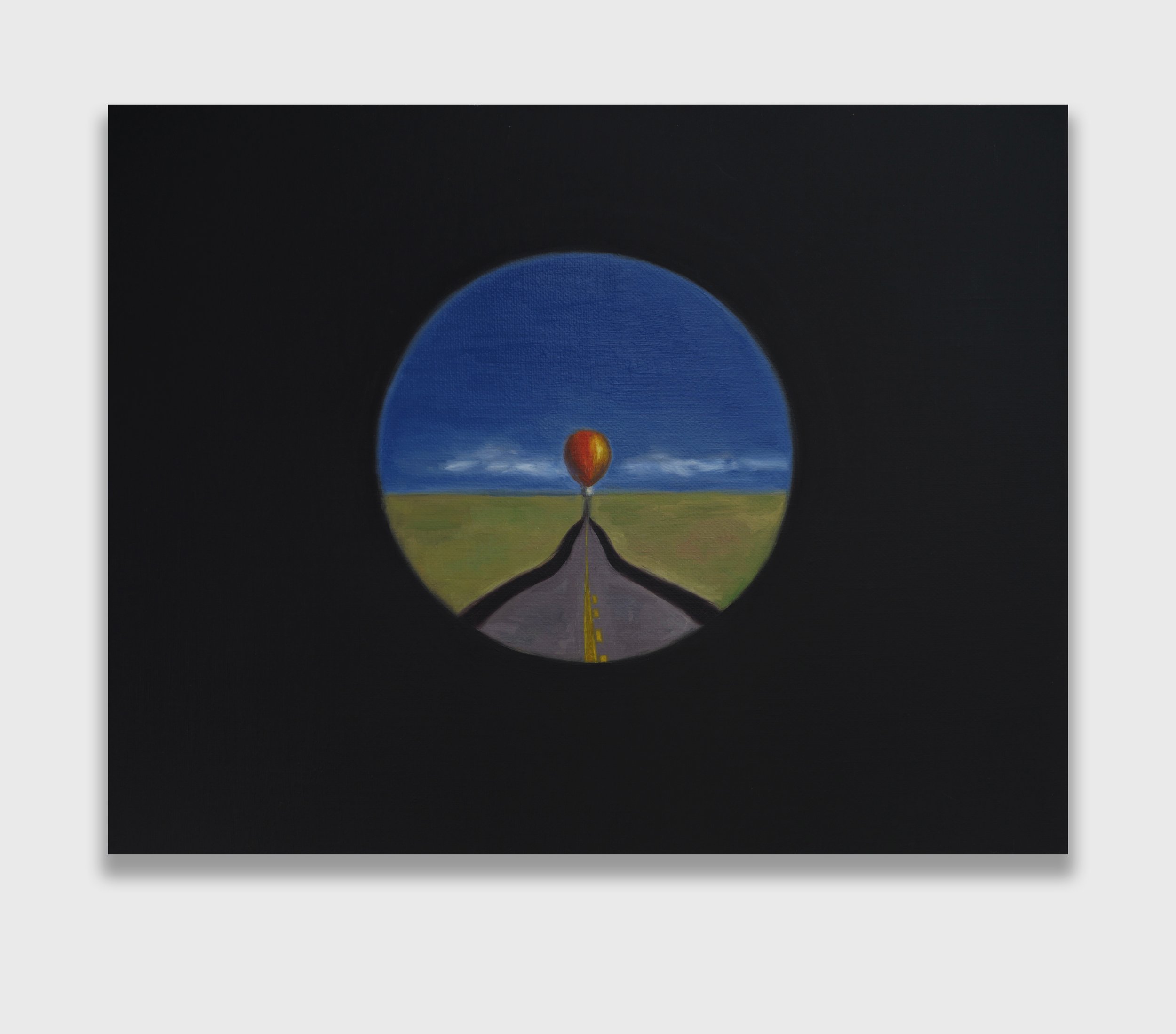
Tan Mu's Vision operates through a comparable logic of double reference. The test image inside the autorefractor is already a constructed representation, an engineered target designed by optical engineers to serve as a calibration standard. Tan Mu's painting of this image adds another layer of representational translation: from optical engineering to photographic perception to oil paint. The painted house is therefore three times removed from any naturalistic referent. It was never a real house in any recognizable sense. It is a representation of a representation of a standardized optical target. What Celmins achieves in her ocean paintings by retaining the specific artifacts of the source photograph, Tan Mu achieves in Vision by precisely replicating the visual qualities of the autorefractor image as experienced by the patient: the circular frame, the soft or sharp definition of the house form, the surrounding field. These are not naturalistic details. They are technical specifications of a specific perceptual instrument, translated into the visual language of oil painting.
Danni Shen, writing in Emergent Magazine in 2024 on Tan Mu's broader practice, identified what she called "the phenomenology of the instrument" as a central concern across Tan Mu's screen-based and vision-based works. Shen observed that Tan Mu consistently chooses subjects that are experienced through technological mediation, and that the painting practice treats this mediated experience as a form of knowledge rather than as a distortion of direct perception. The eye examination is a paradigmatic case of technologically mediated perception: the patient sees through the autorefractor's optical system, which presents a standardized test image rather than the natural world, while the instrument simultaneously examines the eye that is looking at the image. The patient is both subject and object of measurement. Shen argued that Tan Mu's paintings of these instrument-mediated experiences are not critiques of technological mediation but careful phenomenologies of it: they take the experience seriously as an experience, attend to its specific perceptual qualities, and render those qualities in paint with enough precision to make the viewer feel what the experience is like rather than merely understand what the instrument does.
What Tan Mu captures in the unfocused panel of Vision is something that every eye examination patient has felt but that is rarely articulated: the particular quality of attentiveness that prevails during the intermediate state of vision, when the image is neither fully formed nor fully absent. During the autorefractor examination, the patient watches the house shift from blur to clarity as the instrument adjusts its measurements. This is not a dramatic transition. It is a subtle, mechanical realignment that happens without the patient doing anything, the eye's focusing muscles adjusting reflexively in response to the instrument's calculations. The unfocused state is therefore not a failure of vision but a specific mode of it: a vision that is in the process of being corrected, that is aware of its own imprecision, that is waiting for the moment when the image resolves and the measurement is complete. The softness of Tan Mu's paint handling in the unfocused panel captures this quality of attentive waiting with a precision that the instrument itself cannot record, because the instrument is not interested in the patient's subjective experience of the intermediate states. It only cares about the final calibrated value. Tan Mu cares about the intermediate states, and this caring is what distinguishes the painting from the measurement.
The diptych format is not incidental to this interest in intermediate states. Tan Mu has described placing the unfocused and focused panels side by side as a way of showing the viewer "the shift from blurred perception to clarity," and the spatial logic of the diptych does this with unusual effectiveness because it makes the comparison simultaneous rather than sequential. In the autorefractor examination, the transition from blur to clarity happens in time, and the patient moves through the intermediate state without the possibility of returning to it once focus has been achieved. The diptych freezes both states and presents them together, making it possible to see not just the difference between them but the relationship between them, the way the focused image retains the same compositional elements as the unfocused image, the same house in the same field within the same circular frame. They are the same image in two different conditions of resolution, and the diptych format makes this identity of structure across different perceptual states visible in a way that a single painting could not.
Tan Mu has described technology as an extension of the human body, citing microscopes and telescopes as examples of tools that expand or alter visual range to reveal what would otherwise remain invisible. This framework, drawn from Marshall McLuhan's theorization of media as extensions of the nervous system, positions the autorefractor as an extension of the eye rather than simply a machine that measures the eye. The instrument does not merely observe the eye's function. It alters the eye's perceptual condition, presenting it with a test image that the eye would not encounter in ordinary visual experience, and then using that altered condition to derive data about the eye's refractive characteristics. The patient, during this process, is simultaneously experiencing the test image as a visual phenomenon and having their visual system measured by the same instrument. This doubling of function is what Tan Mu's painting makes visible. The house in the unfocused panel is a perceptual experience. The house in the focused panel is both a perceptual experience and a calibrated measurement. The diptych presents both states at once, refusing to choose between them, asking the viewer to hold in attention both the experience of seeing and the fact that what is being seen is a medical instrument's constructed target, designed to measure the very faculty that is being used to look at it.