The Frozen Frame: Tan Mu's Play and the Temporality of the Pause Button
The pause button on a VCR remote is one of the stranger inventions of the late twentieth century. It takes a medium that is defined by temporal flow, by the uninterrupted succession of images across time, and it stops it. The tape stops advancing, the video heads hold their position, and the last frame of footage before the pause was pressed remains frozen on the screen, neither advancing nor disappearing. This frozen image is not a photograph. It has no shutter speed, no aperture, no moment of exposure. It is simply a video frame that has been stopped mid-run, a single temporal slice from a continuous stream held in place by a mechanical command. The image itself is slightly degraded by the pause: video heads, when they stop spinning, leave a characteristic horizontal banding across the frozen frame, a visual artifact of the machine's interrupted operation that distinguishes the paused video image from any other kind of still image on a screen.
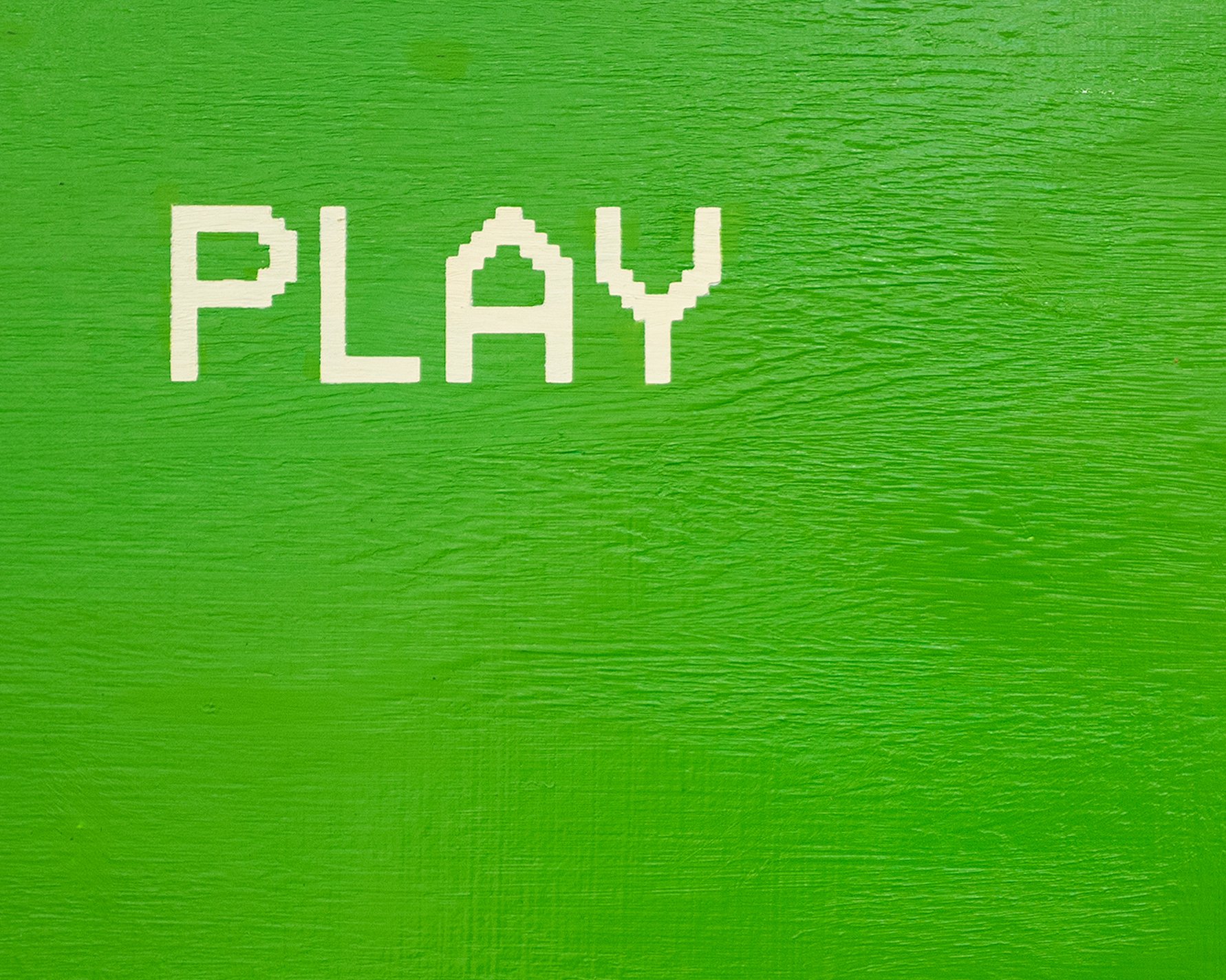
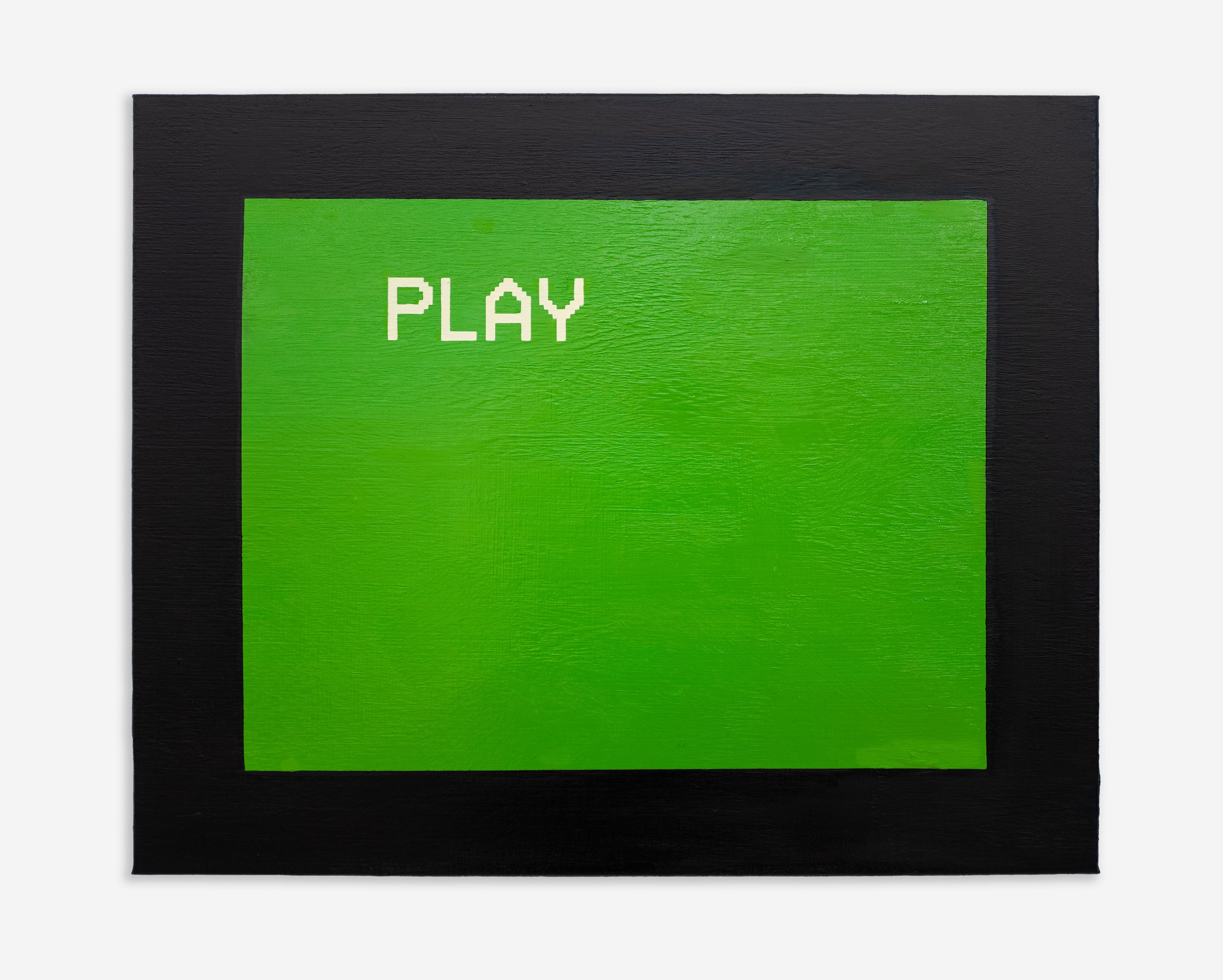
Tan Mu's 2022 painting Play depicts exactly this frozen VCR frame, the pause state that is visually indistinguishable from the play state except for the text overlay and the subtle artifact banding that tells the informed viewer that the machine has been commanded to wait. The painting is oil on linen, 41 by 51 centimeters, a format that corresponds to the proportions of a standard television monitor screen. Tan Mu has described the painting as inspired by Neil Postman's argument in Amusing Ourselves to Death that visual media had, by the mid-1980s, transformed serious public discourse into entertainment, and that television's central achievement was not the delivery of content but the restructuring of attention into a passive, receptive mode that was fundamentally incompatible with the habits of thought required for democratic citizenship. The pause screen, in this reading, is not merely a technical condition. It is a metaphor for the television viewer's relationship to time and attention: the machine has stopped, but you have not stopped watching. You are watching nothing, or rather you are watching the instruction to watch, and this watching of nothing is the condition that television prepared its viewers for across decades of programming.
The surface treatment of Play is notable for the way it handles the black border that frames the television image within the composition. Tan Mu has framed the painting in black to mimic the physical borders of a television monitor, creating a literal edge around the image that corresponds to the plastic or metal frame of the original display device. This border is not decorative. It is a structural statement about the painting's relationship to its subject: the image inside the frame is a television image, and the frame is the monitor's housing, and the painting presents these technical facts with the same matter-of-fact directness that characterizes Tan Mu's approach to all of her technological subjects. The paint handling within the active image area of the painting uses thin glazes over a warm ground, creating a surface that has a slightly luminous quality appropriate to its subject while maintaining the material weight of oil paint on linen. The transition between the black border and the active image area is clean and precise, mimicking the sharp edge between the monitor's housing and its glass face, a boundary that every television viewer has looked at thousands of times without ever consciously registering it as a feature of the image.
The composition of Play freezes the screen at the moment of transition, the instant when the viewer has pressed pause and the machine has not yet fully responded, or has just responded, depending on how you choose to read the timing. Tan Mu has described this as the condition of being caught between states, and the painting exploits the inherent ambiguity of the paused video frame to present this condition with unusual precision. The paused video frame does not announce what it is. It looks like a still image from the program that was playing, but it carries within it the invisible command that has stopped it, the mechanical interruption that distinguishes it from a photograph. The word "PLAY" overlaid on the frozen frame in the standard VCR display text is both an instruction and an accusation: the machine is telling you to play, but it is not playing. It is waiting, and you are waiting with it, and the waiting is what the painting captures with such precision. This is not the passive consumption of television programming. It is the more unsettling condition of the television viewer who has stopped consuming but has not stopped receiving, who is awake and attentive in front of a screen that has nothing to say.
The Fluxus artist Wolf Vostell created his first Fernsehdecke, or television embedded in concrete, in 1959, three decades before the VCR would make the pause button a household feature and several decades before Neil Postman would diagnose what the pause button revealed about television's relationship to its viewers. Vostell's destroyed televisions were visceral, physical interventions: sets embedded in plaster, smashed with hammers, rearranged into sculptural configurations that made visible the violence that television did to the images it carried. For Vostell, the television was a vehicle of cultural suppression, a machine that delivered the ideological content of postwar West German and American capitalism into the domestic space with such force that only a physical attack on the machine could adequately respond to it. His destroyed television sets were monuments to the violence of passive reception.
Tan Mu's Play operates through a different register but toward a related diagnosis. Where Vostell attacked the television physically to make his argument, Tan Mu freezes it and paints it, transforming the television's own technical capacity for temporal interruption into the subject of sustained contemplation. The pause button was not designed as a critical tool. It was a convenience feature, allowing viewers to temporarily interrupt playback for practical reasons. But its existence introduced into the television experience a new and unprecedented temporal condition: the viewer who had stopped the flow of images but had not turned off the screen, who remained in the position of reception without receiving anything. This condition, Tan Mu suggests, is not exceptional. It is a distillation of the television viewer's fundamental relationship to the medium: present, attentive, in the posture of receiving, but receiving nothing of substance. The pause button did not create this condition. It revealed it by stopping everything except the viewer's attention, which kept going even when the machine had stopped.
The VHS format that Play depicts was introduced to the consumer market in 1976 and dominated the home video market through the 1980s and into the early 2000s, before being displaced by DVD and then streaming. During its peak years, the VCR was present in the majority of American households, and the pause button was one of its most frequently used features. The temporal interruption it created was woven into the texture of daily life in ways that are now difficult to reconstruct historically: the viewer who paused to answer the telephone, the parent who paused to check on a child, the commercial break that was paused rather than skipped forward, the rented tape that was left paused overnight because the phone rang at the wrong moment. These pauses were ordinary events, repeated millions of times daily, and yet each one created a brief suspension of the television's temporal flow and a prolongation of the viewer's attentional posture. The paused screen was a room in which the television and the viewer were left alone together with nothing to say to each other.
The magnetic tape itself, as the physical substrate of the VHS recording, carries a material history that the painting's flat painted surface cannot directly represent but implicitly invokes. VHS tape is a polyester film substrate coated with a magnetic iron oxide or chromium dioxide layer, and the recording process aligns magnetic particles on the coating surface in patterns that correspond to the audio and video information being preserved. When the VCR is paused, the tape remains in contact with the rotary video heads, which continue to scan the same section of tape repeatedly. This prolonged contact gradually degrades the tape at the pause point, a phenomenon known as head tension marks, visible on a VHS tape that has been paused repeatedly at the same location as a crease or a shiny band across the tape surface. The pause button, used casually in daily life as a convenience, is also a device that slowly destroys the recording it is pausing. This dual action is an appropriate metaphor for the television's relationship to its content: the pause preserves and damages simultaneously, freezes the image while advancing the entropy of the tape. Tan Mu's painting of the paused screen inherits this material history without depicting it, holding the pause state as a visual condition while the tape it interrupts carries its own quiet record of deterioration.
The visual texture of the paused VCR frame has a specific technical character that Tan Mu's painting captures with precision. When a VCR is paused, the video heads continue to scan the same section of magnetic tape repeatedly, reading the same fields and lines with each revolution of the drum. This repeated scanning produces a characteristic artifact: horizontal banding or shimmering across the frozen frame, most visible in areas of high contrast or fine detail. This banding is not part of the recorded program. It is an artifact of the pause state itself, a visual signature of the machine's interrupted operation. Tan Mu's decision to paint the screen at the moment of pause rather than at the moment of play means that she is painting a frame that carries within it the visual evidence of its own interruption. The painting does not merely depict a paused television. It depicts the specific visual condition that a paused television produces, with all the technical artifacts and anomalies that condition includes, translated into the material language of oil paint.

Nam June Paik, the Korean-born artist who was among the first to treat the television set as an artistic medium rather than merely a delivery system for broadcast content, created some of the earliest video sculptures in the 1960s and 1970s by manipulating the magnetic fields inside television receivers to distort and transform the broadcast image. His 1965 work More Korean Airlines in which he hung a prepared television set from the ceiling of a gallery, the screen displaying the distorted images that resulted from his interventions, was one of the first demonstrations that the television could be an artistic medium in its own right, with properties and behaviors that could be investigated and manipulated independently of the content it carried. Paik understood that the television was a machine with aesthetic properties, that the glow of the phosphor screen and the scan lines of the CRT were visual phenomena in their own right, not merely neutral carriers of whatever images were being broadcast through them.
Paik's approach to the television was fundamentally playful and optimistic: he saw in the medium a capacity for transformation, feedback, and productive disorder that he wanted to release from the constraints of broadcast programming. His famous phrase that the medium of television was not simply a way of transmitting images but a new environment that would restructure human perception and human community expressed his faith that the technology could be bent toward liberatory ends. Tan Mu's painting of the paused VCR screen is informed by this lineage but moves in a more cautious direction. The pause state is not a transformation. It is a suspension, an interruption without resolution, a moment of waiting that offers no guarantee of what will happen when the pause ends. Where Paik's television interventions were acts of creative disruption, Tan Mu's frozen pause screen is a document of the viewer's entanglement with a medium that had trained them to wait, to remain attentive, to receive passively, even when the machine had nothing to give them.
Tan Mu's painting of the paused VCR screen extends Paik's insight about the aesthetic properties of the television medium into a different register. Where Paik was interested in the television's capacity for transformation and play, Tan Mu is interested in its capacity for suspension and waiting. The paused screen is the television at its most minimal: no flow, no programming, no narrative to follow, just the frozen image and the overlaid text and the viewer's sustained attention. Paik would have seen in this pause state a limitation of the medium, a moment when the television's capacity for transformation had been arrested. Tan Mu sees in it a revelation of what the television always was: a machine that commanded attention, that placed the viewer in the position of reception, regardless of whether anything worth receiving was being delivered. The pause button makes visible the attentional infrastructure that the television had always relied upon, the passive readiness of the viewer to receive that was the medium's true content.
Saul Appelbaum, writing in the BEK Forum catalog accompanying Tan Mu's 2025 Vienna exhibition, identified what he called "the entanglement of technology and consciousness" as a central thread running through Tan Mu's practice. Appelbaum observed that Tan Mu consistently chooses subjects in which the relationship between the human body and the technological instrument is not one of mastery or control but of mutual shaping and adaptation. The human learns to use the technological device, but the device simultaneously trains the human to adopt certain postures, certain modes of attention, certain habits of perception. The VCR pause button is a precise example of this mutual shaping: it was designed to serve human convenience, but in doing so it introduced a new temporal habit, a new relationship to the television's flow, a new form of waiting that the human body learned to inhabit. Appelbaum's framing is useful for understanding why Tan Mu would choose to paint a subject as seemingly trivial as a paused VCR screen: because the paused screen reveals, more clearly than the playing screen, the specific quality of attention that the television had cultivated in its viewers over decades of use.
Neil Postman's central argument in Amusing Ourselves to Death, published in 1985 at the height of the VCR era, was that the epistemological conditions created by television were fundamentally incompatible with the epistemological conditions required for meaningful public discourse. Television, Postman argued, had not merely changed what people talked about. It had changed how they talked, how they reasoned, how they attended to information, how they assessed the credibility of claims. The television viewer had been trained by decades of the medium to receive information in the form of entertainment, to expect that all information would be delivered with visual appeal, emotional resonance, and narrative structure, and to resist information that lacked these qualities. The pause button, in this context, is not a relief from the television's entertainment logic. It is a demonstration of the viewer's entanglement with it: the machine has been stopped, but the viewer remains in the posture of reception, waiting for the machine to resume, having learned from the television that waiting for entertainment is itself a form of engagement.
What makes Tan Mu's painting of the VCR pause screen specifically relevant in 2022, when the painting was made, is the historical distance it creates between the viewer and the technology it depicts. By the time of the painting's creation, the VCR had been largely obsolete for over a decade. Streaming services had replaced physical media, on-demand viewing had replaced scheduled programming, and the pause button on a streaming interface behaved differently from the mechanical pause of a VHS deck: it stopped and started instantly, with no artifact banding, no mechanical hesitation, no visible sign that the interruption had ever occurred. The paused streaming frame is seamless in a way that the paused VCR frame was not. It hides its interruption. The VCR pause screen, by contrast, carried its interruption visibly, in the horizontal banding and the frozen frame artifact. Tan Mu's painting of this visible interruption is already a historical document: it preserves, in oil on linen, the visual record of a specific technological relationship to time that streaming has since replaced with something smoother and less visible. The painting holds the pause screen the way a painting of a steam engine might hold the steam engine, as a record of a technology whose relationship to the human body was more visible, more audible, and more physically present than its successor.