The Shadow and the Screen: Tan Mu's Projection and the Layered Identity of the Digital Era
When Caravaggio painted a figure in chiaroscuro, the shadow that fell across the background was a physical fact produced by a physical process: a lamp or a烛 placed in a specific position relative to the subject and the canvas, casting a shadow that fell on the wall behind the figure with a character and intensity determined by the distance and angle of the light source. The shadow was not metaphorical. It was not a symbol for the darkness of the soul or the ambiguity of identity. It was a shadow, and the quality of the shadow, its sharpness or softness, its gradation from deep darkness to partial illumination, was one of the primary means by which the painter controlled the emotional and psychological register of the image. The shadow was a tool, as specific and as controllable as the brush, and the mastery of chiaroscuro was the mastery of this specific tool.
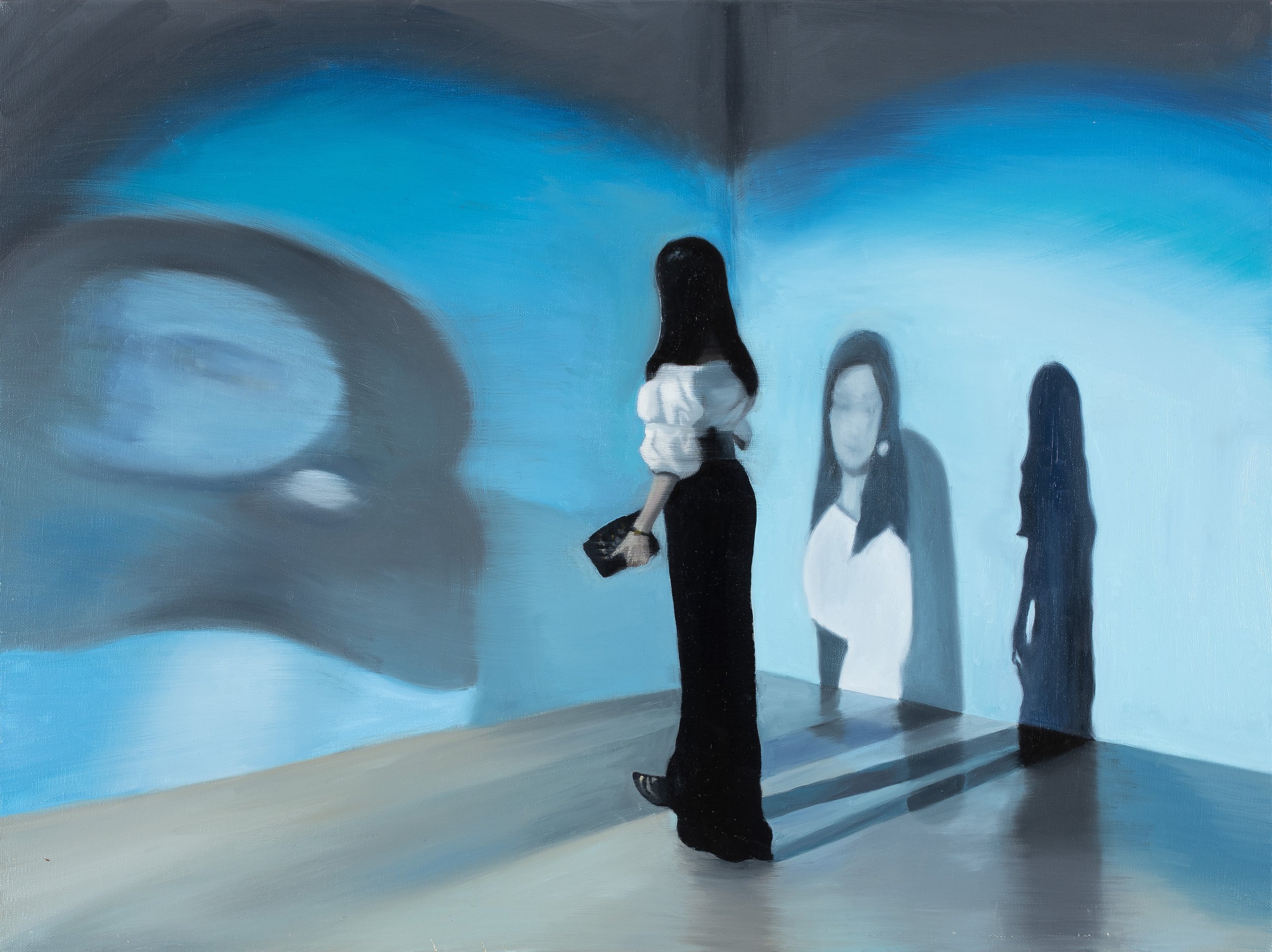
Tan Mu's 2021 painting Projection: Light and Shadow depicts a figure in a blue-toned environment, and the figure's shadow is not singular but multiple. There are three shadows visible in the composition: one solid and dark, one translucent, and one faint, each corresponding to a different light source or a different moment in the projection process. These three shadows do not overlap cleanly. They layer over one another in a way that produces interference patterns, zones of darker and lighter shadow where the transparency of one shadow permits the others to become visible beneath it. This layering is not a failure of painterly resolution. It is the subject of the work. The painting asks: what happens to the shadow when the light that produces it is not a candle or a lamp but an electronic projection system, and what happens to the figure when its shadow is no longer a single physical fact but a multiplicity of visual traces that exist independently of each other?
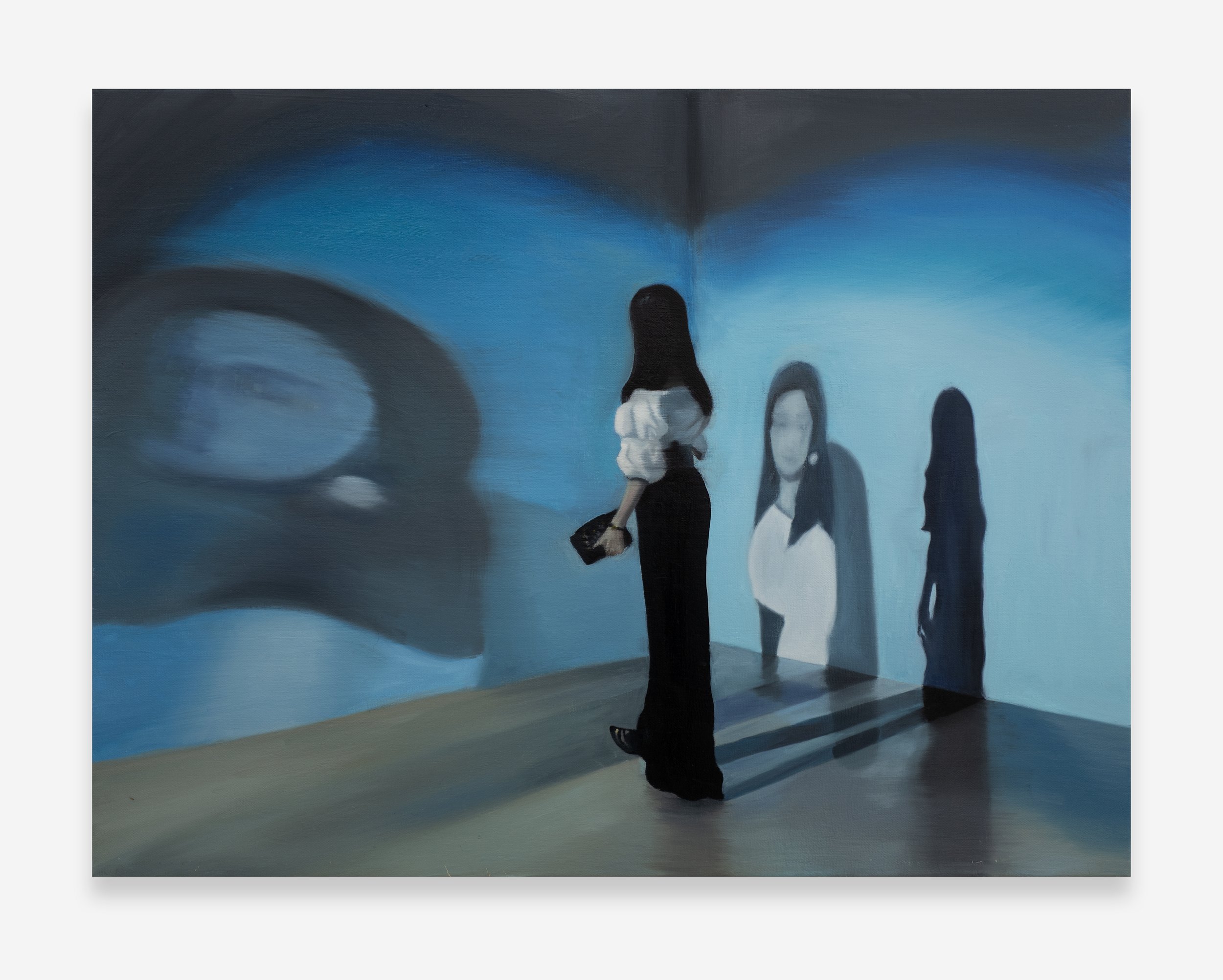
Projection: Light and Shadow measures 46 by 61 centimeters on linen, and its horizontal format corresponds to the proportions of a projected image, a video frame, a cinematic composition. The blue-toned environment in which the figure stands is not a natural outdoor space or an interior room. It is a digitally generated color field, the kind of flat, evenly illuminated background that is used in video production to create a uniform setting for the subject to stand against. Tan Mu has described the blue tone as both a technical choice and an emotional one: blue as the color of screens, of digital interfaces, of the light that has replaced natural daylight in the environments where most contemporary people spend most of their waking hours. The figure in this blue field is simultaneously present and mediated, simultaneously physical and digital, and the three shadows that surround it are the visual record of this doubled condition.
The paint handling in Projection: Light and Shadow uses a technique that Tan Mu has described as real-time painting, an attempt to translate the temporal logic of video projection into the static medium of oil paint. In video projection, the image is never stable. It is constantly refreshed, rebuilt thirty or sixty times per second, each frame slightly different from the one before it in a continuous process of renewal and erasure. The layered shadows in the painting are the attempt to capture in a single still image the temporal experience of being in front of a projection that is constantly shifting, constantly producing new images of the same subject. The solid shadow corresponds to the initial moment of projection, the translucent shadow to the layer of digital information that overlays the physical body as the projection system continues to operate, and the faint shadow to the residual trace that remains in the viewer's perceptual memory after they have looked away from the projected image and back to the physical space. Tan Mu has described this layering as reflecting how light has evolved as both a tool and a subject in artistic expression, from the sacred illumination of religious paintings through the intimate glow of candlelight to the contemporary era of digital projection.
Vija Celmins has spent her career making paintings that exist at the boundary between representation and material fact, translating photographic source material into oil paint in a way that preserves the specific visual information of the photograph while simultaneously revealing the inadequacy of the photographic record as a description of visual experience. Her paintings of ocean surfaces, for instance, take as their source the flattened, pixelated, highly compressed image produced by satellite observation, an image that is already an abstraction of the actual ocean surface it claims to represent. Celmins paints this abstraction with a precision that does not try to recover the original ocean but instead accepts the satellite image as the subject, making visible the specific visual properties of that image, its grain, its compression artifacts, its resolution limits. The ocean she paints is not the ocean. It is the satellite image of the ocean, held in oil paint long after the original image has passed into historical obsolescence.
Tan Mu's Projection: Light and Shadow operates through a related but distinct logic. The layered shadows in the painting are not describing a physical scene that the viewer could enter and observe directly. They are describing the specific visual condition of being in front of a projection, of inhabiting the space between the physical body and its digital double. Where Celmins is interested in the gap between the photographic record and the visual experience of the original, Tan Mu is interested in the gap between the physical body and its digital projection, and the layered shadows are the most precise visual record she could find for this gap. The shadow that electronic projection casts is different from the shadow that candlelight casts because the light source in electronic projection is not a physical object with a position in space. It is a digital simulation of a light source, generated by software, projected from a device that does not illuminate the space the way a lamp illuminates a space but rather overlays an image onto the surface of the space. The shadow that results from this process is not a shadow in the physical sense. It is a visual trace, a record of the figure's presence that persists after the projection has moved on or been turned off.
The historical trajectory of light as a subject in painting, which Tan Mu traces in her artist's statement from sacred illumination through Renaissance candlelight to plein air naturalism and finally to electronic projection, is also a trajectory of the increasing complexity of the shadow. A single light source produces a single shadow. Multiple light sources produce multiple shadows that overlap according to the angles and intensities of each source. Electronic projection, by projecting not a single image but a sequence of images at high speed, produces shadows that are not static but dynamic, that shift with each new frame of the projection, that create interference patterns when two projection sources are used simultaneously. Tan Mu's three shadows in Projection: Light and Shadow are a still image of a dynamic process, a way of showing the viewer what it looks like when a body is lit by electronic projection, which is to say by a light source that is also an image, that illuminates and represents simultaneously, that casts a shadow that is not merely a shadow but also a symptom of the digital mediation through which contemporary identity is constantly being reconstructed and projected back at the body that originated it.
The blue tone that dominates the painting's background is not a neutral choice but a specifically technological one, referencing the chroma key color used in video production to separate subjects from their backgrounds and composite them into new environments. In chroma key photography, the subject stands in front of a uniformly illuminated field of a specific color, typically a saturated blue or green, and the camera records this field along with the subject. In post-production, the colored field is replaced with a different background, allowing the subject to appear against any environment the editor chooses. The blue screen is thus a transitional technology: a background that is designed to be removed, an environment that is designed to be replaced by another environment. Tan Mu's use of blue as the ground for her figure is not a reference to this specific technical process but it inherits the blue screen's logic of provisional presence, of a figure standing in a space that is not quite real, against a background that is not quite present, in a condition of being neither fully in the physical world nor fully in the digital world but suspended between them.

Olafur Eliasson has spent decades investigating the relationship between light, perception, and spatial experience, creating installations that use simple optical principles to produce complex perceptual effects in the viewer. His 2003 Weather Project at Tate Modern suspended a large artificial sun in the turbine hall, using mono-frequency yellow light to eliminate all color variation except yellow from the space, so that visitors walking through the hall experienced their own bodies as dark silhouettes against the bright yellow ceiling and were made aware, through this radical simplification of the visual field, of the specific conditions under which they perceived themselves and others. Eliasson was not interested in showing the viewer something beautiful. He was interested in showing the viewer their own perception as a contingent, constructed, materially determined process. The artificial sun was a tool for revealing the conditions of seeing, and the viewer's body in the yellow light was the subject of the investigation, not the light source itself.
Tan Mu's use of light in Projection: Light and Shadow shares with Eliasson an interest in using light to reveal the conditions of contemporary visual experience, but it operates through a different formal logic. Where Eliasson creates situations in which the viewer physically inhabits an altered light field and discovers their own perception changing in response, Tan Mu paints a situation that the viewer can only observe, not inhabit. The blue-toned environment with the three layered shadows is not a space the viewer can enter. It is an image of a space, rendered in oil paint, frozen in a single moment of what was originally a temporal process. This frozen quality is what distinguishes the painting from the installation: the viewer cannot walk through the projected light field that the painting depicts. They can only look at the painting's record of that field, and this looking is itself a kind of mediation, a translation of the temporal experience of projection into the static experience of a painted surface. Eliasson's installations ask the viewer to feel their own perception changing. Tan Mu's painting asks the viewer to look at the record of a perception changing and to consider what it means that this record is made of oil paint on linen.
Li Yizhuo, writing in "Constellations" (BEK Forum, Vienna, 2025), observed that Tan Mu's practice consistently operates through what she called "the paradox of the static image for temporal media," the way Tan Mu uses the fixed, durable medium of oil painting to represent processes that are essentially temporal and unstable. Li Yizhuo connected this paradox to a broader concern in contemporary art with what she called "the archive problem": the question of how to preserve the record of events, experiences, and media forms that are inherently perishable or mutable. The projected image is a paradigmatic case of this problem. It exists only in the present moment of its projection. When the projector is turned off, the image ceases to exist. When the recording is overwritten, the image is permanently lost. The painting of a projected image is one attempt to solve the archive problem: it takes the temporally unstable image and translates it into a medium that will persist long after the projection technology has become obsolete. Li Yizhuo's observation is that Tan Mu's choice of oil paint as the archiving medium for these temporal experiences is not incidental. Oil paint has a centuries-long history as the medium of serious visual representation. Its choice signals that the content being preserved is worth preserving in the most durable medium available.
The technical process of electronic projection involves several stages that each contribute to the specific character of the shadows that the projected figure casts. The digital image is first stored as a sequence of pixel values in a video buffer, then processed by a projection engine that converts these values into light intensities at each pixel location, then focused through an optical system that projects the resulting image onto the screen surface. Each stage introduces a small temporal delay, and the cumulative effect of these delays across the entire image means that different parts of a single frame are projected at slightly different times. When the projected light falls on a physical body in the space, the body's shadow will be cast by light that arrived at slightly different moments across the projection surface, creating an imperceptible but technically present inconsistency in the shadow's relationship to the original image. Tan Mu's three shadows in the painting are not literally representing this technical inconsistency. They are translating it into a visible form, giving the viewer access to the temporal complexity of electronic projection through the spatial complexity of layered shadows on a blue field.
The three-shadow structure of the painting also corresponds to a specific phenomenon in the history of photographic and cinematic projection: the ghost image that appears when a film print is projected through a damaged or scratched section of the original negative. In early cinema, the accumulation of physical damage on the film print would produce secondary images that appeared as transparent overlays on the primary projection, creating a multiplicity of the same scene that suggested the fragility and instability of the recorded image. These ghost images were considered defects, artifacts to be eliminated through better film handling and preservation. Tan Mu's three shadows are ghost images in this technical sense: they are traces of the same figure that have accumulated through a process of mediation, each shadow a generation of the figure's visual presence, and the layering of the three shadows together a record of the figure's passage through multiple media systems, each of which has added its own mark to the image.
Tan Mu has described the personal uncertainty she was experiencing around memory and identity during the period when she developed Projection: Light and Shadow, and this biographical context is visible in the painting without being stated in it. The figure in the blue-toned field is not a neutral subject. It is a presence that is uncertain of its own boundaries, that extends into space through multiple shadows that do not resolve into a single coherent outline, that is simultaneously physical and digital, solid and translucent, present and mediated. The painting does not illustrate the feeling of identity uncertainty. It enacts it, in the specific technical decisions that produce the layered shadow structure: the figure's shadow is multiplied because the figure's identity is multiplied, because the digital era has made it possible for a single person to exist as multiple visual representations simultaneously, each representation carrying some fraction of the original's information and none of them capturing the original in full. The three shadows are not a metaphor. They are a technical fact about what happens when a body is lit by electronic projection, and this technical fact is also an emotional fact, a description of what it feels like to live in a body that is constantly being projected, recorded, transmitted, and reconstructed by the digital systems that have become the primary mediators of contemporary identity.