Earth Against the Void: Tan Mu's Peek and the First Photograph from Space
On October 24, 1946, a V-2 rocket launched from the White Sands Missile Range in New Mexico carried a camera to an altitude of sixty-five miles and photographed the earth from space. The resulting image, developed on the ground after the rocket returned and was recovered, showed the curvature of the earth against the absolute black of space, and the surface of the planet as a tonal field of browns and grays with no political boundaries visible, no cities legible as aggregations of human activity, no evidence that anything living had ever existed on the surface except as a slight textural variation in the geological record. The people who saw this image first were military engineers and rocket scientists who had designed the camera system to survive the rocket's reentry and return to earth in a hardened capsule. They saw it, according to contemporary reports, with something between professional satisfaction and genuine wonder. They had known what the photograph would show before they took it. Knowing and seeing were different things, and the seeing changed something in them that the knowing had not.
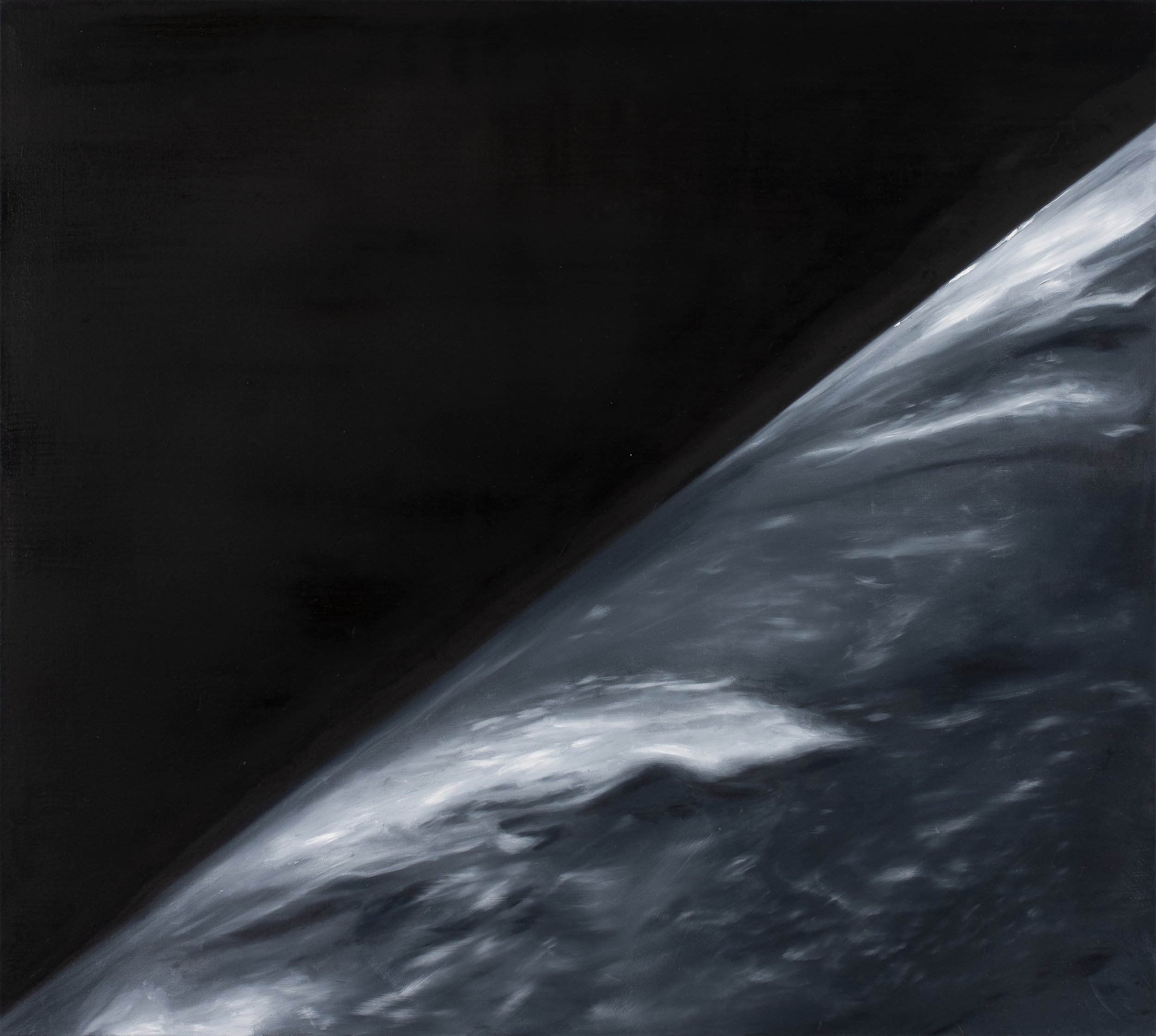
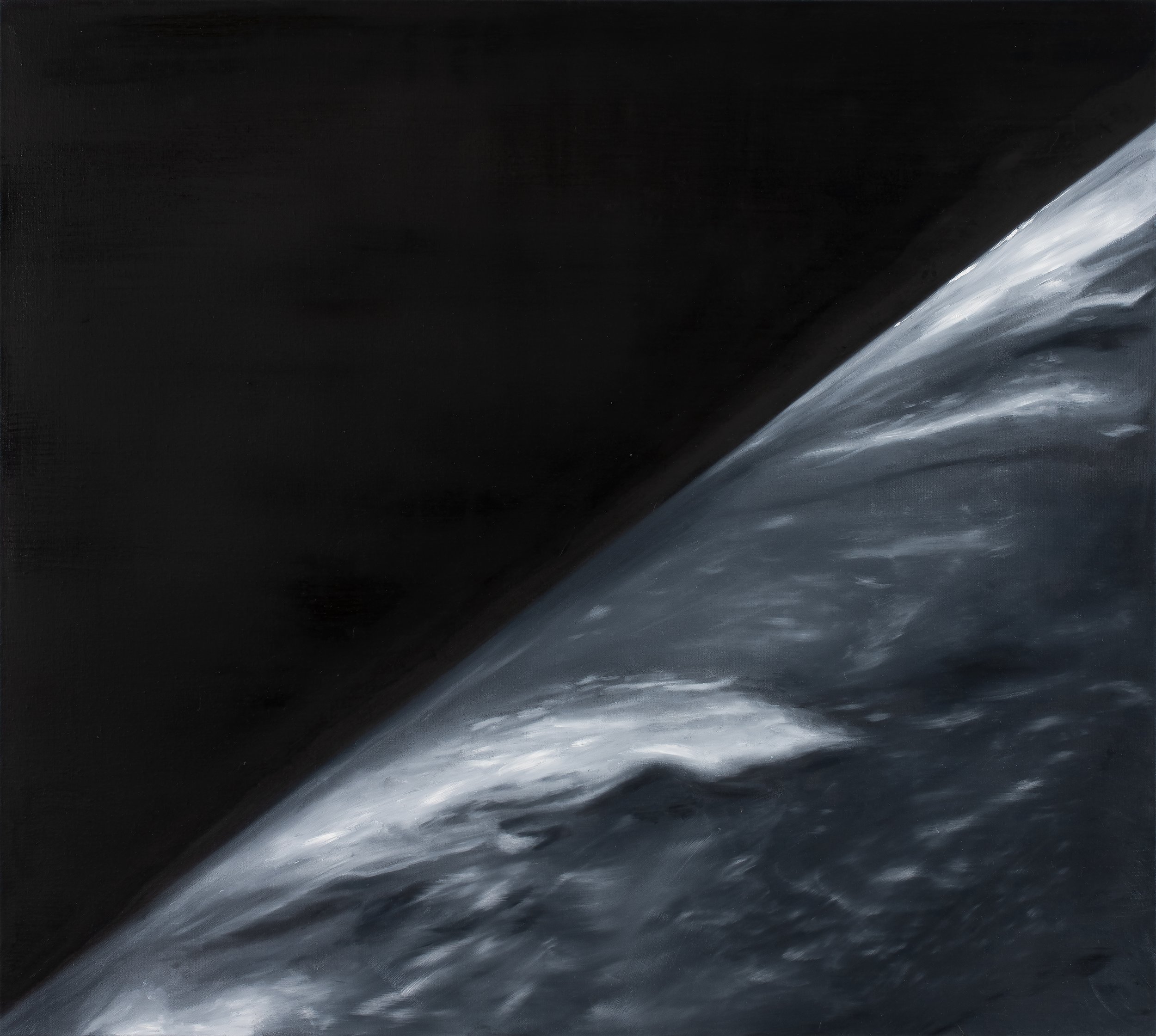
Tan Mu's 2021 painting Peek recreates this image in oil on linen, translating the grainy, high-contrast black-and-white photograph into a painted surface that holds both the specific technical character of the original and the emotional weight of the event it records. The painting is not a photorealistic reproduction. It is an interpretation, made in a slow medium, of a fast event that happened almost eighty years ago. Tan Mu has described Peek as the genesis of her Horizon series, the first work in which she fully committed to the satellite perspective as a subject and a visual strategy, and the painting's significance is not merely commemorative. It is an argument about what the first space photograph did to human self-understanding, and about what it means to paint that argument in a medium that takes months rather than the 1.5 seconds that elapsed between each exposure the V-2 camera made during its ascent.
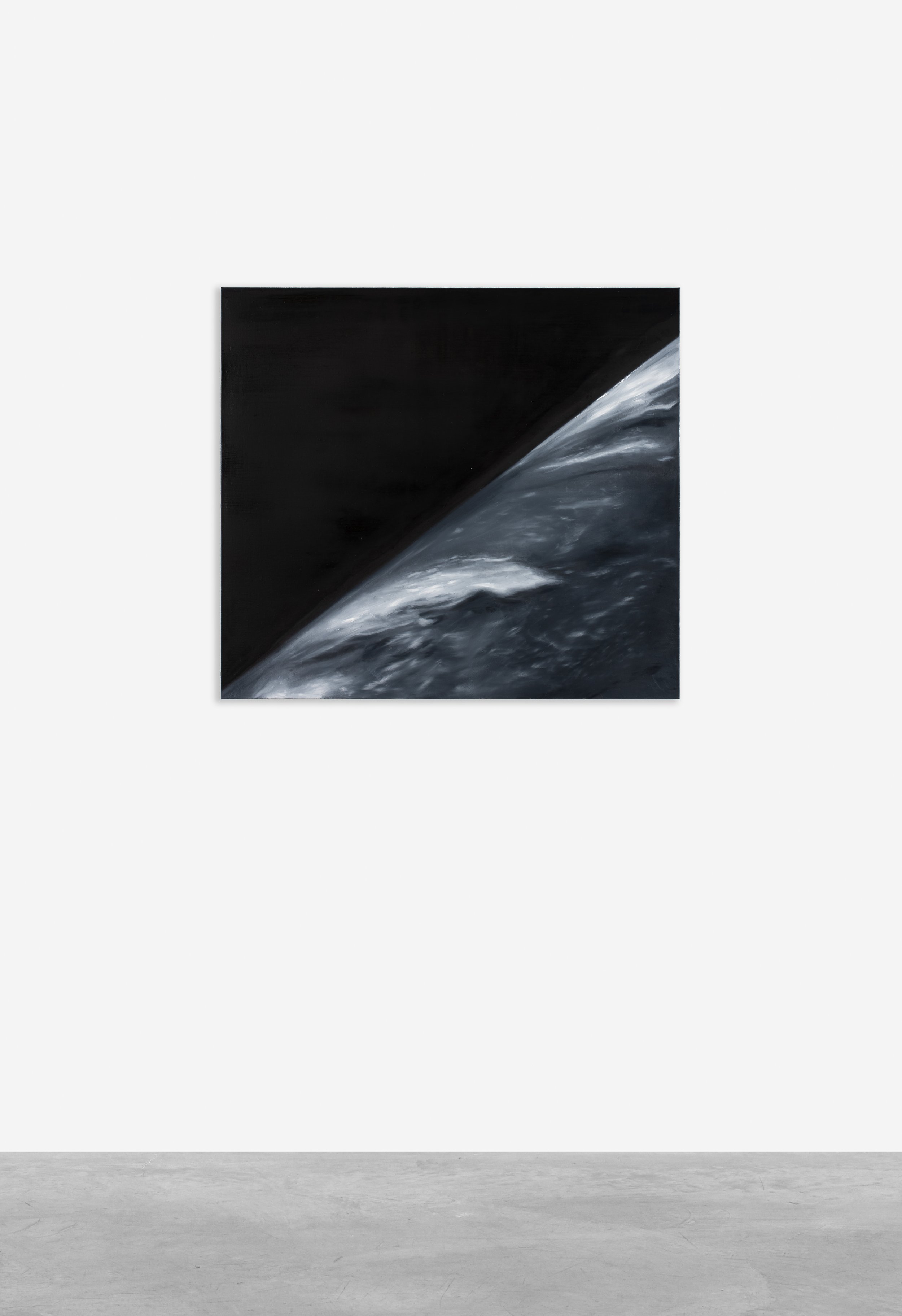
Peek measures 91 by 102 centimeters on linen, a scale that positions the earth as a significant presence against the void of the painting's margins rather than as a small disc caught at the edge of a frame. The canvas is large enough for the viewer to feel the curvature of the planet as a compositional force, the way the arc of the earth organizes the upper edge of the composition and creates a tension between the spherical form of the planet and the rectangular flatness of the canvas edge. The paint is applied in thin, layered glazes that build up the tonal range from the deep black of space through the pale, hazy whites of the atmosphere to the mid-gray-brown of the planetary surface. This build-up of translucent layers is the technical means by which Tan Mu achieves the painting's characteristic quality of atmospheric haze, the sense that the surface of the earth in the image is seen through a thickness of air that softens and flattens the geological detail beneath.
The grain structure of the original photograph, produced by the silver halide crystal matrix of the photographic emulsion, is visible in the painting as a painterly texture that functions differently from the photographic original. In the photograph, the grain is an artifact of the chemical process that recorded the image. In the painting, the grain becomes a deliberate surface quality, a record of the artist's decision about how to represent the photographic source material. Tan Mu has described being drawn to the grain as a quality that connects the image to its material origins, that prevents the image from becoming a smooth, frictionless digital reproduction of what the camera saw. The grain in the painting is the painting's way of saying: this image was made in a specific technical process, by a specific camera, on a specific piece of film, and the grain is the evidence of that process.
The history of early aerial photography as an instrument of military reconnaissance and scientific investigation runs through the entire twentieth century before arriving at the V-2 rocket photographs of 1946. In the First World War, reconnaissance aircraft photographed enemy positions from altitudes that were dangerous to reach but modest by later standards, and the interpretation of these photographs became a critical military skill that required training in the identification of artillery positions, supply routes, and troop concentrations from patterns that were invisible to the unaided eye on the ground. The photograph from altitude was not simply a record of what existed. It was a transformation of what was visible, a way of making legible patterns that were invisible from inside the territory they described. The aerial photograph was, from its earliest use, an instrument of power, a way of knowing territory that belonged to someone else and of using that knowledge to control or destroy what was known.
The V-2 rocket photograph of 1946 transformed this instrumental relationship between altitude and knowledge by removing the human observer entirely from the process. The camera operated without a human operator inside it, triggered by timing mechanisms, recording images at intervals of 1.5 seconds throughout the rocket's ascent and descent. No human being saw the earth from sixty-five miles altitude before the camera did. The camera saw first, and the human beings who recovered the film and developed it were the first human witnesses to what the camera had seen. This inversion of the relationship between human sight and machine sight is one of the central facts of the history of perception in the twentieth century, and it is the fact that Tan Mu's painting is most directly engaged with. The painting shows what the camera saw, but it is made by a human hand responding to what the camera saw, and this double displacement, from the human eye to the camera and from the camera to the brush, is what gives the painting its conceptual complexity. It is not merely a painting of the earth from space. It is a painting of what the non-human saw before the human could see, translated into a medium that only a human could make.
The V-2 rocket that carried the camera to altitude was a German weapon of the Second World War, repurposed after the war by the United States Army as a research vehicle for the upper atmosphere and space. The technology that produced the first photograph of the earth from space was a weapon that had been designed to deliver explosives across the English Channel, and its transformation from instrument of destruction to instrument of cosmological self-discovery is one of the more remarkable reversals in the history of technology. The same rocket motor, the same gyroscopic guidance system, the same pressurized fuel tanks that had been designed to carry a warhead to a target in London were used to carry a camera to the edge of space and return it safely to earth with photographs of the planet that the rocket had been designed to help destroy. This history is not incidental to the meaning of Peek. Tan Mu has described technology as an extension of the human body, and the extension of the human eye into space via a German rocket is a specific instance of this general principle that carries within it the full weight of the historical circumstances from which it emerged.
The V-2 itself, the Aggregat-4 rocket designed by Wernher von Braun and his team at Peenemunde, represented a convergence of several technical traditions that had been developing separately: liquid-fuel rocket technology from the experimental work of Robert Goddard in the United States and Hermann Oberth in Germany, military metallurgy capable of producing thin-walled, high-pressure fuel tanks, and the navigational and guidance systems required to deliver a vehicle accurately over long distances. The V-2 was the first rocket to reach space, crossing the Karman line at 100 kilometers altitude during its test flights in 1944, and it was also the first rocket to produce a photograph from space in 1946. This double achievement, the weapon that became the space vehicle, is the specific historical irony that Tan Mu's painting inherits without explicitly stating. The paint surface holds the grain of the film and the curve of the earth and the void of space, and the historical weight of the weapon system is embedded in the canvas as a structural fact about how the image came to exist.
The camera that produced the 1946 space photograph was a modified 35mm film camera, the same format used in millions of civilian photography applications, mounted in the rocket's nose cone with a motor drive that advanced the film at intervals of 1.5 seconds throughout the flight. The lens had a wide-angle focal length to capture the maximum possible field of view from the limited altitude of the suborbital trajectory, and the film stock was a standard black-and-white emulsion sensitive to the visible spectrum. The resulting images had a resolution that was determined by the grain of the film and the optical quality of the lens, both parameters that were adequate for the scientific purpose of the photographs but far below what contemporary satellite imaging systems achieve. The grain of the 1946 images, which Tan Mu renders in paint as a surface texture across the entire composition, is not a deficiency to be corrected. It is the technical signature of the specific medium that made the first space photograph possible, and the painting's decision to preserve this signature is a decision about what kind of record the painting is making: not a record of the planet as it would appear to a perfect observer, but a record of the planet as it appeared to this specific camera, on this specific piece of film, at this specific historical moment.
Anselm Kiefer has spent his career addressing the German historical catastrophe in paintings that use materials of extreme physical weight, lead and straw and shellac and gold leaf, to create surfaces that are themselves records of destruction, decay, and the persistence of what was supposed to have been erased. His works on the Alchemy series, from the 1970s and 1980s, treat the alchemical texts of Heinrich Cornelius Agrippa and the Rosicrucians as sources for images that combine the language of mystical transformation with the specific weight of German postwar historical consciousness. Kiefer is not interested in alchemy as a historical curiosity. He is interested in it as a system of knowledge that collapsed under the pressure of scientific rationality and that retained, even in its collapse, a form of longing for a relationship between material transformation and spiritual development that the modern world specifically abandoned. His use of lead, a material associated in alchemy with Saturn and with the possibility of transmutation, is a deliberate invocation of this collapsed system of knowledge, a way of placing the weight of the alchemical tradition in the same visual field as the weight of German history.
Tan Mu's use of antimony and other elemental subjects in her practice operates through a different but related logic of material history. Where Kiefer invokes the weight of lead to connect alchemy to German catastrophe, Tan Mu invokes specific chemical elements to connect the ancient history of alchemical inquiry to the contemporary history of technological mediation. The V-2 rocket in Peek is both a weapon and a camera carrier, and the photograph it produced is both a military record and a cosmological self-portrait of the species as a technological being capable of seeing itself from outside its own environment. The painting does not resolve this doubleness into a single meaning. It holds it, in the way the earth itself holds all of the histories that have occurred on its surface simultaneously: the geological, the biological, the human, the technological, all present in the same spherical form, all visible from sixty-five miles altitude as a tonal field without legible boundaries.
Nick Koenigsknecht, writing on Tan Mu's practice in publications accompanying recent exhibitions, has addressed the question of what he calls "the satellite perspective" as a recurring concern across her work. Koenigsknecht observes that the view from altitude, from the distance at which the entire planet becomes visible in a single frame, is not a natural perspective but a specifically technological one, produced by instruments that were designed to see at this distance and that organize what they see according to their own technical parameters. The satellite image does not show the planet as it appears to a disembodied observer. It shows the planet as it appears to a camera with a specific focal length, a specific resolution, a specific spectral sensitivity, mounted on a specific vehicle moving at a specific velocity in a specific orbit. The image is not a window onto the planet. It is a reconstruction of the planet from data collected by instruments that are themselves products of the planet's technological culture. When we look at a satellite image, we are looking at the planet through equipment that the planet built, at an image that the planet's own intelligence constructed from its own remote sensors.
Koenigsknecht's framework extends to what he has described as the problem of planetary scale for human consciousness. The planet's circumference is approximately forty thousand kilometers, and the time it takes light to travel around the planet's equator is approximately 0.133 seconds. Any information about the state of the planet at a given moment arrives at the observer with a delay determined by the distance it has traveled, and the observation of the planet as a whole is always an observation of its past state, never of its present. The satellite image of the earth, in Koenigsknecht's reading of it, is always a historical document, a record of what the planet looked like at a specific moment in the past, the latency of the image determined by the distance between the satellite and the surface it observes. This latency is invisible in the finished image. The viewer sees the planet and does not think about the time that light took to travel from the surface to the sensor. But the latency is structurally present, and Tan Mu's paintings of satellite imagery are, in this reading, paintings of temporal dislocation: records of a planet's appearance at a specific historical moment, filtered through a technological system that introduces its own delays and distortions into the image.
Koenigsknecht's observation is relevant to Peek in a specific way: the painting is not simply showing the earth from space. It is showing what the first camera that reached space recorded, and this record is already a technological mediation, already a reconstruction rather than a direct view. Tan Mu's recreation of this specific image, rather than a generic satellite view of the earth, is a choice to engage with the technological mediation of the first image rather than to pretend that the painting is offering a direct encounter with the planetary form. The V-2 camera recorded what it could see given its specific film stock, its specific optics, its specific altitude and trajectory. The painting shows what that specific technical configuration produced, and the grain and haze and tonal limitation of the original photograph are not obstacles to a more perfect representation of the earth from space. They are the representation. They are what the first space photograph looked like, and the painting preserves this specific historical appearance in a medium that will outlast the film emulsion and the rocket technology that produced the original.
Tan Mu has described the shift from ground-level perception to planetary consciousness as the central experiential transformation that the space photograph produced, and Peek is an investigation of what it means to undergo this transformation through the record of the first time it happened rather than through contemporary satellite imagery that has become so familiar that it no longer produces wonder. The 1946 photograph is remarkable precisely because it is primitive, because the grain and the limited resolution and the uncertain tonal range of the image are visible evidence of the difficulty of what was achieved. A contemporary viewer, accustomed to the high-resolution satellite imagery available on any mapping application, might look at the 1946 photograph and see only its technical inadequacy. Tan Mu, looking at the same image, sees the moment when the transformation began, the first time human technology produced a record of the planetary form that the human species would eventually learn to see as a daily visual experience through the mediation of GPS satellites, weather monitoring systems, and planetary observation networks. The painting holds this historical depth in the same way the crystal holds the record of the supernova: as a temporal fact embedded in the material of the image itself.