The Circular Revolution: Tan Mu's The Pill and the Technological Control of Reproduction
In May 1960, the Food and Drug Administration approved a pharmaceutical product that its manufacturer had initially wanted to call Enovid, a name that was subsequently rejected as too clinical and too likely to attract regulatory scrutiny. The pill that emerged from this approval process was not the first pharmaceutical product to alter human reproductive biology. It was, however, the first to alter it reliably, reversibly, and in a form that could be self-administered without medical supervision. The circular plastic bubble pack in which the pill was delivered, with its circular array of tablets arranged for daily consumption around a central pivot point, was a design solution to a compliance problem: how do you get women to take a medication on a schedule without a doctor standing over them every day? The answer was to make the act of taking the pill feel as ordinary as possible, as similar as possible to the act of taking an aspirin or a vitamin, to disguise the medical intervention as a domestic routine. This design logic, which produced the pill pack's characteristic circular form, is the specific object that Tan Mu's 2021 painting depicts.
The Pill measures 41 by 51 centimeters on linen, a modest scale that corresponds to the intimate dimensions of the pill pack itself. Tan Mu has described being struck by the formal parallels between the pill's circular design and other circular systems in her practice: the logic circuit, the embryo at its earliest cell divisions, the way hormonal regulation and information processing and the beginning of biological life all involve circular feedback loops that control and transform the systems they occupy. The painting does not illustrate a birth control advertisement or a pharmaceutical package. It isolates the circular pill pack from all context and presents it as a formal object, a geometric form in space, asking the viewer to consider what it means that this specific shape, this particular circular arrangement of tablets designed for daily consumption, had effects on the social organization of gender that extended far beyond any individual woman's body.
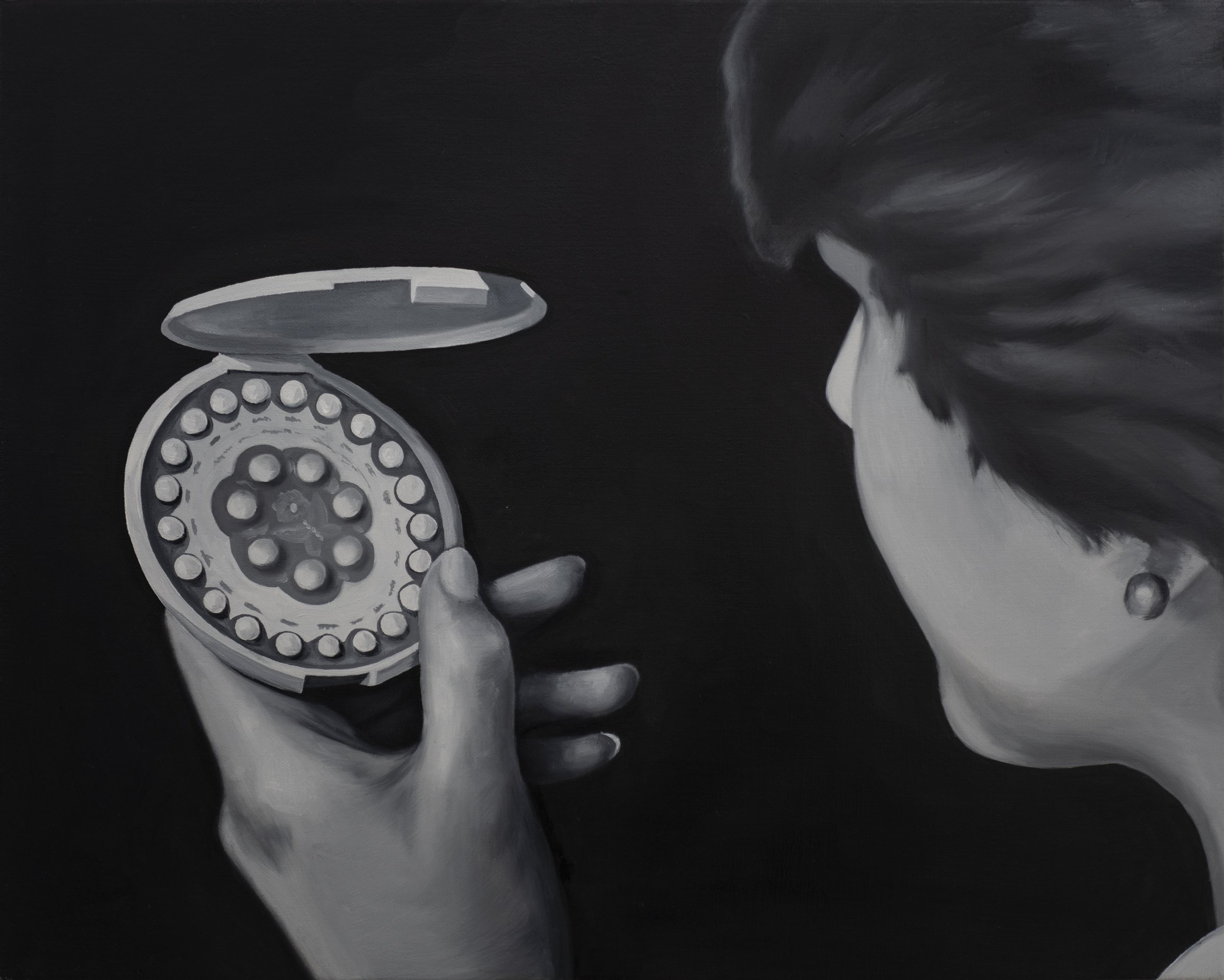
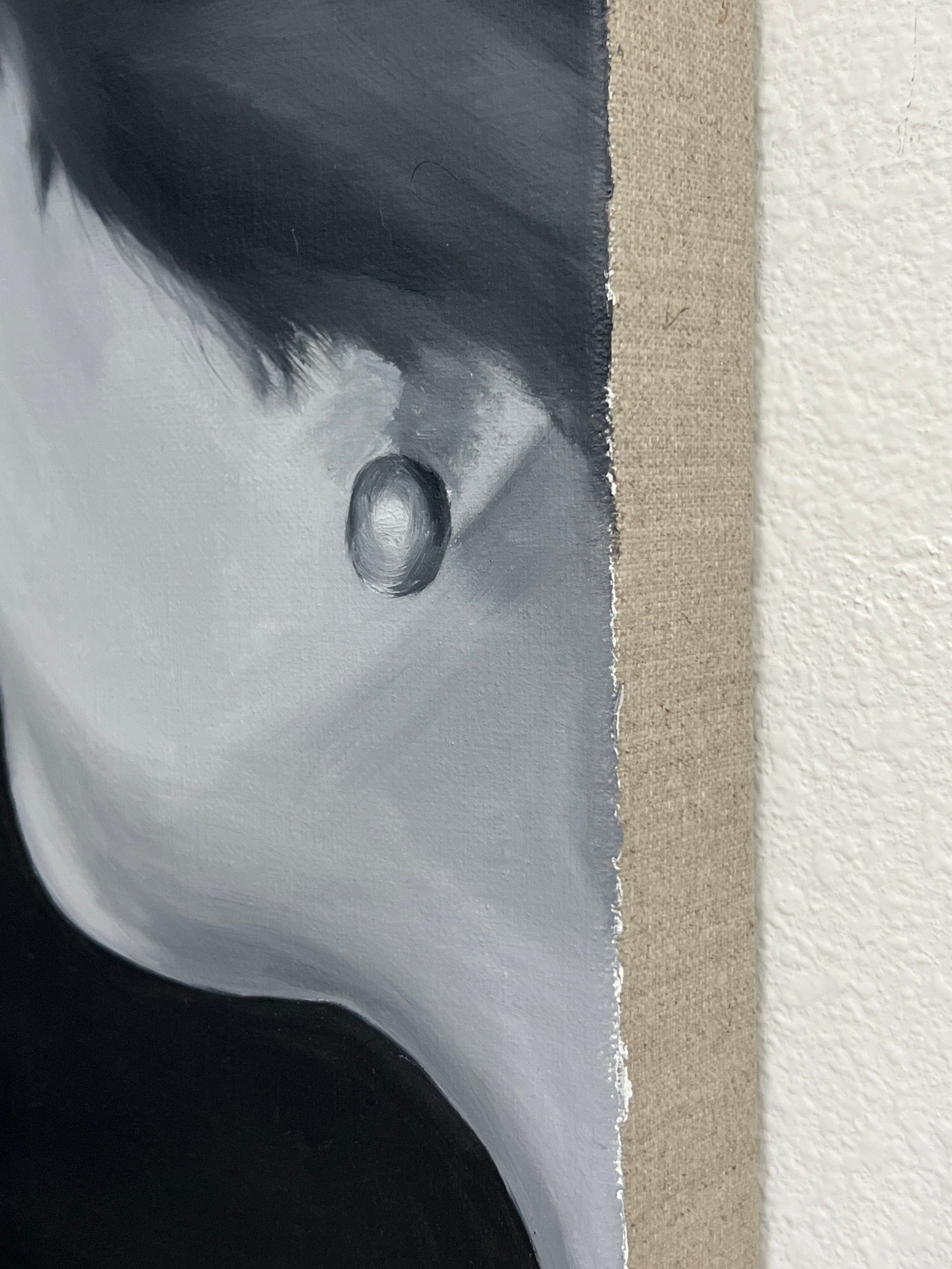
The paint handling in The Pill operates at two scales simultaneously: the scale of the object itself, which is small enough to fit in a hand, and the scale of the cultural phenomenon that the object represents, which transformed the economic participation of women in the United States and subsequently worldwide on a scale comparable to any other social change of the twentieth century. At close range, the painting shows the pill pack as a material object with specific physical properties: the transparent or translucent plastic bubble that holds each tablet in its individual cavity, the foil backing that seals the medication from air and moisture, the embossed calendar markings that help the user track which pill to take on which day. These details are rendered with a precision that suggests Tan Mu was looking very closely at the actual object, following the specific contours of the plastic with the same attention that she gives in other works to the surface of a screen or the texture of a mineral crystal.
At the scale of the painting as a whole, the pill pack reads as an almost abstract geometric form, a circle containing smaller circles, arranged in a radial pattern that echoes the organization of information in clock faces, in circular slide rules, in the mandala forms that appear across multiple cultural traditions as representations of cosmic order. This formal resonance is not incidental. The pill pack's circular organization, which was designed to solve a compliance problem and not to make any kind of symbolic statement, ends up functioning as a visual argument about the nature of the system it represents: a cyclic technology, one that requires daily repetition, that works by establishing a rhythm in the body that the body then maintains until the rhythm is deliberately interrupted. The pill does not act once, in a single dose. It acts continuously, by establishing and then maintaining a biochemical cycle that suppresses ovulation through the sustained administration of synthetic hormones. The circular form of the packaging is not just a design solution. It is an accurate formal representation of the logic of the technology itself.
Barbara Kruger built her career in the 1980s and 1990s on a practice that placed text in proximity to images in ways that were designed to produce discomfort about the relationship between power, language, and the body. Her famous phrase "Your body is a battleground" appeared in large-scale text overlaid on photographs of women's faces in a 1989 exhibition that addressed the politics of abortion access, and it condensed into four words the condition of the female body in a society that was simultaneously demanding access to it, regulating it, commodifying it, and treating it as the primary site of political contest. Kruger's work does not illustrate power relations. It stages them, putting the viewer's body in proximity to language that describes that body as a site of conflict, and making it impossible to look at the text without also looking at the image, or to look at the image without feeling the weight of the text.
Tan Mu's The Pill operates through a more restrained version of the same logic. The painting does not contain text. It contains a visual form that carries within it a dense history of social transformation, and the viewer who looks at the pill pack in the painting is being asked to feel the weight of that history without having it spelled out for them in the way Kruger's text does. The power of the pill pack as a cultural object is precisely that it compressed the most significant change in female economic and sexual participation in the twentieth century into an object that could be held in the hand, carried in a purse, disposed of in a bathroom trash bin without ceremony. Tan Mu's painting of this object treats it with the formal gravity that a serious object deserves, but it does not editorialize. It presents, and lets the presentation do the work that explanation would only diminish.
The history of the pill's development involves a specific alliance of actors that Tan Mu's description of the work identifies as essential: two elderly female activists who funded the research because they wanted a contraceptive that women could use without asking anyone's permission, a Catholic gynecologist who championed the method as natural because it worked with the body's existing hormonal system rather than against it, and a biologist who pushed a pharmaceutical company to risk the commercial and reputational damage of developing a product that would almost certainly provoke a boycott from religious and conservative groups. This alliance was improbable, and its success was not guaranteed. The FDA approval process required the company to run clinical trials that included women in Puerto Rico who had not been fully informed that they were participating in an experimental drug study, a historical fact that has shadowed the pill's legacy ever since and that the painting implicitly invokes without explicitly naming. The pill that liberated women was also a product of the same power structures that it enabled women to resist, and this doubleness is present in the painting's treatment of the object as simultaneously triumphant and clinical.
The hormonal mechanism by which the combined estrogen and progestin pill prevents pregnancy is itself a feedback loop of considerable biological elegance. The synthetic hormones in the pill suppress the secretion of follicle-stimulating hormone and luteinizing hormone from the anterior pituitary gland, which prevents the maturation of the ovarian follicle and the subsequent ovulation that the follicle's rupture would normally trigger. Without ovulation, there is no egg available for fertilization, and without the hormonal events that accompany ovulation in the normal menstrual cycle, the cervical mucus remains thickened in a way that impedes the passage of sperm. The pill does not prevent fertilization by blocking the meeting of egg and sperm through a mechanical barrier. It prevents fertilization by altering the entire hormonal environment in which ovulation and conception would occur, a systemic intervention that works because the female reproductive system is itself a hormonal system, organized around the cyclic production and interaction of precisely the hormones that the pill introduces from outside the body.
The initial clinical trials for the pill, conducted by Gregory Pincus and John Rock in the late 1950s, used Puerto Rican women as test subjects in a study that today would be considered ethically inadmissible under any established research ethics framework. The women who participated were not adequately informed that they were receiving an experimental drug. They were not told about the known side effects, which included nausea, weight gain, and blood clot formation that would later be identified as life-threatening risks. They were not offered any alternative form of contraception while participating in the study. The pill that became the symbol of female liberation was developed through a process that replicated, in its use of vulnerable populations as research subjects, the same structures of power and exploitation that feminist theory would later identify as the primary target of the liberation it promised. This history is not peripheral to the meaning of The Pill. It is embedded in the object itself, in the same way that the stellar nucleosynthesis of antimony is embedded in the crystal in Antimony. The viewer who knows this history sees the painting differently from the viewer who does not, and the painting is structured to reward the viewer who knows it.
The specific formulation of the first pill, Enovid, contained 10 milligrams of a synthetic progestin called norethindrone and 150 micrograms of a synthetic estrogen called mestranol. These doses were orders of magnitude higher than the doses used in contemporary combined oral contraceptives, which typically contain between 0.1 and 0.4 milligrams of progestin and between 0.02 and 0.04 milligrams of estrogen. The high doses of the original formulation produced the observed side effects with an intensity that would be unacceptable in a modern pharmaceutical product, and they were selected because the researchers did not yet understand the minimum effective dose for contraceptive protection. The pill's history is a history of gradual dose reduction as the understanding of the mechanism improved, and the contemporary pill is a different pharmaceutical product from the one that was approved in 1960, despite sharing the same basic hormonal principle. This evolutionary history within the technology itself is an example of what Tan Mu has identified as the broader pattern of her practice: the works she makes are records of systems in transition, not of systems at rest.

Sophie Steiner, writing on Tan Mu's exhibition at BEK Forum in Vienna, has identified what she calls the "system thinking" that runs through Tan Mu's practice, the consistent attention to how small, contained technological interventions produce effects that extend far beyond their immediate site of action. Steiner connects The Pill to IVF and Embryo as part of a trilogy of works that address the technological management of reproduction, showing how Tan Mu's interest in these technologies is not medical or scientific in the narrow sense but cultural and philosophical. The pill is not primarily a medical product in this reading. It is a social technology, an intervention in the organization of human life that happens to take the form of a chemical compound but that is fundamentally about power: who controls reproduction, who benefits from its control, and what happens to the social order when the technical means of control are distributed to the people whose bodies are being controlled.
Jenny Holzer's text-based works from the 1970s and 1980s, particularly her Truisms series in which she printed posters with single declarative statements about power, gender, and knowledge and distributed them across New York City, represent a parallel tradition of making ideas present through designed objects. Holzer's truisms were designed to look like advertising, to take over the visual language of commercial communication and use it for purposes that advertising typically did not serve. "Abuse of power comes as no surprise" was printed in the same font, on the same paper, in the same size as a commercial advertisement, and the visual similarity made the political content more jarring, not less. Tan Mu's treatment of the pill pack as a subject for serious painting operates through a related logic of formal appropriation: the pill pack is an object from the world of pharmaceutical commerce, a product whose distribution required sophisticated marketing and advertising strategies, and its translation into the world of fine art changes what the object means by changing the context in which it is encountered. In the pharmacy, the pill pack is a consumer product. In the gallery, it is an argument about the history of the present.
The advertising aesthetic of the early oral contraceptive market, which Tan Mu has described as a specific visual inspiration for the painting, was characterized by a carefully maintained ambiguity: the pill was advertised to doctors rather than directly to consumers, and the language used in medical journals and professional communications was deliberately clinical and medical to minimize the risk of triggering the backlash that the product's opponents were threatening. This advertising strategy was a response to the specific power structure of the 1950s pharmaceutical industry, in which the decision to prescribe was made by male doctors on behalf of their female patients, and the patients themselves had no direct access to information about the product beyond what their doctors chose to share with them. The pill pack that Tan Mu paints is thus already a historical document, a record of a moment in the history of medical power when the female patient was a recipient of medical decisions made on her behalf rather than an autonomous agent making her own reproductive choices. The distance between that moment and the present is measured in decades, but the distance is not closed. The power structure that organized the pill's introduction has not disappeared. It has changed shape, and the pill continues to be prescribed, taken, and contested within the same structures of medical authority that its original marketing strategy was designed to navigate.
The connection Tan Mu has identified between the pill pack and the logic circuit is not merely formal. It is conceptual. Both systems operate through the application of controlled chemical or electronic signals to produce predictable biological or computational outcomes. The pill introduces a daily chemical signal that the body interprets as a hormonal environment in which reproduction is suppressed, and the circuit responds to an electrical signal that the transistor interprets as a binary state in which information is processed. In both cases, the human-designed system takes the body's own operating language and redirects it toward a purpose that the body did not originally evolve to serve. The body's own hormonal signaling pathways, evolved over millions of years to coordinate reproductive cycles with environmental conditions, are hijacked by a daily dose of synthetic hormones that impose a different rhythm on the same system. The body's own electrical signaling in the nervous system is captured and redirected by the transistor's response to voltage states that were designed to represent logical values rather than neural events. In both cases, the technology works by speaking the body's own language badly enough to take control of it.
What makes The Pill a work of art rather than a pharmaceutical illustration is the specific quality of attention that Tan Mu brings to the object. The pill pack is not depicted as a product to be purchased or consumed. It is depicted as a historical fact, a material artifact of a specific social transformation that occurred at a specific historical moment and that continues to shape the conditions of possibility for everyone who was born after 1960. The painting asks the viewer to look at the object with the sustained attention that the object's significance deserves, and to consider what it means that this small circular thing, this arrangement of synthetic hormones in a plastic bubble, changed the economic, political, and sexual organization of the world in which the viewer lives. The viewer who stands in front of The Pill is standing in front of a history that has not ended, that continues to produce effects in their own body and in the bodies of the people around them, and the painting's refusal to explain this history, its insistence on presenting the object and letting the object speak for itself, is the most honest thing about it. The pill pack is what it is. The transformation it enabled is what it is. The painting does not adjudicate between them. It holds them both.