When the System Shows Its Workings: Tan Mu's The Glitch and the Aesthetics of Infrastructure Failure
On a Tuesday morning in June 2021, a routine software update at a major cloud services provider triggered a cascade of failures that grounded flights across the United States, disrupted hospital scheduling systems, and brought checkout terminals at grocery stores to a halt for several hours. The update was routine. It had been applied thousands of times before. The failure was not caused by a novel attack or a catastrophic hardware event. It was caused by a specific interaction between two configuration settings that had not been anticipated by the engineering team, and the consequence of this unanticipated interaction was the temporary collapse of infrastructure that millions of people depended on every day without thinking about it. The glitch was, in this sense, a revelation: a brief moment when the infrastructure that everyone had learned to treat as natural, as permanent, as simply there, revealed itself as a made thing, a contingent thing, a thing that could fail and that had failed and that was being repaired right now by people whose names no one knew.
Tan Mu's 2022 painting The Glitch takes this condition of brief revelation as its subject, and the painting does not depict the specific failure event so much as it depicts the visual language that the failure produced. Glitch aesthetics are not designed. They are the visual residue of systems operating incorrectly, the evidence that the normal smooth functioning of a digital system has been interrupted and replaced by something else. The color displacement, the fragmented forms, the layered textures that characterize The Glitch are not decorative choices. They are the specific visual output of a signal that has been disrupted and that has not yet been corrected, and the painting's task is to make this disruption visible as a subject in its own right rather than as a failure of some other intended image.
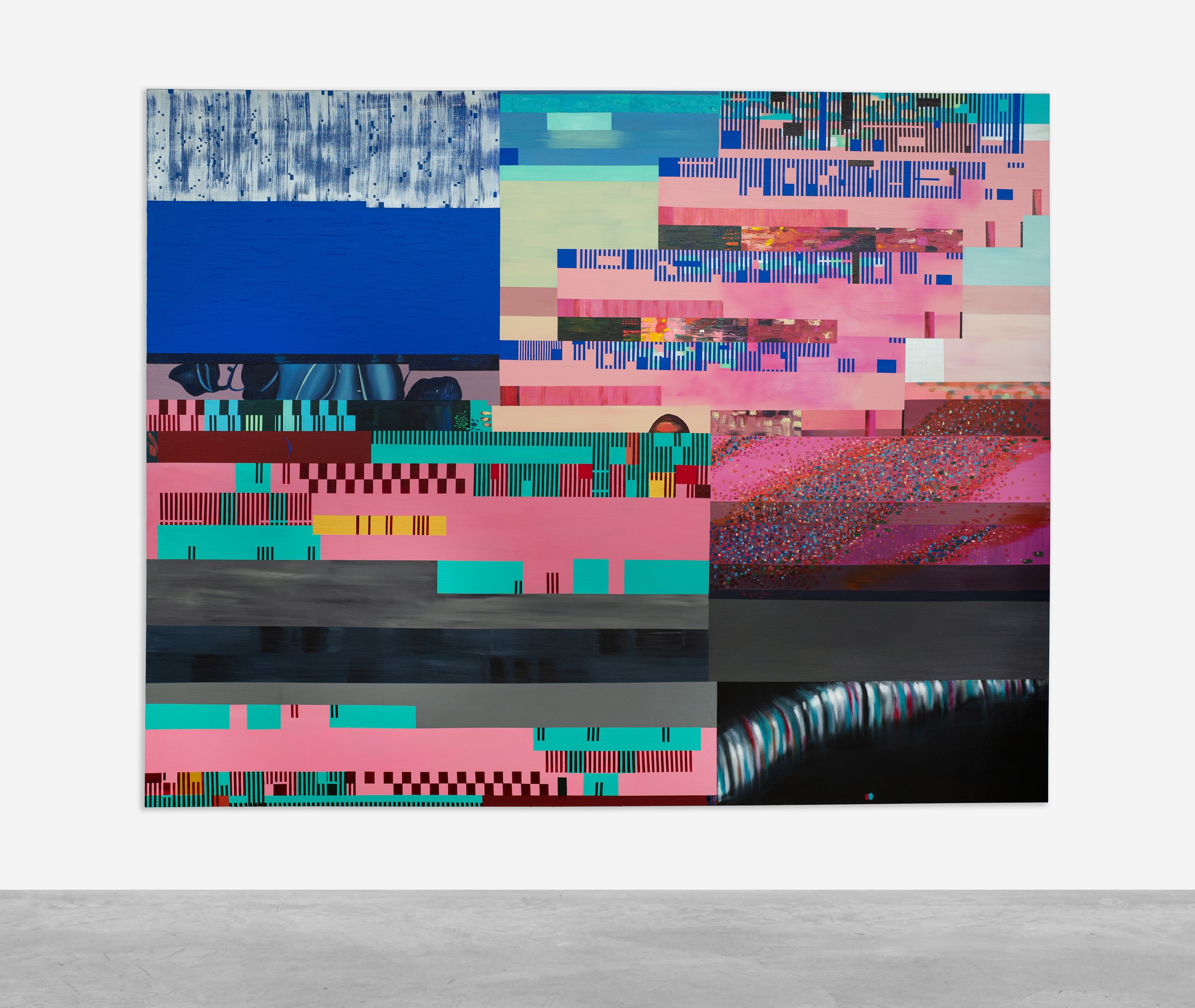
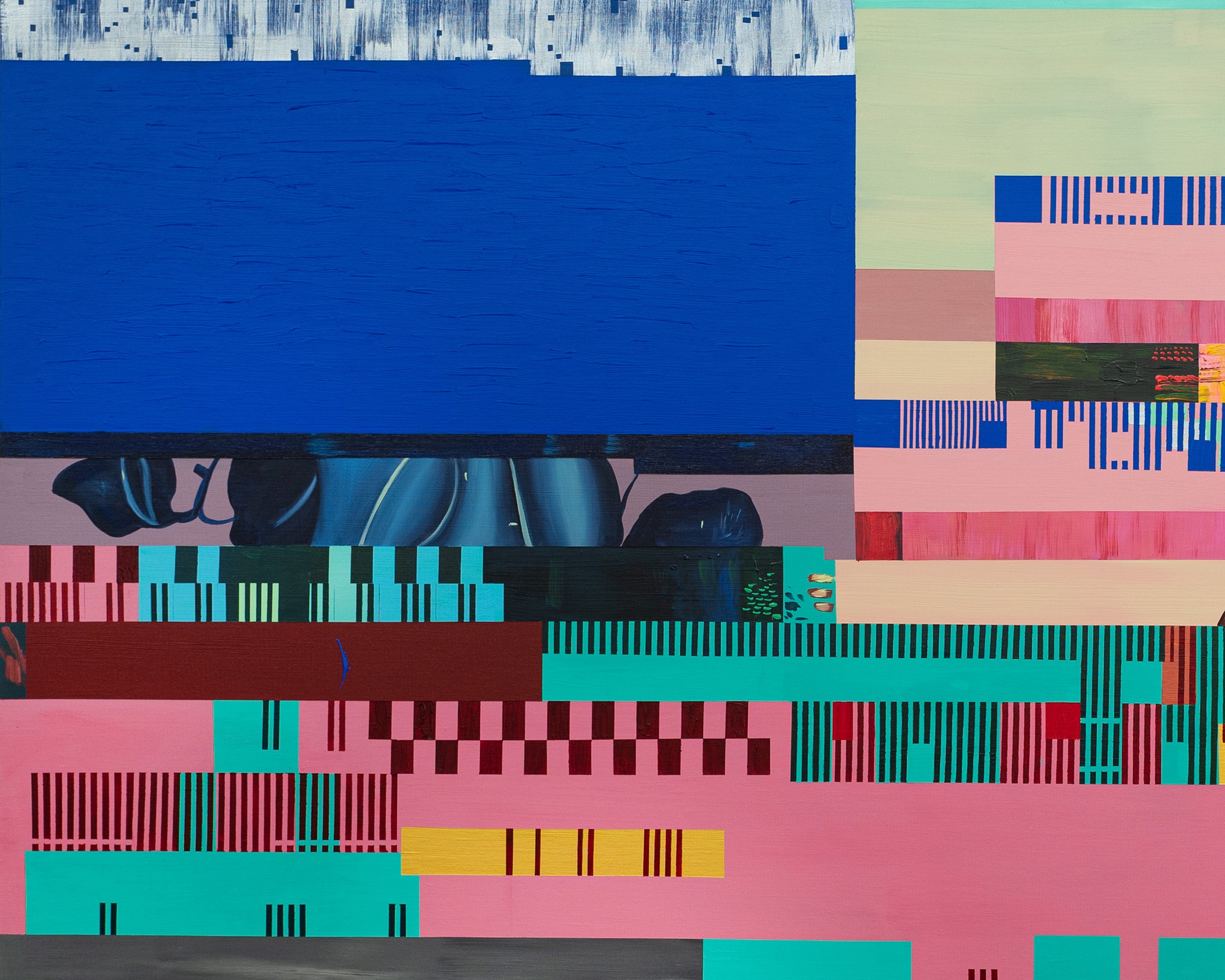
The Glitch measures 193 by 244 centimeters on linen, a large-format canvas that positions the viewer in front of the painting as if in front of a screen that has malfunctioned. The scale is significant. Tan Mu has described working with signal control devices and intentionally altering screen outputs during her time in the Expanded Media Studio Art program at Alfred University, producing abstract distortions through the manipulation of signal processing parameters. The large scale of the painting extends this studio practice into the register of the monumental, transforming the intimate experience of watching a screen malfunction into a painting that asks the viewer to confront the glitch as a significant visual phenomenon rather than a transient annoyance. The scale also corresponds to the scale of the infrastructure that the painting addresses: the systems that the painting represents are large, and the disruption of large systems produces large effects, and the painting makes these large effects present in a space where the viewer can look at them with sustained attention.
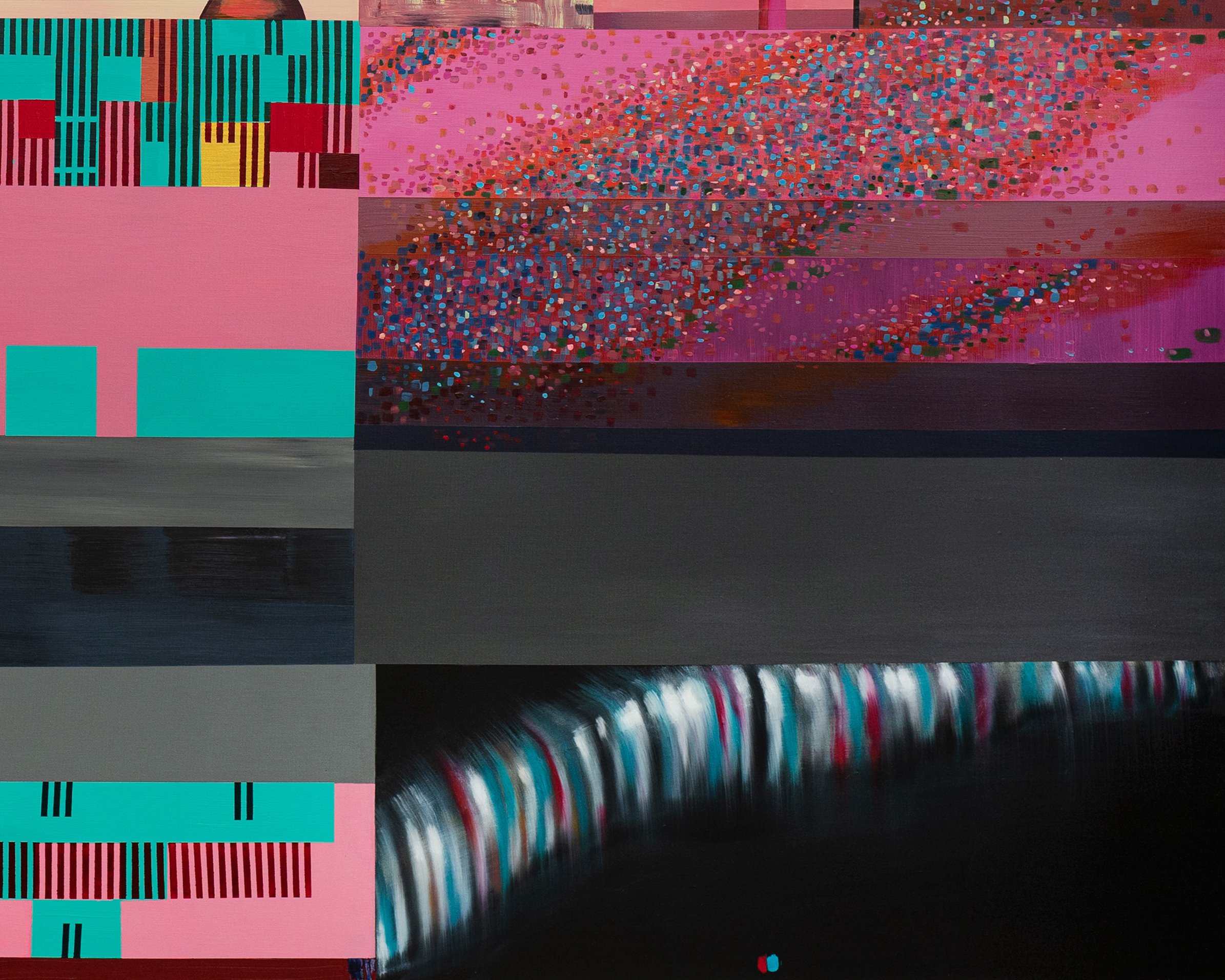
The materials of the painting, oil and acrylic on linen, reflect Tan Mu's developing interest in combining different paint media to achieve specific surface effects. The oil passages provide the depth and tonal complexity that characterize her approach to the painted surface, while the acrylic passages provide a flatness and a boldness of color that connects the painting to the digital aesthetic it is investigating. The acrylic reads as the screen content, the digital signal, while the oil reads as the ground, the infrastructure beneath the surface. This material division is not absolute, and the two media interact at the edges of the painted forms in ways that produce the same kind of visual interference that the glitch itself produces: zones where the two materials overlap and neither is clearly dominant, where the eye cannot quite decide which system is operating at this point in the image.
Sigmar Polke developed a practice in the 1960s and 1970s that treated the photographic image and its failures as a subject for painting, using low-quality printing techniques, dot-screen patterns, and the deliberate incorporation of printing errors into works that challenged the authority of the photographic record as a transparent representation of reality. His works from the Hoppmann collection and the Berlin exhibition in the late 1960s used the visual artifacts of commercial printing, the dot-matrix screen patterns of halftone reproduction, as formal elements in compositions that refused to distinguish between the intended image and the mechanical process that produced it. Polke was not interested in the image that the printing process was supposed to deliver. He was interested in the printing process itself as a producer of visual meaning, and the failures and artifacts of the process were, for him, the most interesting parts of the image.
Tan Mu's approach in The Glitch operates through a related but temporally extended logic. Where Polke was investigating the printing process as a site of visual meaning production in the age of mechanical reproduction, Tan Mu is investigating the digital signal processing chain as a site of visual meaning production in the age of networked computation. The glitch is not a printing error but a data transmission error, a corruption of the signal that occurs during encoding, transmission, or decoding, and its visual character is determined by the specific technical protocols that organize the data flow. Polke's dot-screen is the visual signature of the halftone printing process. Tan Mu's fragmented forms and color displacements are the visual signatures of specific failure modes in digital signal processing: the block artifacts produced by compressed video transmission, the color channel separation that occurs during incorrect decoding of a chroma-subsampled image, the macroblocking that results from packet loss in a compressed video stream. The painting is, in this sense, a technical diagram of a failure mode, rendered in paint with enough precision to allow the technically informed viewer to identify which specific failure the painting is representing.
The connection between signal disruption and critical infrastructure failure that Tan Mu has described as central to her conception of the Glitch series is not metaphorical. It is literal. Every major infrastructure system in the contemporary world operates on data networks that are vulnerable to signal disruption, and the cascade effects of a localized disruption can propagate across systems in ways that were not predicted by the original design. The grounded flights of June 2021 were not caused by a failure in the air traffic control system. They were caused by a failure in the software systems that airlines use to manage crew scheduling, which cascaded into a situation where there were no available crews to operate the scheduled flights. The hospital scheduling system failures were not caused by a failure in medical software. They were caused by a failure in the authentication systems that hospital staff use to access patient records, which cascaded into a situation where staff could not access the information they needed to schedule procedures. The glitch reveals the interdependence of the systems, and the interdependence is not visible when the systems are functioning normally. The specific technical failure that triggered the 2021 outage was a interaction between two configuration parameters in a content delivery network that had been operating correctly for years, and the failure only occurred because both parameters were set to specific values that had not previously occurred in combination. The rarity of the failure made it harder to diagnose, because the monitoring systems that had been designed to detect failures were not looking for this specific combination, and the failure therefore propagated further before it was detected than a more common failure mode would have.
Saul Appelbaum, writing in the BEK Forum catalog accompanying Tan Mu's 2025 Vienna exhibition, identified what he called "the pedagogy of failure" in Tan Mu's practice: the way her paintings of system failures, from The Glitch to No Signal to the earlier works in the Signal series, function as teaching devices that show the viewer something about how the systems they depend on actually work. Appelbaum observed that normal functioning hides the mechanisms of functioning. We use the electricity without understanding the grid. We use the network without understanding the protocols. We send messages without understanding the encoding. The failure removes the veil of transparency that normal functioning maintains, and the failure makes visible the structure that was always there but that was not available to observation. Tan Mu's paintings of failures are, in Appelbaum's reading, paintings that make the hidden structure accessible, that use the visual evidence of failure as a pedagogical instrument for teaching the viewer how the system works.
Tan Mu has described approaching glitches not as errors to be corrected but as moments where underlying systems briefly reveal themselves, and this description is central to understanding why The Glitch is a painting rather than a graphic design or a troubleshooting diagram. The glitch, in her framing, is not the absence of the intended image. It is the presence of something else, something that was always there but that the intended image was obscuring. The underlying system is always there, always operating, always determining what appears on the screen, but it is invisible in the normal mode of use. The glitch makes it visible, and the making-visible is the content of the painting. The fragmented forms and color displacements are not decorations. They are the system becoming visible, the infrastructure appearing in the field of representation. This pedagogical function of the glitch, which Appelbaum identified as central to Tan Mu's practice, operates through the same logic as a scientific experiment: the normal conditions of a system hide its mechanisms, and only by disrupting the normal conditions can the mechanisms be observed. The painting does not illustrate a theory about how digital systems work. It creates the conditions for the viewer to observe the system working, or rather to observe it failing, which is the only way the system can be seen from the outside.
Hito Steyerl, in her writings on the politics of the digital image, has argued that the poor image, the compressed and degraded digital image that circulates widely and carries within it the artifacts of its own production and transmission, is a political achievement rather than a failure condition. Steyerl's argument was specifically about video and photographic images, but it has a direct application to the glitch image. The glitch, in Steyerl's framework, would be the extreme case of the poor image: an image that has been so degraded by the conditions of its transmission that it has lost all claim to represent anything beyond the failure of its own transmission. The glitch image shows the viewer the conditions of its own making, which is to say it shows the viewer the network that produced it, the protocols that failed to handle it correctly, and the technical infrastructure that the image traversed before arriving, damaged, on the screen. Tan Mu's painting of the glitch is thus, in a Steyerlian sense, a painting about the conditions of existence of the digital image, about what it costs to produce and transmit images in the contemporary network environment, and about the fragility of the systems that we have built to handle the enormous volume of image traffic that the network carries every second. The specific compression algorithms that produce the artifact patterns visible in The Glitch are the same algorithms that govern the transmission of all digital video: MPEG-4 encoding produces characteristic macroblocking artifacts when packet loss occurs, and the block structures visible in the painting are specific technical records of this encoding process, translated into paint. Each block is a record of a moment when a chunk of data failed to arrive at its destination and the decoder had to guess what should appear in the missing region, producing the characteristic blocky approximations that digital video viewers have learned to recognize as signs of network congestion.
The relationship between The Glitch and Tan Mu's earlier No Signal and No Channel works is one of development and deepening, a progression through different modes of signal failure that together constitute a comprehensive investigation of what it means for a signal to be interrupted. No Signal addressed the absence of any signal, the complete termination of transmission. No Channel addressed the absence of any content at the expected channel location, the situation where the receiver is present and functioning but there is nothing to receive. The Glitch addresses a different condition: the situation where a signal is present but incorrect, where the transmission is happening but the data is corrupted, where the receiver is producing an output but the output does not correspond to what was sent. These three conditions, termination, absence, and corruption, are the three primary failure modes of any communication system, and Tan Mu's progression through them across multiple works constitutes an investigation of communication failure as a comprehensive phenomenological field rather than as a series of isolated technical events. The three works together form a systematic taxonomy of failure, and the viewer who encounters all three is being given a comprehensive education in how communication systems fail and what those failures look like when rendered in paint with the formal precision that Tan Mu brings to each subject.
What Tan Mu asks of the viewer in The Glitch is not simply to recognize the aesthetic of digital malfunction. She asks the viewer to consider what it means that these systems are everywhere, that the modern world has been built on infrastructure that is largely invisible to the people who depend on it, and that this invisibility is a political condition rather than a natural one. The systems were built by people, designed by people, and paid for by people, and they fail in ways that were not anticipated by their designers, and the failures affect the people who had no role in building them. The painting of the glitch is, in this sense, a painting about power: about who builds the systems, who depends on them without having built them, and who suffers when they fail. The fragmented, distorted visual language of the painting is not neutral. It carries within it the record of the disruption, the data error, the packet loss, and by extension it carries within it the record of the infrastructure whose failure produced the visual effect that the viewer is looking at. The painting asks the viewer to feel the weight of this infrastructure, to understand that the image they are looking at is the product of systems that cost money to build, that require ongoing maintenance to keep running, and that fail in specific ways at specific times for reasons that can be investigated and understood. The glitch is not an act of God. It is an engineering failure, and engineering failures are always the result of decisions made by people, and those decisions reflect priorities and values and interests that can be identified and examined.