Image in Flames: Tan Mu's Philadelphia and the Event That Circulated Until It Burned
On a Tuesday in June 2020, a photograph appeared on the screens of millions of people simultaneously. It showed an overturned car burning on a street, its chassis blackened and its windows shattered, flames rising from the engine compartment against a city skyline that looked like any city in America. The photograph had been taken by someone on the scene, processed through a news wire, and distributed to every screen that had subscribed to the feed. Within hours, it had been shared millions of times, liked and commented on and argued over, each share adding a layer of context and accusation and grief to the original document. By the end of the week, the event that the photograph depicted had become a symbol, an icon, a condensed image of everything that was broken in the country that year. And the car continued to burn in the photograph, long after the actual car had been towed away and the street had been cleared and the news cycle had moved to the next image of the next burning car in the next city.
Tan Mu was in isolation during this period, working from home in New York, watching the news with the same compulsive attention that she has described as formative for her entire practice. The image of the overturned burning car struck her as a condensed symbol of everything that was happening simultaneously in the summer of 2020: the pandemic lockdown, the economic collapse, the mass protests against police violence, the sense of a social order that had revealed itself to be more fragile than anyone had assumed. She did not paint the event directly. She painted the photograph, the image as it had moved through the feeds and appeared on the screens, transformed by the passage through digital systems into something that was simultaneously more and less than the original event. Her 2020 painting Philadelphia is the record of this transformation, a painted object that holds within it the accumulated distance between the burning car on the street and the burning car on the screen.
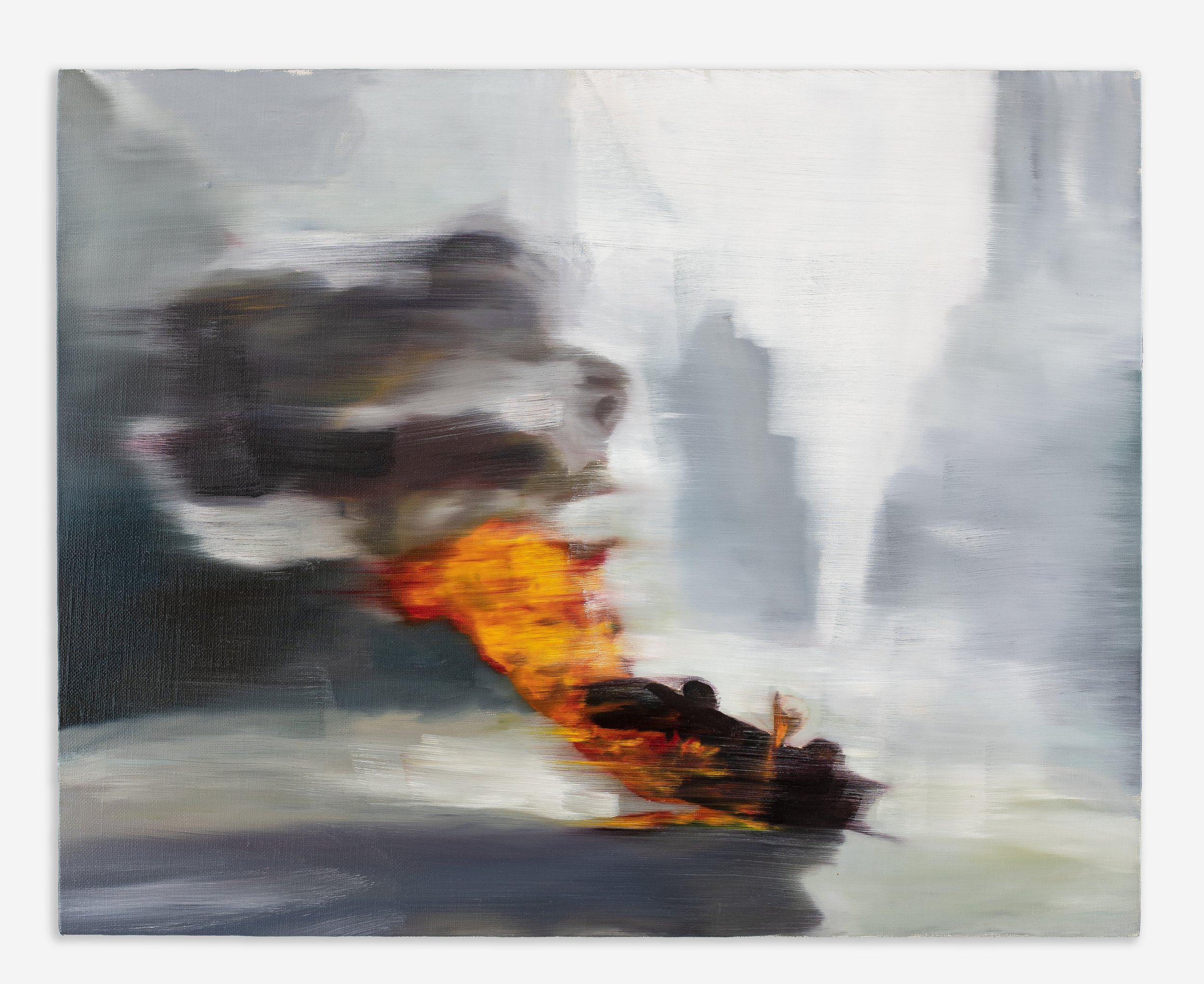
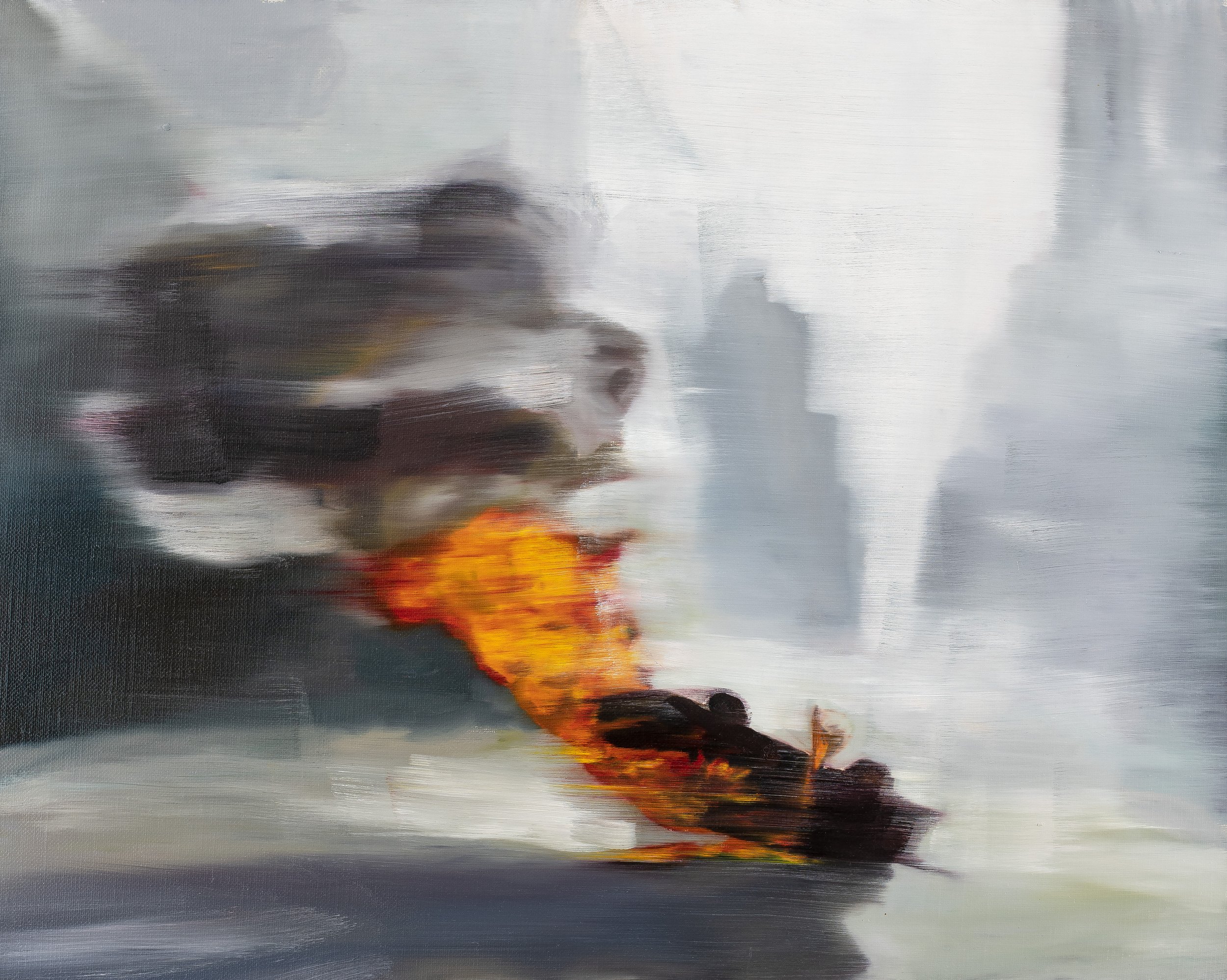
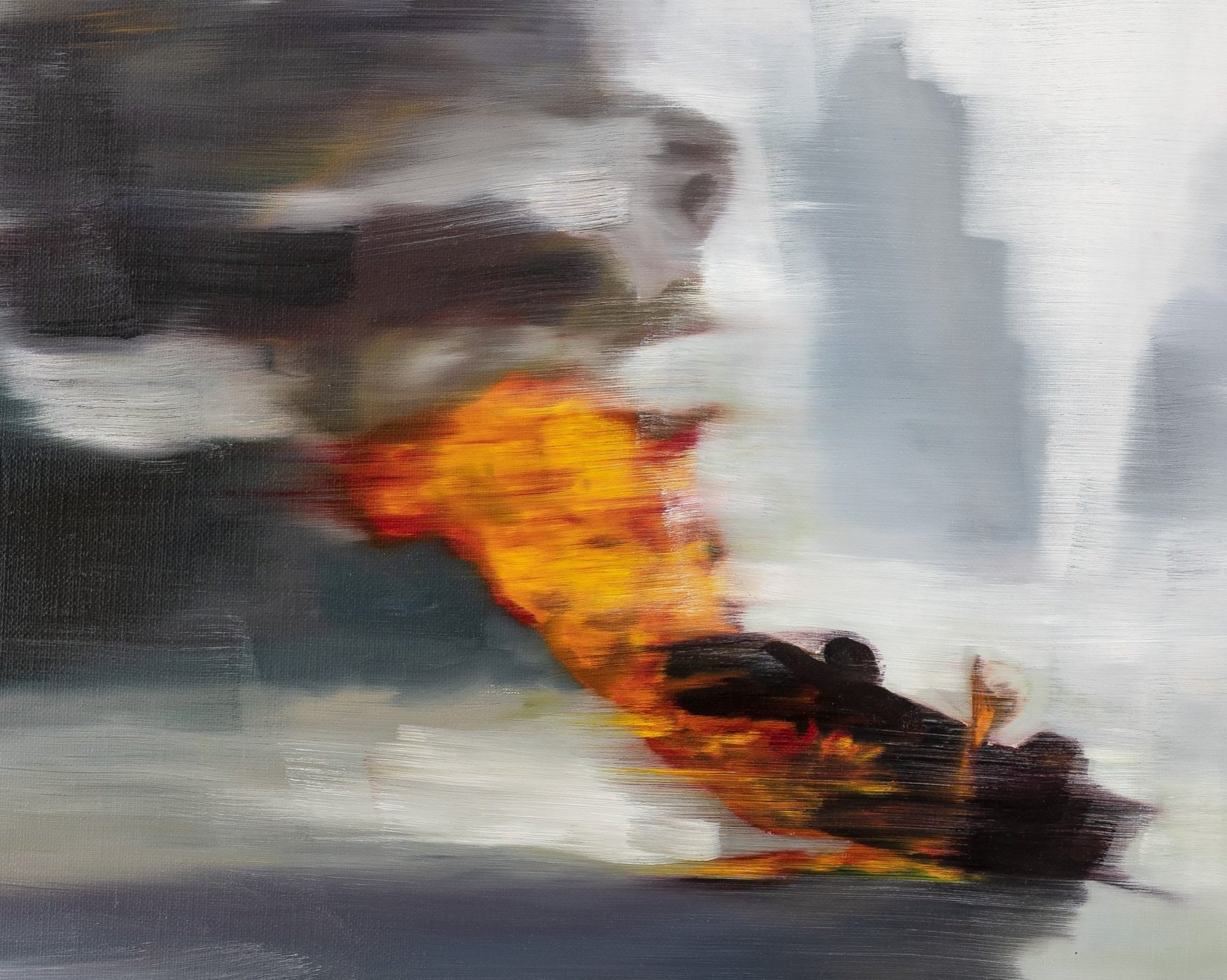
Philadelphia measures 41 by 51 centimeters on linen, a modest scale that corresponds to the dimensions of the screen on which the original photograph appeared. The format of the canvas, wider than it is tall, echoes the horizontal orientation of the news feed photograph, and the scale makes the painting feel less like a monument to an event than like a document of one. The painting is executed in a predominantly black-and-white palette, with the grayscale treatment extending to the point where the forms of the burning car and the cityscape behind it are rendered in tonal values that recall the high-contrast look of photojournalism at its most austere. The flames themselves are the exception to this palette, rendered in sharp reds and oranges and yellows that cut across the monochrome surface like an interruption, like something that refused to be translated into grayscale, that insisted on its own incandescence even as it was being converted into a painted image.
The paint handling in Philadelphia uses horizontal brush strokes that Tan Mu has described as a deliberate reference to the way digital images move through screens, to the scanning lines of the display technology that carried the original photograph to its viewers. These horizontal marks are not casual. They create a surface texture that is both a record of the painting's making and a visual reference to the technical apparatus of digital display, a way of acknowledging that the image the viewer is looking at was produced by a brush but originated in a screen. The flames in particular are painted with a directional quality that suggests motion, heat, upward movement, and the brush strokes in these passages follow the form of the flames rather than the weave of the linen ground beneath. At close range, the surface texture of the painting is dense with this directional information, each stroke a small record of the painter's movement across the surface. At distance, the strokes resolve into the representational image of the burning car and the cityscape behind it, and the viewer loses access to the making in order to see the made thing.
Robert Rauschenberg began making his Combines in the early 1950s, combining painting and sculpture in works that incorporated newspaper clippings, wood, fabric, and everyday objects into painted compositions that refused to respect the boundaries between art and life. His 1954 work Gold paintings, which combined newspaper sections printed in gold leaf with painted passages, created surfaces in which the commercial language of the newspaper and the aesthetic language of abstraction existed in direct tension, neither one dominant, both present in the same visual field. Rauschenberg was interested in the way that images from mass culture carried within them the evidence of their own production and circulation, the way a newspaper clipping or a commercial print carried within it the record of the industrial processes that had produced it, and his Combines were attempts to make this circulation visible by incorporating the evidence of it directly into the work.
Tan Mu's Philadelphia operates through a related but temporally extended logic. Where Rauschenberg was incorporating the physical evidence of circulation, the newspaper clipping, the commercial print, the urban detritus of the city where he lived, Tan Mu is incorporating the digital evidence of circulation, the compression artifacts, the pixelation, the scan-line texture of the screen image that moved through the feeds before arriving at her canvas. The burning car in Philadelphia is not the burning car on the street. It is the burning car as it existed in the photograph, after the photograph had been processed by the news wire's compression algorithm, after it had been displayed on a phone screen and photographed by the eye and reconstructed in memory, after it had passed through every step of the digital translation that converted the physical event into a digital image and the digital image into a painting. Rauschenberg's Gold paintings carry the physical history of their production within them. Tan Mu's Philadelphia carries the digital history of its production within it, and the two histories, while separated by decades of technological change, are doing the same kind of work: making visible the systems of production and circulation that normally remain invisible behind the transparency of the finished image.
The contrast between the monochrome cityscape and the full-color flames in Philadelphia is the painting's most striking visual decision, and it is a decision with a specific conceptual motivation that Tan Mu has described in her artist's statement. The grayscale treatment of the background cityscape corresponds to the visual language of the news photograph, which often renders urban environments in tones that are desaturated by the compression algorithms of the feeds and by the conventions of photojournalistic aesthetics. The flames, however, refuse this desaturation. They appear in the painting in exactly the colors that fire appears in a photograph before compression has homogenized its tones, and this refusal is deliberate: the flames are what is real, what is present on the street at the moment of the photograph's taking, and the monochrome cityscape is the mediated, compressed, circulated version of the city that the news feed presents. The painting holds both simultaneously, and the tension between them is the painting's most precise statement about the relationship between physical event and digital image in the summer of 2020.
David Hockney began working with photo collages in the 1980s, arranging dozens of photographs into composite images that showed the same scene from slightly different positions and at slightly different times, creating works that looked, at first encounter, like conventional photographs but that, on sustained looking, revealed themselves to be assembled from fragments, each fragment carrying its own timestamp, its own angle, its own slight deviation from the others. Hockney called these works Joiners, and he described them as attempts to capture something that a single photograph could not capture: the experience of occupying a space over time, of moving through an environment and accumulating visual information from multiple positions rather than from a single fixed point. The Joiners were a critique of the single-point perspective that had organized Western painting since the Renaissance, a claim that the fixed viewpoint was not a natural condition of seeing but a convention, a decision, a political choice about whose perspective counted as authoritative.
Tan Mu's Philadelphia makes a related but differently oriented argument. Where Hockney was concerned with the inadequacy of the single photograph to capture the temporal experience of occupying a space, Tan Mu is concerned with the inadequacy of the single image to capture the social experience of witnessing an event through multiple screens simultaneously. The viewer who saw the burning car photograph in June 2020 was not a single fixed observer in a single fixed position. They were a participant in a network of simultaneous witnessing, millions of people watching the same image at the same time on screens that were physically located in different places but that were receiving the same feed, the same compression, the same selection of what to show and what not to show. The painting does not represent this network directly. It represents the image that the network produced, the photograph after it had been processed and distributed and received and stored in the memories of the people who had seen it, and this representation is itself a kind of Joiner: a composite image that contains within it the evidence of many different moments and many different positions, assembled into a single painted surface that holds them all together.
The pandemic summer of 2020 was characterized by a specific perceptual condition that Tan Mu's Philadelphia makes visible: the condition of witnessing events through a screen while being physically separated from the scene of those events by thousands of miles of distance and by the constraint of a lockdown that confined her to her apartment in New York. This condition was not unique to her. It was the condition of everyone who was watching the news during the pandemic, who was learning about the protests in Minneapolis and Philadelphia and Atlanta and Portland through screens rather than through direct experience, who was witnessing events that were happening in other cities as images on their phones while sitting in their own homes. The screen became the primary site of political engagement for millions of people, and the images that appeared on those screens became the primary evidence of what was happening in the world. Tan Mu's painting of the burning car photograph is a record of this displacement, this condition of knowing events through images rather than through direct experience, and this displacement is not incidental to the painting's meaning. It is the painting's meaning.
Danni Shen, writing in Emergent Magazine in 2024 on Tan Mu's practice, identified what she called "the mediation problem" as central to Tan Mu's engagement with events that were newsworthy before they were paintable. Shen observed that Tan Mu consistently chooses subjects whose newsworthiness and whose painterly potential are derived from the same fact: that the event in question exists at a distance from the viewer, mediated by some technological system, and that the painting's task is not to overcome this mediation but to represent it, to make visible the conditions under which the viewer knows what they know. Philadelphia is a precise example of this method in action. The burning car is not a direct experience. It is a mediated experience, an image that arrived through a screen and that the painting records as a screen image rather than as a direct encounter. The painting does not pretend to give the viewer direct access to the event. It gives the viewer a painted record of the mediated image, and the quality of that mediation, the specific visual character of the news photograph as it appeared on a phone screen in an apartment in New York in June 2020, is what the painting preserves.
The Black Lives Matter protests that were unfolding in cities across the United States during the pandemic summer of 2020 were themselves events that were simultaneously physical and digital. People took to the streets and were photographed and filmed by people in the crowds and by drones and by police surveillance cameras, and all of these images circulated through social media feeds and news aggregators and messaging applications, and the circulation itself became part of the event, a second layer of documentation and meaning-making that accompanied the physical action in the streets. The burned car in Philadelphia is a document of both layers simultaneously: it is a record of what happened on the street, and it is a record of what happened in the feeds, and these two records are not separable from each other. The image of the burned car that Tan Mu paints is the image that circulated, and the image that circulated was the image that people in the feeds were arguing about and sharing and interpreting, and the interpretation was part of the event's meaning as much as the burning was. The painting holds both layers without resolving them into a single legible narrative, and this holding is what makes it a painting of the pandemic summer rather than merely a painting of the protest.
The specific technical conditions of the image's production and transmission are embedded in the painting's surface as a visual history that the viewer can read if they know how to look. The horizontal brush strokes that Tan Mu uses to build up the cityscape and the car body are records of a specific technical process: the way digital photographs are built up from horizontal scan lines, the way the display screen renders images as a sequence of horizontal passes from top to bottom, the way compression algorithms often produce artifacts that follow horizontal or vertical orientations because those are the orientations that the human visual system is most sensitive to and that the encoding algorithms therefore prioritize. The painting is not depicting a city. It is depicting a photograph of a city, and it is depicting the photograph through the technical language of its own production, which is the language of horizontal scan lines, of compression artifacts, of the specific visual grammar that digital photography has introduced into the image stream that the human visual system now inhabits.
The color space conversion that produces the specific reds and oranges of the flames in Philadelphia is governed by the same technical standards that organize all digital color reproduction. When a camera captures the image of a burning car, it records the scene in a color space determined by the sensor's spectral sensitivity and the image processing pipeline's color matrix, which converts the raw sensor data into the standard Red-Green-Blue values that digital images use. This conversion is lossy, meaning that it discards information in order to fit the captured scene into the standard color range, and the specific reds of fire are often among the colors that suffer most from this compression because they fall at the edge of the representable range and are therefore the first to be clipped when the processing software encounters a value that exceeds the maximum displayable intensity. The flames in the painting, rendered in their full saturated reds and oranges against the grayscale cityscape, are therefore a record not just of the fire but of a fire that exceeded the color capacity of the digital system that recorded it, a fire that was brighter than the camera could fully describe and that therefore burned with a chromatic intensity in the original photograph that the compression algorithms reduced to something closer to the grayscale of the surrounding environment. Tan Mu's decision to restore the full color to the flames is a decision to recover information that the digital pipeline discarded, to give back to the fire what the technology took away.
What Tan Mu asks of the viewer in Philadelphia is not a decision about what the painting means. She asks the viewer to feel the weight of the distance between the event and the image, and to consider what it means that this distance has become the primary condition of political knowledge for people who are watching events unfold on screens. The burning car in the painting is not a symbol of anything specific. It is a specific image that accumulated meaning as it circulated, that was shared by people who had different political commitments and who interpreted it in different ways, that was used by some as evidence of the breakdown of social order and by others as evidence of the righteous anger of the dispossessed. The painting does not adjudicate between these interpretations. It holds them, as it holds the grayscale cityscape and the full-color flames, as parallel visual facts that the viewer must hold in attention simultaneously, the way anyone who watched the news in the summer of 2020 had to hold the reality of the events and the reality of the images at the same time, without either one fully resolving the other.