Near Absolute Zero: Tan Mu's Quantum Computer and the Portrait of a Machine That Thinks
Inside the IBM Q System One, suspended in a housing of engineered glass and gold-plated copper, the core of a quantum processor operates at 15 millikelvin. That is approximately 180 times colder than the void of outer space, where the cosmic microwave background radiation retains a residual warmth of 2.7 kelvin. The machine required eight years of development before anyone outside IBM's quantum division could stand in front of it and understand, with their own eyes, that computation had crossed a threshold. Tan Mu was among the first artists granted access to document it. She painted what she saw on a linen support measuring 46 by 61 centimeters, roughly the dimensions of a paperback novel held open. The scale is intimate, almost tender. The machine it depicts would fill a one-bedroom apartment. This contradiction, between the painting's modest scale and the infrastructure it represents, is not incidental. It is the argument.
The cryostat, the cylindrical cooling apparatus at the heart of the quantum computer, appears in Tan Mu's painting as a luminous blue form against near-blackness. The blue is not a decorative choice. It is the color of the dilution refrigerator's internal lighting, visible through the glass housing that IBM designed to make the machine legible to visitors, to investors, to the public. The glass casing transforms a physics experiment into an object of contemplation. Tan Mu recognized this gesture and met it with her own: she renders the glass with a hyperrealistic precision that makes the viewer's own screen or window feel like another pane of containment separating them from the quantum interior. The reflective surfaces in the painting do not merely describe the machine's exterior. They describe the experience of looking at the machine through an interface, which is to say they describe the experience of looking at almost everything in contemporary life.
The composition isolates the cryostat with the deliberate focus of a Dutch Golden Age portrait. The figure fills the frame. The background, a void of deep charcoal and black, provides no spatial context, no laboratory bench, no indicator lights, no engineers in shirtsleeves to establish human scale. What remains is the machine itself, centered and frontal, its vertical axis emphasized by the cylinder's proportions. The effect is devotional. The cryostat's concentric rings, rendered in graduated tones of blue and silver, read as structure, as hierarchy, as the visible architecture of something invisible. Superconducting qubits, the quantum equivalent of classical bits, exist in superposition at this temperature, meaning they exist in multiple states simultaneously until measured. The painting cannot show superposition. What it shows instead is the apparatus of measurement itself, the physical infrastructure that makes quantum computation possible, rendered with the reverence an earlier century reserved for relics.
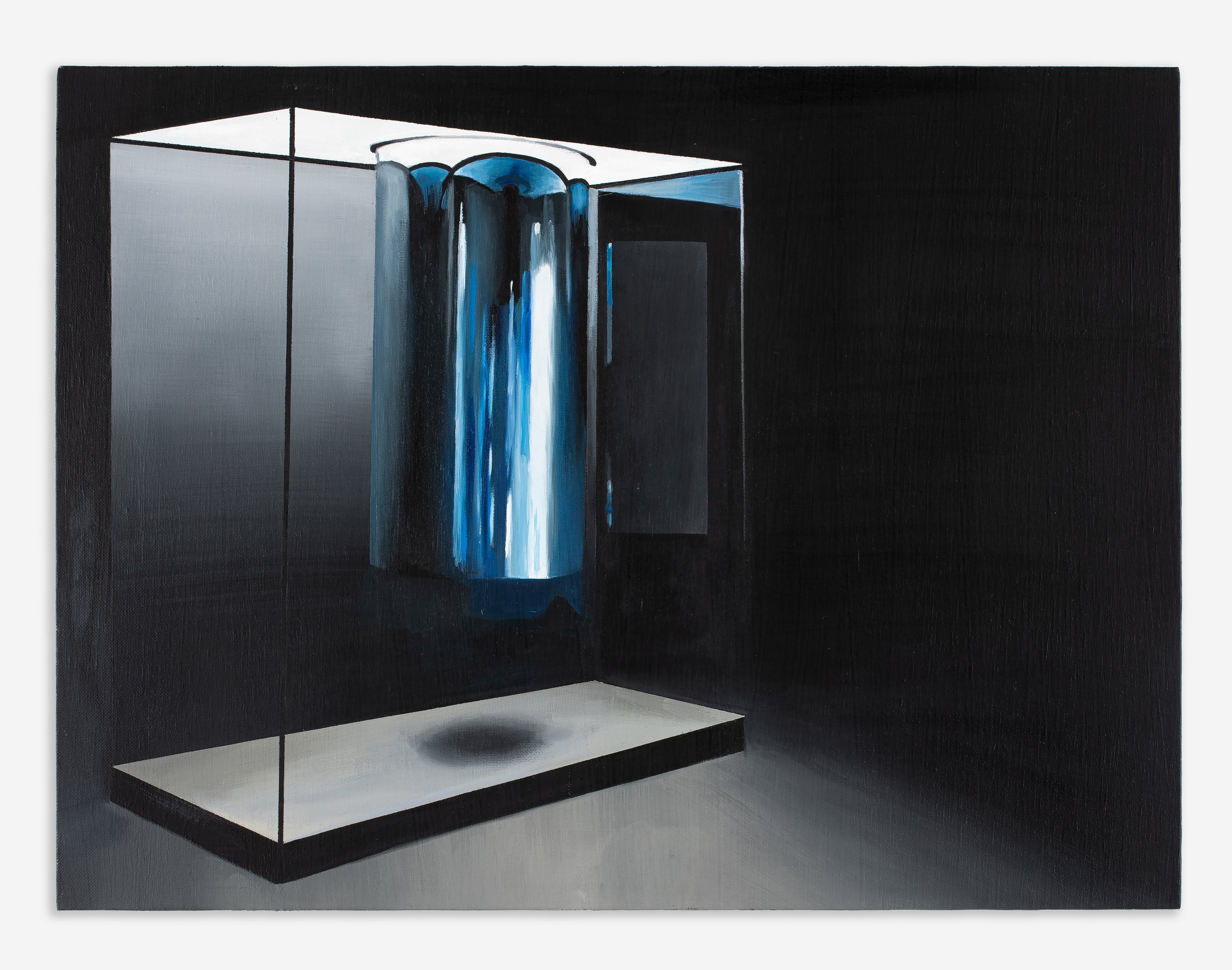
Thomas Struth understood this imperative when he traveled to CERN in 1993 and again in 1999 to photograph the detectors at the Large Electron-Positron Collider. His large-format photographs, printed at dimensions that exceed human height, place the viewer in the presence of machines as if before altarpieces. The ATLAS detector, photographed in sections across multiple panels, accumulates detail until the scale becomes oppressive, until the viewer understands that no single human mind designed this machine in its entirety, that it represents a distributed intelligence, a collective cognition made physical and massive. Struth's photographs do not explain how particle accelerators function. They do something more fundamental: they make the experience of confronting scale and complexity available to a viewer standing in a gallery, separated from the machine by thousands of miles and a complete irrelevance to the physics being conducted. Tan Mu's Quantum Computer operates on the same logic, but in the inverse direction. Where Struth magnificently enlarges the infrastructure of physics, Tan Mu intimately reduces the infrastructure of computation to a scale the body can hold. The cryostat that would require a high ceiling and a controlled environment becomes a painting small enough to hang above a desk. The inversion is not diminishing. It is an act of translation, from the language of engineering to the language of attention.
The decision to paint the cryostat rather than the quantum processor itself reflects a deeper understanding of what Tan Mu has described in her Q&A as the painting's true subject. The quantum processor inside the Q System One operates in a regime so foreign to human intuition that no image can adequately represent it. The qubits, fragile superpositions of 0 and 1 maintained at temperatures colder than deep space, exist in a physical regime that cannot be photographed, cannot be visualized, cannot be rendered in any conventional sense. The cryostat, by contrast, is a machine made visible. Its concentric rings of cooling stages, its gold-plated heat exchangers, its intricate plumbing for liquid helium and liquid nitrogen, are all designed to be examined, maintained, understood by engineers. Tan Mu treats this visible architecture as a portrait subject precisely because the interior, the quantum processor itself, remains fundamentally inaccessible to direct representation. The painting becomes an act of showing what can be shown while acknowledging, through the devotion of its attention, what cannot. This is not a failure of the image. It is the image's most honest admission of its own limits, translated into a formal and material success.
The gold tones in the painting deserve the attention they demand. IBM's cryostat components are gold-plated not for aesthetic reasons but for functional ones: gold does not oxidize, it conducts heat efficiently, and it maintains electrical contact at the cryogenic temperatures required to keep the superconducting qubits in their fragile quantum states. The gold is thus both a material fact and a philosophical gesture. Gold, in the Western tradition, has always been the color of the divine, of icons that were meant to be touched only by priests, of backgrounds in medieval painting that posit a world beyond the physical. Tan Mu's gold is not gilded in this tradition, but it carries the same weight of reverence. The cryostat's gold components glow against the dark ground of the painting, and they glow in a register that the viewer's eye recognizes as sacred before the mind has processed why. The machine that promises to solve problems no classical computer could ever manage, that promises to crack encryption and simulate molecular bonds and accelerate drug discovery, appears in this painting as an object worthy of devotion. The ERES Foundation exhibition text for the Munich show put this most directly: they described the quantum computer as "a modern golden calf," associated with hopes that border on the theological. Tan Mu does not ironize this comparison. She deepens it. The gold she paints is the actual gold of the machine's engineering, and its resonance with centuries of sacred objects is not a coincidence but an inheritance.
What the painting shows, at its most fundamental, is temperature. Not the quantum processor's near-absolute-zero interior, which remains invisible, but the temperature differential that separates the machine's core from its exterior environment. The graduated blues and silvers that describe the cryostat's rings are a chromatic record of cooling stages, of the progressive removal of thermal energy from a system that requires extreme cold to function. This emphasis on temperature connects the painting to Tan Mu's broader practice, where thermal dynamics recur as subject matter: the cooling systems of data centers in Memory, the solar radiation absorbed and reflected by glacier surfaces in the Arctic series, the heat signatures captured by infrared imaging. Temperature is never neutral in this practice. It is always a measure of energy flow, of information transfer, of the invisible processes that maintain the systems on which contemporary life depends. In Quantum Computer, the temperature gradient rendered in oil paint becomes a portrait of effort, of the extraordinary engineering required to isolate quantum states from a warm and chaotic environment. The painting does not merely depict a machine. It depicts the condition of possibility for that machine's operation, the sustained expenditure of cold that makes computation possible.
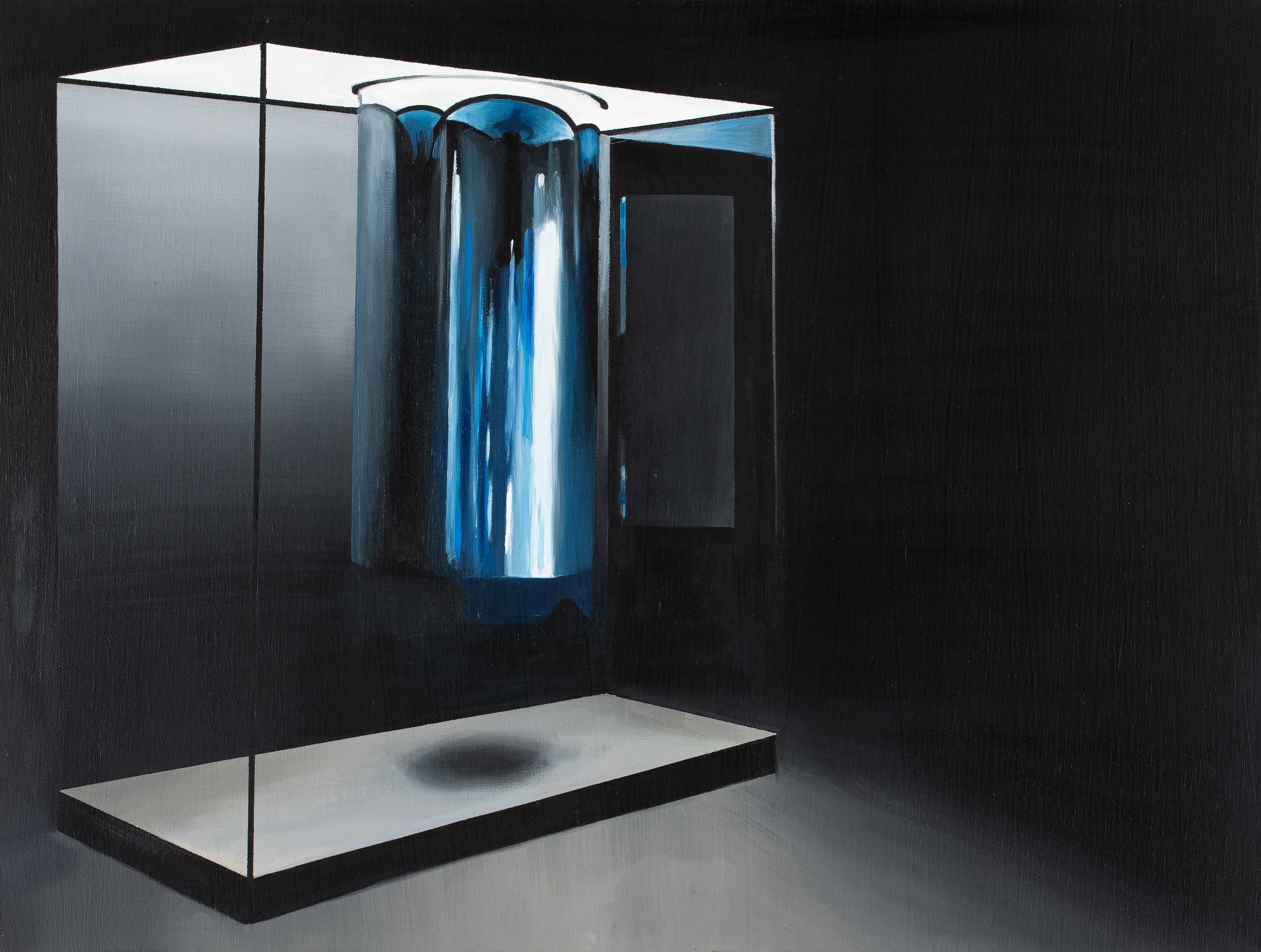
Santiago Ramon y Cajal spent forty years drawing the nervous system of humans and other vertebrates, and what he produced in the 1890s through the 1930s were not illustrations but arguments. His ink drawings of pyramidal neurons, of Purkinje cells in the cerebellar cortex, of the retinal circuitry that processes light before conscious vision begins, proposed that the brain was a computational network, that information was processed through physical structures, that thought itself had an anatomy. Cajal drew what no one had seen directly, working from tissue samples he prepared himself, staining neurons with silver nitrate and camera lucida techniques that allowed him to render the invisible architecture of cognition. The drawings have a dual nature: they are scientific documents of extraordinary precision, and they are images of haunting beauty, compositions that anticipate Abstract Expressionism by fifty years. Cajal was not merely documenting. He was arguing, through form, through the density of connection he chose to emphasize, through the scale relationships between cellular components, that the mind and the machine were not metaphors for each other but instances of the same category.
Tan Mu's Q&A for Quantum Computer makes this connection explicit. She describes the machine's structure as "mirroring the human body" and the relationship between hardware and software as "an apt analogy" for the relationship between brain and mind. The quantum computer, in her framing, is not merely inspired by biology but is a genuine extension of biological computation into a new physical regime. When she describes the painting as functioning "as a self-portrait," she means something more than the obvious self-reference of an artist who works with systems choosing to depict a system. She means that the quantum computer, like the artist, is engaged in a process of pattern recognition, of information storage and transmission, of the manipulation of symbols according to rules. The painting of the quantum computer is thus also, inevitably, a painting of thought. Cajal's drawings of neurons prepared the visual vocabulary for this recognition, establishing that the cell and the circuit were not separate domains but aspects of a single inquiry. Tan Mu inherits this tradition and extends it, working not in ink on paper but in oil on linen, asking the same question Cajal asked through different means: what is the shape of intelligence, and can the act of drawing it teach us something about what it means to think?
Li Yizhuo's catalog essay for the BEK Forum exhibition in Vienna makes a broader argument about Tan Mu's practice that clarifies the stakes of Quantum Computer within the larger body of work. She observes that almost every visitor to the Signal series initially mistakes the submarine cable paintings for star charts, for constellations, for maps of the heavens. The visual vocabulary of points and lines that Tan Mu has developed across multiple series, from neural networks to quantum cryostats to fiber-optic cables, produces a consistent syntax of connection, of pathways, of nodes joined by pathways that carry something essential from one point to another. The quantum computer, in this context, becomes another node in a network that extends from the microscopic to the cosmic, from the qubit to the cable to the glacier. What connects them is not a shared aesthetic but a shared structure: all are systems for organizing information, for transmitting significance across distance, for maintaining coherence in the face of entropy. The painting of the cryostat is thus not an isolated portrait of one machine. It is part of an ongoing argument about the shapes that information takes when it is made visible, when it is slowed down enough to be examined, when it is translated from the regime of computation into the regime of contemplation.
The choice to paint this subject in 2020, at the moment of the Q System One's commercial debut, reflects a practice built on temporal precision. Tan Mu has described her paintings as "visual timestamps," records of specific moments in technological and scientific history that future viewers can consult to understand how a particular era understood its own capabilities and aspirations. The year 2020 sits at a threshold. IBM's quantum computer was no longer a laboratory demonstration but a commercial product, available to clients who could access it through cloud computing. The machine had crossed from the regime of pure research into the regime of infrastructure, from the laboratory into the world. Painting it at this moment, before the technology matured, before quantum advantage became commonplace, before the public had time to forget what it felt like to encounter the thing for the first time, preserved the experience of that encounter. The painting is not nostalgia. It is testimony. It testifies that there was a moment when the quantum computer was new, when its cryostat gleamed in the light of its engineered glass housing, when the possibility of computation at this temperature felt like a genuine surprise. Tan Mu's oil on linen holds that moment in the only form that can outlast the infrastructure it depicts.
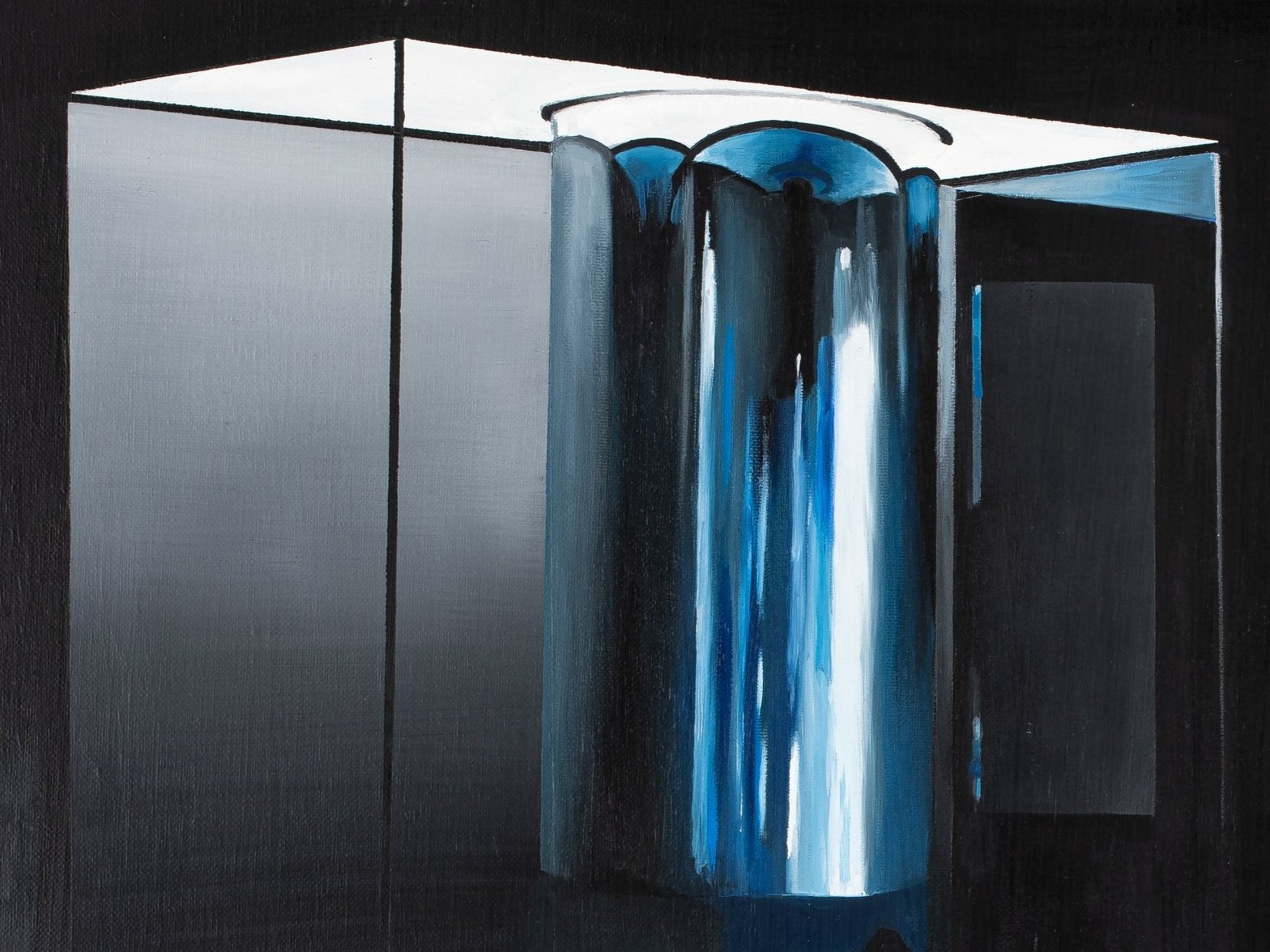
Nick Koenigsknecht, Tan Mu's studio manager and the curator of the BEK Forum exhibition, has written that these works "function more as self portraits, rather than depictions of external, scientific milestones." This is the reframe that Quantum Computer demands. To see the painting as a self-portrait is not to diminish its engagement with quantum physics but to recognize that the physics has been translated, through attention and through the specific pressures of oil paint on linen, into something personal, something with a viewpoint, something that takes a position. Tan Mu's position, as articulated in her Q&A, is that the quantum computer represents "the mind at its most advanced state, pushing beyond physical limitations and extending our capacity to think and calculate." The painting agrees with this assessment. But it does not merely illustrate it. The agreement happens in the paint, in the way the cryostat's rings are rendered, in the way the gold catches light, in the way the dark ground recedes behind the machine's gleaming form. The painting argues through its material, not despite it. This is the difference between an illustration and a work of art, between a diagram and a painting, between the thing described and the act of describing it.
Tan Mu has spoken about the cryostat in terms that blur the boundary between the mechanical and the somatic. She describes the relationship between hardware and software as analogous to the relationship between body and mind, and she treats this analogy not as a loose metaphor but as a structural identity. The human nervous system, as Cajal documented it, processes information through electrochemical signals traveling along neurons, with synapses releasing neurotransmitters according to rules that are both physical and logical. The quantum computer processes information through superconducting loops carrying superposition states, with gates applying operations that are similarly physical and logical. The scale differs. The temperature differs. The substrate differs. But the underlying project, the translation of information into structure and structure into information, the creation of patterns that represent something beyond themselves, this project is continuous from the cell to the circuit. When Tan Mu paints the cryostat with the devotion she reserves for sacred objects, she is not making a religious claim about quantum computing. She is recognizing that the project of understanding thought through its physical substrates has a history, and that this history connects the neuron drawings of a Spanish neuroscientist in 1900 to the quantum processors of IBM in 2020, and that the oil paint on linen in 2020 participates in that history by making it visible to the human eye at human scale.
The final image the painting offers is not of the machine. It is of the space between the viewer and the machine, a space defined by glass, by reflection, by the impossibility of direct contact with what lies at the cryostat's core. Tan Mu has painted this space with the same attention she gives to the machine itself. The reflections in the painted glass include fragments of the studio, of the viewer, of the world outside the image. This is not a mistake. This is the painting's most precise statement about what it means to know a quantum computer. The viewer can approach the machine, can stand before it, can admire its engineering and contemplate its implications, but they cannot touch its core, cannot directly perceive the superposition states it maintains, cannot experience quantum coherence with their senses. What they experience instead is the interface. The glass. The reflection. The act of approaching without arriving. Tan Mu has painted this experience, which is to say she has painted the condition of human knowledge in the quantum age: proximate to wonders, separated from them by a pane of temperature differential and engineering precision, capable of reverence but not of direct contact. The cryostat glows in the dark like a relic in its case, like a neuron photographed under the microscope, like a star too distant to approach. The painting holds it there, at the distance where attention becomes devotion, where documentation becomes testimony, where the act of looking becomes an act of faith in what the human mind can perceive.
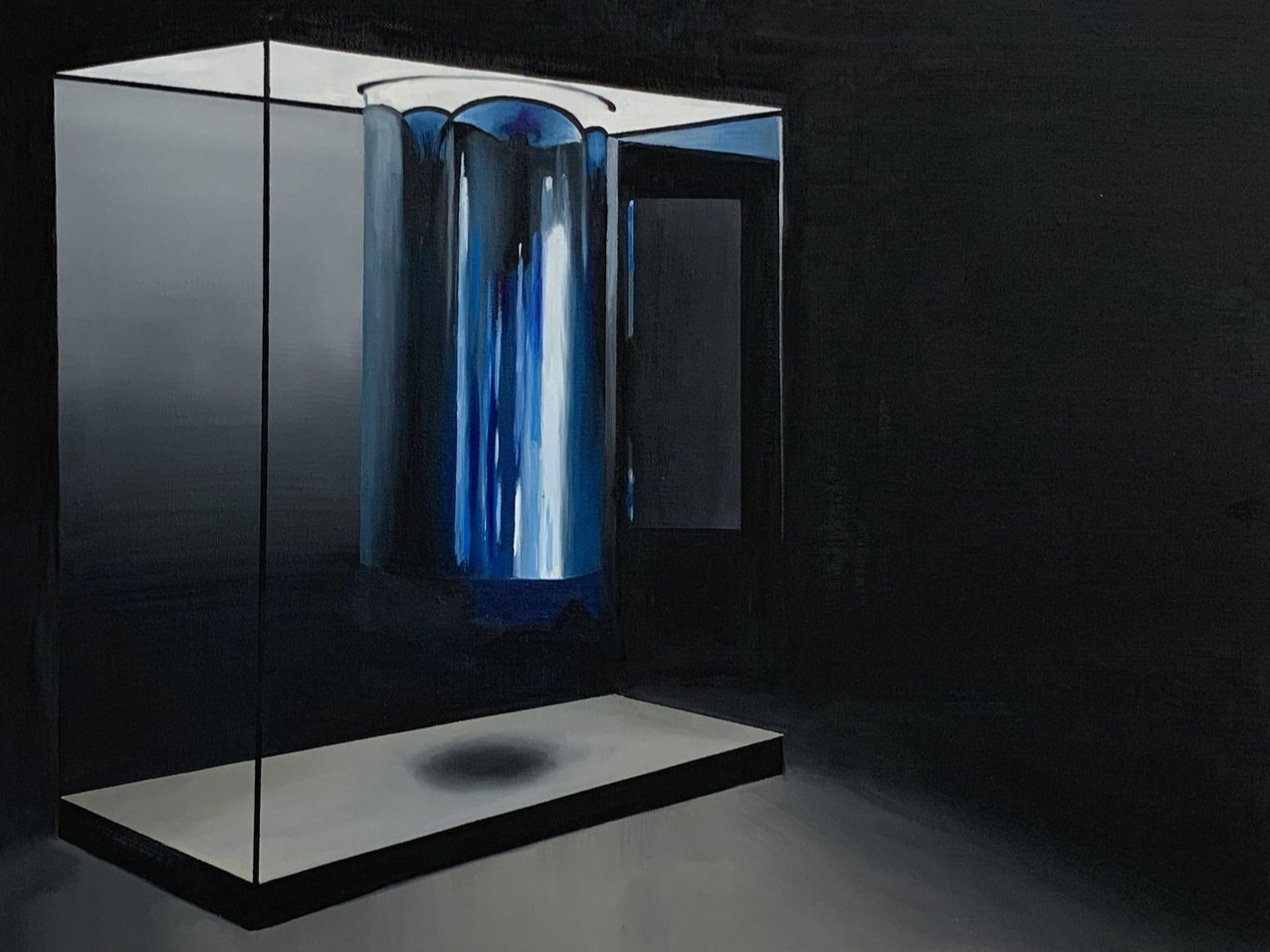
The painting measures 46 by 61 centimeters. IBM's Q System One measures approximately 3 by 3 by 2.7 meters. Somewhere between these two sets of numbers lies the space where painting operates, where the effort of hundreds of hours of attention transforms documentation into testimony, where the decision to render a machine at intimate scale rather than monumental scale makes a claim about what the machine means to the person who made the painting and to the future viewers who will encounter it. Tan Mu has said that she paints "as a way to record the historical weight of that moment," and the word weight is critical. The painting does not float above its subject. It does not transcend the machine through formal pyrotechnics. It descends into the subject, sits with it, renders it with the patience and precision of a Cajal drawing a Purkinje cell, and emerges with something heavier than an image: a record of what it felt like to stand in front of a quantum computer and understand, for the first time, that the boundary between thought and thing had become uncertain.