The Fabric of Memory: Tan Mu's Emergence 03 and the Neural Architecture of the Cosmos
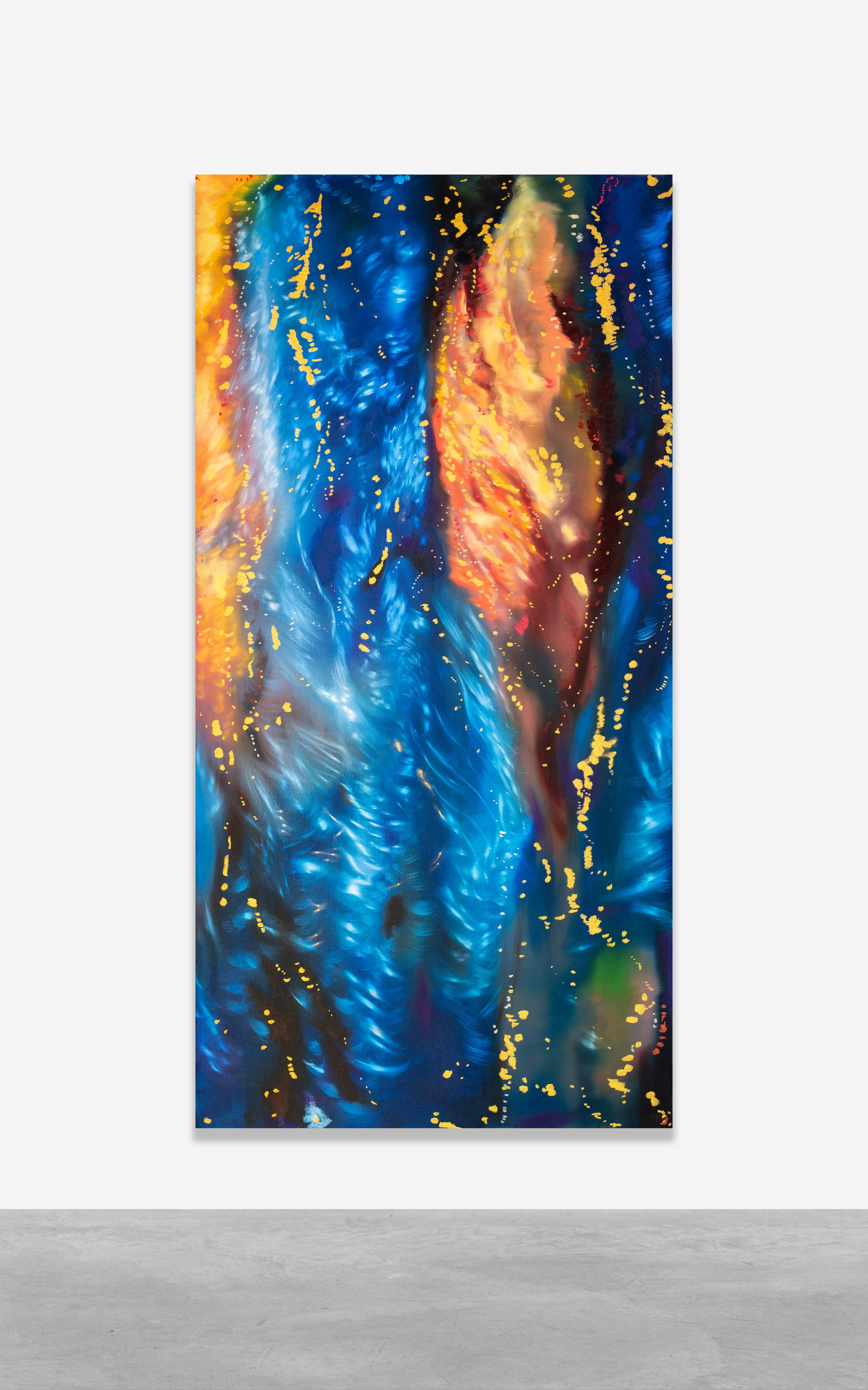
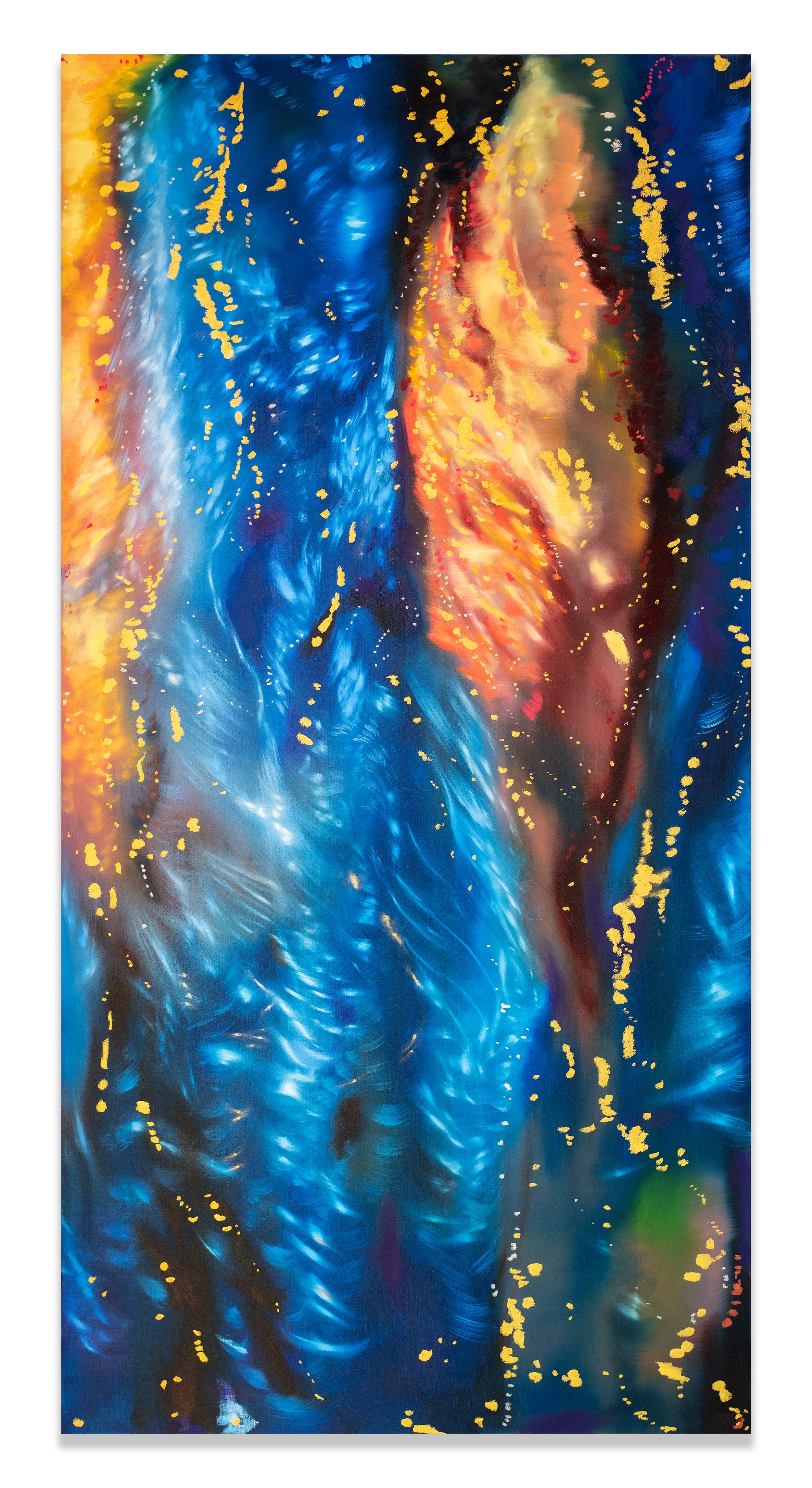
The human brain contains approximately one hundred billion neurons, each connecting to thousands of others through synapses, producing roughly one hundred trillion synaptic junctions. If every connection in this network were a lightbulb, the combined activation patterns would exceed the complexity of any supercomputer ever built. Yet the brain does not merely compute. It remembers. It imagines. It conjures the face of someone not seen in decades, or the smell of a kitchen from childhood, with a fidelity that no storage system has yet replicated. Tan Mu has stood at the edge of this capacity and watched it fail. During a deep dive that pushed her past thirty meters, cerebral hypoxia temporarily impaired her memory, and she describes the experience of forgetting as an encounter with the brain's physical substrate, with the wet architecture of neurons and synapses that constitute the machinery of who she is. Emergence 03, painted four years after that incident, takes this encounter as its subject not through depiction of the dive itself but through the neural structures the dive revealed. The painting measures 183 by 92 centimeters, a vertical format that echoes the vertical axis of the standing human body, and within that format, Tan Mu renders the brain's internal architecture at a scale that makes the invisible visible, that transforms the microscopic machinery of thought into something the human eye can traverse.
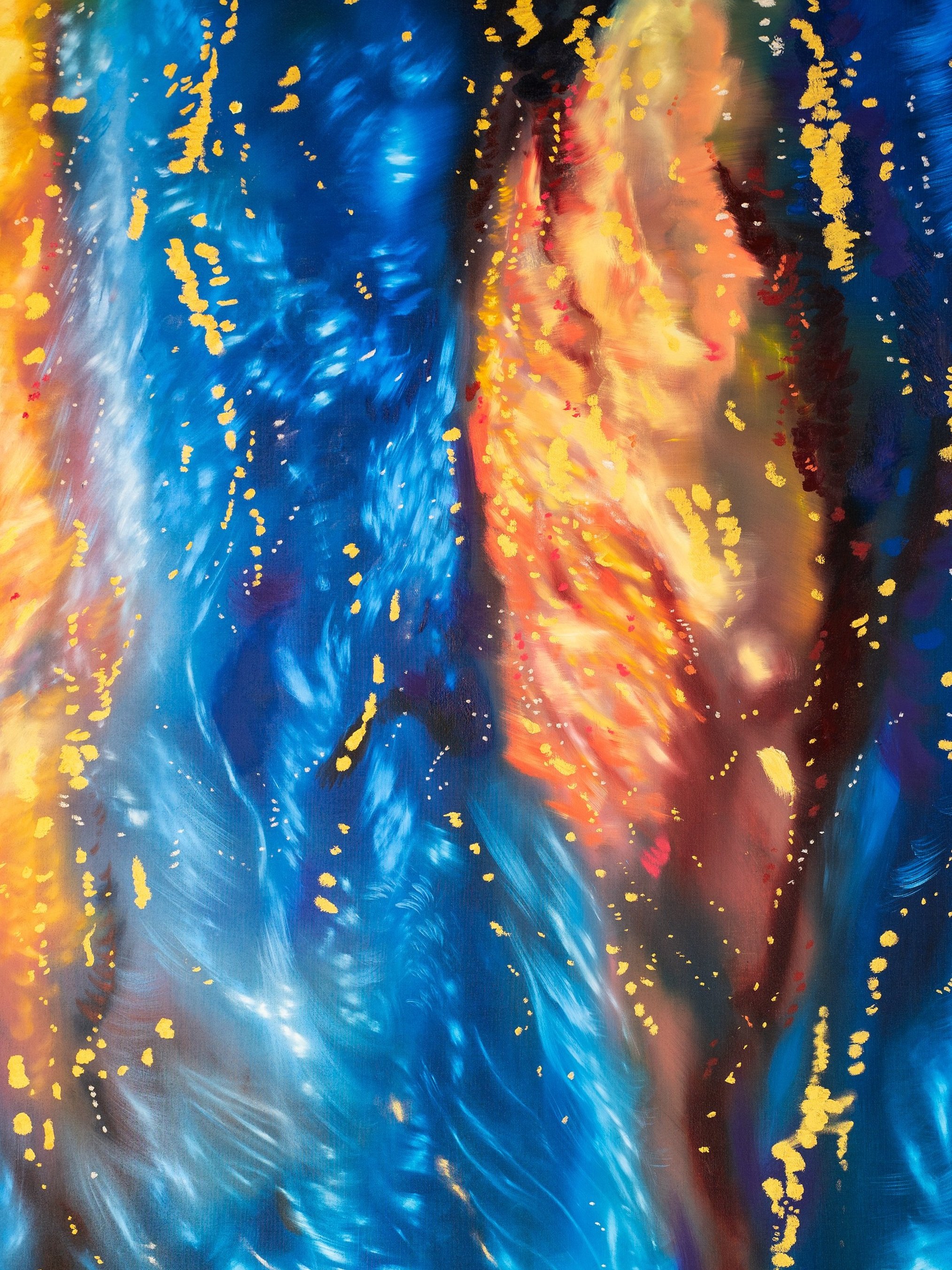
The canvas holds a web of branching forms in luminous blue against a ground that pulses with yellow and amber, with pale gold light radiating outward from the composition's center in patterns that accumulate density toward the edges. At a distance, the painting reads as a cosmic event, as something astronomical, as if the viewer were looking at a nebula photographed by the Hubble Space Telescope or a simulation of dark matter distribution across the early universe. This is not a mistake or an accident. Tan Mu has described neurons in her Q&A as resembling trees, as glowing marine organisms, and as images of galaxies suspended in the void. The resemblance is structural and intentional. Both neurons and galaxies organize matter and energy through branching pathways, through nodes connected by filaments, through systems that are simultaneously local and global, discrete elements participating in larger patterns that cannot be reduced to any single node. The painting makes this parallel literal by refusing to resolve it into one domain or the other. The forms read simultaneously as neural and as cosmic. The scale is ambiguous. The viewer must decide, again and again as they move closer and farther, whether they are looking at something infinitely large or infinitely small.
Tan Mu has cited holographic theory as an intellectual framework for this ambiguity of scale. The holographic principle, derived from black hole thermodynamics and string theory, proposes that all information contained in a three-dimensional volume can be encoded on a two-dimensional surface at the boundary of that volume. The whole is present in every part. Every neuron, if the analogy holds, contains within its molecular structure a compressed version of the entire pattern of connections that constitutes the brain. Every galaxy, if the analogy extends outward, contains within its gravitational field a record of the entire universe's mass-energy. The painting operates on this principle by constructing an image that functions at multiple scales simultaneously. At the closest viewing distance, the viewer sees individual brushstrokes, impasto marks where paint has been loaded and dragged across linen, small explosions of color that resolve, at greater distance, into branching forms that resolve, at still greater distance, into the structure of something vast and ordered. The oil paint is the holographic surface. The image it carries is present in every square centimeter.
Harold Cohen spent twenty years building a system he called AARON, one of the earliest serious attempts to create a machine that could produce original artwork. Beginning in 1973 and continuing through the 1990s, Cohen developed algorithmic rules that governed how AARON would place shapes and colors on a canvas, producing drawings and paintings that circulated through the art world as curiosities, as evidence that computers could participate in creative practice. What Cohen discovered, and what he documented with increasing candor over the years, was that the algorithmic approach to art-making revealed more about the structure of his own thinking than it did about machine creativity. AARON was a mirror. Its rules were his rules, translated into code. Its aesthetic preferences, its compositional instincts, its sense of when a painting was finished, all reflected the accumulated decisions Cohen had made over decades of practice. The system that was supposed to replace human creativity turned out to be an extended self-portrait, a documentation of one human mind's approach to visual organization.
The implications of Cohen's discovery become visible when set alongside Tan Mu's practice, particularly the works she has grouped under what she calls the investigation of the fabric of memory. MRI (2021), the Memory triptych (2019), Emergence (2022), Emergence 03 (2024), Logic Circuit (2022), the Signal series, and Synaptic (2023) form, in her description, a continuous inquiry into memory, connection, and disconnection. She distinguishes between internal memory, located in the neural networks of the brain, and external memory, distributed across data centers and submarine cables. This distinction is not dualism. It is infrastructure. The brain and the data center are both storage systems, both physical substrates for information, both subject to entropy and decay, both capable of holding patterns that exceed the capacity of any single component. When Tan Mu paints the neural structure of the brain in Emergence 03, she is painting a computational system, not metaphorically but literally. Neurons process information through electrochemical signals. They store patterns through synaptic weights. They transmit conclusions through action potentials. The language of neuroscience and the language of computer science have converged on the same vocabulary because they are describing the same underlying phenomenon: the organization of information across physical substrates. Cohen's AARON, which he described as an attempt to model the process of painting rather than the product, anticipated this convergence by fifty years. The question his work posed was not whether machines could paint but whether painting was a process that could be modeled, that had structure, that could be decomposed into rules and steps. Tan Mu answers yes, but her answer takes the form not of rules but of images, not of algorithms but of oil paint on linen, not of silicon but of neurons.
The blue that dominates Emergence 03 is not a single blue but a field of blues, ranging from near-white Cerulean at the brightest terminals of the branching forms to deep Prussian in the dense networks where forms overlap and accumulate. Tan Mu describes these blue tones as representing neurons specifically, with axons and dendrites extending outward to form dense networks. The surrounding yellows and ambers represent the luminous particles of neural signals, the constant activity of transmission and reception that maintains the brain's ongoing operation. This chromatic system is not decorative. It is functional. The blues recede visually while the yellows advance, creating a spatial tension that mimics the experience of depth in neural tissue, where the densest concentrations of connections appear darkest not because they are darkest in color but because they absorb and scatter the most visual attention. The viewer, in looking at this painting, is looking at the brain's interior from the inside, not from the perspective of neuroanatomy but from the perspective of consciousness itself, from the viewpoint of the one hundred billion neurons whose coordinated activity constitutes thought.
The vertical format of the canvas, 183 centimeters tall and 92 wide, makes the painting taller than most viewers. The proportions are approximately 2:1, narrow enough that the eye travels naturally from bottom to top, from the dense root forms at the base to the more dispersed terminal branches at the upper edge. This directional movement echoes the direction of information flow in neural systems, from input to processing to output, from sensation to integration to response. The viewer standing in front of the painting is positioned as if they were standing at the receiving end of a neural pathway, waiting for signals to arrive from the sensory surfaces of the body. The painting gives them signals in the form of color and form, light and density, a visual experience that accumulates as attention deepens, that becomes more complex the longer the viewer looks. This is not accidental. Tan Mu has described her paintings as attempts to slow down perception, to create conditions for a kind of attention that is different from the rapid scanning that digital images demand. Emergence 03 requires the viewer to spend time, to let the image resolve gradually, to discover that what appeared at first glance to be a nebula is in fact a neural network, and that the distinction between the nebula and the network may not be as clear as the viewer initially assumed.
Hiroshi Sugimoto's Diorama photographs, begun in 1976 and continuing for decades, share with Emergence 03 a fundamental interest in the relationship between the photographic image and the three-dimensional world it represents. Sugimoto photographs museum dioramas, those three-dimensional reconstructions of natural history scenes in which taxidermied animals are placed against painted backgrounds, and he photographs them in such a way that the distinction between the physical foreground and the painted background becomes invisible. The resulting images are photographs of scenes that never existed, that are simultaneously real and constructed, present and absent. The viewer cannot tell from the image alone which elements were three-dimensional and which were painted. The photograph collapses the distinction. Sugimoto has said that he is interested in the threshold between presence and absence, between the real and the represented, and his dioramas exploit the camera's capacity to make this threshold indiscernible.
Tan Mu's Emergence 03 operates on an analogous threshold, but through painting rather than photography and at a scale that is inverse to Sugimoto's. Sugimoto photographs small dioramas and prints them large, making the miniature appear life-size or larger. Tan Mu paints an enormous neural network that is simultaneously microscopic, that represents a structure too small to see with the naked eye, and displays it at a scale the human body can inhabit. The reversal of scale is not merely a visual trick. It is an epistemological argument about the nature of visibility. Sugimoto argues that the camera can make the absent appear present. Tan Mu argues that painting can make the invisible visible, not by magnifying it optically but by translating it into a visual language the human eye can parse. The neural network is not magnified in Emergence 03. It is reimagined. It is made according to a logic of representation that prioritizes legibility over accuracy, that chooses to render the structure of connections rather than the molecular detail of individual synapses, that creates an image of the brain that is more true to the brain's function than any photomicrograph could be because it shows the pattern rather than the pixel.
Li Yizhuo's catalog essay for the BEK Forum exhibition observes that almost every viewer encountering Tan Mu's submarine cable paintings initially mistakes them for star charts or astronomical maps. The visual vocabulary she has developed across multiple series produces a consistent syntax of connection, of pathways, of nodes joined by lines that carry something essential from one point to another. Emergence 03 belongs to this syntax without depicting cables or satellites. The neural network it depicts shares the grammar of the Signal series, where submarine cables appear as luminous lines crossing dark ocean grounds. Nodes, lines, pathways, networks: these are the grammatical elements of Tan Mu's visual language, and they recur regardless of the physical substrate she is investigating. The brain, the cable, the circuit, the galaxy: all are instances of the same structural category. All organize information across space. All maintain coherence in the face of entropy. All are systems that are greater than the sum of their parts. The consistency of this syntax across different scientific domains is not merely aesthetic. It reflects a claim about the universe itself, about the recurrence of certain patterns at every scale of existence, from the subatomic to the cosmic, from the neuron to the galaxy cluster.
This claim is not unique to Tan Mu. The observation that the same mathematical structures appear in different domains of nature has a long history in Western thought, from Plato's Forms to the Romantic concept of the correspondence between microcosm and macrocosm. What distinguishes Tan Mu's version is its grounding in contemporary physics and neuroscience rather than in philosophy or theology. She has cited the research paper The Geometry of Concepts: Sparse Autoencoder Feature Structure as intellectual context for her practice, a paper that examines how large language models process cognition in ways that resemble specialized regions of the human brain. The paper describes knowledge as a multidimensional point cloud, a universe of concepts distributed across space. Tan Mu's response to this description is to paint it, to create images that visualize the structure of concepts as if concepts had spatial extension, as if the mind's organization of knowledge were literally a landscape the body could traverse. The Geometry of Concepts paper is itself a holographic document: it describes how a model of cognition represents knowledge, and it does so using the same geometric vocabulary that Tan Mu uses to represent neural and cosmic structures.
Nick Koenigsknecht, who has managed Tan Mu's studio and curated her exhibitions, has written that her works function more as self-portraits than as depictions of external scientific milestones. This observation applies to Emergence 03 with particular force. The painting emerged from Tan Mu's encounter with her own brain's fragility, with the experience of cerebral hypoxia during a deep dive and the subsequent recognition that her memories were stored in physical structures that could be damaged, disrupted, lost. The painting is not about this incident. It is about the architecture that the incident revealed. But the revelation would not have occurred without the incident. The subjective experience of neural failure became the occasion for investigating neural structure. The self-portrait is not of the diver but of the neurons that survived the dive, that reknit their connections, that restored the memories that hypoxia had temporarily erased. The painting celebrates their resilience by rendering their complexity with devotion and precision, by treating the neural network as a subject worthy of the sustained attention that earlier generations of painters directed at landscapes and portraits and religious scenes.
The Freediver who descended past thirty meters and lost her memory and the painter who spent months rendering neural networks on a 183-by-92-centimeter linen support are the same person engaged in the same project: an investigation of the conditions that make consciousness possible. The project extends beyond the individual. Tan Mu's Q&A makes clear that her interest in the brain is not only personal but systematic. She approaches the brain as one node in a network of memory systems that includes data centers and submarine cables, and she approaches each of these systems as an instance of the same general phenomenon: the encoding of information in physical structure, the maintenance of patterns against entropy, the representation of one thing by another. This phenomenon is not merely technological. It is the defining characteristic of life. Every organism that has ever existed has encoded information in physical structure. DNA is memory. Neurons are memory. The mycelial network is memory. The submarine cable is memory extended beyond the body, externalized, made available to collective rather than individual recall. Emergence 03 participates in this larger system by making the brain's memory visible, by rendering the substrate of individual consciousness in a form that can be shared, contemplated, wondered at.
The final visual impression of Emergence 03 is not of resolution but of ongoing activity. The neural signals continue to fire. The branching forms continue to extend. The luminous particles continue to traverse the space between neurons, carrying information that has not yet arrived at its destination. The painting captures a process that has no conclusion, that is happening now and will happen again and again as long as the brain remains alive. This quality of the not-yet-arrived, the always-in-transmission, connects the painting to Tan Mu's broader interest in signals and signal decay, in the moment before the image resolves, in the latency between data and meaning. The neural network is not static. It is a dynamic system, continuously reconfiguring itself in response to experience, continuously forming new connections and pruning old ones in a process that never pauses until the brain itself ceases to function. The painting holds this dynamic system still long enough for the viewer to see it, to trace its pathways, to understand that the pattern they are looking at is not a structure but a process, not a thing but an event, not a snapshot but a duration too brief to perceive but too important to ignore.
Tan Mu has described Emergence 03 as part of a body of work that approaches technology not as something separate from humanity but as an extension shaped by emotion, materiality, and lived experience. The lived experience here is specific: a deep dive, a moment of hypoxia, a gap in memory, a return. But the extension is universal. Every human who has ever formed a memory has engaged with the same neural architecture that Tan Mu depicts. Every human who has ever forgotten something and then recovered it has navigated the same precarious terrain between presence and absence, between the physical substrate and the content it carries. The painting does not sentimentalize this experience. It renders it with the same devotion and precision that Tan Mu applies to quantum computers and submarine cables, to black holes and glacier faces. The neural network is not more intimate because it is in the body. It is simply closer. The distance between the viewer and the neural architecture in Emergence 03 is measured not in light-years or kilometers but in millimeters, in the thickness of the skull and the layers of tissue between the eye and the brain's visual cortex. This proximity is the painting's final argument. We are our brains. We contain the cosmos we are trying to understand. The network we paint is the network we are.