The Red Horizon: Tan Mu's Mars 01 and the Machine Eyes That Saw Another World
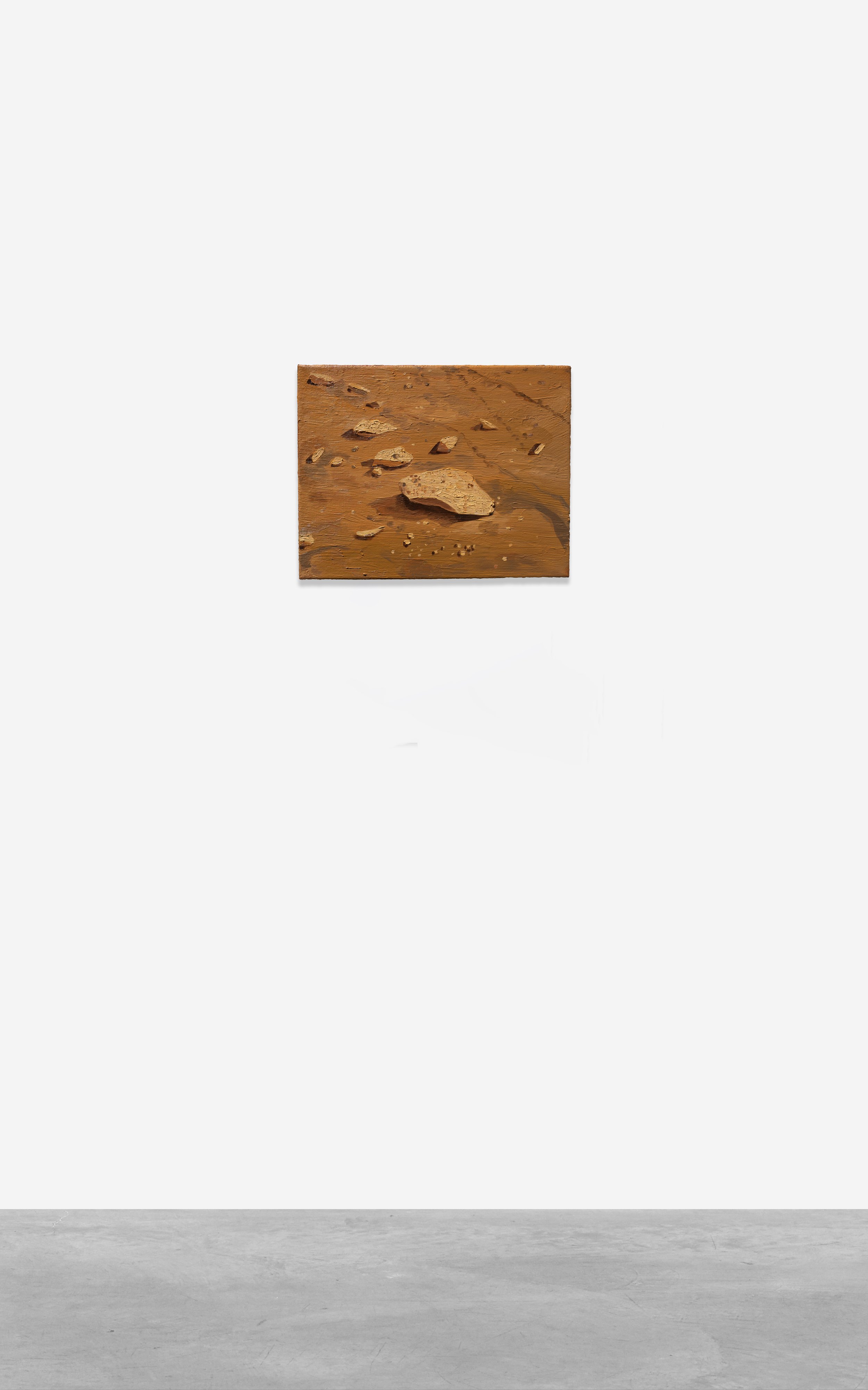
The rover named Perseverance touched down in Jezero Crater on February 18, 2021, and immediately began transmitting images to Earth through a relay chain that included NASA's MAVEN orbiter and the Deep Space Network, a global array of radio telescopes that can listen to signals from across the solar system. Each image traveled for approximately five minutes through interplanetary space before arriving at a receiver in California or Spain or Australia. The wait was not a malfunction. It was the speed of light across the void. The Martian surface in these images had been photographed autonomously by the rover's Mastcam-Z, a dual-camera system capable of zoom lenses and spectral analysis, operating without human guidance in real time because the communication delay made real-time control impossible. Tan Mu has described this camera as her eyes on Mars. The description is accurate but incomplete. The camera is not merely her eyes extended across 225 million kilometers of empty space. It is her eyes operating in a regime her body cannot inhabit, processing light from a world she has never visited, transmitting that light back to her studio in Paris where she translates it into oil paint on linen. The painting measures 28 by 36 centimeters, approximately the size of a sheet of notebook paper. It contains a landscape no human being has ever stood within. This contradiction, between the painting's modest scale and the immensity of what it depicts, is the central fact of the work and the argument the essay must make.
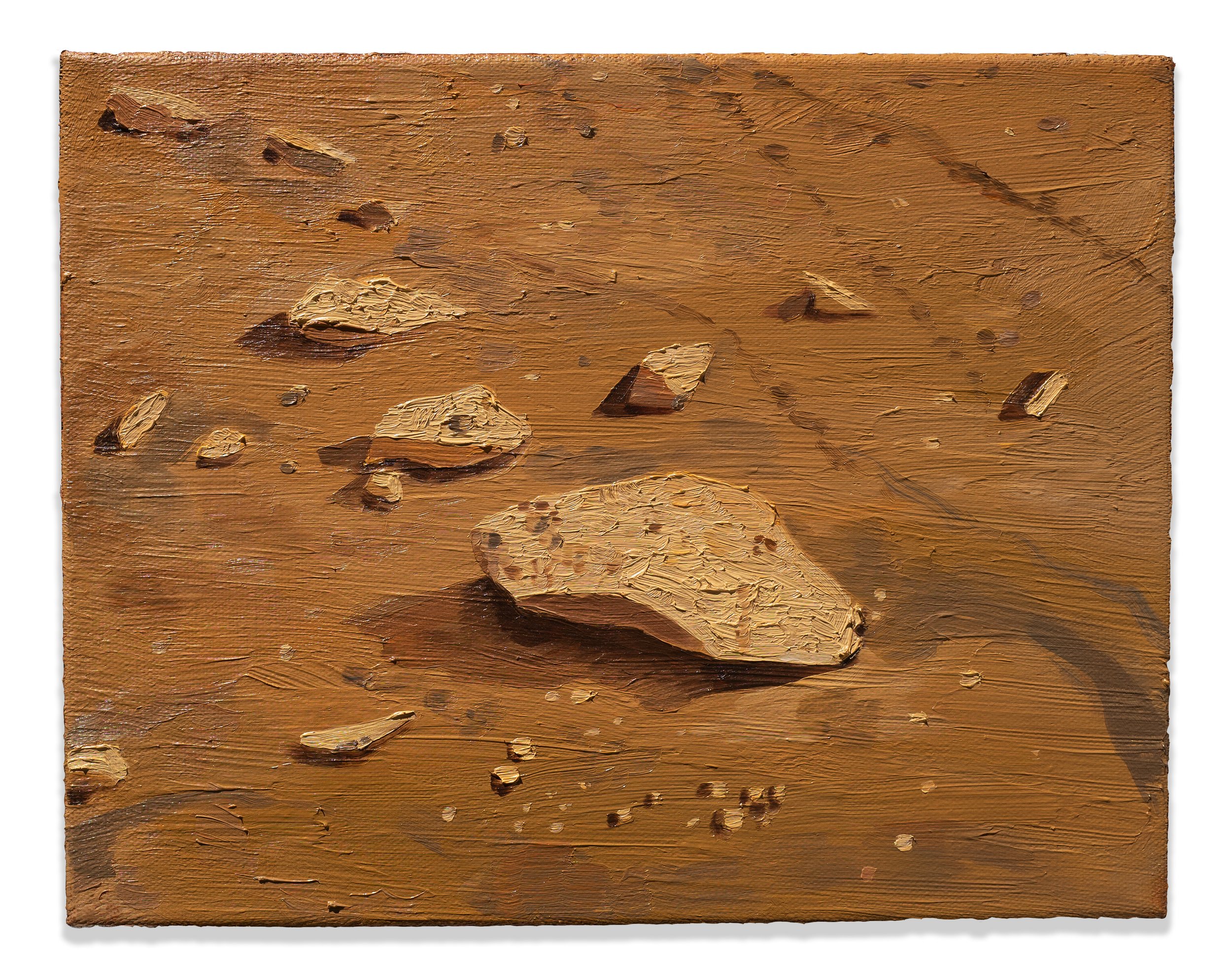
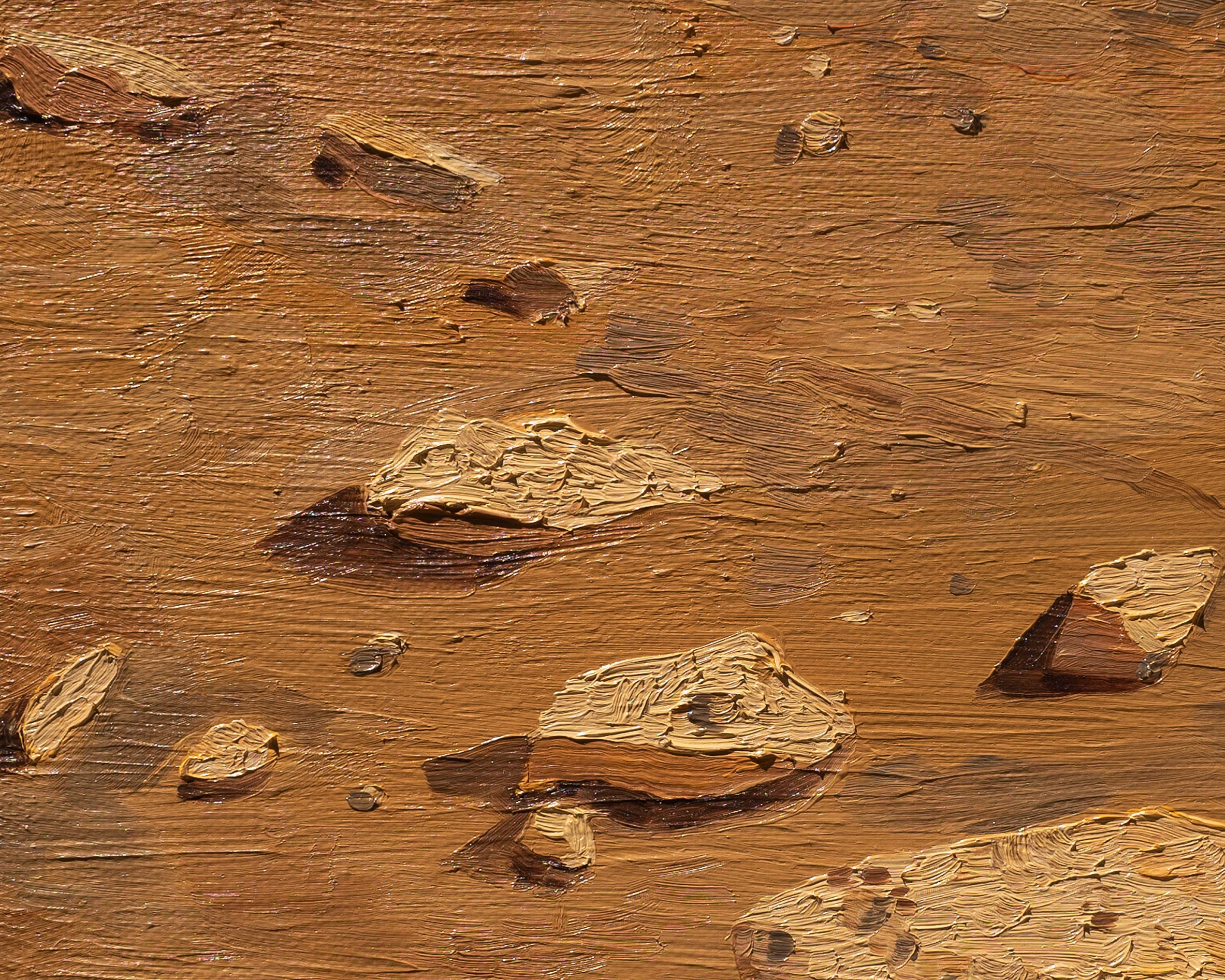
The surface in the painting is ocher, rust, and burnt umber, with traces of gray where the fine Martian dust has been compressed into strata by billions of years of wind. The brushwork is horizontal in the mid-ground, following the natural contours of what geologists call aeolian processes, the movement of sediment by wind, which on Mars operates at a fraction of Earth's atmospheric density but has had billions of years to work. In the foreground, the brushwork breaks into shorter marks, impasto passages where Tan Mu has loaded the paint and dragged it across the linen weave, creating a texture that reads as rocky, uneven, present. At the upper edge of the composition, a pale band of salmon and pale gold resolves, at close inspection, into the Martian sky, which is not blue but ochre, thick with suspended dust particles that scatter light in a spectrum shifted toward red by the iron oxide content of the atmosphere. The viewer of the painting is positioned as if they were standing on the surface itself, looking toward a horizon they cannot reach, in a landscape that is real and documented and simultaneously inaccessible. The oil paint records the record.
The question the painting poses, and that Tan Mu's Q&A makes explicit, is what it means that vision can be extended across interplanetary distances by machines operating autonomously. She has described the Curiosity rover's camera as functioning like a human eye but one that never tires, never needs water, never requires oxygen. The rover can drive for years across a landscape that would kill a human explorer within minutes, photographing and transmitting what it sees without the distortions of human desire or expectation. It sees what it sees. The question is whether what it sees is the same as what a human standing there would see, or whether machine vision has its own epistemology, its own way of organizing visual information that differs from human perception in ways that matter. Tan Mu's painting suggests that the difference matters less than the similarity. When she looks at the Martian surface and sees Mongolia, the Gobi Desert, the eroded sandstone formations of Inner Asia, she is making a claim about the universe's recurring patterns, about the way wind and gravity and time produce similar forms on different planets. The rover's camera did not see Mongolia. It saw rocks and sand on Mars. But through Tan Mu's translation, the Martian image becomes an occasion for recognizing the structural kinship between deserts on Earth and deserts on Mars, between the aeolian processes shaping the Gobi and those shaping Jezero Crater.
Caspar David Friedrich made landscapes that positioned the human figure as small before the immensity of nature, and his great paintings do not merely depict a scene. They enact a confrontation between the viewer's consciousness and the natural world in its most sublime and indifferent aspect. Monk by the Sea, painted between 1808 and 1810, shows a solitary figure in a dark cloak standing at the edge of the Baltic, facing a horizon line that separates water from a pale, overcast sky. The figure is dimensionless, anonymous, a silhouette against the vastness. Nothing happens. The sea does not storm. The sky does not change. The painting presents the fact of human finitude before natural processes that preceded and will outlast human existence. Friedrich was working within a philosophical tradition that ran from Kant's aesthetics of the sublime through the German Romantic interest in contemplation as a form of spiritual practice. He believed that the proper response to nature was awe, and that the proper response to awe was silence. His paintings do not explain nature. They put the viewer in its presence.
Tan Mu's Mars 01 inherits this imperative without repeating it. The painting positions the viewer on the Martian surface, but the position is mediated by two layers of machine vision that Friedrich could not have imagined. The first layer is the rover's Mastcam-Z, which photographed the scene autonomously and transmitted it across interplanetary space. The second layer is Tan Mu's hand, which translated the digital image into oil paint, making decisions about color and texture and composition that are the painter's own but that operate within the constraints of a specific source image. The viewer standing before Mars 01 is not standing on Mars. They are standing in a gallery looking at a painting that was made from a photograph that was taken by a machine that was programmed by engineers working for a space agency. The sublime that Friedrich could only access through direct encounter with nature is here accessed through a chain of representations that ends in oil on linen. The question the painting asks is whether the sublime survives this chain. Whether the Martian landscape, rendered in 28 by 36 centimeters of oil paint, still produces in the viewer the sense of scale and solitude and indifference that the actual landscape would produce. Tan Mu's answer, implicit in the care and precision of her handling, is yes, but differently. The painting does not recreate the sublime of direct encounter. It creates a different sublime, one that arises from the strangeness of looking at Mars through the machine's eyes and finding, in those mechanical images, landscapes that resemble the Gobi.
The ocher and rust and burnt umber in Mars 01 are not arbitrary. They are the actual colors of the Martian regolith, the loose rock and dust covering the planet's surface, which owes its characteristic coloration to iron oxide prevalent in the soil. NASA has calibrated the white balance of Mastcam-Z images so that geologists can accurately assess mineral composition, which means that the colors in the rover's transmitted images are as close to what the human eye would see as the engineering team could manage. Tan Mu has copied these colors faithfully, adding nothing and subtracting nothing, treating the digital palette as a constraint within which her painterly decisions operate. This obedience to the source image distinguishes Mars 01 from the Romantic tradition in one crucial respect. Friedrich invented his landscapes, or more precisely, he composed them from remembered impressions and from the formal vocabulary of the Sublime that he had inherited from earlier painters. Tan Mu's landscape arrives pre-formed, already processed by the rover's camera and the transmission chain and the software that assembles individual Mastcam frames into panoramic mosaics. What she adds is not the forms but the material presence of oil paint, the specific way a brush loaded with burnt umber catches light differently than a digital pixel, the texture of impasto that no digital image can reproduce at the same resolution the eye perceives. The painting is a translation that preserves the content and transforms the medium, from light transmitted across space to pigment applied by hand.
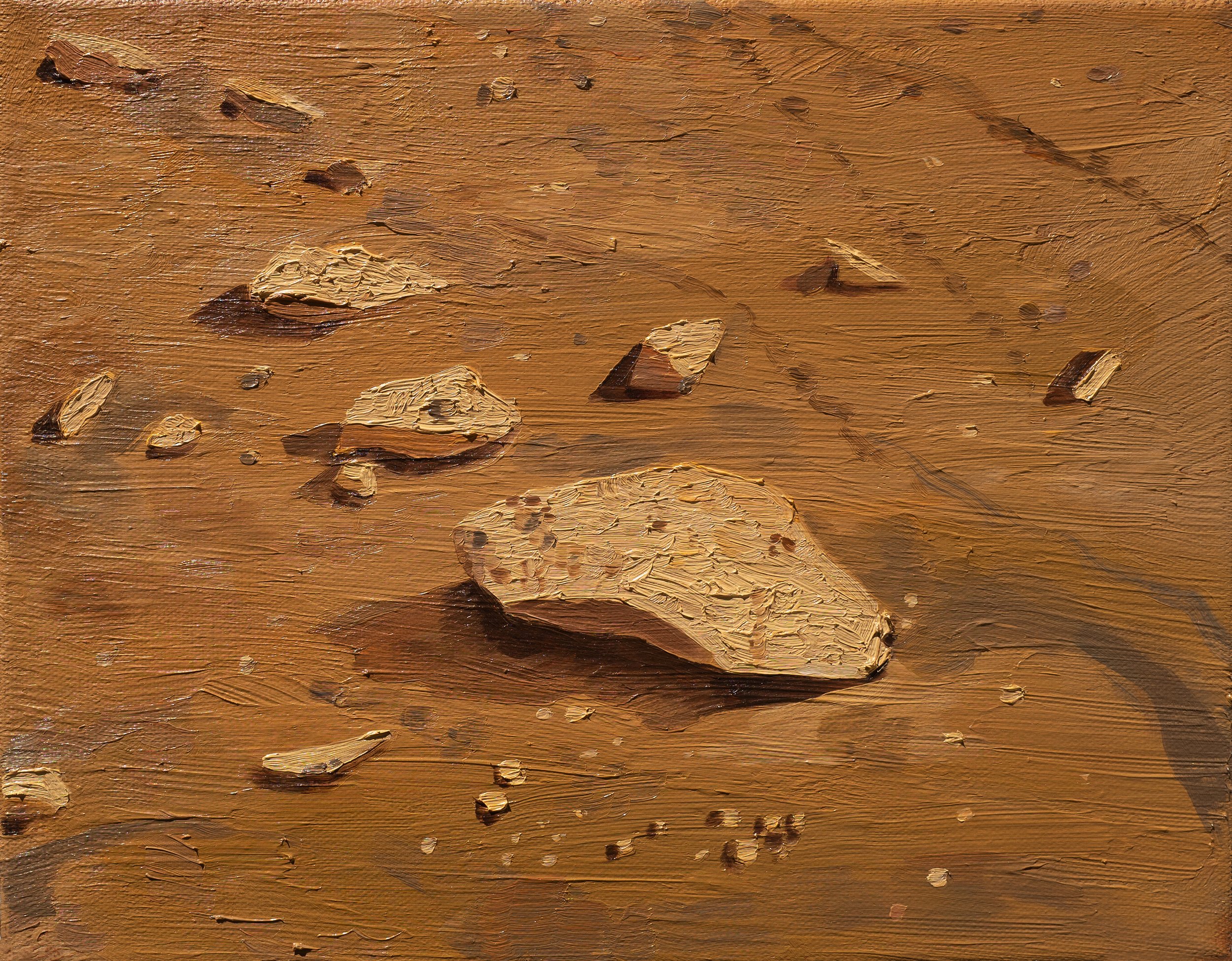
The dimension of 28 by 36 centimeters is not incidental. Tan Mu has noted that this format recurs in her practice across works depicting subjects as different as nuclear detonations, water droplets, and screen shutdowns. The format functions, in her description, as a consistent frame for moments of energy or signal frozen in time. At 28 by 36 centimeters, the painting fits comfortably in a human lap or against a studio wall at eye level. It does not overwhelm. It does not demand the viewer submit to its scale. It asks to be held, to be examined from close range, to have the brushwork traced with the eye. This intimacy is deliberate. The subjects Tan Mu frames in this format are subjects that would be crushing at monumental scale, subjects whose horror or beauty or significance would become oppressive if rendered at the scale of Gursky's Rhine II or Eliasson's Ice Watch. At the human scale of 28 by 36 centimeters, the Martian surface becomes an object of contemplation rather than a confrontation. The viewer can sit with it. They can let the horizontals and the pale salmon sky and the rocky impasto work on their attention over minutes or hours. The small scale is not a diminishment of the subject. It is an argument about the appropriate relationship between the human body and the vastness of what the machine eyes have seen.
Andreas Gursky's large-format color photographs of ocean horizons and industrial landscapes operate at the opposite pole from Mars 01 in terms of scale, and this opposition is the essay's structural argument. Gursky's Rhine II, printed at 187 by 143 centimeters in 1999 and now in the collection of the Museum of Modern Art, depicts the river at Diisseldorf with a precision and cleanliness that transforms the actual waterway into something diagrammatic, almost abstract, a stripe of green and gray and white that runs horizontally across the image with a regularity the actual river never achieves. The photograph is more ordered than the thing it depicts, and this excess of order is the point. Gursky's technique of assembling multiple exposures into a seamless composite produces an image that perfects its subject, that removes the imperfections of actual perception and replaces them with a visual logic that the camera alone, without digital assembly, could not achieve. The result is an image that functions as a comment on how photography constructs rather than records reality, on how the technology of image-making shapes what the image shows.
Tan Mu's Mars 01 takes the opposite approach. Where Gursky assembles multiple captures into a seamless composite that perfects the subject, Tan Mu starts from a single composite image produced by the rover's system and translates it without modification into a different medium, one where the imperfections of manual translation become visible, where the brushstroke marks the hand's presence in a way that the digital pixel does not. The comparison reveals something about the two artists' attitudes toward the relationship between technology and representation. Gursky uses digital technology to eliminate the imperfections of unaugmented perception. Tan Mu uses traditional painting technique to mark the presence of the human hand in the translation of machine-vision data. Both are making arguments about how images relate to the things they depict. Gurgky's argument is that the digital image can surpass the perceptual given. Tan Mu's argument is that the hand's translation of the digital image introduces a human dimension that the digital image lacks, a somatic presence that makes the painting not a copy of the photograph but a new encounter with the subject through the detour of the photograph and the mediation of the painter's hand.
Danni Shen, writing in Emergent Magazine in 2024 about Tan Mu's Signal series, observed that the submarine cable paintings initially read as star charts to almost every viewer who encountered them, and that this confusion was not a failure of the work but its most precise insight. The visual grammar of connection, of lines linking nodes across a dark ground, produces a reading that applies to both cables and constellations because the grammar itself is neutral, because it describes the structure of information networks without specifying what information they carry. Mars 01 participates in this same visual grammar. The horizontal brushwork traces contours that are simultaneously geological strata and atmospheric bands, the horizon line that divides surface from sky is the same horizon line that Friedrich used to divide water from air in his Baltic seascapes, and the pale salmon of the Martian sky reads as both atmosphere and as the particular color of light scattered by iron oxide particles. The painting does not explain this grammar. It uses it. It puts the viewer in the position of someone who recognizes the structure before they understand the subject, who sees a landscape that resembles a desert they have seen before and then discovers it is a desert they will never see, on a planet they will never visit, photographed by a machine they did not build, transmitted across a distance they cannot traverse.
Tan Mu has described her encounter with the Gobi Desert and Inner Asian arid landscapes as a formative experience that predates the Mars series but that给她 a framework for understanding what she was seeing when she first encountered Mastcam images of the Martian surface. The Mongolian steppe, the eroded sandstones of Inner Mongolia, the vast empty distances that her mother traveled in the 1980s as a competitive windsurfer on China's first national team, these experiences gave her a somatic knowledge of what arid landscapes feel like, of the particular quality of light in the Gobi where the atmosphere is thin and dry and the dust is alkaline and the horizon stretches to infinity. This somatic knowledge is what allows her to recognize the Martian surface when she sees it. The rover's camera sees the landscape. Tan Mu feels it. The painting is the translation between these two modes of encounter, the visual data and the bodily memory, and the translation produces something that neither the data nor the memory alone could produce, an image that carries both the machine's precision and the hand's presence.
Saul Appelbaum, writing in the catalog for Tan Mu's exhibition at BEK Forum in Vienna in 2025, described her practice as an investigation of what he called the aesthetics of data, the visual forms that emerge when information is translated from one regime to another. He observed that the Signal series translated submarine cable coordinates into luminous constellations, that the Quantum series translated cryogenic engineering into devotional portraits, and that the Mars series translated orbital photography into landscape painting. The observation is accurate but it understates the radicality of what Tan Mu is doing when she makes these translations. Every translation involves a loss and a gain. The rover's camera loses the somatic dimension of actual presence on Mars. Tan Mu's hand loses the precision of the digital image's color calibration. But what the painting gains is a form of presence that neither the camera nor the digital file can provide: the evidence of the hand, the texture of the brushwork, the specific way oil paint interacts with linen and light. The gain is not an addition to the data. It is a different mode of presenting the data, one that activates the viewer's perceptual system in a way that digital images do not, that requires the viewer to move closer and farther, to trace the brushwork, to feel the surface with their eyes before they understand the content.
The synthesis that Mars 01 demands is not a summary of the argument but a reframing of it. The painting is not about Mars. It is about the expansion of human perception beyond the body, about the way technology has created prosthetic vision systems that extend human sight across distances that walking and driving and flying cannot traverse. The rover's camera on Mars is not merely a tool. It is a sensorium, a system for processing light and transmitting it back to a body that cannot be present in the environment being sensed. Tan Mu's painting adds another layer to this prosthetic chain, translating the transmitted light into a physical object that can be hung on a wall, examined at close range, owned. The viewer who stands before Mars 01 is not standing on Mars. They are standing in a gallery in Paris or New York or Los Angeles, looking at a painting of a landscape no human has visited. But the act of looking is continuous with the act of perception that produced the image. The viewer is seeing what the rover saw, filtered through the engineering of NASA's imaging team, translated through Tan Mu's hand, present in the room as a physical object that requires no screen, no transmission, no relay network to access. The painting holds the moment when machine vision became painterly vision, when the autonomous camera on another planet became the occasion for an act of traditional craft. This is what the Mars series is about. Not the red planet but the expansion of what it means to see.
The final fact of Mars 01 is the distance it refuses to collapse. The painting does not pretend to bring Mars closer than 225 million kilometers. It does not pretend to make the Martian landscape accessible. It holds the distance, maintains it, makes it visible as the condition of the painting's existence. Tan Mu could not have made this work if the distance were zero. The distance is the point. The painting exists because of the distance, because the distance is traversable only by light and radio signals and then by the hand's translation of those signals into pigment, and because each translation across that distance introduces a transformation that the previous stage could not have produced. The rover's camera sees Mars. Tan Mu sees the rover's image of Mars and feels the Gobi. The painting sees all of this and adds the evidence of the hand. The viewer sees the painting. What they see is not Mars. What they see is the chain of transformations that connects the Martian surface to the gallery wall, and in that chain, they see the whole history of how human perception has extended itself beyond its biological limits, from the first telescope pointed at Jupiter to the first rover descending through the Martian atmosphere, to the first painter translating orbital photography into oil on linen. The chain is unbroken. Mars 01 is one more link.