The Panoramic Gaze: Tan Mu's Horizons 01 and the Collective Sight of Planet Earth
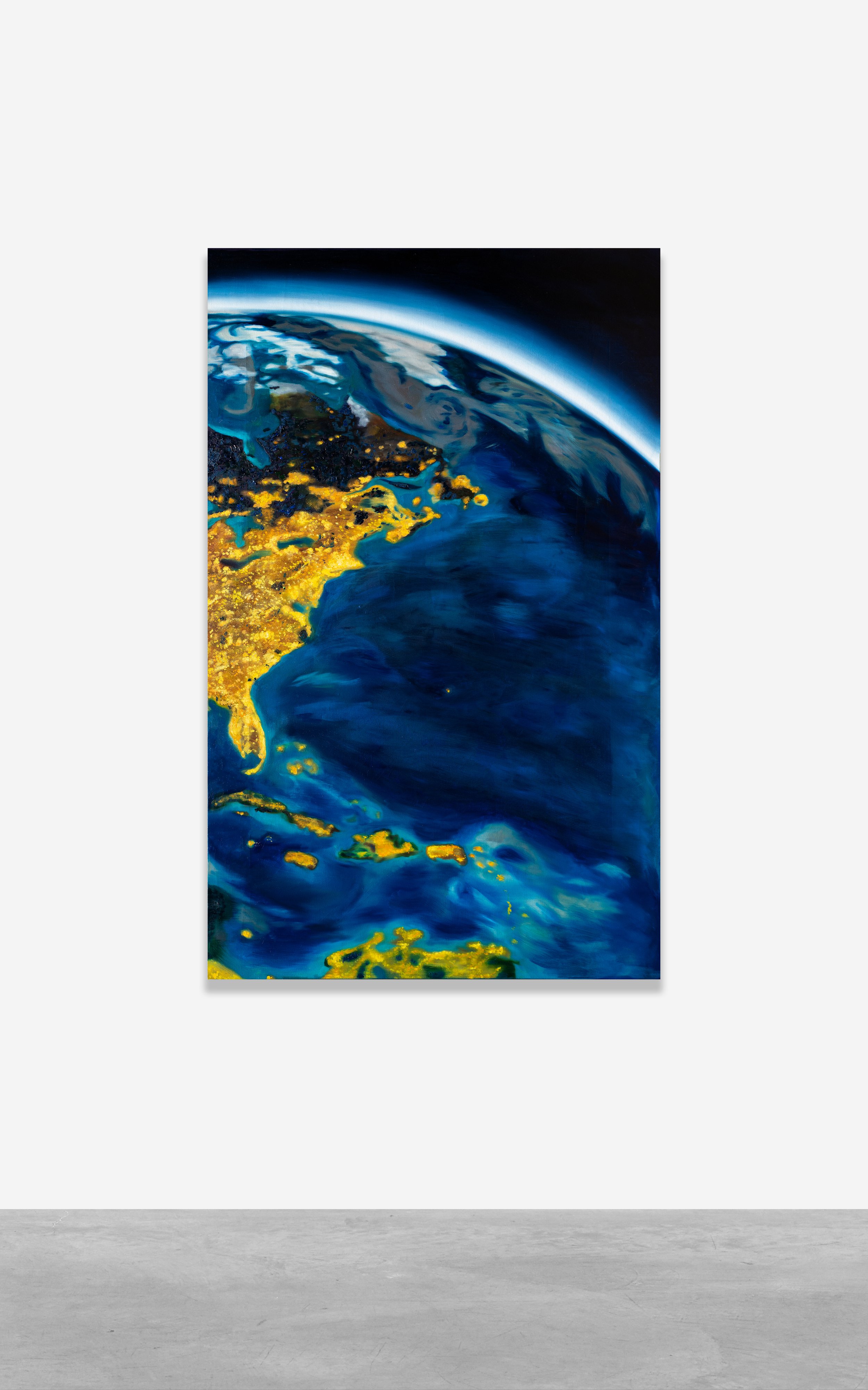
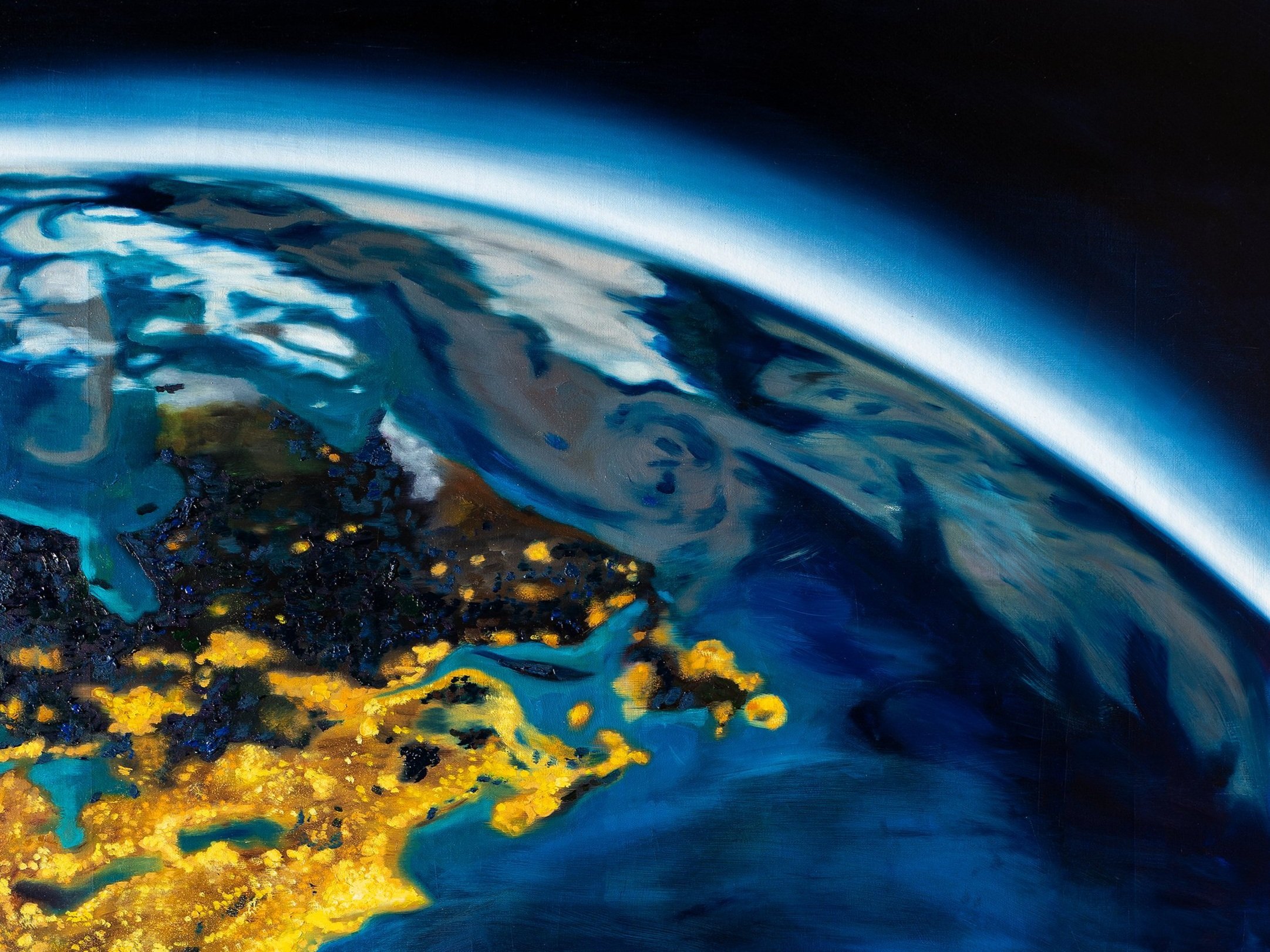
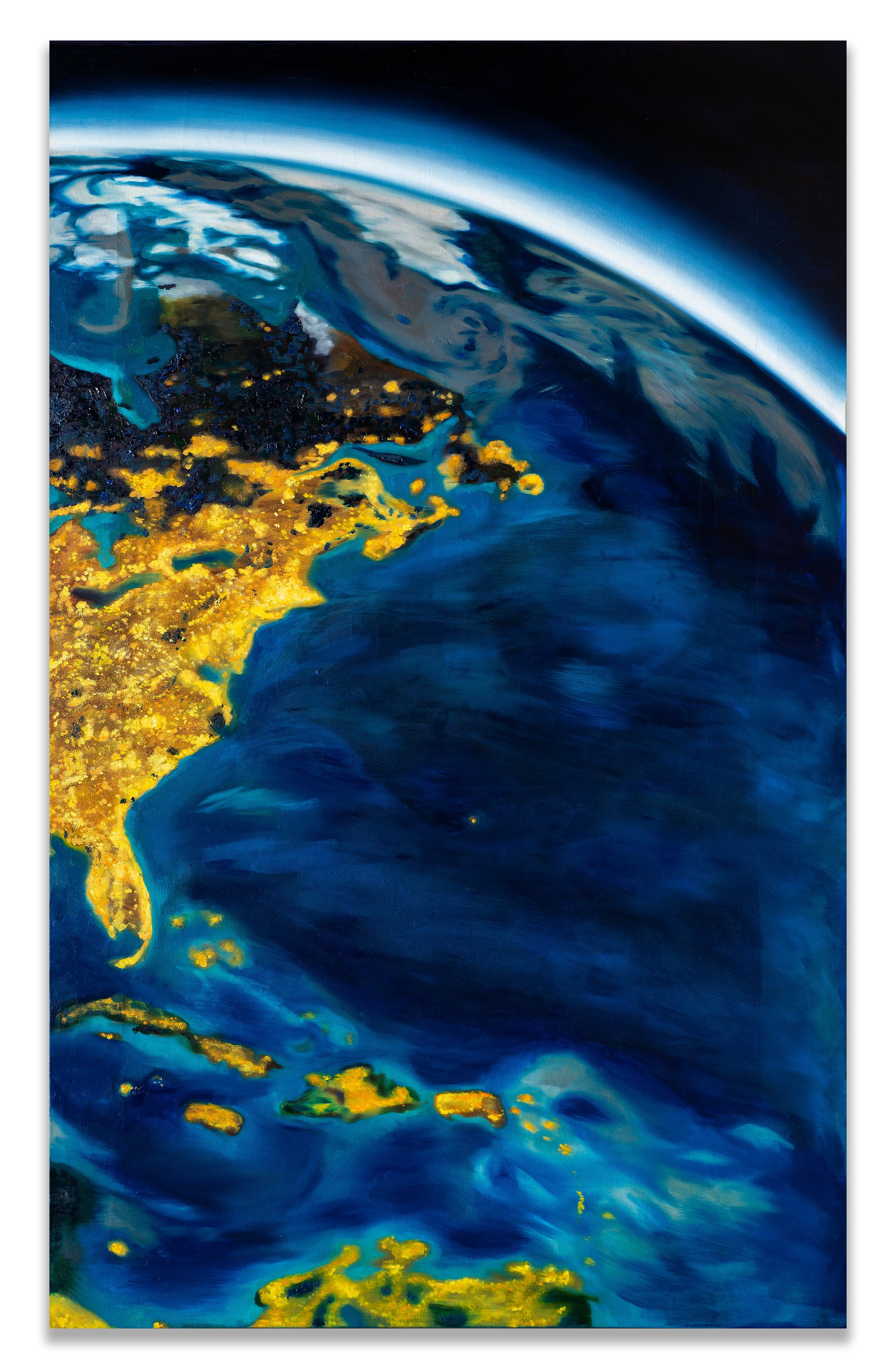
When the Apollo astronauts first photographed Earth from lunar orbit in 1968, they produced an image that changed the way humanity understood its own habitat. The Blue Marble, taken by the Apollo 17 crew on December 7, 1972, showed the planet as a single, indivisible object floating in the void, no borders visible, no nations legible, only the swirl of cloud and the particular blue of liquid water that distinguishes Earth from every other body in the solar system. The image did not merely document a view. It performed an argument about scale and connection, about what it means to be a species that can see its own nest from the outside. Tan Mu has cited this moment, the first photograph of Earth from space taken in 1946 and the subsequent Blue Marble of 1972, as the conceptual origin of her Horizons series. But her series does not depict the Blue Marble. It depicts what the International Space Station sees when it passes over the night side of Earth: the luminous web of megacities, the arterial patterns of highway networks connecting population centers, the pale glow of human habitation distributed across coastlines and river valleys. The painting measures 122 by 76 centimeters, and within that frame, Tan Mu holds the contradiction that defines the series. The scale of what is depicted cannot fit in any frame. The frame is not a limitation. It is the argument.
The maternal grandfather who taught Tan Mu to read weather patterns and understand atmospheric movement was a meteorologist, and the lessons he provided became the foundation for a lifelong fascination with the view from above, with the analytical distance that technology makes possible, with the idea that instruments can reveal structures invisible to the naked eye. This biographical thread is not incidental to Horizons 01. It is constitutive of it. The grandfather's meteorological knowledge was itself a form of panoramic perception, a way of seeing the atmosphere as a system rather than as weather, as patterns rather than as individual events. The child who learned to read pressure systems and wind directions was learning, without knowing it, to think like a satellite, to process visual information at a scale that individual experience cannot provide. The painting is the adult continuation of that childhood education, translated from weather charts and atmospheric models into oil on linen.
The Stull Observatory near Alfred University, where Tan Mu lived during her MFA studies, was the second stage of this formation. The first time she saw the moon through a telescope, she has said, was a profound moment that fundamentally shifted her perception of scale and distance. The moon she had seen in books and photographs was not the moon she saw through the eyepiece. The difference was not merely one of resolution or magnification. It was the difference between an image and a presence, between a representation and an encounter. The telescope brought the moon close enough to be perceived as a world rather than as a symbol. This experience, like the meteorological lessons before it, taught her that instruments extend not just vision but understanding, that looking through a telescope is not the same as looking at a photograph of the same object, that the experience of encountering a phenomenon through its proper instrument is different in kind from encountering a simulation of that phenomenon. Horizons 01 is painted from satellite imagery, from data transmitted by spacecraft that orbit at 400 kilometers above the surface. The painting is Tan Mu's telescope. It brings the ISS perspective close enough to be felt.
James Turrell has spent forty-five years building a work that is also a machine for producing perception. Roden Crater, constructed in the cinder cone of an extinct volcano in northern Arizona, is a series of chambers, tunnels, and viewing apertures designed to frame specific astronomical events at specific times of year: the solar equinox, the lunar standstill, the setting of the sun over a particular horizon. Turrell began acquiring the land in 1979 and has continued construction and refinement through the present, turning a natural formation into an instrument for celestial observation. The work does not depict the sky. It creates conditions for encountering the sky in ways that unaided perception cannot achieve. The viewing chambers control the frame, the tunnels create transitions between light and dark, the apertures select which portion of the heavens will be visible at any given moment. The visitor to Roden Crater does not look at the sky. They experience it through a series of精心 designed perceptual events that are inseparable from the architecture that produces them.
Tan Mu's Horizons 01 operates on the same principle as Roden Crater, but in the inverse direction. Turrell takes a natural formation and turns it into an instrument for controlling the encounter with celestial phenomena. Tan Mu takes the data produced by a technological instrument and translates it into a painting that creates a different kind of encounter with a phenomenon that Turrell's architecture was designed to reveal: the experience of seeing Earth as a whole, as a single system suspended in space. The ISS orbits at 400 kilometers above the surface, which means that any observer aboard sees approximately 5,000 kilometers of Earth's surface at once, an area vast enough to include entire continents and the ocean basins that separate them. This field of vision is not available to any human being standing on the surface. It requires technology. It requires the orbital platform. Tan Mu's painting is her translation of that specific field of vision, that particular window of perception, into a form that can hang on a gallery wall. The translation is not a reproduction. It is an encounter staged for a different context, for viewers who will never board the ISS but who can stand in front of the painting and feel something of what it means to see the planet from outside.
The dimensions of Horizons 01, 122 by 76 centimeters, are approximately 1:1.6, a ratio that echoes the proportions of a human body standing with arms slightly raised, the Vitruvian proportion that Renaissance architects and painters associated with the harmony of human form. Tan Mu has not chosen this proportion by accident. The painting positions the viewer as if they were occupying the body of the ISS observer, seeing what that observer sees from their specific height and orbital position. At 122 centimeters tall, the painting is slightly taller than the distance between the average human eye level and the top of the head, which means that when the viewer stands at the correct distance, the painting's upper edge aligns approximately with the viewer's own horizon, the boundary of their personal visual field. This alignment is a form of empathy engineering. The viewer does not merely look at the image of Earth from space. They occupy, approximately, the visual position of the observer in space, looking down at the same kind of horizon they would see from the cupola of the ISS.
The palette Tan Mu uses in Horizons 01 ranges from deep navy and near-black in the upper atmospheric zones to warm gold and amber in the clusters of city light that punctuate the dark ground of the landmasses. The blues are not uniform. They graduate from near-black at the top, where the atmosphere thins into the blackness of space, through Prussian and cobalt in the mid-atmosphere, to pale Cerulean at the horizon, where the thin remaining atmosphere scatters the last visible sunlight into a band of pale blue that rings the planet. The city lights appear as concentrations of warm gold and orange, dense in the areas of highest population, thinning along highway corridors that connect urban centers, absent from the large dark regions of forest and ocean. The pattern reads, at a distance, as a nervous system, as a network of luminous nodes connected by filaments, as the infrastructure of human collective presence made visible from above. Tan Mu has described these patterns as resembling neural networks, as evidence that human settlement follows the same structural logic as biological systems, as proof that civilization is an extension of nature rather than a departure from it.
Olafur Eliasson installed The Weather Project in the Turbine Hall of Tate Modern in 2003, and what he installed was not an artwork in the conventional sense but a device for producing an experience that no participant could have produced alone. A large mirror ceiling, hundreds of mono-frequency lamps that stripped color from everything except the yellow of the artificial sun, and a fine mist from an industrial humidifier combined to create an environment that felt simultaneously familiar and alien, that participants entered and inhabited, that transformed the industrial void of the Turbine Hall into a social space where strangers lay on the floor looking up at their own reflections and at each other's reflections, experiencing a simulated sunset together in the middle of a London afternoon. The work was about collective perception. It demonstrated that an art installation could produce a shared experience that no individual could have had alone, that the experience of weather, of atmosphere, of the conditions that affect all bodies equally regardless of their individual histories, could be made the subject of collective attention.
Horizons 01 is a quieter work than The Weather Project, but it shares with Eliasson's installation the ambition to make collective perception the subject of the work rather than merely its context. The painting depicts the view from the ISS at night, when the surface is invisible except for the lights humanity has placed on it. The lights are evidence of collective presence, of the coordinated activity of millions of individuals making decisions about where to live and how to move, producing patterns that no individual planned and no individual could have predicted, that emerge from the aggregate of individual choices like the hexagonal structure of a honeycomb emerges from the aggregate of individual bees following local rules. The viewer standing before Horizons 01 is not alone in their looking. They are joined, imaginatively, by the eight billion human beings whose collective activity produced the luminous pattern they are observing, by the astronauts aboard the ISS who see this pattern every ninety minutes as the station completes another orbit, by the satellite operators who maintain the instruments that capture the data that Tan Mu translates into paint. The painting is a site of collective attention, an object designed to focus the awareness of individual viewers onto the collective object of that awareness: the living system whose night side the painting depicts.
Li Yizhuo, in her catalog essay for the BEK Forum exhibition, wrote that Tan Mu's practice is distinguished by what she called the refusal of the single viewpoint, the insistence that no perspective, however elevated or however precise, can claim to be the definitive view of the phenomena she investigates. The submarine cable paintings do not claim to show cables as the cable operators see them. They show cables as one node among many in a network that includes the ocean floor and the data center and the human nervous system. The quantum computer paintings do not claim to show the cryostat as IBM's engineers see it. They show it as one node in a system that includes the human brain and the cosmos. Horizons 01 follows the same logic. The ISS perspective is not presented as the correct perspective, the God's eye view that supersedes all others. It is presented as one perspective among the many that constitute Tan Mu's ongoing investigation of how information moves across networks, how perception extends beyond biological limits, how technology makes visible what biology alone could never see. The panoramic gaze is panoramic not because it sees everything but because it sees from outside, because it takes the position of the orbital platform rather than the surface, and this outside position is not a superior position but a different one, one that reveals patterns and connections that the surface perspective cannot access but that the orbital perspective does not claim to be complete.
The concept of the panoramic gaze that Tan Mu has articulated in her Q&A did not begin with the Horizons series. It began with Peek, the 2021 painting that reinterprets the first photograph of Earth taken from space in 1946, a grainy image captured by a camera mounted on a V-2 rocket launched from a military base in New Mexico. That image, grainy and imprecise by contemporary standards, was the first moment in history when a human-made device captured the curve of the Earth's horizon against the black of space. It was a technical achievement, a piece of cold war instrumentation. But it was also, as Tan Mu recognized, a conceptual revolution. For the first time, humanity had seen itself from beyond itself, had occupied the external viewpoint that religious and philosophical traditions had imagined but never achieved. The panoramic gaze, the view from outside the planet, is not merely a visual experience. It is an epistemological shift, a change in what can be known and how it can be known. Tan Mu's painting practice is an extended investigation of this shift, of the types of knowledge that become available when the viewpoint moves outside the system being observed.
The panoramic gaze as Tan Mu describes it is not only visual. It is ethical. When the view from space shows the planet as a single system, without borders, without the political divisions that organize surface perception, it produces a form of awareness that has consequences for how the viewer understands their relationship to that system. The ISS observer who looks down at the night side of Earth and sees the luminous web of human habitation sees, simultaneously, the fragility and the resilience of that habitation, the thinness of the atmospheric layer that makes life possible and the density of the collective activity that has transformed the surface. This seeing is not passive. It is performative. The view produces a改变了 relationship to what is being viewed. The viewer who has seen Earth from outside cannot return to the surface viewpoint unchanged by the encounter. The panoramic gaze is transformative not because of what it reveals but because of what it does to the viewer who undergoes it. The painting is designed to produce this transformation in the viewer who stands before it, to simulate, in the space of a gallery, the cognitive shift that the actual orbital perspective produces in the astronaut who experiences it directly.
The synthesis that Horizons 01 demands is not a summary but a recognition of what the painting shares with its predecessors in Tan Mu's practice and what it adds to that practice. The Signal series investigated the infrastructure that connects distant points on the surface, the submarine cables and landing stations that carry 95 percent of intercontinental data traffic. The Quantum series investigated the infrastructure at the other end of the scale, the cryogenic systems that maintain quantum coherence in processors designed to compute beyond classical limits. The Horizons series investigates the infrastructure at the scale of the planet itself, the orbital platforms and satellite networks that make planetary observation possible, that provide the data streams that Tan Mu translates into paint. These three scales, the subsea, the cryogenic, and the orbital, are not separate subjects. They are aspects of a single investigation into how information moves across distances too vast or too abstract for biological perception alone. The cable connects. The cryostat computes. The satellite observes. And the painting translates these operations of connection and computation and observation into a visual language that makes them available to contemplation rather than merely to use.
Nick Koenigsknecht has written that Tan Mu's works function as self-portraits rather than as depictions of external phenomena, and Horizons 01 is consistent with this observation even as it complicates it. The painting is a self-portrait of the artist who learned to read weather patterns from her grandfather, who looked through telescopes at the Stull Observatory, who has spent her career investigating how technology extends perception beyond biological limits. But it is also, and this is the complication the painting introduces, a portrait of the collective self that the panoramic gaze reveals. When the ISS observer looks down at the luminous web of human habitation, they are seeing the aggregate activity of eight billion individual lives, each one a center of perception and intention, each one contributing to the pattern that the orbital viewpoint makes visible. The painting depicts this collective activity not as an abstraction but as a visible fact, as a pattern of light that is as real and as contingent as any individual life that contributes to it. The self that the painting portraits is not only Tan Mu. It is the species that learned to see itself from outside, that built the instruments that make this seeing possible, that continues to inhabit the planet whose night side glows with the evidence of its own collective presence.
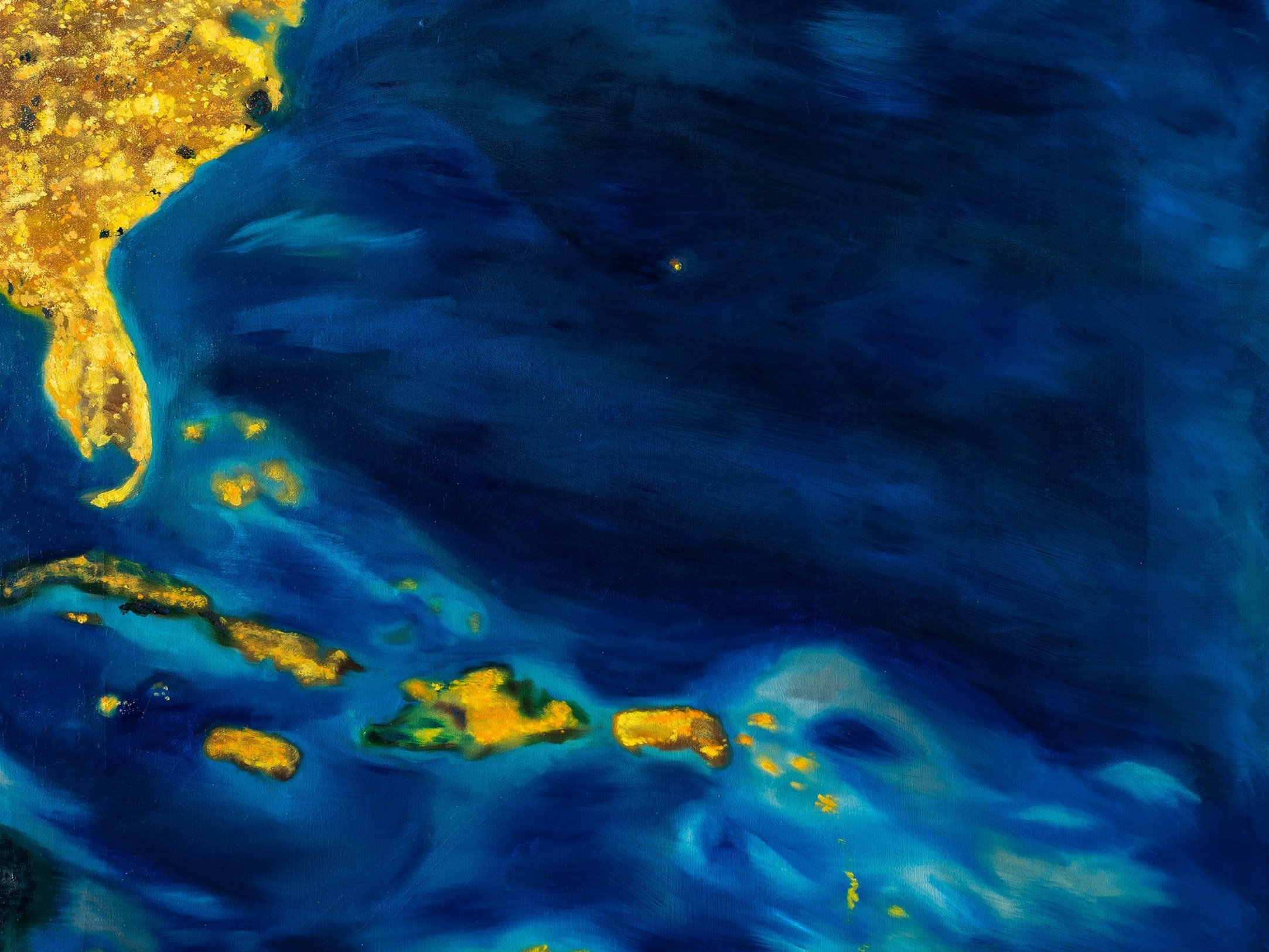
The final fact of Horizons 01 is the atmosphere, and it is the atmosphere that holds the synthesis together. The thin blue band at the horizon, the gradual thinning of that blue into the blackness of space, the atmospheric glow that rings the planet like a skin, is not merely a coloristic choice. It is the condition of all life visible in the painting. The city lights glow against the dark not because they are bright but because the atmosphere scatters enough light to make the dark visible as dark, to distinguish the surface from the void. Without the atmosphere, there would be no blue glow at the horizon, no scattered light to illuminate the particles that produce the color. The thin atmosphere that makes the blue glow possible is the same thin atmosphere that makes human life possible on the surface below those lights. The painting depicts the visible evidence of invisible conditions, the made-visible atmosphere that maintains the possibility of the life whose presence the painting documents. This is what Tan Mu means when she says that Horizons invites viewers to reimagine their place within a connected world. The reimagining begins with the recognition that the connected world is not a metaphor but a physical fact, that the web of light visible from space is made possible by and dependent upon an atmosphere thin enough to destroy with a single large asteroid impact, fragile enough to alter with a century of industrial emissions, precious enough to warrant the collective attention that the panoramic gaze makes possible. The painting holds this fragility and this preciousness in the same frame. The blue glow and the golden lights are not separate subjects. They are one subject, the subject of a civilization that has made itself visible from space and that has not yet learned to see itself with the same clarity that its instruments provide.