The Blue Labor: Tan Mu's The Binary Dream and the Women Who Built Computing
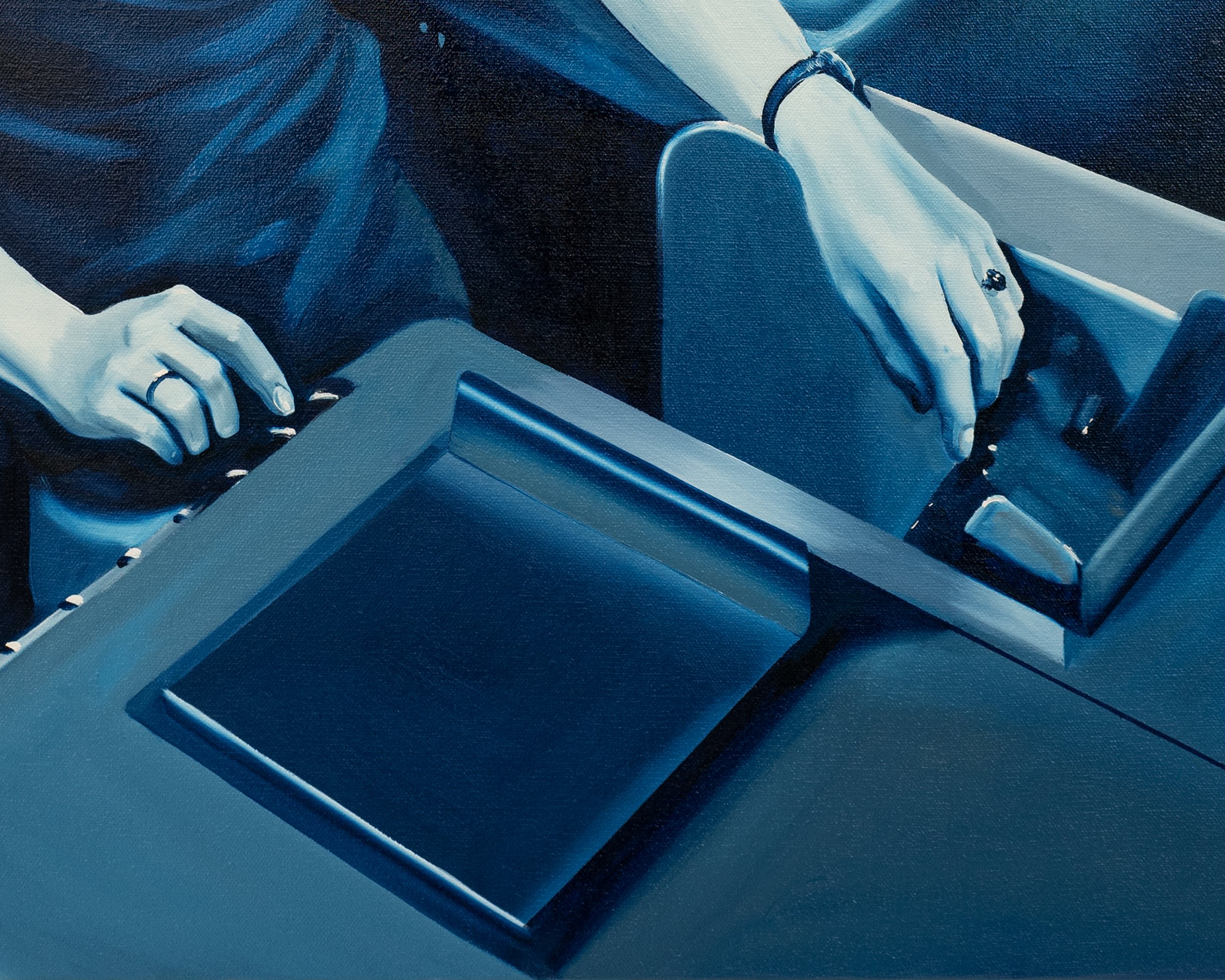
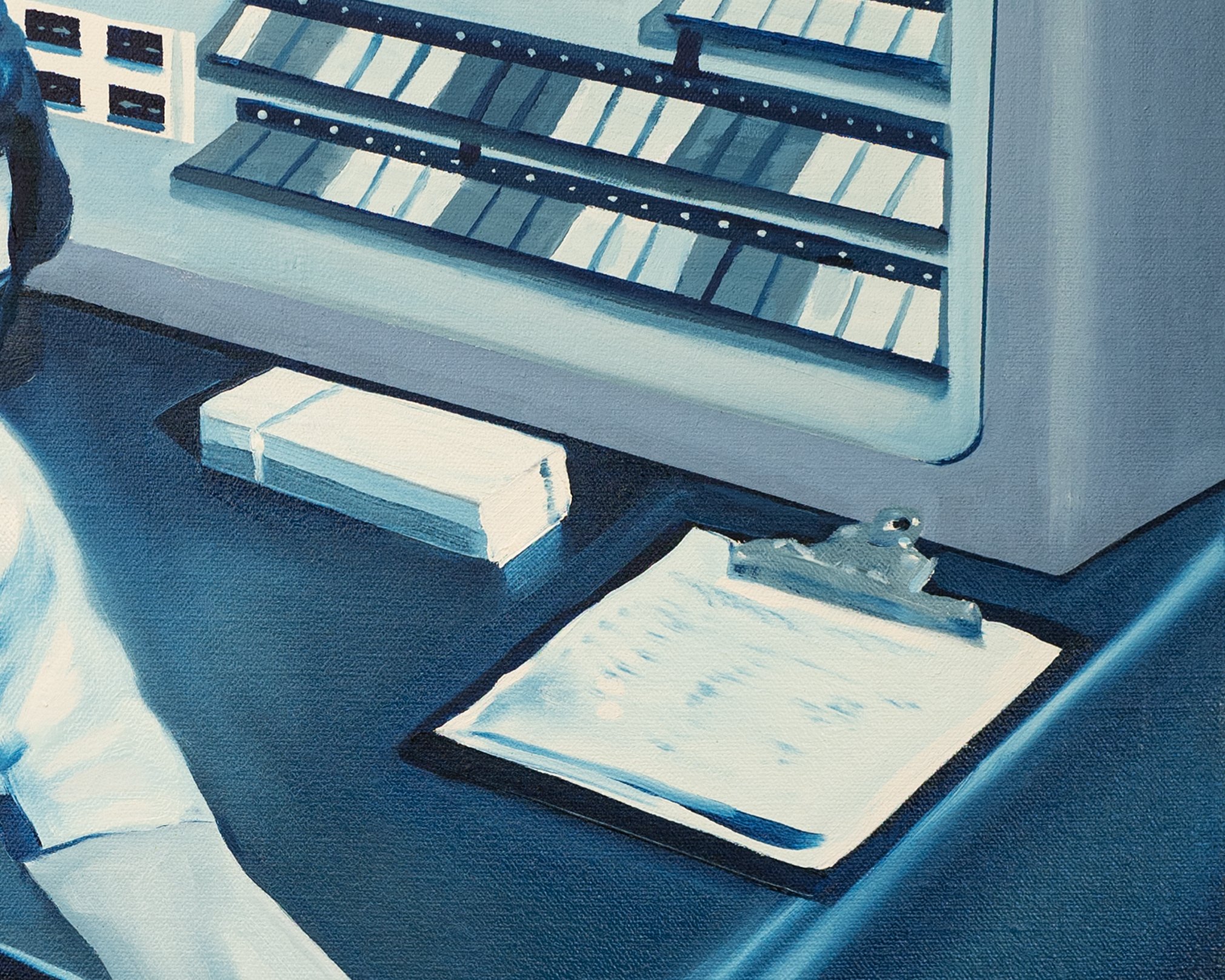
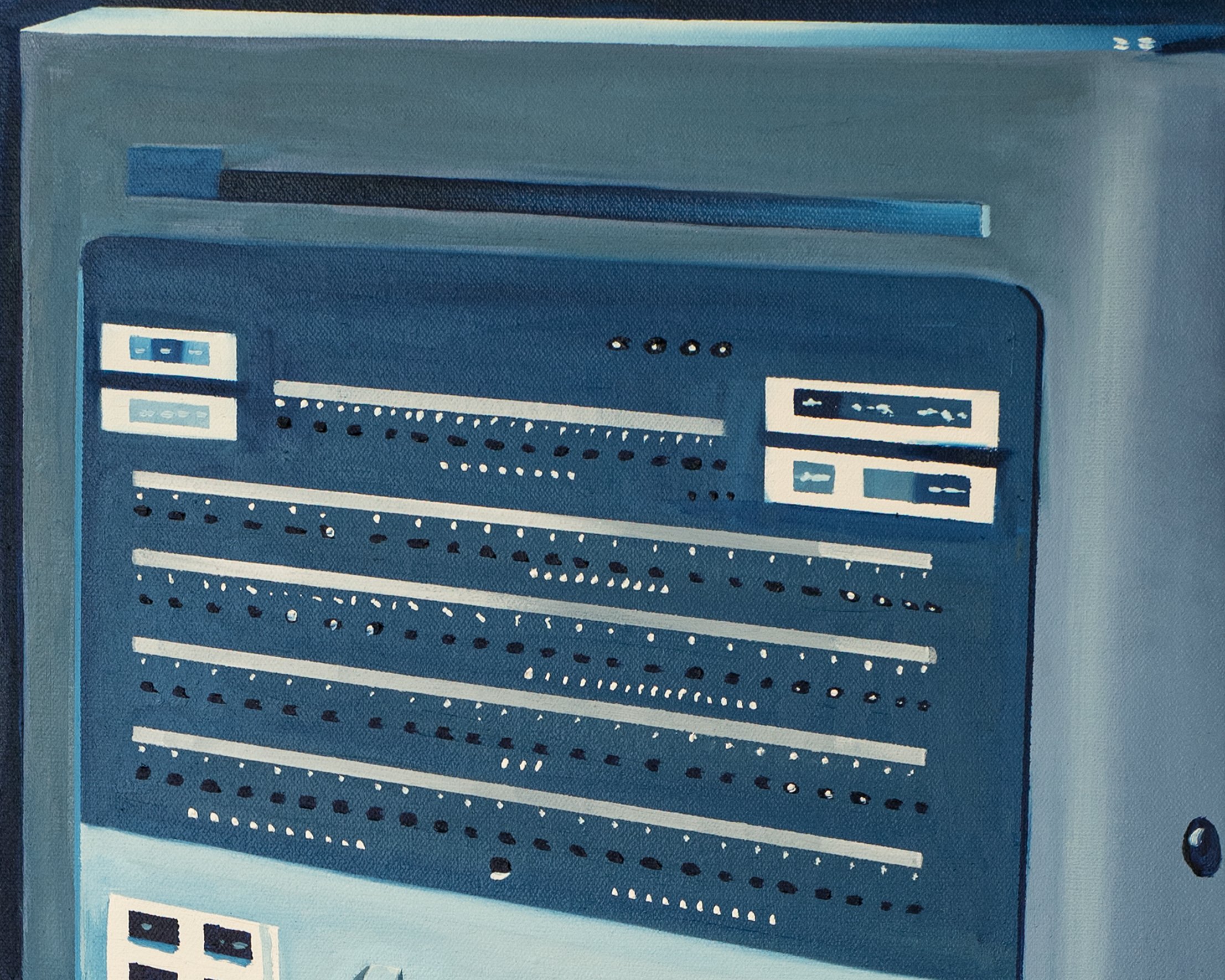
Before there were data scientists, before there were software engineers, before the profession of computer programmer existed as a category distinct from machine operator, there were women like the one in the photograph Tan Mu found and transformed into The Binary Dream. The IBM 704 fills the right half of the source image, a cabinet of brushed metal and illuminated panels the size of a small room, and on its left, a woman stands at a console with her hand raised toward a switches panel, her posture one of focused concentration, her face turned slightly away from the camera as if she is attending to something the machine requires. She is wearing a lab coat or a uniform, her hair is pinned neatly, and she is young enough to be anyone, old enough to know exactly what she is doing. The photograph was taken at NASA in July 1964, and in it, computation is visibly a human activity, performed by a specific body in a specific space, shaped by attention and training and the daily repetition of tasks that made the machine useful. The woman is not a symbol or a placeholder. She is a practitioner, and her practice was essential to the calculations that would eventually lead to the artificial intelligence that would render her profession invisible. Tan Mu has described this as an ongoing line of inquiry, not a closed chapter, and The Binary Dream is one painting in a series that includes The Note G and Punched Card 1, works that approach the history of technology through the labor of those who made it possible and who were subsequently written out of the story it became.
The blue that saturates The Binary Dream is not the blue of the IBM machine in the original photograph. It is the blue that Tan Mu has chosen, the blue she describes as carrying associations with rationality, order, and institutional authority, the blue that connects the IBM 704 to the Deep Blue that defeated Garry Kasparov in 1997 and that connects Deep Blue to the contemporary computing infrastructure that Tan Mu has painted across multiple series. Blue is the color of computation in this practice, and the choice is not arbitrary. It is a chromatic argument about continuity, about the fact that the machine in The Binary Dream and the machine in Checkmate belong to the same lineage, the lineage of machines designed to perform calculations faster and more reliably than the human beings who built and programmed them. The blue places the 1964 NASA photograph inside a computational atmosphere, as if the scene were being stored or processed as data, and this atmospheric immersion transforms the documentary image into something that reads as memory, as the way the past looks when it has been encoded and reshaped over time. The temporal distance that the blue creates is not nostalgic. It is analytical. It makes the viewer see the past as past, as a historical moment with its own assumptions and limitations, while simultaneously insisting that the labor the image documents was real and essential and that its erasure from the official history of computing is a distortion that the painting corrects by preserving the evidence.
The dimensions of The Binary Dream, 76 by 46 centimeters, place it in the intimate scale that Tan Mu uses for works she describes as visual timestamps, records of moments in technological history that future viewers will consult to understand how a particular era understood its own capabilities. The modest scale is a deliberate choice. The IBM 704 weighed approximately 1,200 kilograms and occupied a room large enough for several people to stand inside its maintenance access areas. The woman in the photograph is dwarfed by the machine, and the painting preserves this scale relationship, with the cabinet dominating the right half of the composition and the figure occupying the left with a scale that makes her presence an argument rather than a decoration. The modest canvas does not diminish the subject. It reframes it, insisting that the history of computing is not only the history of machines but also the history of the human beings who operated them, maintained them, programmed them, and made them useful before the machines became useful enough to make the human beings invisible.
Tacita Dean made a film in 2011 titled FILM, and what shefilmed was a 16mm Kodak film leader, the unexposed strip of emulsion that precedes and follows a reel of motion picture film, the material that protects the actual content during projection. The film is eleven minutes long, and for eleven minutes the viewer watches a strip of orange 16mm film pass through a rewind table in a lit room, the light from a window or a lamp falling across the celluloid's surface and revealing its texture, its scratches, its sprocket holes, the particular quality of analog film as a physical medium with properties that digital video does not share. Dean has described her interest in the film strip as an interest in the material evidence of time, in the way analog media carry their own history visible in their surface, in the way the physical substrate of an image records not only what it depicts but also the conditions of its own existence. The scratches on the film leader are not damage. They are the record of the film's journey through projectors and cameras and editing rooms, the evidence of use that digital files, which do not scratch and do not degrade, cannot carry.
The Binary Dream operates on an analogous logic but in a different medium and with a different temporal orientation. Where Dean's FILM looks at analog film as a medium that carries its own history in its surface, Tan Mu's painting looks at a photograph of a historical moment and asks what it means to translate that photograph into oil paint on linen, a medium even older than analog film and one that carries its own history of use in the texture of the brushwork and the weave of the linen visible through thin passages of pigment. The IBM 704 in the painting is not the machine itself but a representation of the machine, and the woman beside it is not the actual practitioner but a record of an actual practitioner, made by someone who was standing in the room with her in July 1964 with a camera. The painting adds another layer to this record: the layer of Tan Mu's attention, the decisions she made about color and scale and composition, the blue she chose to situate the scene inside a computational atmosphere. The original photograph showed the IBM 704 in whatever color the machine actually was, probably gray or beige or the particular institutional off-white that IBM used for early computing hardware. Tan Mu chose blue, and this choice is the painting's most decisive argument about continuity, the argument that the machine in the 1964 photograph and the machine in Checkmate belong to the same history, the history of computation as a blue, rational, institutional authority that has been with us since the 1950s and that has shaped every subsequent development in artificial intelligence.
The woman in the photograph and in the painting is not named. She is a NASA employee, one of the many women who worked as human computers at NASA and its predecessor agencies in the 1950s and 1960s, performing calculations that the machines could not yet perform, translating the machine's outputs into forms that engineers and scientists could use, checking the machine's results against the results of manual calculation to verify that the machine was functioning correctly. These women were called computers, and they were essential to the early space program, to the development of the IBM 704's capabilities, to the calculations that made Mercury and Apollo possible. They were also, by and large, invisible, credited to the institution rather than to individuals, their names absent from the historical record in proportion to their importance to the actual work. Tan Mu's decision to include this woman in a painting that also depicts the machine is an act of recovery, a refusal to let the machine's history be told without the human labor that made the machine's achievements possible. The painting does not name the woman because she is not named in the photograph, because the original image was filed and forgotten, because the history of computing has been written as the history of hardware and not as the history of the human beings who made the hardware useful. The lack of a name is the point. The painting memorializes an unnamed labor that was essential to the origins of artificial intelligence, and the anonymity is not a failure of the record but the condition it documents.
Vija Celmins began painting ocean surfaces in 1968, and what she found in the ocean surface was something she would spend decades investigating: a subject that is simultaneously simple and impossibly complex, a surface that appears to the eye as a flat plane of color and texture but that is in fact a dynamic system of waves and currents and thermal gradients and suspended particles, a surface that the human visual system perceives as horizontal and stable but that is in fact in constant motion, never the same from one moment to the next. Celmins rendered this surface with a graphite on paper technique that compressed the vastness of the Pacific into the intimate space of a drawing, making the viewer confront the scale of the ocean not through monumental size but through intimate attention, through the time required to render a surface that refuses to hold still for the artist who is trying to record it. The ocean in Celmins' drawings is not a place. It is a problem in representation, a test of what painting can do when the subject is something that exceeds the capacity of any single image to contain.
Tan Mu's Binary Dream confronts an analogous representational problem, but in a different direction. Where Celmins worked on compressing something vast into something intimate, Tan Mu has expanded something historical into something intimate, taking a machine that weighed 1,200 kilograms and a woman who stood beside it and an institution that employed thousands of people and rendering all of it in a painting that measures 76 by 46 centimeters, small enough to hold in the lap, to study at close range, to let work on the viewer's attention over time. The modest scale of the painting does not diminish the historical significance of what it depicts. It reframes that significance, insisting that the history of computing is not only the history of big machines and big institutions but also the history of individual practitioners whose names have been lost and whose contributions have been dispersed into the institutional record. Celmins' ocean drawings are acts of attention directed at a natural phenomenon that cannot be captured in any single image. Tan Mu's Binary Dream is an act of attention directed at a historical photograph that documents a human presence that was subsequently made invisible, and the painting restores that presence by rendering it with the same care and precision that Celmins directed at the ocean surface, by treating the labor of the unnamed NASA employee as a subject worthy of the sustained attention that earlier generations of painters directed at natural phenomena.
Nick Koenigsknecht has written that Tan Mu's works function as self-portraits rather than as depictions of external phenomena, and this observation applies to The Binary Dream with a particular force that stems from the painting's biographical resonance with Tan Mu's ongoing interest in female labor in technology. Tan Mu has stated that this interest appears repeatedly in her work, including The Note G and Punched Card 1, and that she approaches these works not as isolated historical investigations but as part of a continuous inquiry into the relationship between technological progress and the human labor that makes that progress possible. The Binary Dream is thus not only a portrait of an unnamed NASA employee. It is also a portrait of the artist who has chosen, across multiple works, to investigate the history of female labor in computing, to create what she has described as an archive for the future that recognizes how technological progress has always depended on human hands, attention, and care. The self-portrait is not in the image of the woman. It is in the decision to paint her, to preserve her presence in a medium that will outlast the institutional records that failed to document her name, to insist through the care of the painting's execution that she was real and that her labor mattered and that its erasure from the official history of computing is a wrong that painting can address by making the erased presence visible again.
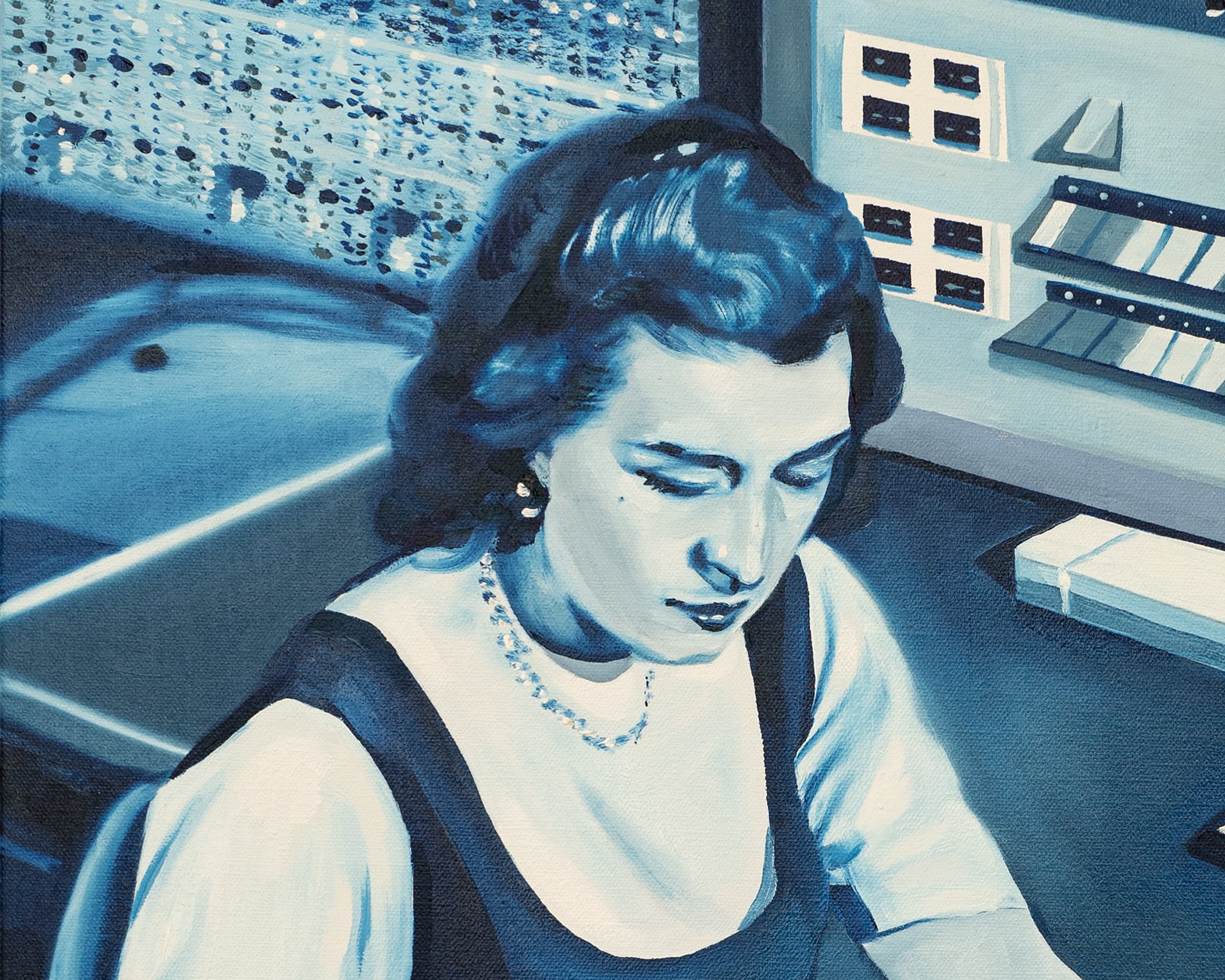
The blue that saturates The Binary Dream is the blue that connects this painting to Checkmate, and the connection is not merely chromatic. It is the blue of IBM, the blue that the company used for its corporate identity in the 1950s and that it has maintained, with variations, to the present, the blue that became associated with rationality and order and institutional authority and that has been so thoroughly colonized by computation that it now reads, in the visual language of technology, as the color of machines and their operations. Tan Mu has acknowledged this association explicitly, describing how the blue immerses the 1964 scene inside a computational atmosphere, and the immersion does something that the original photograph does not do. It places the historical moment inside a larger narrative, the narrative of computation from the IBM 704 to Deep Blue to the large language models that now write prose and generate images and carry on conversations that would have been science fiction in 1964. The blue is not decoration. It is a timeline, a way of saying that the woman standing beside the IBM 704 in 1964 was participating in the origins of something that would eventually become the artificial intelligence that is now transforming every domain of human activity, and that her labor was not peripheral to this transformation but constitutive of it, essential to the calculations that made the machine useful before the machine became useful enough to make her invisible.
The synthesis that The Binary Dream demands is not a conclusion about whether technology is good or bad for humanity. It is a recognition that the history of artificial intelligence is also the history of human labor that artificial intelligence has subsequently rendered invisible, and that this rendering is not an accident but a structural feature of the way technological progress has been narrated. The IBM 704 required human computers to make it useful. The artificial intelligence systems of 2026 require human labelers and content moderators and training data providers to make them useful. The labor is different in form but continuous in function: human beings making machines useful by performing the tasks that the machines cannot yet perform, until the machines can perform those tasks and the human beings move on to tasks the machines still cannot perform, and the history of this transition is written as the history of the machines and not as the history of the human beings who made the transition possible. The Binary Dream holds this recognition open. It does not resolve it. It presents the woman at the console and the machine beside her and the blue atmosphere that connects them to everything that followed, and it asks the viewer to consider what it means that the labor documented in this painting has been the condition of possibility for every technological milestone that followed, and that the history of those milestones has been written without the names of the people who made them possible. The painting is an archive for the future, as Tan Mu has described it, a visual timestamp that future viewers will encounter and understand as evidence of how the present once understood its own past, and as a reminder that the labor of making machines useful is always real and always human and always at risk of being forgotten when the machines become capable enough to write their own histories.
Tan Mu has described her paintings as timestamps left for the future, and The Binary Dream is such a timestamp, but it is also something more specific: it is a correction. The official history of artificial intelligence, the history that appears in textbooks and museum displays and corporate commemorations, is a history of machines and their capabilities, of algorithms and architectures, of benchmark performances and commercial deployments. The woman at the IBM 704 console does not appear in this history because she was not a machine and because her contributions were dispersed into the institutional record where they became indistinguishable from the contributions of the machines she operated. The painting corrects this omission by preserving the evidence, by rendering the woman and the machine and the blue atmosphere that connects them to everything that followed, by insisting through the care of its execution that the labor it documents was real and essential and that its absence from the official history is a distortion that can be partially corrected by the act of painting. The future viewer who encounters The Binary Dream will see something that the official history has omitted: the presence of a specific human being at a specific moment in the origins of artificial intelligence, rendered with the devotion that Tan Mu applies to all her subjects, preserved in a medium that will outlast the institutional records that failed to document her name. The layer of oil paint on linen is more durable than the corporate memory that allowed her to be forgotten.