The Interior of the Ring: Tan Mu's Stanford Torus and the Architecture of Interplanetary Hope
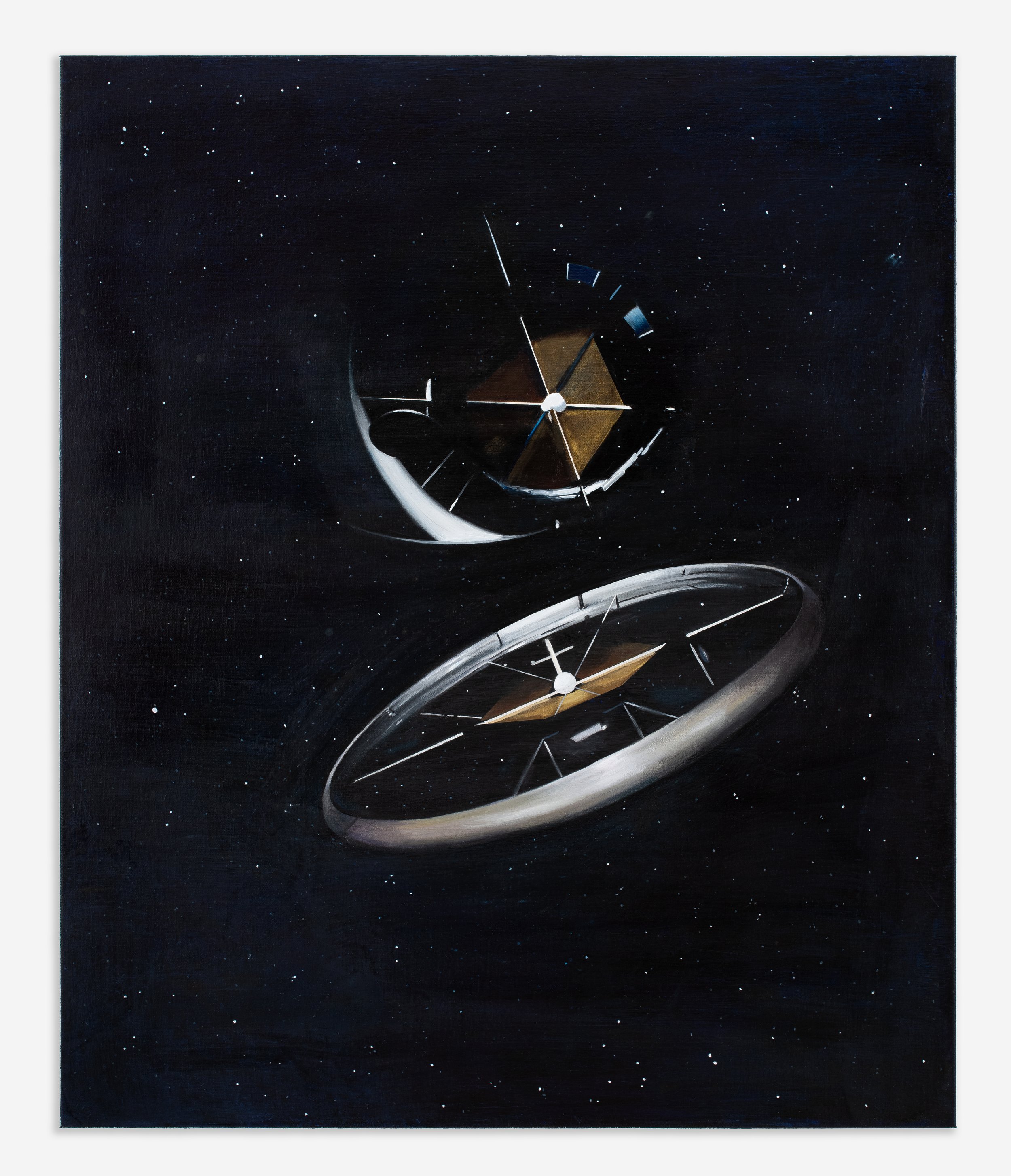
The NASA Summer Study of 1975 was held at Stanford University and produced a design for a space habitat that would house ten thousand people in a rotating ring one mile in diameter, a torus of steel and glass and cultivated soil that would generate its own gravity through centripetal acceleration, that would have agriculture and housing and a lake at its center, that would orbit at the Lagrange point between Earth and the Moon where the gravitational pulls balance and a habitat could remain stable without constant thrust corrections. The participants were scientists and engineers and architects and artists, and they produced drawings and scale models and performance analyses and cost estimates that filled three volumes. The habitat was never built. It remains one of the most detailed designs for permanent human habitation in space that has ever been completed, not as engineering fantasy but as serious proposal, the work of serious people who believed that humanity's long-term survival required learning to live beyond the single planet that evolution prepared us for. Tan Mu painted the Stanford Torus in 2020, forty-five years after the Summer Study concluded, and the painting does not depict a realized structure. It depicts an idea, a vision that has been circulating in the culture of space exploration since before she was born, that has appeared in science fiction and in government reports and in the portfolios of aerospace engineers, and that she treats with the same devotion she applies to quantum computers and submarine cables: as a subject worthy of sustained visual attention, as evidence of what human beings have imagined and not yet achieved.
The interior of the Stanford Torus, as the 1975 designs envision it, is the most counterintuitive aspect of the concept. The living surface is on the inside of the ring, not the outside. The rotation creates artificial gravity by pushing everything outward against the outer hull, so that the floor of the habitat is the inside of the outer cylinder, and the open interior of the ring is visible overhead, a disk of light and cloud and blue sky that surrounds the central structural hub. The view from any point on the inner surface is of a curved horizon, closer than Earth's and more quickly reached, beyond which the sky curves upward and over to meet itself. The sun is visible through large windows that admit light and create day-night cycles, and the stars are visible through the open center when the windows face away from the sun. Living in the Stanford Torus means living in a world that is always curving upward around you, that is contained and bounded and artificial in every dimension, a world designed to be habitable rather than found to be habitable, a world whose every parameter has been engineered rather than discovered. Tan Mu has described this painting and others in the space series as ultimately about humanity rather than about technology, and this observation is nowhere more apt than in the Stanford Torus, because the habitat's most radical feature is not its engineering but its implied anthropology: what human beings need to thrive, and whether that need can be satisfied by a world built to specification.
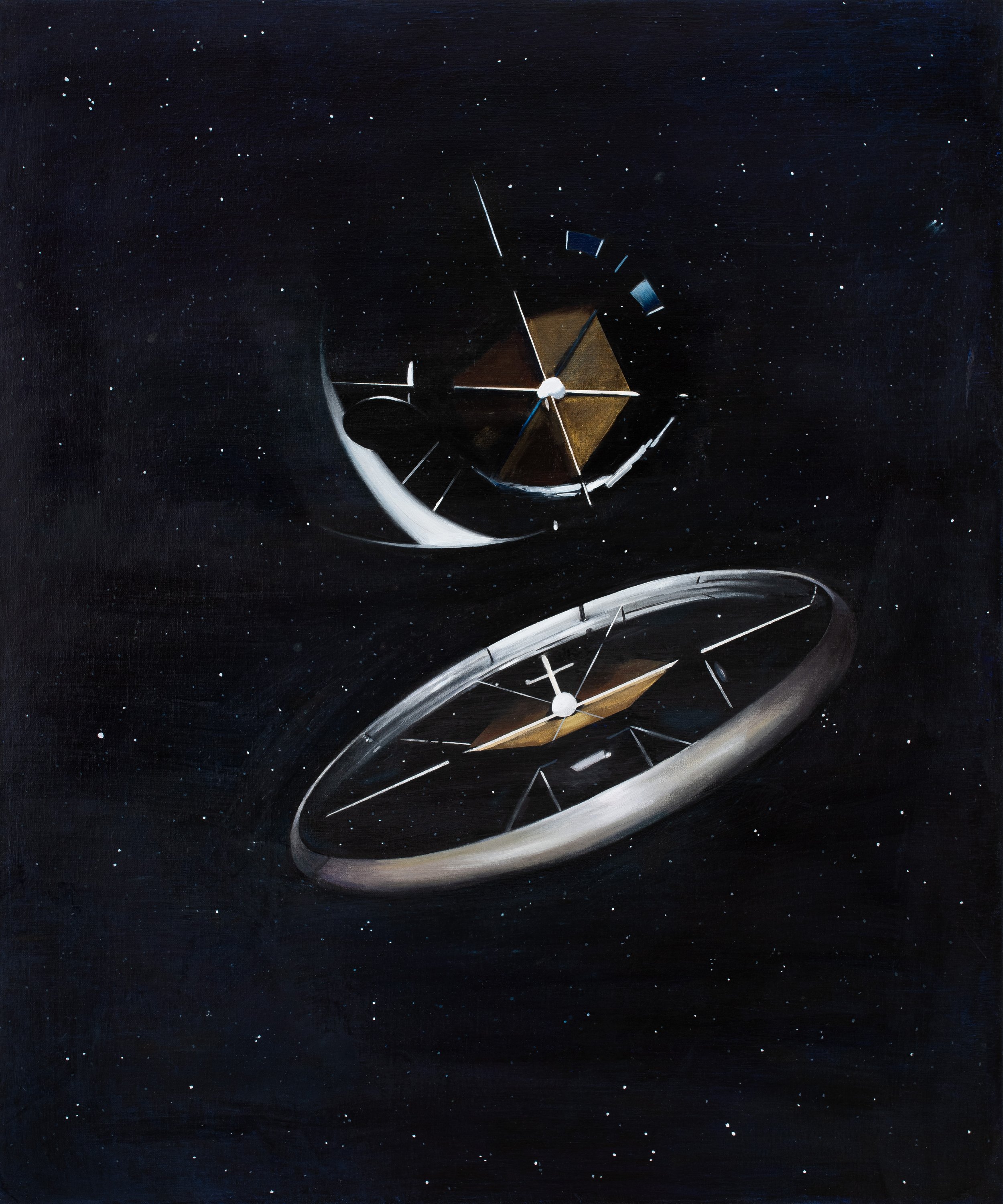
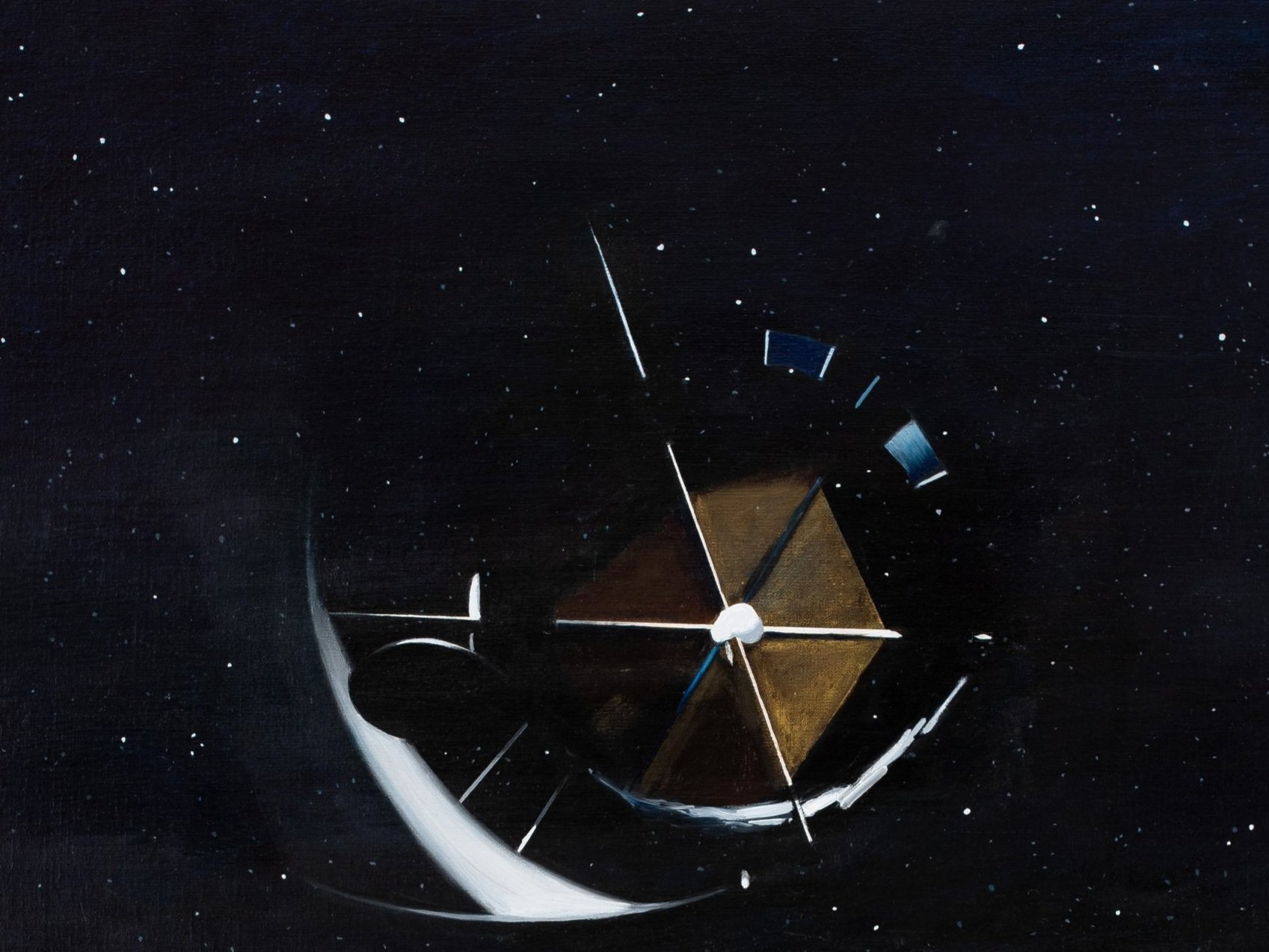
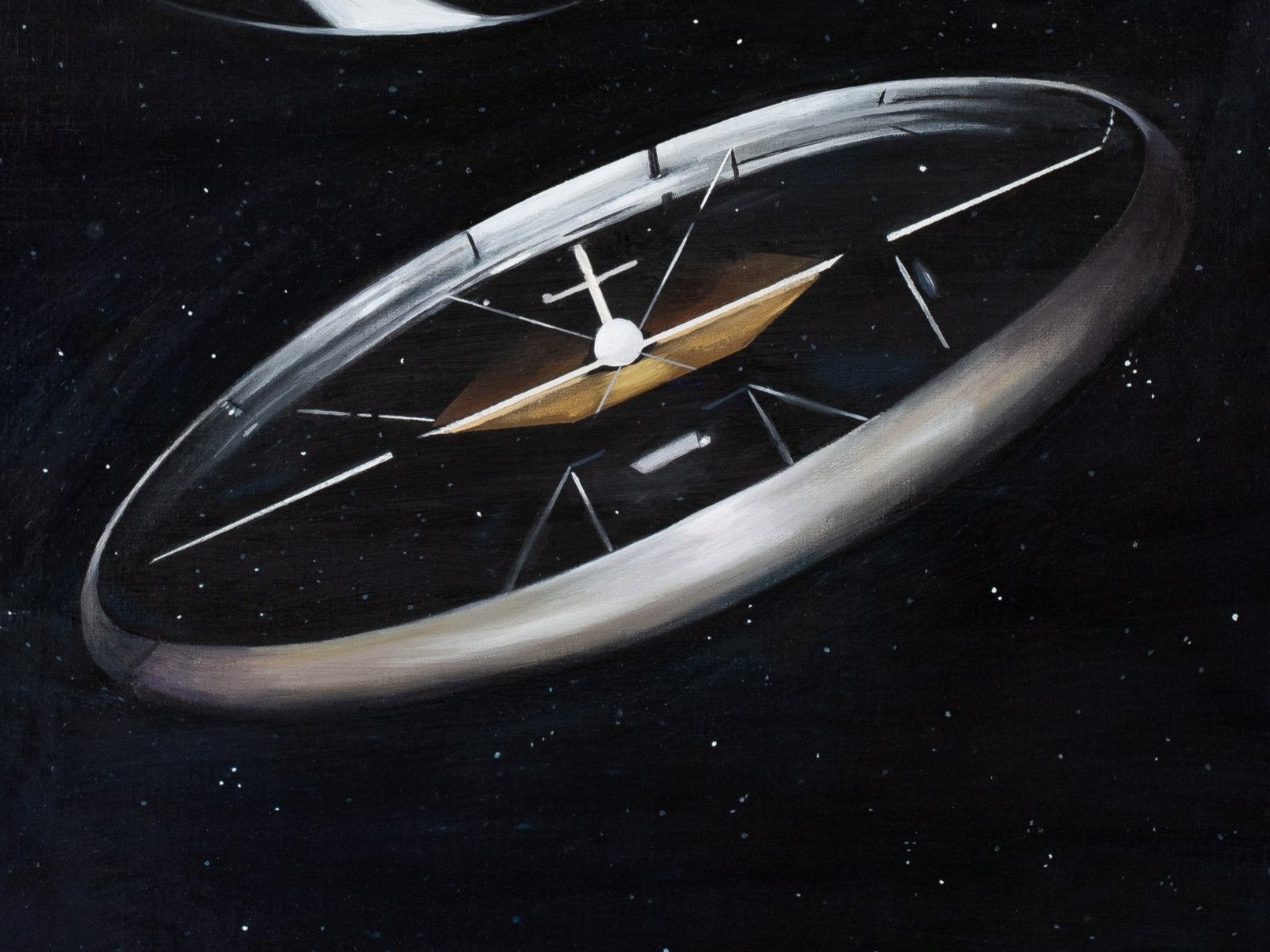
The proportions of the Stanford Torus in the painting, 91 by 76 centimeters, position the canvas as a window rather than a monument. The torus appears in the composition as a ring seen from an angle that reveals its three-dimensional structure, the outer surface curving away from the viewer and the interior visible as a luminous disc of sky and cloud and habitat light. Tan Mu has rendered the interior atmosphere with the same attention to atmospheric color and light that characterizes her Horizons series and her Mars paintings, creating a sky that reads as genuinely inhabitable, that has the quality of afternoon light rather than the harsh direct illumination of space or the technical blue of engineering diagrams. The painting is not a technical illustration. It is an inhabited space, and the distinction matters because it reveals what Tan Mu is doing when she approaches scientific subjects: she is not documenting or explaining. She is imagining, using the technical data as a constraint within which her visual imagination can operate, producing images that are more real than diagrams because they engage the viewer's perceptual system rather than only their understanding.
Buckminster Fuller spent forty years developing and refining the geodesic dome, a structure based on the principle that a sphere can be constructed from triangular elements arranged in a pattern of hexagonal and pentagonal faces, distributing structural stress across the surface so efficiently that the structure becomes stronger as it scales up rather than weaker. His first major geodesic dome was built for the United States Marine Corps in 1953, a hemispherical shelter that could be assembled by soldiers without special equipment and that could withstand hurricane-force winds because the aerodynamic shape allowed wind to flow around rather than against the surface. Fuller was not merely interested in efficient shelter. He was interested in the relationship between geometry and human survival, in the possibility that the same mathematical principles that governed the structure of viruses and radiolaria and the great crystalline lattices of mineral formations could be applied to human habitation, producing structures that were not just functional but literally natural, part of the same order as the rest of the universe. His book Operating Manual for Spaceship Earth, published in 1968, proposed that humanity's only chance of long-term survival was to learn to manage the planet as a unified system rather than as a collection of competing nations, and the geodesic dome was the architectural expression of this systemic thinking.
The Stanford Torus is, in a sense, a geodesic dome inflated into a ring. The structural logic is similar: a continuous curved surface that distributes stress across its entire extent, a form that is efficient because it is geometrically optimal, a habitat that is enclosed and controlled and independent of the external environment. But where Fuller's domes were designed for terrestrial use, for climates that ranged from Arctic to tropical, the Stanford Torus is designed for the vacuum of space, for an environment where the structure must provide not just shelter from weather but shelter from radiation and vacuum and temperature extremes and the absence of air. The geodesic principle, which Fuller developed for buildings on Earth, becomes in the Stanford Torus a principle for building worlds. Tan Mu's painting of the Stanford Torus inherits this Fuller-like ambition without replicating the technical vocabulary. The ring in the painting does not display its engineering. It presents itself as a world, as an environment for human life, as a space that people could inhabit and call home. The geodesic logic is present in the painting's structural clarity, in the way the ring's form is legible and coherent, but it is present as aesthetic rather than as engineering diagram, as the beauty of a form that works rather than the explanation of how it works.
The Stanford Summer Study of 1975 was organized by the Space Studies Institute, founded by Princeton physicist Gerard O'Neill, who had become convinced that humanity's future lay in space and who wanted to move the conversation beyond science fiction and into serious engineering. O'Neill's question was practical: given what we know about materials and physics and human biology, what kinds of structures could we build in space to support human habitation? His answer, developed with his students at Princeton and refined at the Stanford workshop, was the Stanford Torus and two related designs, the Cylinder and the Cluster, all of which proposed that human beings could live in space in structures that provided artificial gravity, natural light, and enough agricultural capacity to be self-sufficient. The Summer Study was not optimistic in the naive sense. It acknowledged the enormous engineering challenges and the decades of development that would be required. But it was optimistic in the deeper sense that the problems were solvable, that the human species could extend its range beyond Earth if it chose to, that the alternative to expansion was not stasis but eventual extinction when the Sun exhausted its fuel and expanded to vaporize the inner planets. The Stanford Torus is not an escape from Earth. It is an insurance policy against cosmic accident, a way of ensuring that the human project continues regardless of what happens to any single world.
Paolo Soleri proposed in the 1960s that the solution to the environmental and social crises of urbanization was not better cities but denser cities, not suburban sprawl but vertical concentration, and he called his proposals arcologies, portmanteau words combining architecture and ecology. Soleri's arcology was a single massive structure that contained everything a city needed: housing and agriculture and industry and commerce and transit, all stacked vertically in a form that minimized its footprint on the land and maximized its density of human activity. The proposals were never built, though one was begun in Arizona and abandoned. But they circulated in architectural culture and in science fiction and in the environmental movements of the 1970s, and they influenced the design of every subsequent proposal for space habitation, including the Stanford Torus. The arcology and the space habitat share a fundamental premise: that human beings can design environments that are better than nature for human habitation, that the controlled interior can be preferable to the uncontrolled exterior, that density and enclosure are not losses but gains. Tan Mu has described the Stanford Torus as embodying the optimism of late twentieth-century futurism, and Soleri's arcologies are part of the same cultural moment, expressions of a confidence that design could solve problems that politics and economics could not.
The arcology logic leads, if followed consistently, to the Stanford Torus and beyond. If density is good, then the densest possible environment is a structure that contains everything necessary for life in a compact, enclosed form. If enclosure is good, then the most enclosed possible environment is one that is sealed against vacuum. If artificial gravity is necessary for long-term human health, then the structure must rotate to generate it. The Stanford Torus is the logical conclusion of the arcology premise applied to space. Tan Mu's painting renders this logic visible, showing the ring as a coherent, inhabited world rather than as an engineering diagram, and this rendering is an act of imagination that supplements the engineering without contradicting it. The painting asks what it would feel like to live in the Stanford Torus, to look up and see the far side of the ring curving overhead, to watch the clouds form and move in the contained atmosphere, to experience the artificial day-night cycle generated by the rotation and the windows. These are questions that the engineering cannot answer, because the engineering can calculate rotation rates and structural loads and agricultural yields but cannot calculate the phenomenology of actually inhabiting the structure. The painting operates in precisely this phenomenological space, using the visual language of lived experience to imagine what the engineering has made possible.
Saul Appelbaum, writing in the BEK Forum catalog in 2025 about Tan Mu's broader practice, observed that she approaches technology not as something separate from humanity but as an extension shaped by emotion, materiality, and lived experience. The observation applies to the Stanford Torus with particular force because the subject is so explicitly about human experience in extreme conditions, about what human beings need to feel at home, about whether an engineered environment can provide the conditions that human psychology requires for flourishing. The Summer Study participants understood that the torus would need to have windows and sky and vegetation and water and social space to avoid what they called cage syndrome, the psychological damage that would result from living in a featureless enclosure without natural light or the sense of openness that human beings require for mental health. The engineering and the psychology are inseparable in the Stanford Torus design, and Tan Mu's painting captures this inseparability by rendering the interior as genuinely atmospheric, as a space that people could love rather than merely tolerate. The painting is not a celebration of technology for its own sake. It is an investigation of what technology is for, and what it is for, the painting argues, is the continuation of human experience in forms that extend beyond the conditions that evolution prepared us for.
The maternal grandfather who was a meteorologist and who introduced Tan Mu to ways of observing the sky was the first guide to the cosmic perspective that appears throughout her practice, and the Stanford Torus is one of its most explicit expressions. Tan Mu has described how the grandfather showed her the tools of atmospheric observation, how she later took an astronomy course at Alfred University and visited the Stull Observatory regularly, how she was deeply moved by the vastness and beauty of the night sky and how that experience left a lasting impression. The move from observing the sky to painting space habitats is not a departure from this childhood formation. It is the continuation of it by other means. The child who looked through a telescope at the moon was learning that human perception could extend beyond its biological limits, that instruments could bring distant phenomena close enough to study and wonder at. The adult who paints the Stanford Torus is working in the same register, extending the imagination to environments that have not yet been reached but that have been designed in enough detail to be visualizable. The grandfather's meteorological tools and the Stull Observatory telescope and the NASA Summer Study's engineering designs and Tan Mu's oil paint are all instruments for making the distant present, for bringing the not-yet-realized into the space where human attention can be directed toward it.
The Stanford Torus and the Dyson Sphere, which Tan Mu has also painted, belong to the same cultural moment and the same speculative tradition, and she has acknowledged both as expressions of late twentieth-century futurism's confidence in humanity's potential to settle space. The Dyson Sphere, proposed by physicist Freeman Dyson in 1960 as a shell that a sufficiently advanced civilization could construct around a star to capture its entire energy output, represents the ultimate scale of engineering ambition, the possibility that civilizations could become so technically capable that they could reconfigure stellar systems. The Stanford Torus represents the nearer-term possibility, the first step on a path that might eventually lead to structures of Dyson Sphere scale. Together, they define a spectrum of speculation, from the achievable to the conceivable, and Tan Mu's paintings of both are acts of imaginative investment in that spectrum, ways of saying that these visions matter not because they will necessarily be realized but because the act of imagining them changes what human beings think is possible and therefore what they attempt. The painting of the Stanford Torus is not a prediction that the habitat will be built. It is a statement that the vision deserves to exist in the space of human attention, that the idea of ten thousand people living in a rotating ring in space is worth preserving, worth contemplating, worth translating into oil paint on linen so that it can be examined and wondered at by viewers who may never read the three volumes of the 1975 Summer Study.
The synthesis that Stanford Torus demands is not a conclusion about whether space colonization will happen or whether it is advisable. It is a recognition of what the painting contributes to Tan Mu's broader investigation of how human perception extends beyond biological limits. The telescope at Stull Observatory brought the moon close. The satellite imagery in the Horizons series brings Earth close in a different way, as a unified system visible from outside. The Mars paintings bring another planet close, photographed by rovers operating autonomously in an environment too hostile for human presence. The Stanford Torus brings something else: the interior of a not-yet-built world, the phenomenological experience of inhabiting a designed environment in space, the question of what human beings need to feel at home and whether that need can be satisfied by engineering. The grandfather who was a meteorologist and who taught Tan Mu to read weather patterns was teaching her to see systems, to understand the atmosphere as a dynamic process rather than as a backdrop, to recognize that the sky is not a ceiling but a fluid with properties and behaviors. The painting of the Stanford Torus applies this systemic thinking to the question of space habitation, asking what kind of system would need to be built to sustain human life in the void, and rendering that system with the same devotion and precision that the practice applies to every subject, from the microscopic to the cosmic, from neurons to galaxies, from what is to what might be.
Tan Mu has described her paintings as archival records for the future, visual timestamps that future viewers will encounter to understand how a particular present understood its own technological imagination. The Stanford Torus is such a timestamp, but it is more specific than most: it is a record of what the 1970s space habitat movement believed was achievable and desirable, of the optimism that characterized a particular moment in the history of space exploration before Challenger and Columbia and the end of the Apollo program and the long interval when human spaceflight seemed to have reached its limit. The painting preserves this optimism in a form that will outlast the moment that produced it, that allows future viewers to encounter the vision and to decide for themselves whether the Stanford Torus was utopian or prophetic, whether the vision of ten thousand people living in a rotating ring was a fantasy or a plan that was never funded but remains achievable, waiting for the political will and the engineering investment that would make it real. The layer of oil paint on linen holds the vision without resolving the question, preserves the hope without adjudging whether it was warranted. The future viewer who encounters this painting will see something that the 1975 Summer Study participants could not have imagined: a record of their vision made by an artist who was not yet born when they completed their work, extending their imagination forward into a future that has now become the present.
The interior of the Stanford Torus in Tan Mu's painting has clouds. This detail is not incidental. The presence of weather, of a water cycle and atmospheric dynamics and the particular quality of light that comes through scattering in a gas medium, is what makes the interior read as genuinely habitable rather than merely survivable. The clouds are Tan Mu's argument about what the Stanford Torus would need to be to justify its existence as a home rather than merely as a life support system. The painting does not depict the engineering that would produce and maintain those clouds. It depicts the phenomenological result: a sky inside a ring, weather in a contained world, the sense of open space that human psychology requires and that the engineers of the Summer Study understood was not optional. The clouds in the painting are the painting's way of saying that the vision is serious, that it accounts for what human beings actually need, that the architects who designed the Stanford Torus understood that a home is not merely a set of environmental parameters but a place that feels like home, that provides not just survival but flourishing. The painting holds this standard against every speculative habitat it depicts, and against every realized environment on Earth, asking in each case whether the conditions for genuine habitation are present or merely the conditions for continued existence.