The Golden Vortex: Tan Mu's The Wave 02 and the Spiral That Connects All Motion
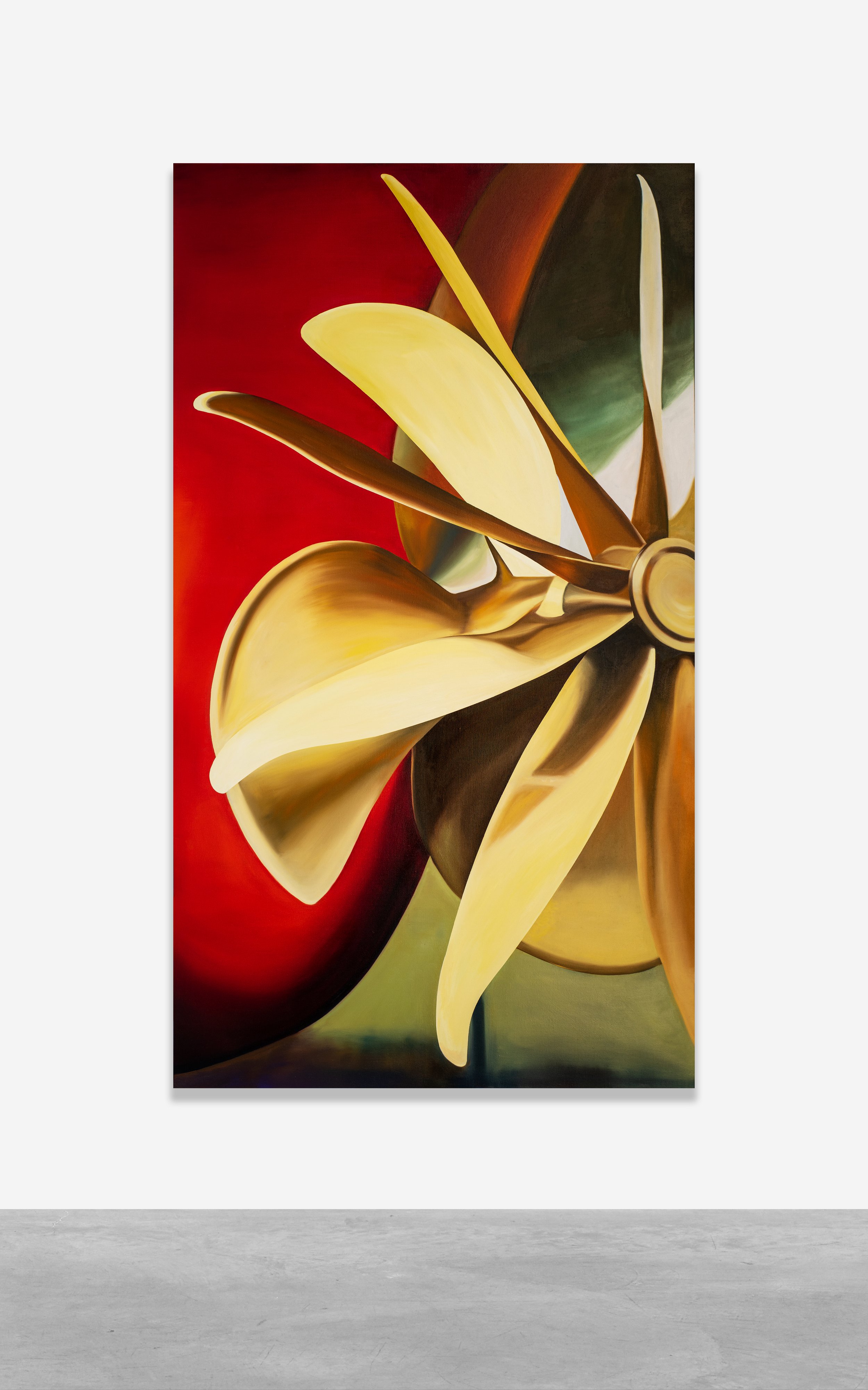
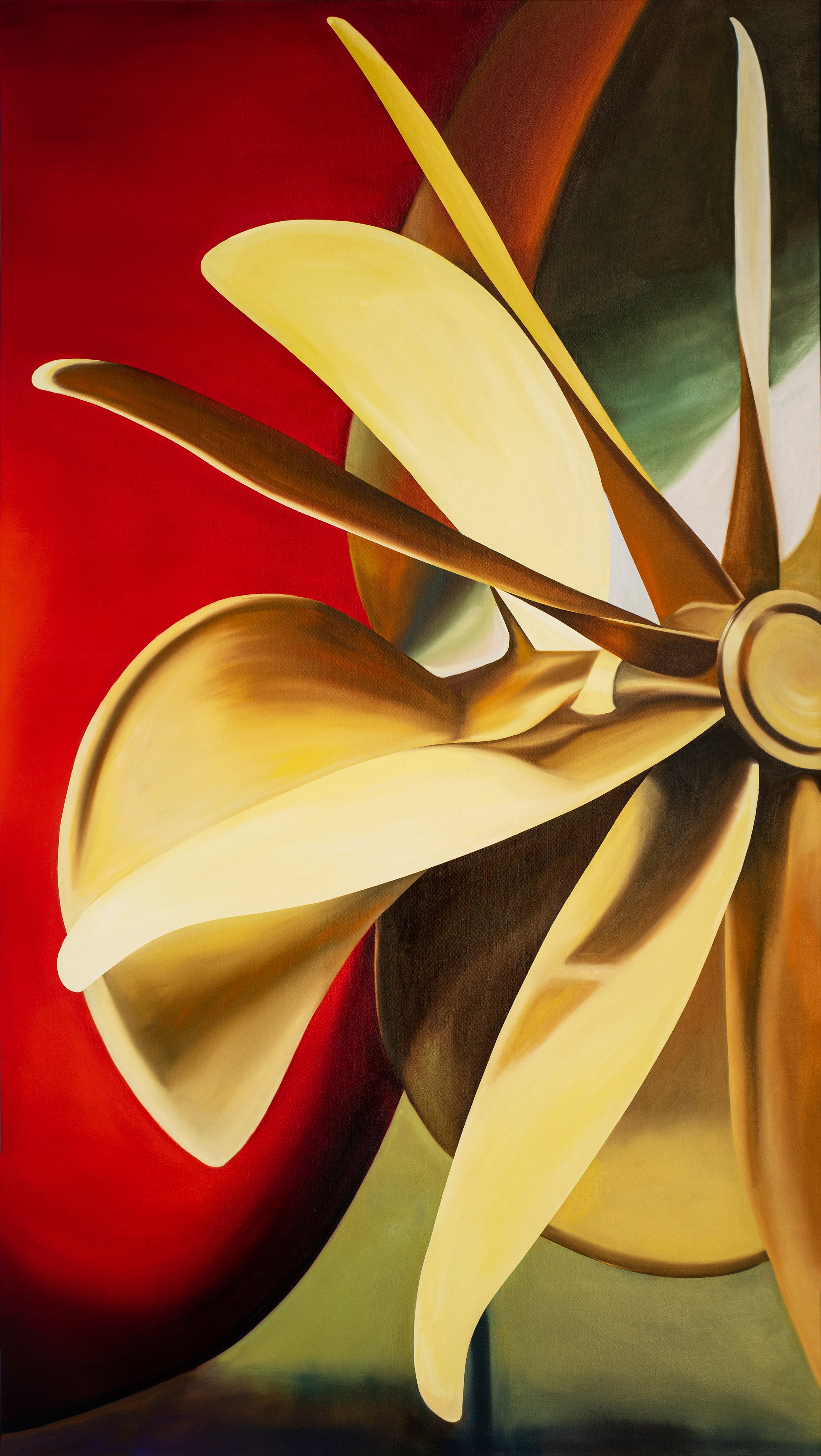
In 1934, the Museum of Modern Art mounted an exhibition called Machine Art, and among the objects it displayed were ship propellers borrowed from naval vessels and maritime engineering firms, propellers less than one meter in diameter that drove the ocean-going traffic of the 1930s. The exhibition proposed that industrial objects could be exhibited as art, that the precision and efficiency of machine forms constituted an aesthetic quality independent of their functional purpose. By 2024, when Tan Mu painted The Wave 02, the largest ship propellers had grown to eight meters in diameter, driven by engines producing tens of thousands of horsepower, moving cargo containers that held the goods of a globalized economy worth trillions of dollars. The propeller has scaled up by an order of magnitude while remaining fundamentally the same object: a rotating blade assembly that converts rotational force into thrust by pushing water backward. Tan Mu has described this persistence of function across scale as what draws her to the subject, the way a technology designed in the nineteenth century continues to propel the twenty-first, unchanged in its operating principle even as its dimensions and power output have grown beyond what the engineers of the earlier century could have imagined. The painting measures 165 by 92 centimeters, and within that frame, Tan Mu holds the propeller as an object of devotion, golden and gleaming, rotating in a void of deep blue that suggests ocean depth rather than surface, the vortex of its motion made visible through the spiral forms that radiate outward from the hub.
The great-grandfather who was a sea merchant during the Nationalist era, traveling between China and Korea and spending much of his life on international waters, is the biographical anchor of the Wave series, and the anchor is load-bearing. Tan Mu has described how through his stories she became aware that the ocean is not only a route for goods but also a carrier of culture, memory, and exchange, and this understanding shapes everything she sees when she looks at a propeller. The great-grandfather crossed the same waters that modern cargo ships cross, relying on the same basic physics that propellers convert rotational force into thrust, but his vessels had sails and oars and small engines, nothing like the diesel-powered leviathans of contemporary shipping. The continuity is not sentimental. It is physical. The ocean has not changed. The relationship between a blade moving through water and the force that propels a vessel forward has not changed. What has changed is the scale and the power, the degree to which human engineering has amplified a natural principle to the point where a single propeller can move a structure the length of several football fields across an ocean. Tan Mu paints this amplification with the same attention she gives to quantum cryostats and submarine cables, as evidence of what engineering has achieved while remaining faithful to principles that physics established long before there were engineers to apply them.
The gold that dominates The Wave 02 is not the gold of the submarine cables or the quantum cryostat's cooling plates. It is the gold of the propeller's polished surface, the brass or nickel-aluminum-bronze alloy that ship propellers are cast from and that Tan Mu has chosen to render in a tone that recalls gilded religious objects and Art Deco machine aesthetics simultaneously. She has described this duality explicitly: gold associates with reverence, power, and devotion, and in The Wave series she uses it to transform the polished propeller into an object that feels almost sacred, as if contemporary society venerates technology in the same way earlier societies venerated religious icons. The comparison is not ironic. It is anthropological. Tan Mu is interested in the structural similarity between the impulse to worship and the impulse to admire, between the devotion of the pilgrim before the relic and the awe of the viewer before the precisely machined surface of a ship's propeller rotating at 100 RPM in the open ocean. The gold makes the propeller legible as an object of contemplation. It removes it from the category of industrial equipment and places it in the category of objects that demand sustained attention, that reward the viewer who looks closely with the discovery of forms and relationships that the casual glance would miss.
Alexander Calder began making his mobiles in the early 1930s, and what he discovered in the process of making them was that a balanced system of weighted levers and curved blades could respond to air currents in ways that mimicked the behavior of natural forms, that the gentle and unpredictable motion of a Calder mobile in a drafty gallery could evoke the motion of clouds or leaves or water or any of the other natural phenomena that the mobile was not depicting but was structurally imitating. Calder was not trying to represent nature. He was trying to create mechanical systems that behaved like natural systems, that had the same quality of unpredictable responsiveness that characterized living things. His stabiles, the large-scale steel sculptures he began in the 1950s, extended this interest into three dimensions, creating forms based on the Mobius strip and other mathematical surfaces that appeared in nature in seashells and plant forms and the configurations of celestial bodies. The Mobius strip, with its single continuous surface and its counterintuitive property of having only one side, became one of Calder's signature forms, and it encodes the same structural principle that Tan Mu has identified in the propeller: the transformation of rotation into linear motion through a curved surface, the conversion of one kind of movement into another through the geometry of the blade.
The propeller and the Calder mobile share a fundamental interest in the relationship between kinetic energy and form, but they approach this interest from opposite directions. Calder began with natural forms and sought to mechanize them, to create objects that moved like nature but were made of industrial materials. Tan Mu begins with industrial forms and seeks to reveal their naturalness, to show how the propeller's blade geometry derives from fluid dynamics principles that govern ocean currents and blood flow and atmospheric circulation. The convergence of their interests in The Wave 02 is complete: Tan Mu's golden propeller, rotating in a deep blue void, generates vortices and turbulence in the surrounding water that echo the vortices Calder was trying to capture in his suspended blades. The spiral that connects them is not metaphorical. It is physical. It is the same spiral that appears in galaxies and in nautilus shells and in the cochlea of the human ear, the spiral that is one of the universe's preferred solutions to the problem of organizing matter and energy in motion. Tan Mu has described this recurrence of the spiral form across scales as one of the central findings of her practice, evidence that the same mathematical principles govern phenomena as different as a ship's propeller and a spiral galaxy, and The Wave 02 makes this argument through the visual presence of the spiral rather than through any explicit statement.
TheMoMA Machine Art exhibition of 1934 that Tan Mu cites is worth considering more carefully than a single reference allows, because the exhibition itself was a threshold event in the history of attitudes toward industrial objects. Philip Johnson, who organized it with Alfred H. Barr Jr., faced resistance from trustees who believed that machine products could not be art, that the exhibition's premise was胡说. The objects Johnson chose, including the propellers and other industrial components, were meant to demonstrate that the formal properties of well-designed machines, their balance and precision and efficiency, constituted an aesthetic achievement independent of their functional purpose. The exhibition was controversial then and remains instructive now, because it established the terms of a debate that Tan Mu's Wave series continues: can an industrial object be treated as an object of contemplation without losing its identity as a functional machine? The propeller in The Wave 02 is not a readymade. It is not presented without transformation. It is painted in gold, placed in a deep blue void, rendered with the devotion that Tan Mu applies to all her subjects, from quantum cryostats to submarine cables to neurons. The painting does not argue that the propeller is art. It treats the propeller as an object worthy of sustained visual attention, and this treatment is continuous with the Machine Art exhibition's proposition that industrial forms merit the same attention that earlier generations of painters directed at religious subjects and landscapes.
Marcel Duchamp made his Rotary Demisphere in 1924, a device consisting of a demisphere fitted with twelve curved panels arranged radially around a central axis, designed to be spun at 60 revolutions per minute so that the interaction of the panels with a beam of light would produce a flickering, pulsing visual effect. He revised and recreated it in 1965 as a motorized version that maintained the same optographic principle while adding the continuous rotation of an electric motor. The Rotoreliefs, as Duchamp also called them, were optical toys as well as works of art, designed to demonstrate that visual perception is not passive reception but active construction, that the eye and the brain working together create the illusion of depth and motion from patterns of light that are in fact flat and static. Duchamp was interested in the threshold between perception and illusion, in the conditions under which the visual system mistakes one for the other, and his optographic disks were instruments for exploring this threshold under controlled conditions.
Tan Mu's propeller generates a similar optographic effect, though through different physics and with different intentions. As the propeller rotates, it creates a vortex in the surrounding water, a spiraling disturbance that the eye perceives as motion and turbulence and force, even though what is actually happening is the continuous displacement of water molecules by the blade surfaces. The vortex is invisible in the same sense that Duchamp's optographic effects are invisible: it exists only as long as the rotation continues, it cannot be touched or stopped for examination, it is perceived only through its effects on the surrounding medium. Tan Mu has rendered this vortex in The Wave 02 through the spiral forms that radiate outward from the propeller hub, creating a visual field of flow and rotation that the viewer reads as motion even though the painting itself is static. The oil paint on linen captures the evidence of motion rather than the motion itself, the record of kinetic energy rather than the energy itself, and this distinction is what makes the painting possible. The actual propeller's vortex is invisible and continuous. The painted vortex is visible and frozen, an instant of motion preserved in a medium that does not move. Duchamp's disks demonstrated that the perception of motion could be generated by static patterns under the right conditions. Tan Mu's painting demonstrates that the evidence of motion can be preserved by a static surface under the right attention, that the record of what the eye saw is not the same as what the eye saw but is equally valuable as testimony.
Saul Appelbaum, writing in the BEK Forum catalog, described Tan Mu's practice as an investigation of what he called the aesthetics of the threshold, the visual forms that emerge when one regime of knowledge is being replaced by another. The Wave series, in Appelbaum's framing, participates in this investigation by placing the propeller at the threshold between the natural and the mechanical, between the fluid dynamics that govern its operation and the industrial engineering that designed it, between the maritime tradition of sails and oars that the great-grandfather knew and the global shipping infrastructure that his great-granddaughter paints. The propeller is not a neutral object in this analysis. It is a site of transition, a technology that carries the past into the present and that will carry the present into whatever future maritime technologies emerge to replace it. Tan Mu's decision to render it in gold, to treat it as an object of reverence, acknowledges this transitional status. The golden propeller is not the propeller as it actually appears on a working cargo ship, coated in antifouling paint and barnacles and the evidence of years of operation in saltwater. It is the propeller as idea, as concept, as the pure form of rotational thrust that the engineering has realized in metal. The distance between the golden propeller in the painting and the fouled propeller on the working ship is the distance between the technological vision and the technological reality, and Tan Mu occupies this distance deliberately, painting the vision while knowing the reality, holding both in the same frame.
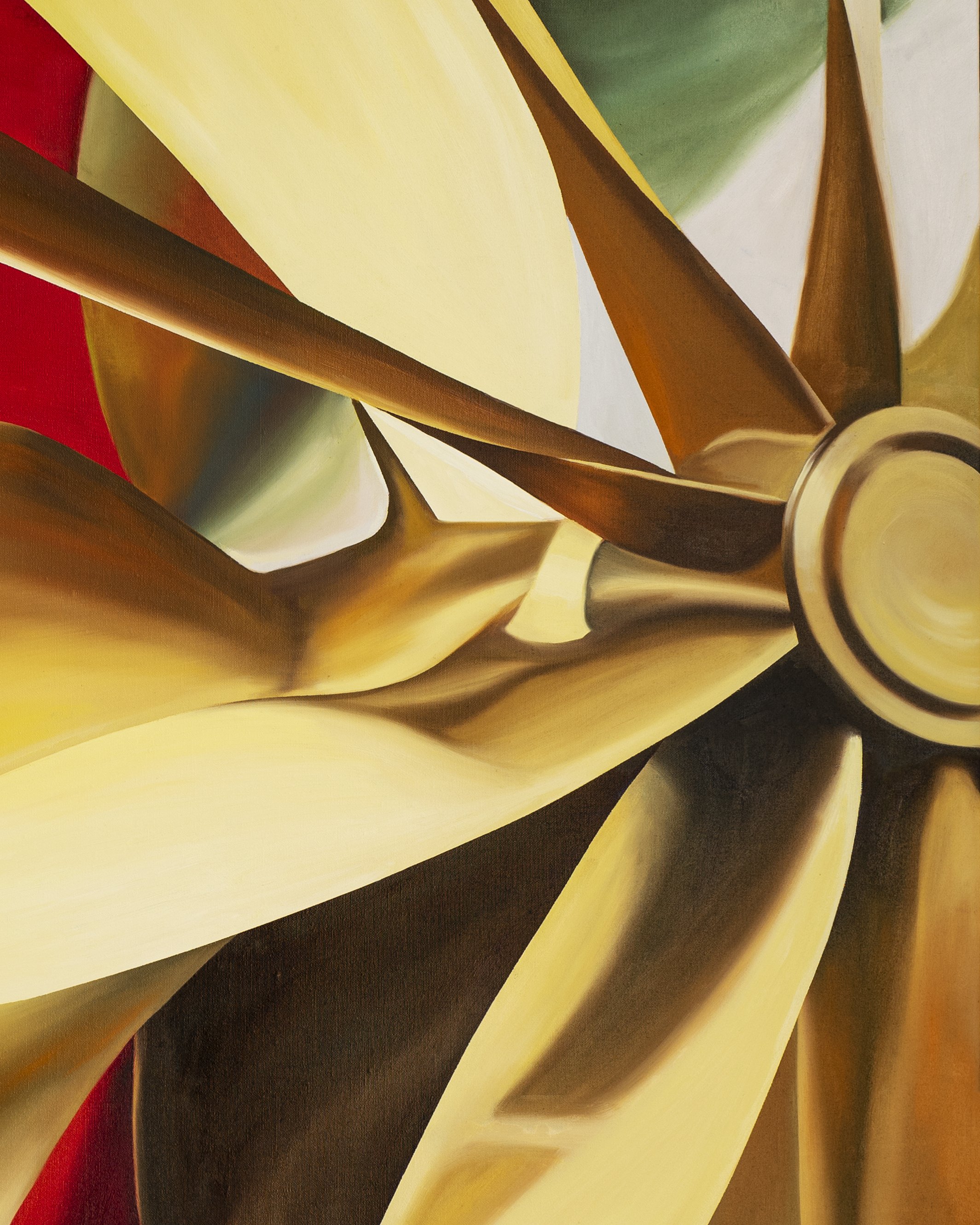
The toroidal geometry that Tan Mu has identified as connecting the propeller to her broader practice is not a loose analogy. It is a structural identity. A torus is a surface generated by rotating a circle around an axis that lies in the same plane as the circle but outside it, producing a shape that looks like a donut or an inner tube, a surface with a hole at its center through which the rotation axis passes. The propeller's blades, viewed from the side as they rotate, trace a circular path that generates a torus in three dimensions. The vortex that the propeller creates in the surrounding water has a toroidal structure, with the flow curling outward from the blade tips and returning toward the hub in a pattern that marine engineers call tip vortex recovery. The DNA double helix has a toroidal topology when considered as a surface of constant pitch. The electromagnetic field around a current-carrying wire forms toroidal structures. The Hopf fibration in mathematics describes how spheres can be arranged in toroidal configurations in higher dimensions. Tan Mu has painted all of these forms across her practice, and The Wave 02 connects them by showing the propeller as the mechanical instance of a geometry that nature uses everywhere, a solution to the problem of organized motion that the universe has arrived at independently through evolution and physics and mathematics and engineering.
The series context matters for understanding The Wave 02. The first work in the series depicted a massive propeller with a small human figure positioned beside it, a scale reference that emphasized how far propulsion technology has scaled up since the MoMA exhibition of 1934. The Wave 02 does not include the human figure. It is only the propeller, rendered at a scale that suggests intimacy rather than monumentality, 165 by 92 centimeters, tall and narrow in a way that emphasizes the vertical axis of rotation. The absence of the human figure is a choice. It says that the propeller is the subject, that the human labor and scale reference that mattered in the first painting have receded here, leaving only the object itself and the vortex it generates. This recession is part of the series' arc, from the documentation of scale and labor in the first painting to the pure formal investigation of rotation and geometry in the second. The Wave 02 is more abstract than its predecessor, more committed to the spiral as an independent visual subject, less dependent on the narrative of human progress that the first painting carried. The spiral is the argument. Everything else has been removed.
The synthesis that The Wave 02 demands is not a conclusion about maritime technology or globalization or the great-grandfather's journeys across the China-Korea route. It is a recognition that the spiral form is the painting's true subject, and that the spiral is not a metaphor for anything but a physical fact that the universe keeps arriving at through different means. The propeller's spiral generates thrust. The galaxy's spiral organizes stars. The nautilus shell's spiral provides growth. The black hole's accretion disk spirals matter into the event horizon. Tan Mu has painted all of these, and The Wave 02 is their latest addition, the ship propeller joining the company of cosmic and biological forms that share the same geometry because the geometry is optimal for the problem of motion through a fluid medium. The ocean that the great-grandfather crossed and that modern cargo ships cross is the same ocean that the propeller moves through, and the physics of that movement are the same physics that govern the spiral of a galaxy or the growth of a shell. The painting holds these connections without explaining them, presents them as visual evidence that the viewer's eye can trace, leaves the work of connection to the viewer who has learned, from the preceding works in the series and across the practice, that Tan Mu's visual vocabulary is not decorative but structural, that when she uses the spiral she means the spiral everywhere it appears, in every domain and at every scale, as a solution the universe keeps discovering because it is the best solution available.
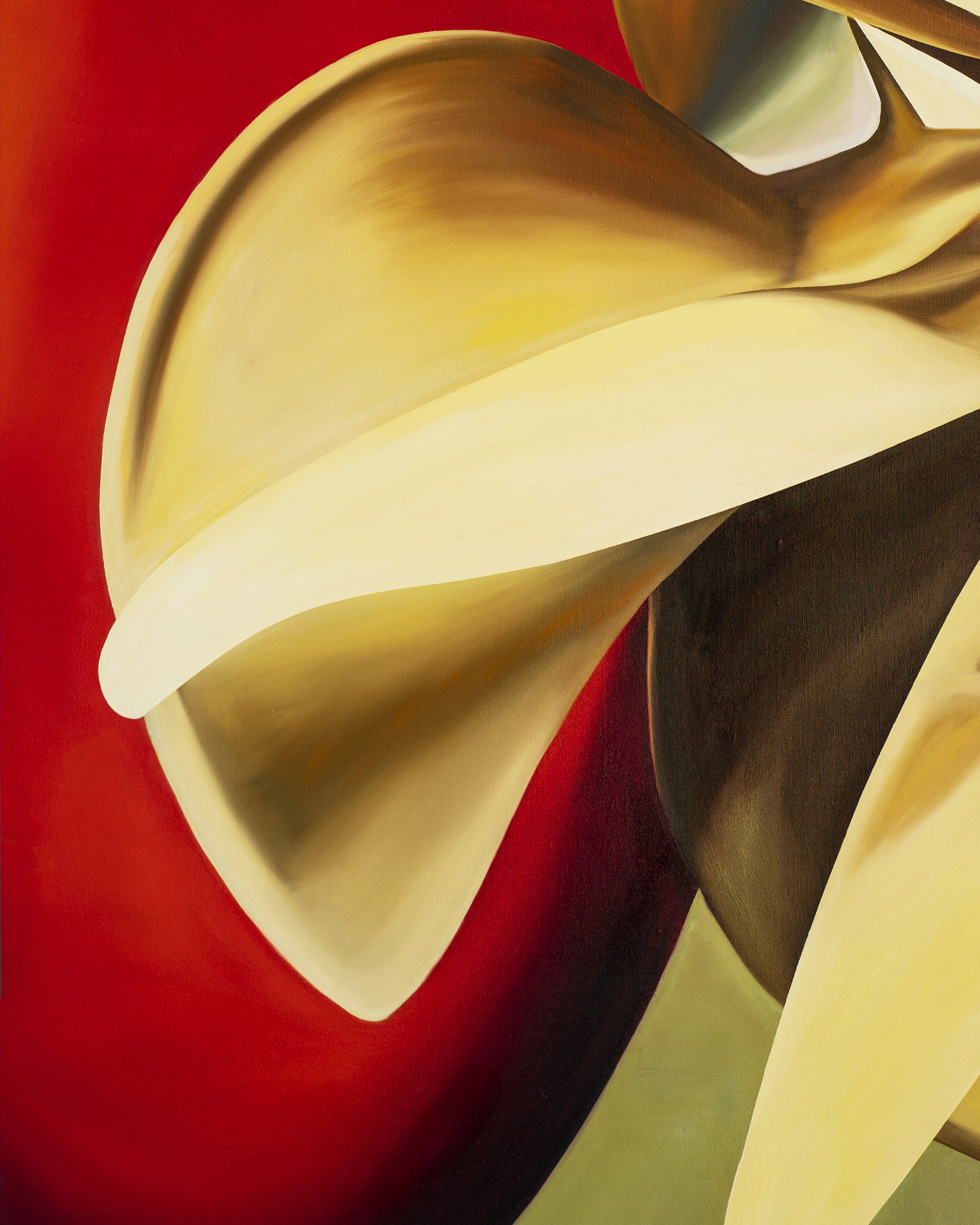
Tan Mu has said that in The Wave she is interested in moments where technology does not oppose nature but mirrors it, and this is the observation that holds the synthesis together. The propeller is not an imposition on nature. It is an application of nature's own principles, a device that exploits fluid dynamics to generate thrust, that works because the mathematics of fluid flow are the same whether the fluid is water or air or blood. The golden surface of the propeller in the painting catches the light in a way that makes it readable as precious, as if the object it depicts is not a piece of industrial equipment but a work of craft so refined that it belongs in a treasury alongside gilded reliquaries and bejeweled crowns. This reading is not wrong, but it is incomplete. The golden propeller is golden because it is optimal, because the engineering that produced it has refined the form over centuries of maritime development to the point where it approaches a mathematical ideal, and this optimality is what makes it beautiful. The beauty of the propeller is not separate from its function. It is the visual expression of its function, the form that function has produced through centuries of iterative refinement, the solution that engineering has arrived at because the problem of moving a vessel through water has only one optimal solution and the propeller is it. The layer of oil paint on linen captures this convergence of beauty and function, holds it in a static surface that the viewer can examine at leisure, presents it as evidence that the best engineering and the best art arrive at the same place through different methods, both servants of the human need to understand and shape the world they inhabit.