The Grid That Replaced the Field: Tan Mu's Solar Farm and the Engineered Landscape
Stand close enough to the surface of Solar Farm and the first thing you see is the weave. The linen underneath the paint is a fine, tight grid of horizontal and vertical threads, and in the passages where the oil has been laid down thinly, the fabric shows through as a faint diagonal hatching, a pale tan underlayer that warms the greens and blues above it from below. The painting is square: 76 by 76 centimeters, 30 by 30 inches, a format that gives the composition no preferred orientation, no landscape bias toward width or portrait bias toward height, just a square of linen on which a square of panels is arranged, and the squareness of the canvas echoes the squareness of the solar panels within it, a correspondence between the support and the subject that is not incidental, because the grid of the panels is the grid of the canvas is the grid of the weave, three nested geometries of orthogonal lines that repeat at different scales, from the millimeter scale of the linen threads to the centimeter scale of the painted panels to the meter scale of the canvas itself, each one a system of horizontal and vertical marks that produces order out of raw material, whether that material is flax or pigment or sunlight.
The second thing you notice, pulling back from the surface, is the color. The solar panels that dominate the upper two-thirds of the composition are rendered in a range of deep blues and purples that shift across the surface of each individual panel, catching light at slightly different angles depending on their position in the array. These are not the flat, uniform blues of a diagram. They are modulated blues, blues that have been built up from multiple thin layers of translucent oil, each one a slightly different hue, a slightly different temperature, so that the panels appear to refract light in the same way that actual solar panels refract sunlight: unevenly, with bands of lighter blue where the angle of the panel catches the light directly and bands of deeper indigo where the surface curves away from the source. The surrounding landscape, visible at the bottom of the composition and along the right edge, is rendered in greens and browns that blur and dissolve where they meet the geometric precision of the panels, creating a contrast between the hard edges of the infrastructure and the soft, atmospheric edges of the terrain, a contrast that Tan Mu has identified as central to the work's argument: "The rigid geometry and reflective surfaces of solar panels impose a new aesthetic order onto the land. It is systematic, efficient, and rational, yet undeniably artificial."
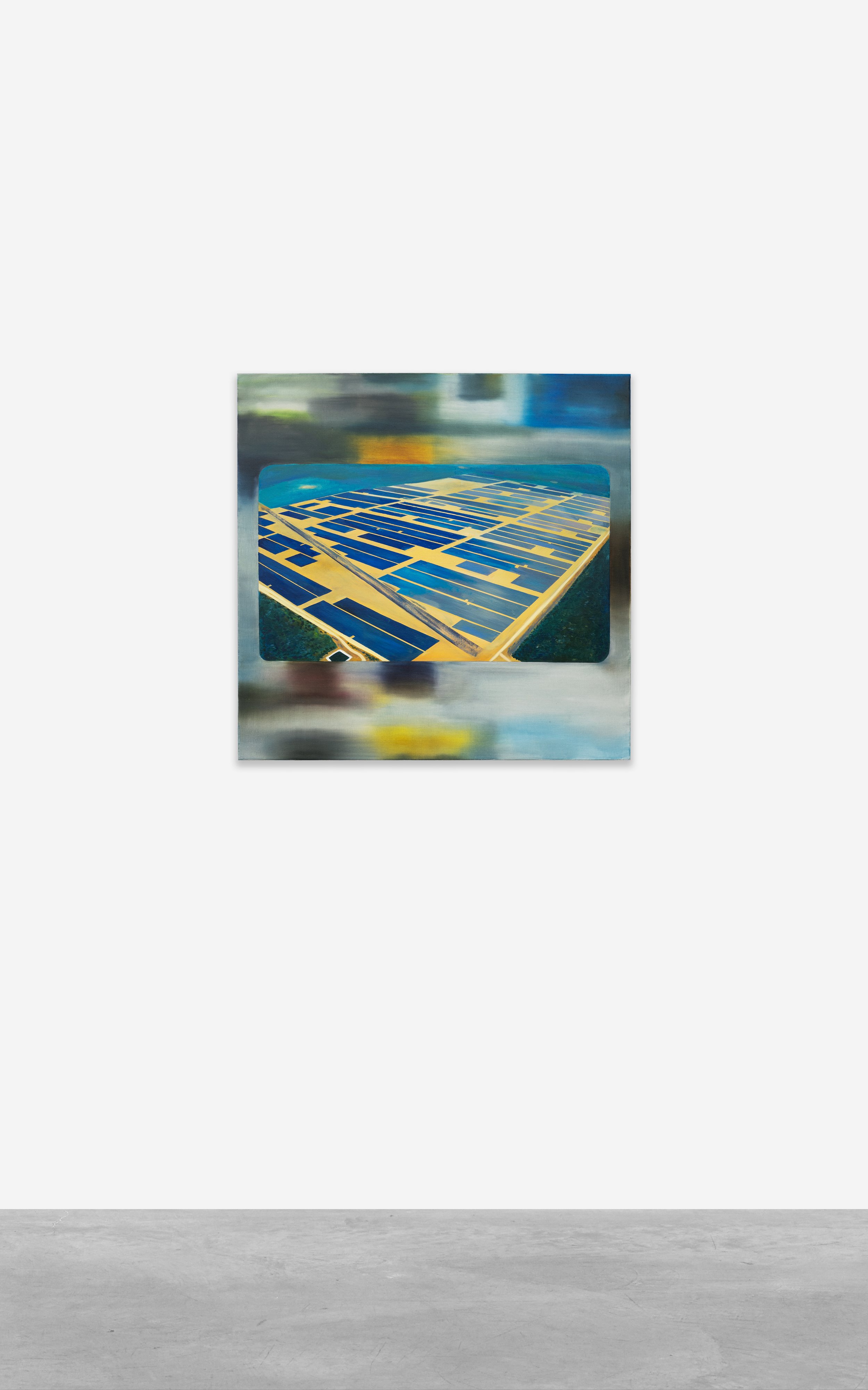
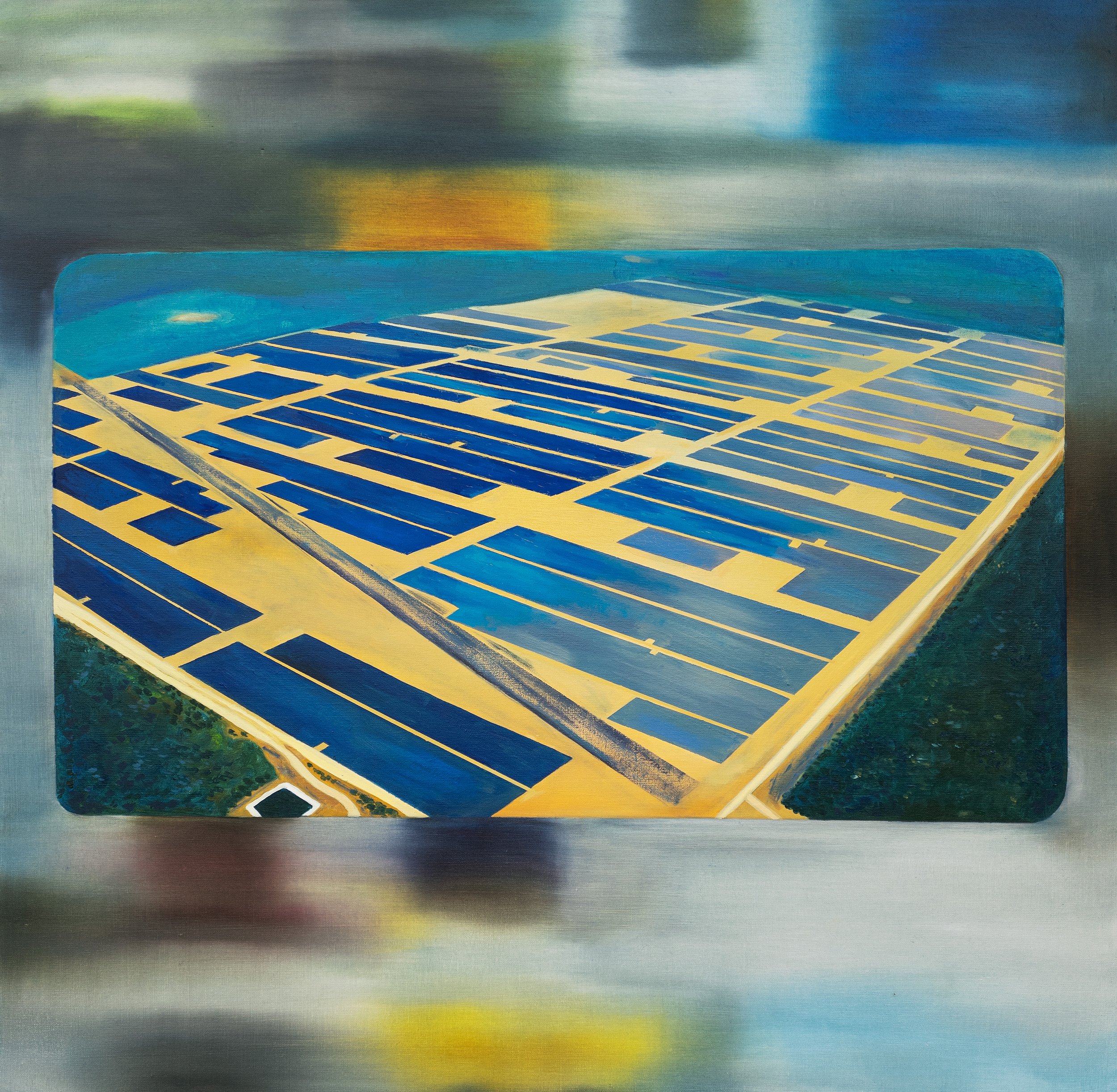
The painting measures 76 by 76 centimeters, a square format that is unusual in Tan Mu's practice, where horizontal formats dominate, and the squareness serves a specific compositional purpose: it allows the grid of panels to spread across the canvas without the directional bias that a horizontal rectangle would impose, without suggesting that the array extends further in one direction than another. The solar farm, in this format, is a field, not a strip. It occupies the canvas the way a farm occupies the land: as an area, not a line, a two-dimensional surface of organized rectangles that covers the available ground. The edges of the panel array are crisp where they meet the surrounding terrain, each one defined by a straight line of paint that follows the edge of a ruler or a strip of masking tape, and these straight edges are the sharpest marks in the painting, sharper than any contour in the landscape, sharper than any edge in the blurred photo-gallery passages that dissolve into the background behind the panels. The contrast between the hard edges of the panels and the soft edges of everything else is the painting's primary visual tension, and it enacts, at the level of brushwork, the same tension that the subject enacts at the level of landscape: the imposition of a rational, geometric system onto an organic, irregular terrain, the replacement of one order by another, the substitution of the field by the grid.
Tan Mu has described the painting's source material with unusual specificity. The solar panels were derived from a photograph captured with a phone camera, while the surrounding environment was rendered in a more abstract and blurred manner. The blurred passages come from her phone's photo gallery, images that dissolve at the edges of the composition, fragmentary and indistinct, like the periphery of a screen where tabs and notifications and half-remembered images accumulate. This incorporation of the phone screenshot is not a casual gesture. It embeds the painting in the specific condition of digital mediation that Tan Mu has identified as the framework for how contemporary individuals perceive the world: "This perspective mirrors how contemporary individuals increasingly perceive the world through screens and digital interfaces. Moments are often fragmented, compressed, and fleeting." The solar farm, as it appears in the painting, is already an image before it becomes a painting. It has already been mediated by the phone camera, compressed into pixels, cropped by the screen, and this initial mediation is preserved in the final work not as a defect but as a structural feature, a record of the way that the landscape arrives to the painter already filtered through the apparatus of digital vision. The painting does not pretend to show the solar farm as the eye would see it from an airplane window. It shows the solar farm as the phone would capture it, and then as the hand would re-record it, two successive mediations that accumulate rather than cancel each other, producing a composite image that carries the traces of both the digital and the analog, both the screen and the canvas, both the instantaneous capture and the slow deliberation of oil paint.
Claude Monet painted the Gare Saint-Lazare in 1877, producing a series of canvases that depicted the newly constructed train station from multiple angles, the platforms beneath their iron and glass roofs, the locomotives releasing clouds of steam into the vaulted space, the trains arriving and departing along tracks that cut through the urban fabric of Paris. The most famous of these, Arrival of the Normandy Train, Gare Saint-Lazare (1877), now in the Art Institute of Chicago, shows a locomotive approaching the viewer beneath a roof of iron trusses, its steam filling the upper register of the canvas with a luminous haze that dissolves the architecture into atmosphere, making the iron structure seem as though it is emerging from the steam rather than containing it. Monet was not the first painter to depict a train station, but he was the first to treat the station as a subject worthy of the same sustained attention that he had previously devoted to gardens, coastlines, and cathedrals. The decision was deliberate, and it carried a specific argument: the infrastructure of modernity was a fit subject for painting, not despite its industrial character but because of it, because the train station, with its iron architecture, its mechanical rhythms, and its atmospheric effects, presented the painter with visual problems that no garden or cathedral could offer, problems of capturing the play of light through steam, the geometry of iron against sky, the compression of space beneath a roof that was engineered rather than built.
Tan Mu has cited Monet directly as a precedent for Solar Farm, and the citation is specific: "I often think about Impressionist painters such as Claude Monet, who documented industrial transformations in their time. His paintings of train stations and factories not only captured new technologies but later became valuable historical records. Scholars now study those works to understand environmental conditions and technological shifts of the nineteenth century." The parallel is not decorative. It is structural. Monet painted the train station at the moment when rail infrastructure was reshaping the French landscape, carving new routes through farmland, constructing new buildings in the center of Paris, creating a new kind of space that was neither fully interior nor fully exterior, neither fully natural nor fully artificial, and he painted it with an attention that was equal to the attention he gave to water lilies and Rouen Cathedral, because he understood that the station was not a secondary subject but a primary one, a record of the forces that were reshaping the world he inhabited. Tan Mu paints the solar farm at the moment when renewable energy infrastructure is reshaping the American landscape, converting agricultural land into energy-producing arrays, replacing crops with panels, and she paints it with the same sustained attention, the same refusal to treat the infrastructure as less worthy of painting than the landscape it replaces, because she understands, as Monet understood, that the infrastructure is the landscape, that the solar farm is not an intrusion into the land but a transformation of it, and that the painting that records this transformation may one day function, as she has written, "as archaeological records of our current energy infrastructure," documents of a transition that future viewers will study the way scholars now study Monet's trains.
The solar farm, as Tan Mu paints it, is a landscape that has been reorganized for extraction, but the extraction is of a different kind than the mining or drilling that preceded it. Solar panels do not remove material from the ground. They convert light into electricity, harvesting the energy that falls on the surface of the land without depleting the substance of the land itself. This distinction matters, because it means that the solar farm occupies a position that is neither purely industrial nor purely agricultural. It is industrial in its geometry and its scale: the panels are arranged in rows, connected by cables, managed by monitoring systems, and their output is measured in megawatts. But it is agricultural in its relationship to the land: it covers the ground the way a crop covers the ground, it occupies open space the way a field occupies open space, and it harvests a renewable resource the way a harvest reaps a renewable crop. The word "farm" in the title is not metaphorical. It is literal. A solar farm is a farm that produces energy instead of food, and the transition from one kind of farm to another is the transition that the painting documents: from agriculture to energy production, from the organic grid of furrows and rows of seedlings to the engineered grid of silicon wafers and electrical connections, from a landscape shaped by the rhythms of planting and harvesting to a landscape shaped by the physics of the photovoltaic effect and the economics of renewable energy markets. Tan Mu has identified this transition as the core of the work's significance: "Their presence marks a significant transition in how land is used. Historically, land was cultivated primarily for food production. Today, large areas are repurposed to host solar panels that harvest energy instead. This shift reshapes both the physical landscape and the social structures connected to it."
Robert Smithson's Spiral Jetty (1970) is a coil of basalt rocks and earth extending into the red water of the Great Salt Lake in Utah, a construction that is neither sculpture nor architecture nor landscape but something that occupies the territory between all three. Smithson built the jetty from materials found on site: mud, salt crystals, rocks, and earth, arranged in a spiral that follows the shape of the lake's shoreline and extends 460 meters into the water, a form that is at once a human intervention in the landscape and a response to the landscape's own structures, the spiral echoing the crystalline patterns that form in the salt-saturated water. The work is also an exercise in entropy. Smithson built it knowing that the lake would rise and fall, that the salt water would discolor the basalt, that the spiral would be submerged and exposed by the seasonal cycles of drought and flood, and that the work would deteriorate over time, not because of neglect but because deterioration is the condition of all material things, and the work was designed to make that deterioration visible, to make the landscape's indifference to human construction into the subject of the construction itself. Spiral Jetty does not resist the landscape. It enters the landscape and accepts the landscape's terms, including the terms of entropy and decay, and in doing so it becomes a record not only of the artist's intervention but of the landscape's response to that intervention, a two-way process of construction and dissolution that continues for as long as the work exists.
The connection between Smithson's Spiral Jetty and Tan Mu's Solar Farm lies in this double condition: both works depict landscapes that have been reorganized by human engineering, and both understand that the reorganization is temporary, that the infrastructure will age, that the system will deteriorate, that what has been built will eventually be dismantled or replaced. Smithson built entropy into the work from the beginning. Tan Mu has built it into Solar Farm from a different angle: not through the physical deterioration of the object but through the awareness that the solar farm, as an energy infrastructure, belongs to a specific historical moment, that it will be superseded by more efficient technologies, and that the painting that documents it may outlast the infrastructure it depicts. "In the future," Tan Mu has written, "this work may move beyond its role as an image and serve as an archive of how our era transformed nature through technology." The archive is necessary precisely because the thing being archived will not last. Solar panels have a functional lifespan of twenty-five to thirty years. The farms that house them will be decommissioned, upgraded, or replaced. The landscape they occupy will be reshaped again, repurposed for a different kind of extraction or returned to agricultural use or left to revert to whatever ecology preceded the installation. Smithson understood that his jetty would be submerged and re-emerged, overgrown and eroded, and he designed the work to make that process of transformation part of its meaning. Tan Mu has designed Solar Farm to register the same awareness: that the infrastructure of the present is the archaeology of the future, that the grid of panels covering the field is a temporary arrangement, and that the painting, which works at the speed of the hand rather than the speed of technological obsolescence, may persist longer than the farm it records, a square of oil on linen outlasting the square of silicon on earth.
The elevated viewpoint that Tan Mu has chosen for Solar Farm is neither the ground-level view of a person walking through the landscape nor the vertical view of a satellite photograph. It is the view from an airplane window or a drone camera, a slightly oblique perspective that reveals the scale of the panel array while keeping the horizon visible at the upper edge of the composition. This viewpoint is specific, and Tan Mu has described its origin: "I chose a slightly elevated viewpoint, similar to what one might see from an airplane window or within a video game interface. This perspective allows the horizon to remain visible while revealing the vast scale of the solar panels below. It also mirrors how contemporary individuals increasingly perceive the world through screens and digital interfaces." The elevation produces two effects simultaneously. It makes the farm visible as a system, as a grid of repeating units that covers the terrain in a pattern that could not be perceived from the ground, where the individual panels would obstruct the view of the array. And it detaches the viewer from the landscape, placing the viewer in a position that is not fully grounded, not fully airborne, but somewhere in between, a position that is characteristic of how the landscape is experienced in an age of screens and cameras, where the most comprehensive views of the terrain are the ones that arrive through digital mediation, through the phone screen, the satellite image, the drone footage, the map application. The elevated viewpoint is not a neutral choice. It is a choice that encodes a specific relationship between the viewer and the land, a relationship of distance and overview, of observation without immersion, of seeing the pattern without being inside the pattern, and this relationship is the same relationship that the solar farm itself imposes on the landscape: a system of organized rectangles seen from above, a geometry that is legible only from a distance, a transformation of the terrain that is comprehensible only when the viewer has been lifted out of the terrain and placed in a position from which the whole array becomes visible.
Li Yizhuo, writing in 2022 about Tan Mu's practice, observed that the paintings "do not aim at diagnosing the modern spectacles from a distance. They conjure up a kind of vitality and depth of their own." The observation is precise, and it applies to Solar Farm with particular force. The painting does not diagnose the solar farm as an environmental problem or celebrate it as an environmental solution. It records the solar farm as a fact of the landscape, a transformation that has already happened, a grid that has already replaced a field, and in recording it, the painting gives the farm a kind of visual vitality that the farm itself, as infrastructure, does not always possess. The panels in the painting refract light. The landscape behind them dissolves into atmosphere. The grid shimmers with the same modulated blues that the actual panels produce when sunlight strikes their surface at different angles throughout the day. The painting is not an illustration of a solar farm. It is a re-performance of the solar farm's visual effects through the medium of oil paint, and the re-performance produces a different kind of attention, a slower attention, an attention that takes minutes and hours rather than milliseconds, an attention that registers the weave of the linen and the thickness of the paint and the decision behind every edge, an attention that is the opposite of the swipe and the scroll and the half-glance that the phone screenshot implies. Tan Mu has said that she is "drawn to this instability, which is why I choose to translate these transient digital impressions into the slow and deliberate language of painting." The instability is the condition of digital perception: fragmented, compressed, fleeting. The deliberation is the condition of painting: slow, accumulated, permanent. And the painting holds both conditions at once, the phone screenshot and the oil-on-linen, the digital capture and the manual record, the swipe and the brushstroke, producing an object that is not a critique of digital mediation but a translation of it into a form that allows the viewer to see what the mediation itself obscures: the structure of the infrastructure, the geometry of the conversion, the grid that replaced the field, the square of panels on the square of earth on the square of canvas, three nested systems of order, each one an attempt to extract something useful from the raw material of the world, whether that material is sunlight or paint or the visible surface of the planet as it appears from an airplane window on a clear day above the flat terrain of Florida, where the farms stretch to the horizon in rows of blue and purple rectangles that harvest the same light that makes them visible, converting the condition of their own appearance into the condition of their function, and the painting records this conversion, not as a report but as a structure, not as a document but as a surface on which the infrastructure of the present has been inscribed in a medium that will outlast the infrastructure itself, a square of linen on which the square of panels has been painted in oil that will still be there when the panels have been dismantled and the land has been repurposed and the farm has become, as Tan Mu predicts, an archaeological record of a transformation that the painting was made to remember because the landscape, left to its own devices, will forget.