Shell of Suns: Tan Mu's Dyson Sphere and the Architecture of Infinite Want
Nick Koenigsknecht, writing in the catalog for the BEK Forum exhibition, observed that when we look at technology, we are looking at ourselves. His argument was specific: the paintings of submarine cables, data centers, and computational infrastructure that constitute Tan Mu's Signal series function not as depictions of external scientific milestones but as self-portraits, records of the human impulse to build systems that extend the body's reach into the ocean, into the atmosphere, into the void. The observation is acute, and it opens a question that Dyson Sphere (2023) answers in a register that Koenigsknecht's essay did not anticipate. If the cables are self-portraits, what is a megastructure? What kind of self-portrait is a shell the size of a solar system, a structure so vast that its only precedent in human imagination is the dome of heaven itself? The Dyson Sphere, as Tan Mu paints it, is not a cable or a circuit or a data center. It is a thought experiment made of gold, a civilization's fantasy of total capture, and the painting holds that fantasy in a state of permanent suspension between the rational and the ecstatic, between the engineering logic that the structure demands and the wonder that the structure inspires, between the cold arithmetic of stellar energy output and the warm, luminous field of amber and ochre that fills the canvas from edge to edge.
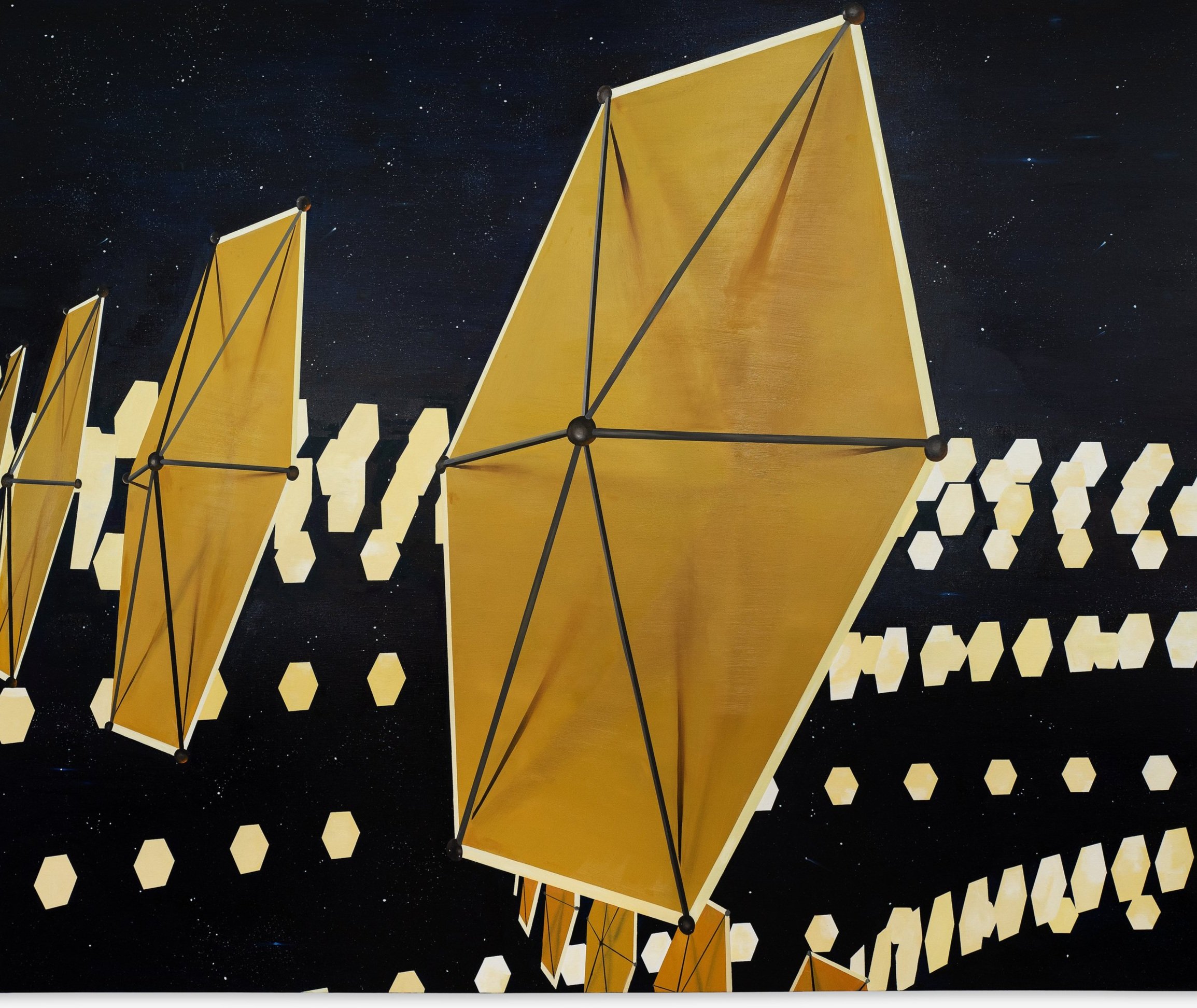
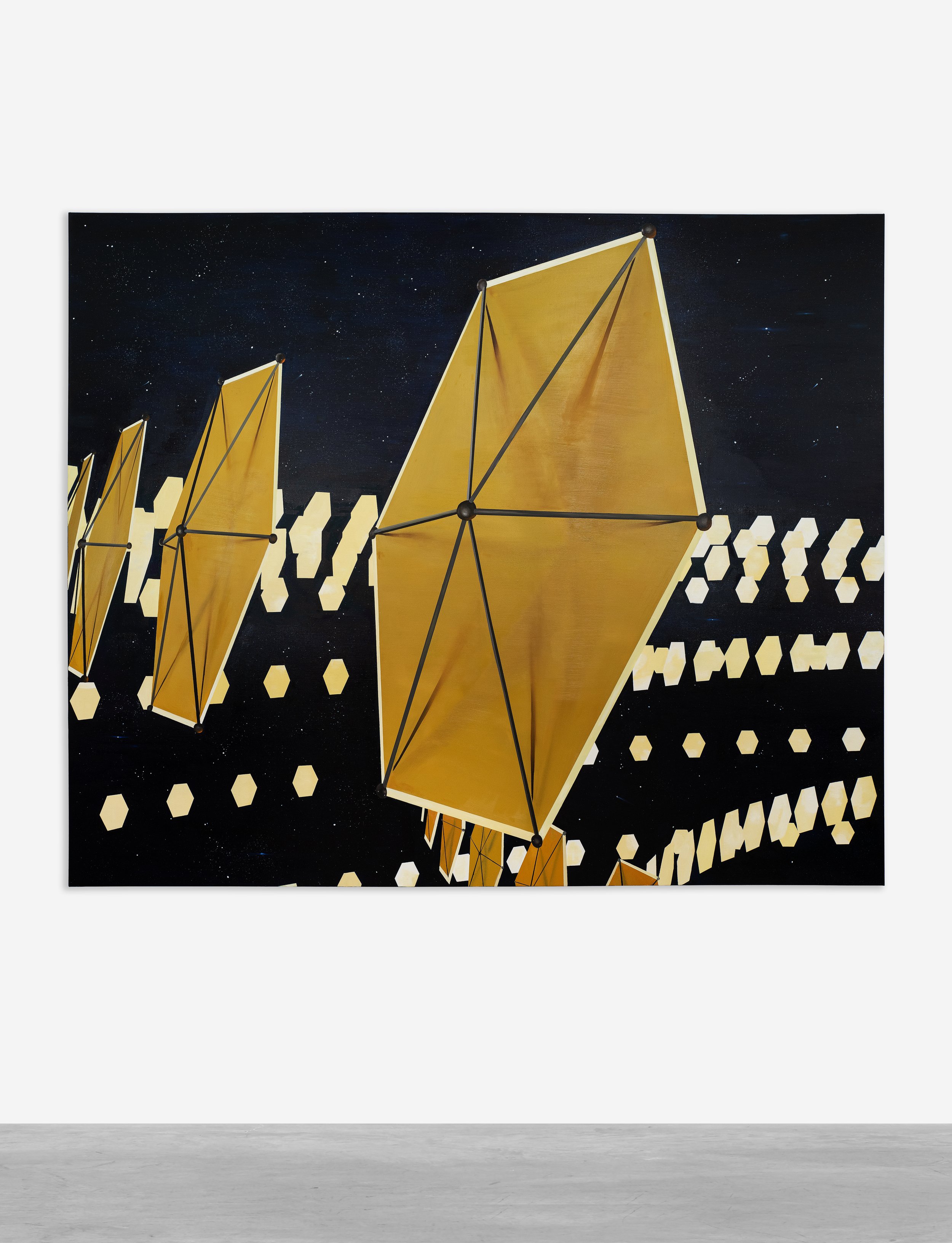
The painting is large. Oil on linen, 152 by 183 centimeters, 60 by 72 inches, a horizontal format that exceeds the viewer's peripheral vision at close range and requires the eye to move across the surface in stages, registering first one passage and then another, the way a satellite scans the surface of a planet in longitudinal strips. The scale is not arbitrary. It is the largest painting in Tan Mu's practice at the time of its making, and the size is a response to the subject: the Dyson Sphere, even as a hypothetical concept, is defined by its scale, by the fact that it would enclose an entire star, and the painting that depicts it must register that immensity somehow, not by reproducing it but by creating a surface that the eye cannot take in at a glance, that requires the viewer to navigate it the way an astronaut might navigate the interior of a structure that has no horizon and no ceiling, only a continuous field of energy-harvesting panels extending in every direction toward the curvature of the shell. The linen at this scale carries a pronounced weave that is visible in the thinner passages of paint, a diagonal hatching that gives the surface a subtle texture, a ground that prevents the golden field from becoming a flat, printed surface and insists instead on the materiality of the canvas, the fact that the painting is an object made of flax and oil and pigment, not a screen emitting light.
The color is overwhelmingly warm. Tan Mu has described using "a field of golden tones to depict energy collection panels orbiting a star," and the description is precise: the dominant register of the painting is gold, amber, ochre, and burnt sienna, a chromatic field that suggests the diffuse, omnidirectional light of a star being absorbed by a surrounding shell of panels. These golden tones are not uniform. They modulate across the surface in flowing gradients, bands of lighter and darker gold that move across the canvas in curves and arcs, suggesting the rotation of the panels around their central star, the continuous motion of a structure that has no fixed orientation because it encloses its light source on all sides. The flowing gradients are built from thin, translucent layers of oil, each one a slightly different temperature of gold, and the layering produces a depth that is not perspectival but chromatic: the eye perceives some passages as closer and others as farther away not because of linear perspective but because of the warmth and density of the pigment, the way a thicker deposit of cadmium yellow reads as nearer than a thin wash of raw sienna, the way the paint itself creates a topography of proximity and distance that mirrors the topography of the imagined structure.
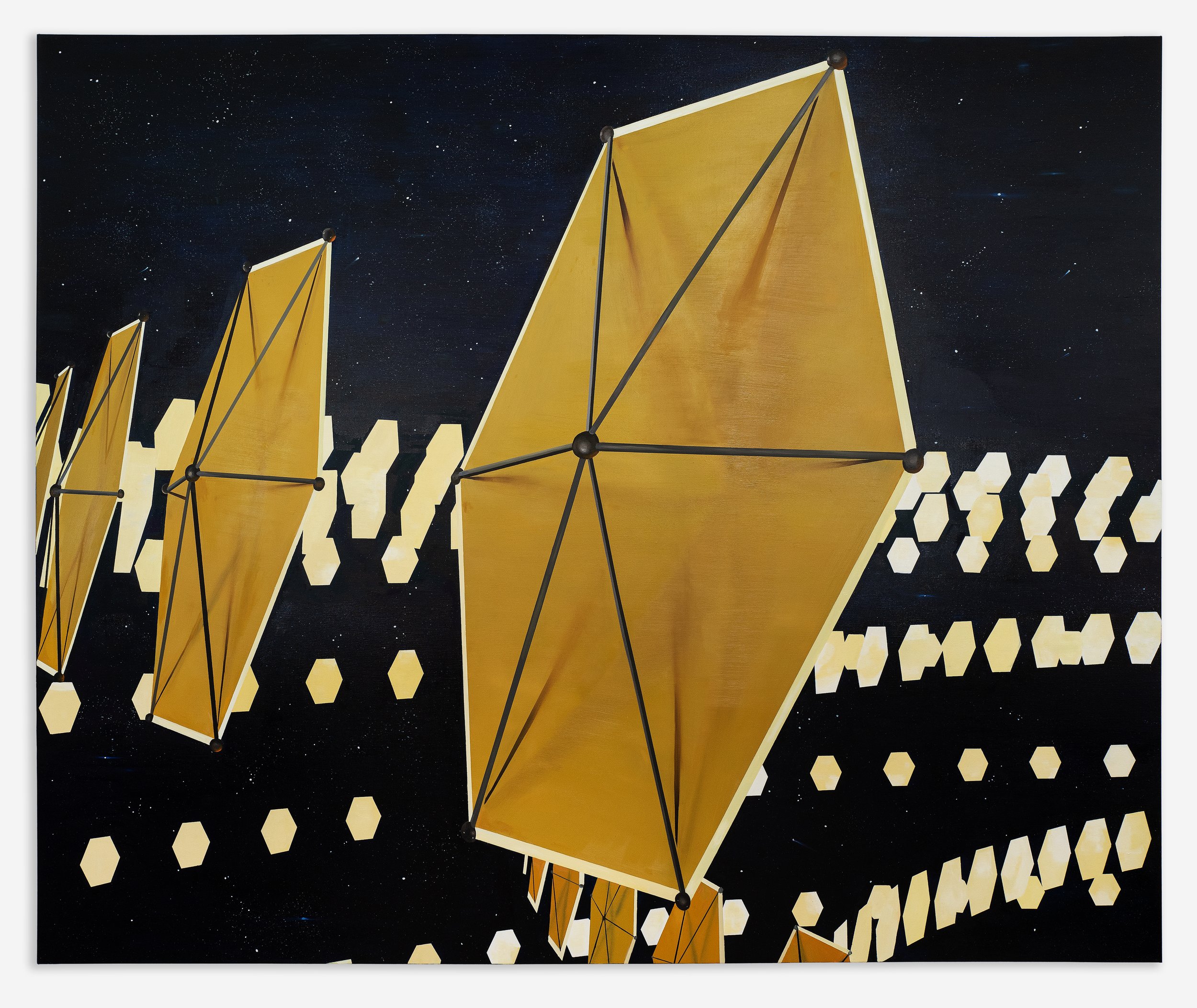
Against this golden field, two other visual elements operate. The first is the dense accumulation of points that fills the upper register of the painting, a field of tiny, individual marks in whites, pale yellows, and cool blues that reads as a starry sky seen from within the sphere, looking outward through the gaps between panels or through the transparent sections of the shell toward the distant stars that lie beyond. These points are not distributed randomly. They cluster and disperse in patterns that suggest the actual distribution of stars in a galactic field, denser in some regions, sparser in others, with occasional concentrations that evoke star clusters or nebulae. Tan Mu has identified Dyson Sphere as "my first sustained attempt to depict the starry sky," and the technique she developed here became what she calls "a foundational visual language" for later works in the Horizons and Signal series. The points are painted individually, each one a single touch of the brush, and at close range they reveal themselves as small, gestural marks with slight variations in size and opacity, not the mechanical dots of a digital print but the deliberate marks of a hand working through a field of luminous points one at a time, accumulating them across weeks of painting into a surface that, from across the room, appears to shimmer with the light of thousands of individual stars. The second element is a darker passage that occupies the lower register of the canvas, a band of deep blues, purples, and blacks that suggests the interior structure of the sphere itself, the shadowed surfaces that face away from the star, the scaffolding and infrastructure that supports the energy-harvesting panels. This darker passage provides the chromatic counterweight that makes the golden field read as luminous rather than monotonous, and the boundary between the bright field and the dark passage is a zone of transition where the gold dissolves into amber and the amber dissolves into deep purple, a gradient that suggests the edge of the star's illumination, the terminator line between the lit and unlit hemispheres of a megastructure that is both a planet and a machine.
Kasimir Malevich's Suprematist Composition: White on White (1918), now in the Museum of Modern Art, New York, is a painting of a slightly tilted white square on a white ground, the two forms differentiated only by the faintest shift in tone and texture, the square a shade warmer or cooler than the ground depending on the light in which it is viewed. Malevich described the work as a painting of the "void" or the "white abyss," a reference to the cosmic space that he believed Suprematism could access through the reduction of painting to its most elemental terms: square, ground, color. The year 1918 was the year of the Russian Revolution's most violent phase, and Malevich's turn toward an art of pure geometric forms against an empty ground was a rejection of the representational obligations that revolutionary culture was beginning to impose on artists, an insistence that painting could occupy a space beyond politics, beyond narrative, beyond the figure, a space that was not empty but that was filled with something representation could not name: the structure of feeling itself, the geometry of sensation before it is assigned a subject. The white square in White on White floats. It has no ground line, no horizon, no orientation. It is a form in an undifferentiated space, and the slight tilt of the square suggests rotation, a slow drift that the viewer cannot complete because there is no frame of reference against which to measure the square's movement. It is, in its radical austerity, a painting about a form in the act of becoming, or a form in the act of dissolving, and the viewer cannot determine which because the painting has removed every contextual marker that would allow that determination.
The connection between Malevich's White on White and Tan Mu's Dyson Sphere lies in this condition of the geometric form suspended in a luminous void, oriented by no external frame, defined only by the chromatic relationship between the form and the ground that surrounds it. In White on White, the form is a square, the ground is a square, and the difference between them is a difference of tone so slight that it verges on invisibility. In Dyson Sphere, the form is a shell, the ground is the void, and the difference between them is the difference between gold and black, between light and darkness, between the energy that the star emits and the nothing that exists beyond the shell. But in both cases, the painting refuses to provide a fixed viewpoint, a horizon, or a scale. The viewer of White on White cannot tell whether the inner square is large or small, near or far, rising or falling. The viewer of Dyson Sphere cannot tell whether the shell is the size of a city or the size of a solar system, whether the star at its center is a candle or a sun, whether the golden panels are a meter across or a million kilometers. The paintings operate in a register of radical indeterminacy, where the geometry of the form is precise but the scale of the form is unknowable, and this indeterminacy is not a failure of representation but a structural feature of the subject, because the Dyson Sphere, as a hypothetical megastructure, exists only in the space of imagination, and imagination does not assign fixed dimensions to its objects. The painting holds the structure in a state of suspended scale, neither microscopic nor telescopic, neither model nor monument, and in doing so it registers the essential condition of the thought experiment: it is a structure that the mind can conceive but the body cannot locate, a form that exists in the space between the rational and the speculative, the same space that Malevich's white square occupies, floating in its white void, a form without a world.
Freeman Dyson proposed the structure that bears his name in a 1960 paper published in the journal Science, titled "Search for Artificial Stellar Sources of Infrared Radiation." The argument was characteristically concise: any technological civilization with sufficient energy demands would eventually need to capture the total output of its star, and the most efficient way to do this would be to dismantle a planet or a series of planets and reassemble their material into a shell or a swarm of satellites surrounding the star, absorbing its radiation on all sides. Dyson was not proposing a construction project. He was proposing a method for detecting extraterrestrial intelligence: if such a structure existed around a distant star, the star's visible light would be partially or fully obscured, but the shell would radiate infrared radiation as it absorbed and re-emitted the star's energy, and this infrared signature could be detected by astronomical instruments. The paper was three pages long. It contained no diagrams, no engineering specifications, no cost estimates. It was a provocation in the most rigorous sense of the word: a thought experiment that followed the logic of physics to a conclusion that physics alone could not verify, a structure that existed at the boundary between the calculable and the unimaginable, between the energy output of a star, which can be measured in watts, and the scale of a shell that would enclose that star, which can only be described in terms that exceed the vocabulary of engineering and enter the vocabulary of mythology.
Tan Mu has addressed the challenge of translating this scale into paint with unusual candor. "The true dimensions of such a structure are almost impossible to comprehend," she has written, "so rather than aiming for literal representation, I approached the composition metaphorically." The metaphor operates at the level of material: the layered brushstrokes that build the golden field function as "a visual analogy for energy being gathered and stored over time," each layer a deposit of paint that corresponds, in the logic of the metaphor, to a deposit of energy accumulated by the panels of the sphere over the lifetime of their operation. The painting does not attempt to show the entire sphere. It shows a fragment of its interior surface, a section of the shell as it might appear to an observer standing within the structure and looking outward through the panels toward the stars beyond. The viewpoint is neither the distant perspective of a satellite looking down at the sphere from outside nor the intimate perspective of a single panel examined at close range. It is a middle distance, a view that captures enough of the structure to suggest its immensity without attempting to contain it, and the edges of the canvas function as the limits of the fragment, the boundary of what can be shown without reducing the whole to a diagram. The decision to paint a fragment rather than the whole is the decision that makes the painting work as painting rather than as illustration, because the fragment allows the viewer to project the rest of the structure beyond the edges of the canvas, extending the sphere into the viewer's imagination, where it can have whatever scale the viewer assigns to it, and the scale that the viewer assigns will always be larger than any scale that the painting could have rendered on a six-foot canvas.
James Turrell has spent more than four decades building Roden Crater, a volcanic cinder cone in the Painted Desert of Arizona that he has reshaped into a naked-eye observatory, a structure of tunnels, chambers, and apertures designed to frame the sky and the light that passes through it at specific moments of the day and the year. The project, which Turrell began acquiring in 1979 and which remains incomplete as of this writing, is an artwork that operates at the scale of geology: the crater is approximately 500 feet high and a mile and a half in circumference, and the chambers carved into its interior are sized to accommodate the human body in standing, sitting, and reclining positions, so that the viewer's experience of the light that enters through the apertures is always a bodily experience, an experience of light registered by the skin and the retina and the circadian system, not by the intellect alone. Turrell has described the project as an attempt to create "a space that is a container for light," and the description is precise: the chambers do not display images of light, they contain light itself, and the light that they contain changes continuously as the sun moves across the sky, as clouds pass, as the seasons turn, so that the viewer never sees the same light twice, and the artwork is not the crater or the chambers or the apertures but the experience of looking at light from within a structure that has been designed to make that looking as intense and as sustained as the human visual system can bear.
The structural parallel between Turrell's Roden Crater and Tan Mu's Dyson Sphere is not obvious at first glance, because one is a work of land art and the other is a painting of a hypothetical megastructure. But both works are engaged with the same fundamental problem: how to create a form that contains light, that holds light, that makes light the subject rather than the medium. Turrell's crater is a container for the light of the sun. Tan Mu's painted sphere is a container for the light of a star. Both structures define their interior by the light that enters it, and both make the boundary between interior and exterior, between the space that holds the light and the space that the light comes from, the defining structural condition of the work. In Roden Crater, the boundary is the aperture, the opening in the crater's ceiling or wall that admits the light and frames the sky, and the aperture is the element that Turrell has calibrated most carefully, adjusting its size, its angle, and its shape to produce specific optical effects at specific times. In Dyson Sphere, the boundary is the shell itself, the network of panels that surrounds the star and absorbs its light, and the gradient that Tan Mu has painted between the golden field and the dark passage represents the zone where the star's light is absorbed and the void beyond the shell begins, the visual equivalent of the aperture that separates the lit interior from the dark exterior. Both works understand that containing light is not the same as depicting light, and both understand that the structure that contains light is a structure that mediates the viewer's relationship to the source, determining not only what the viewer sees but how the viewer sees it, whether the viewer stands in the full illumination of the star or at the edge where the illumination fades into the darkness of empty space. The difference is that Turrell built his container in the desert and Tan Mu painted hers on linen, but the ambition is the same: to make a space, whether real or represented, where light is not the condition of visibility but the content of the work.
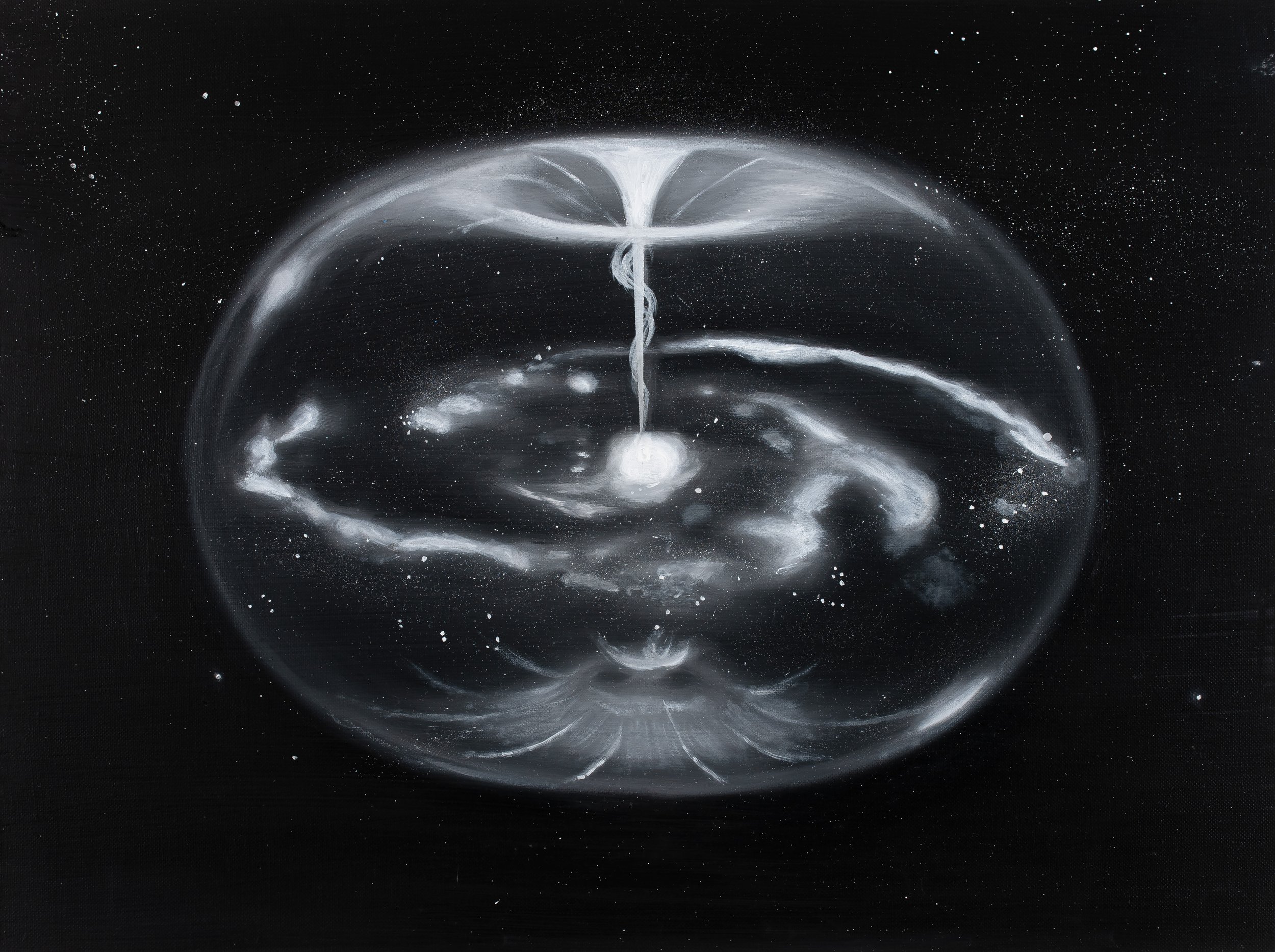
Tan Mu has situated Dyson Sphere within a sequence of works that document the evolution of energy, from early electrical infrastructure and nuclear power to solar energy and speculative scientific ideas, and the sequence reads as an arc that moves from the historical to the contemporary to the hypothetical, from what humanity has built to what humanity might build, from the cables and reactors and solar farms that already exist to the megastructure that exists only as a thought in the mind of a physicist and a painting on a wall. The arc includes Illuminate (2022), which depicts a data center illuminated by artificial light, and Solar Farm (2022), which documents the conversion of agricultural land into energy-producing arrays, and Bikini Atoll (2020) and Trinity Testing (2020), which record the nuclear tests that inaugurated the atomic age, and Torus (2020 and 2021), which visualize the self-sustaining energy systems that govern everything from tornadoes to planetary atmospheres. Dyson Sphere is the endpoint of this arc, not because it is the largest painting or the most ambitious subject but because it represents the limit of the sequence: the structure that would, if it could be built, render all previous energy infrastructure obsolete, the megastructure that absorbs the total output of a star and renders the solar farm and the nuclear reactor and the coal plant irrelevant, the ultimate energy system that makes every previous energy system a relic of a civilization that had not yet learned to think at the scale of its own star. Tan Mu has written that "energy is never neutral. It transforms landscapes, reorganizes power structures, and reshapes human relationships from land to sea to sky." The Dyson Sphere is the structure that would transform not a landscape but a solar system, reorganizing not a power structure but the structure of power itself, reshaping not human relationships but the relationship between a civilization and its star, a relationship that is currently defined by the fraction of stellar energy that falls on a single planet and that the Dyson Sphere would redefine as the totality of stellar energy, captured and contained within a shell that is the size of an orbit.
Tan Mu has described a tension that she experienced while painting Dyson Sphere, a tension between "scientific logic and emotional intuition," and she has identified this tension as "essential to the work." The scientific logic of the Dyson Sphere is the logic of thermodynamics and stellar physics: a star emits a calculable quantity of energy per unit time, and a shell that surrounds the star will absorb that energy on all sides, and the civilization that controls the shell will have access to all of it. The emotional intuition is something else. It is the response to the image of a star entirely enclosed by a structure built by living beings, the response to the vision of light that is not scattered into the void but gathered and held, the response to the idea that the cosmos is not an infinite reservoir of wasted energy but a system that can, in principle, be made to serve the needs of consciousness, that the stars do not have to burn in vain, that their light can be caught and used rather than simply radiating outward into the emptiness where no eye will ever see it. This is the emotional core of the Dyson Sphere concept, and it is the emotional core of the painting: not the engineering of the shell but the desire that the shell answers, the desire to contain what has always been uncontainable, to gather what has always been scattered, to put a boundary around the boundless. The painting holds this desire in its golden field, in the warm, luminous surface that suggests a light so total and so evenly distributed that it has no source and no shadow, only a continuous glow that fills the visible world the way the light of a star fills the interior of the sphere that surrounds it, and the viewer standing in front of the canvas experiences a fraction of that totality, a body in a gallery standing in front of a painted surface that emits no light of its own but that appears to glow with a light that has no origin, a surface that seems to generate its own illumination, and this effect, which is an effect of pigment and not of photons, is the painting's translation of the Dyson Sphere's promise: a space where the light is everywhere, where there is no outside and no darkness, where the boundary between the star and the shell is the boundary between the source and the world that the source sustains, and the viewer is inside that boundary, inside the painting, inside the sphere, inside a structure that exists only as a thought but that the painting has made visible, tangible, and warm, a golden room at the center of the cosmos where the light does not diminish and the energy does not fail and the desire for infinite power is answered by the steady glow of paint on linen that outlasts the thought that produced it, because the physicist who proposed the structure is dead and the structure has not been built and may never be built, but the painting is still here, still glowing, still holding the star in its shell of amber and gold, a shell made not of dismantled planets but of oil and linen and the patient accumulation of thousands of individual points of light painted by hand over weeks of work in a studio where the artist, alone with the canvas, built the interior of a megastructure one brushstroke at a time, each one a deposit of energy in a medium that preserves what the imagination produces long after the imagination has moved on to the next thought.