The Image That Replaced the World: Tan Mu's LOADING... and the Screen That Changed the Earth
In September 2017, the opening screen of WeChat changed. For six years, since the application's launch in 2011, users who opened the app were greeted by NASA's Blue Marble, the iconic photograph of Earth taken by the crew of Apollo 17 in December 1972, showing the African continent centered in the frame, a swirl of white clouds above the Sahara, the deep blue of the Indian Ocean, the brown and green of the landmasses, the entire planet rendered in the vivid color of a photograph taken from space. When WeChat replaced this image with a photograph produced by China's own Fengyun 4A satellite, the center of the Earth shifted. The new image showed the Asian continent instead of Africa. China occupied the visual center. The ocean was the Pacific, not the Indian. The perspective had not changed. The satellite was in the same geostationary orbit. But the framing had moved, and with the framing, the center of the world. Over a billion people saw this new Earth every time they opened the app, and most of them saw it without noticing that it had changed, because a loading screen is not something you look at. It is something you wait through. It is the digital equivalent of elevator music, a placeholder that fills the interval between your intention and its fulfillment, a moment of suspension that the mind typically bypasses on its way to the conversation, the payment, the news. Tan Mu did not bypass it. She looked at the loading screen and saw a geopolitical assertion disguised as a software update, and then she painted it.
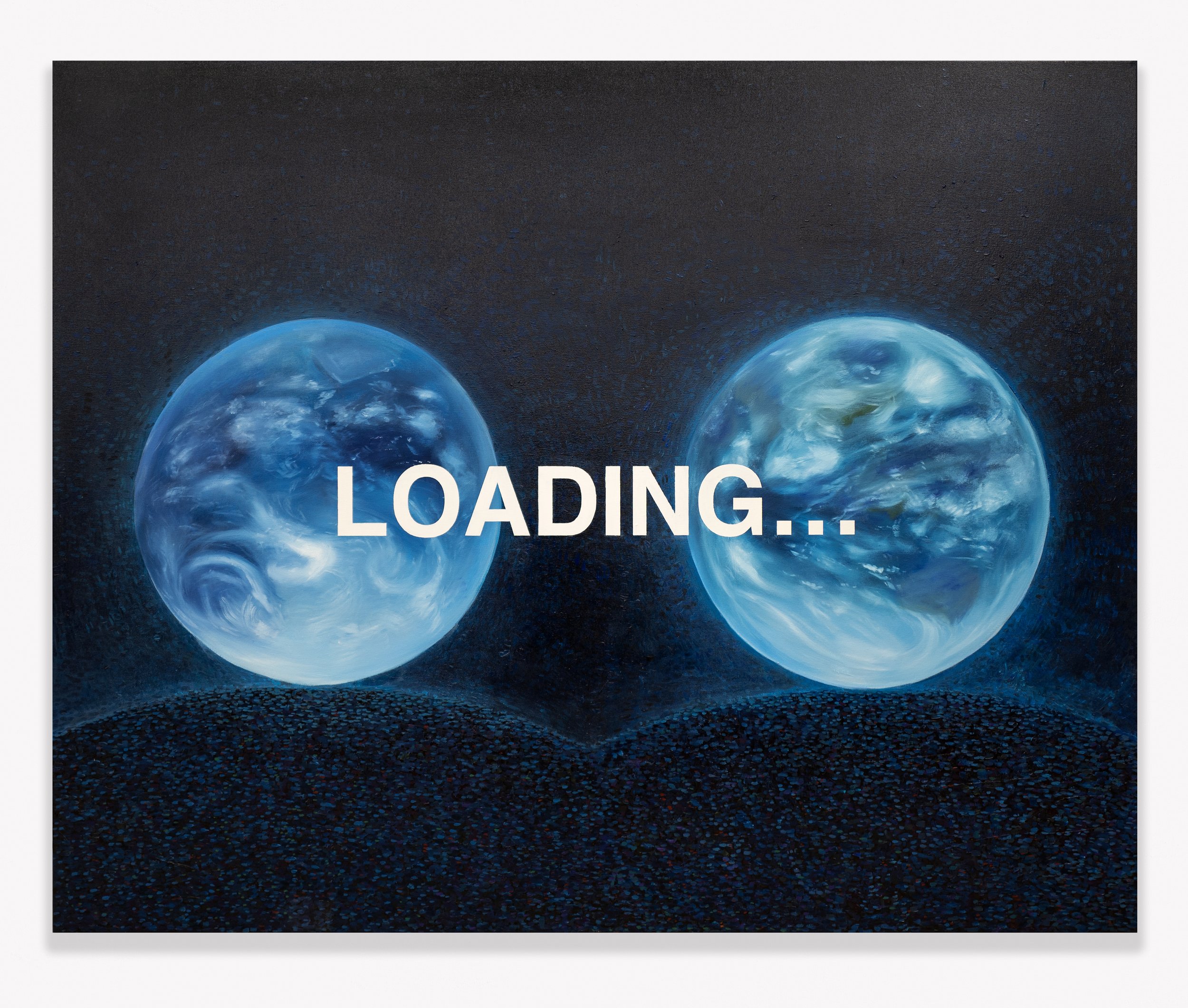
LOADING... (2019) is oil on canvas, 122 x 152 cm (48 x 60 in). It is one of the largest works in the early period of Tan Mu's practice, and its scale is significant. A loading screen is encountered on a phone, a device held in the hand, a screen measuring roughly six by three inches. The painting measures nearly five by four feet. The expansion from palm to wall is not merely an enlargement. It is a transformation of category. What was ephemeral becomes permanent. What was glanced at becomes looked at. What was functional becomes painterly. The composition presents two circular images of the Earth facing each other symmetrically across a dark field. On one side, the Blue Marble: Africa centered, the Indian Ocean dominant, the continent's familiar shape rendered in the distinctive color palette of the NASA photograph, with its saturated greens and browns and the stark white of cloud cover swirling above the equator. On the other side, the Fengyun image: Asia centered, China occupying the frame's visual midpoint, the Pacific Ocean spreading to the right, the brown mass of the Asian landmass anchoring the composition. Between them, and behind them, and extending to the edges of the canvas, the background is not a flat dark field. It is built from countless layered dots, each one a small, deliberate mark of paint, accumulating into a field that reads at a distance as uniform but reveals itself at close range as dense with individual gestures. Tan Mu has described these dots as "fragments of data, memory, and signal," and the description is both literal and metaphorical. They are literal because each dot is a discrete unit of paint applied by the artist's hand. They are metaphorical because they stand for the data packets that pass through the network during the loading process, the invisible traffic that the loading screen conceals even as it announces it is happening.
The symmetry of the composition is its most immediately striking feature. The two Earths are positioned at the same height, the same distance from the center, the same size. They mirror each other across the vertical axis of the canvas like the facing pages of an open book, or like the two halves of a diptych, each one complete in itself but each one finding its full meaning only in relation to the other. This is not a painting of one Earth. It is a painting of two Earths, and the two Earths are not the same. They are the same planet, seen from the same orbital altitude, but framed differently, centered differently, presented differently, and the difference in framing is the difference in who controls the image, who decides what the center of the world looks like, who has the technological capacity to produce a photograph of the whole Earth and the institutional authority to place it in front of a billion people every day. The Blue Marble was produced by NASA, an agency of the United States government. The Fengyun 4A image was produced by the China Meteorological Administration, an agency of the Chinese government. The shift from one to the other is not a shift from a global image to a national image. Both are national images. The Blue Marble was no less American for being presented as universal. The shift is a shift from one national perspective to another, from a framing that centers Africa to a framing that centers Asia, and the fact that most users did not notice the change is evidence not of the change's insignificance but of the loading screen's effectiveness as a vehicle for invisible ideology. A loading screen is not a billboard. Nobody studies it. Nobody debates it. It is seen without being perceived, absorbed without being examined, and this is precisely what makes it such an efficient carrier of meaning: it delivers its content below the threshold of conscious attention, and the content it delivers is a particular way of seeing the Earth, a particular centering of the globe, a particular answer to the question of where the world's center is.
Between 1950 and 1976, Josef Albers produced over a thousand works in the series he titled Homage to the Square. Each painting consists of three or four nested squares of color, the largest filling the canvas edge to edge, each subsequent square centered within the one before it, the smallest floating at the center like a window into a deeper layer. The format never changed. The only variable was color. Albers chose his colors with meticulous precision, recording the specific commercial paints he used and the proportions of their mixtures, and he arranged them in combinations that produced effects of depth, vibration, and atmospheric presence that seem impossible given the rigid geometry of the format. A painting of three nested squares should be flat. Albers's paintings of three nested squares are not flat. They recede. They advance. They glow from within, as if the center square were emitting light rather than reflecting it. The effect is achieved entirely through color interaction: the way a warm orange placed beside a cool gray appears to push forward, the way a pale yellow inside a deep blue appears to float, the way the same hue reads differently depending on the hue that surrounds it. Albers demonstrated that color is not a fixed property of a surface but a relationship between surfaces, and that the relationship changes depending on context, proximity, and sequence.
The structural parallel between Homage to the Square and LOADING... is not in the specific visual form, which is different, but in the logic of the format. Albers committed to a single compositional structure and then produced over a thousand variations within it, each one testing a different color relationship, each one proving that the same format can produce an inexhaustible range of perceptual effects. The format is the constant. The variable is the color. Tan Mu's painting operates on a similar logic, though it compresses the variation into a single canvas. The format is the loading screen: a circular image of the Earth, centered on a dark field, seen from orbit. This format is constant. The variable is the framing: which continent occupies the center, which ocean dominates the field, which nation's satellite produced the photograph. The two Earths in LOADING... are the same format with different content, just as any two paintings from Homage to the Square are the same format with different color. The comparison is not decorative. It is structural. Albers proved that changing the color within a fixed format changes the entire perceptual experience of the format. Tan Mu demonstrates that changing the center within a fixed image of the Earth changes the entire geopolitical meaning of the image. The format is the same. The planet is the same. The perspective is the same. But the framing has moved, and with the framing, the center of the world, and with the center of the world, the meaning of the picture, and with the meaning of the picture, the invisible assertion of who gets to decide what the Earth looks like when a billion people open their phones in the morning.
The WeChat loading screen that Tan Mu painted is one instance of a broader phenomenon: the satellite image as cultural icon. The Blue Marble photograph, taken by Harrison Schmitt or Ronald Evans on December 7, 1972, during the Apollo 17 mission, is among the most widely reproduced photographs in human history. It has appeared on postage stamps, book covers, environmental campaign posters, and the opening screens of at least two major operating systems. Its authority derives from its apparent neutrality. It is the Earth, seen from space, without borders, without nations, without politics. It is the whole planet, entire and singular, hanging in the void. This neutrality is, of course, constructed. The photograph was taken by American astronauts on an American mission, launched from American territory, using American technology, and the decision to center Africa in the frame rather than, say, the Pacific Ocean or North America, was a decision made by human beings with specific institutional affiliations and specific audiences in mind. The image's apparent universality is the product of an American space program at the height of its prestige, and its global circulation was facilitated by American media infrastructure. The Blue Marble is a national image that succeeded in presenting itself as a global one. The Fengyun 4A image, when it replaced the Blue Marble on WeChat, performed the same operation in reverse: it presented a nationally produced image as a universal one, centering China instead of Africa, shifting the visual center of the world from the Indian Ocean to the Pacific, and it did so not through a grand announcement or a policy document but through a software update, a change in a splash screen that most users absorbed without conscious recognition. The genius of the loading screen as a vehicle for visual ideology is that nobody examines a loading screen. It is not a destination. It is a corridor. You pass through it on your way to somewhere else, and the images it shows you register below the level of attention, like wallpaper in a doctor's office or the pattern on a paper cup, present but not perceived, influential but unexamined.
Tan Mu's personal connection to this image is not abstract. She left Yantai for Beijing in 2006 and for the United States in 2011. Before WeChat existed, she relied on prepaid international data plans and Skype to communicate with family, and every conversation felt, as she has described it, "slightly delayed, slightly fragile." WeChat, when it appeared, changed this condition. It "collapsed distance and time zones" and "allowed emotional continuity across continents." It "stopped feeling like a tool and started to feel like an extension of how intimacy worked." The loading screen was the threshold of this intimacy. You opened the app, you saw the Earth, you waited, and then you were connected. The moment of waiting was the moment of suspension between separation and connection, between being alone and being in contact, and the image that appeared during that suspension was not a neutral placeholder. It was a statement about where the center of your world was, about which satellite was watching you, about whose technology was mediating your intimacy. For Tan Mu, who had spent years living between China and the United States, navigating time zones and data plans and the fragility of international communication, the shift from one Earth to another was not a technical update. It was a shift in the visual architecture of her daily life, a change in the image that appeared at the threshold of every conversation she had with her family, and it is this threshold quality, this suspended betweenness, that the painting captures.
In 1962, Andy Warhol produced Gold Marilyn Monroe, a painting based on a publicity photograph of the actress that had been reproduced endlessly in newspapers, magazines, and advertisements. Warhol silkscreened the photograph onto a canvas and then hand-painted the gold background that surrounds the image, creating a secular icon that combines the impersonality of mechanical reproduction with the reverence of a Byzantine votive painting. The face is identical to every other reproduction of that photograph. The gold is unique to the canvas. The combination produces a work that is simultaneously mass-produced and precious, disposable and devotional, a commodity and an icon. The critical insight of Gold Marilyn Monroe is that the photograph of Monroe had already become an icon before Warhol painted it. It had been reproduced so many times that it had ceased to refer to a specific person and had begun to function as a cultural symbol, a visual shorthand for fame, beauty, vulnerability, and premature death. Warhol's contribution was to make the iconographic status of the image visible by placing it against a field of gold, the traditional background of Christian religious paintings, thereby announcing that the photograph had become what the gold background said it was: an object of worship, a face that demanded veneration, a secular saint in a culture of mass reproduction.
LOADING... operates on a similar logic, though the image it treats is not a celebrity photograph but a satellite image, and the iconographic tradition it invokes is not the golden background of Byzantine painting but the dark field of a loading screen. The Blue Marble had already become an icon before Tan Mu painted it. It had been reproduced on postage stamps, book covers, and environmental posters. It was, and remains, the default image of the whole Earth, the picture that comes to mind when someone says "the planet" without specifying a view. By placing two versions of this icon on a single canvas, Tan Mu does what Warhol did with Monroe's face: she makes the iconographic status of the image visible by forcing the viewer to see that it is not one image but two, that it is not a neutral representation of the Earth but a particular framing of the Earth produced by a particular institution for a particular audience, and that the replacement of one framing by another is not a change in the Earth but a change in who controls the image of the Earth. The background of Tan Mu's painting, with its countless layered dots, functions like the gold in Warhol's Gold Marilyn Monroe: a field that elevates the image above the status of a reproduction and into the status of a painted object, an object that has been made by hand, that bears the trace of the maker's decisions and the maker's time, and that refuses to let the image pass by unexamined. The dots are not decoration. They are the painting's argument that the loading screen is worthy of sustained attention, that the moment of suspension between pressing the icon and entering the conversation is not empty time but filled time, time that carries within it the weight of geopolitics, national identity, and the invisible infrastructure of connection.
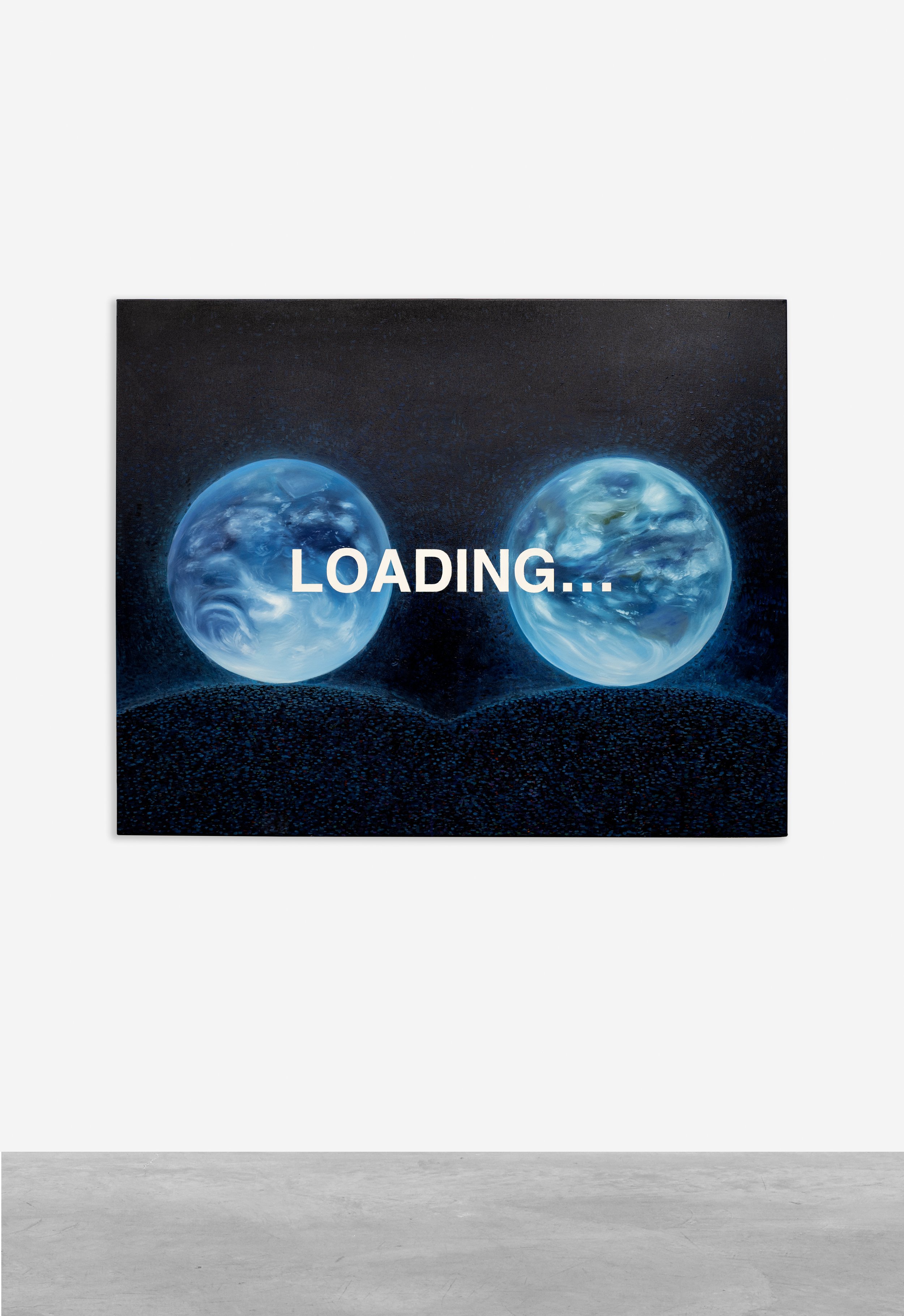
The background dots of LOADING... are, at close range, the painting's most distinctive material feature. At viewing distance, they resolve into a uniform dark field, nearly black, shot through with a faint bluish cast that suggests the color of a screen before an image appears. At arm's length, the dots are visible as individual marks, each one small and precise, each one applied with the kind of deliberate control that a pointillist applies to a single point of color, each one occupying a specific position in a field that contains hundreds, perhaps thousands, of such marks. The effect is of a surface that vibrates slightly, that shimmers with a low-level optical energy, as if the canvas were a screen that is not quite off and not quite on, a screen in the process of loading, showing its pixels before the image assembles. This is the painting's most literal connection to its subject: the dots are the data, the packets, the invisible traffic that the loading screen conceals. They are the infrastructure of connection made visible, the substrate of digital communication rendered in oil paint, and their presence on the canvas transforms the loading screen from a moment of absence into a moment of presence, a moment when the normally invisible machinery of connection reveals itself as a field of marks, a constellation of signals, a dense accumulation of transmitted information that is always happening but is never seen.
The scale of the painting, 122 x 152 cm, is the scale of a human body standing with arms slightly spread. To stand in front of LOADING... is to stand in front of something that is roughly your own size, and this physical correspondence between the viewer's body and the painting's dimensions produces a confrontation that a phone screen does not. The loading screen on a phone is smaller than your hand. You hold it, you glance at it, you wait through it, and it disappears. The painting on the wall is larger than your torso. It confronts you. It refuses to be glanced at. It demands the kind of sustained attention that a loading screen, by definition, does not receive, and it converts the act of waiting into the act of looking, the passive suspension of the digital threshold into the active engagement of standing in front of a work of art and seeing what is actually there. What is actually there is not a representation of a loading screen. It is a loading screen that has been remade by hand, translated from the ephemeral medium of pixels into the permanent medium of oil on canvas, and in the translation, everything that the loading screen was designed to conceal has been made visible: the two Earths that reveal the shift in perspective, the dots that reveal the data traffic beneath the surface, the symmetry that reveals the comparison that the viewer is being asked to make, and the scale that reveals the significance of an image that most people see without seeing.

Yiren Shen, writing about Tan Mu's engagement with communication technology in 10 Magazine, noted that "the underwater world resembles outer space, a dreamlike realm where the boundaries of reality fade away," and that Tan Mu's practice consistently moves between scales that are too large or too small for unaided human perception, from neural pathways to submarine cables to satellite views of the whole planet. LOADING... occupies the largest of these scales, the planetary, but it treats the planetary view not as a sublime object but as an infrastructure image, a picture produced by a machine for a purpose, and it insists that the purpose is not neutral. The satellite does not simply record the Earth. It frames it. The frame is not simply a window. It is a decision about what belongs at the center. The loading screen is not simply a pause. It is a threshold, and on that threshold, for the fraction of a second before the conversation begins, a billion people see an image of the Earth that tells them where they are in the world, and the painting holds that fraction of a second open long enough for the viewer to see what the fraction contains, which is a planet that has been imaged twice, centered twice, claimed twice, and the second claim has been installed so quietly that nobody noticed when the center of the world moved.