First Glimpse: Tan Mu's Peek and the Photograph That Invented the Overview
On October 24, 1946, a V-2 rocket launched from the White Sands Missile Range in southern New Mexico reached an altitude of sixty-five miles and took a photograph. The rocket carried a camera mounted in its tail section, and the camera was rigged to fire automatically every one and a half seconds, producing a sequence of images at a speed five times faster than any previous camera had achieved in flight. The photographs that came back, developed from film that survived the crash of the rocket's casing into the desert floor, showed something no human eye had ever seen: the curvature of the Earth against the black of space, a thin band of atmosphere along the limb, and below it, the grey and white surface of the planet as it appears from above the atmosphere, stripped of color, stripped of the blue veil that makes the sky blue from the ground, reduced to a pattern of light and shadow that could have been the surface of any planet except that it was ours. This was not the first photograph of Earth from space. That distinction belongs to the images captured by the same V-2 program in the months that followed. But it was among the first, and its significance has less to do with the technical achievement of the camera than with the perceptual shift that the image introduced: for the first time, the planet was visible from outside itself, and the human beings who looked at the photograph were looking at their own world from a position that no body had ever occupied, a position that only a machine could reach, and the machine had brought back an image that was not a view from a mountaintop or an airplane window but a view from beyond the atmosphere, a view that belonged to no one, that was taken by no eye, that was the product of a camera mounted in the tail of a weapon that had been designed to destroy cities and was now, in its afterlife as a scientific instrument, producing the first images of the world it had been built to threaten.
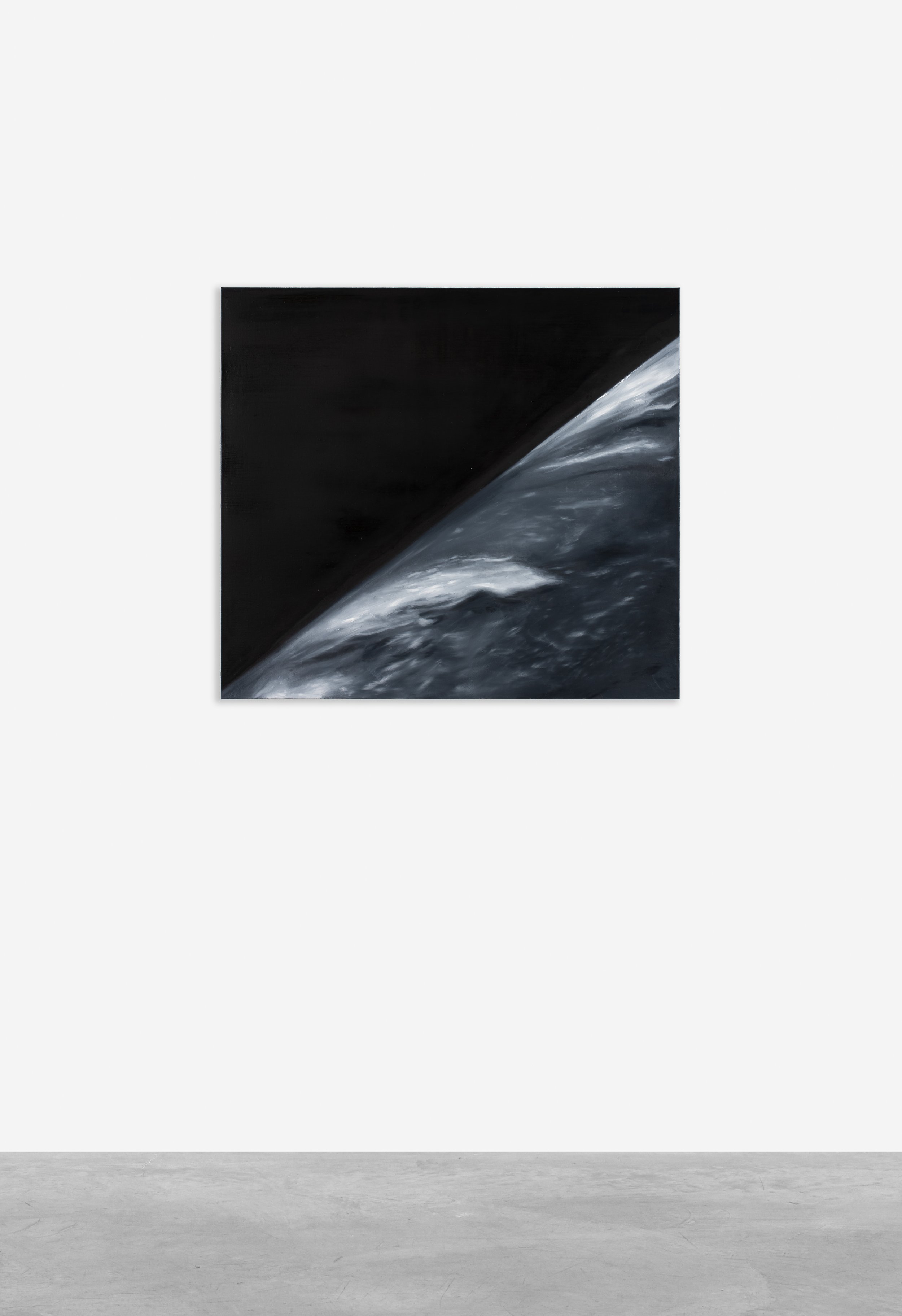
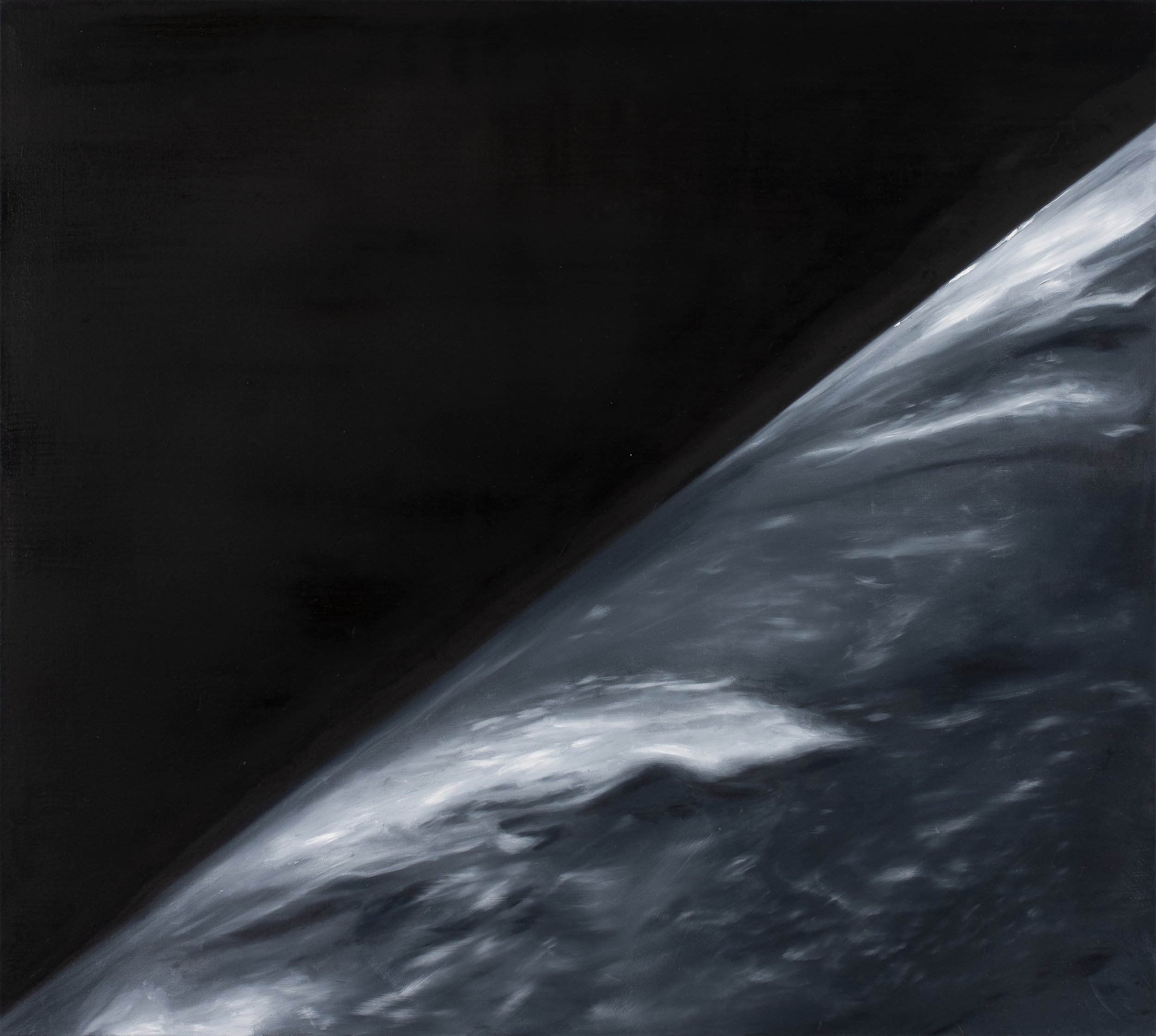
Peek is oil on linen, 91 by 102 centimeters, 36 by 40 inches, a near-square format that mirrors the proportions of the original 1946 photograph and the screen on which such images are typically viewed. The canvas is dominated by two registers: an upper register of deep black, so dark that the linen weave is invisible beneath the paint, a black that reads as the black of space, the black that exists outside the atmosphere, the black that the V-2 camera recorded when it pointed away from the planet and saw nothing; and a lower register of greys and whites, modulated across the surface in broad, horizontal bands that suggest the cloud cover and surface terrain of the Earth seen from above, the same hazy gradations that appear in the original 1946 image, where the atmosphere scatters the light and softens every edge and reduces the complexity of the landscape to a pattern of luminous forms floating in a field of grey. The boundary between the black of space and the grey of the Earth is a thin, luminous line that runs across the canvas at an angle, following the curve of the planet's limb, and this line is the brightest passage in the painting, a band of pale grey and white that suggests the atmosphere itself, the thin shell of air and moisture that separates the planet from the void, and that appears from space as a line of light because it is the zone where the sun's light is scattered by the gases and particles that make up the atmosphere, producing the blue sky from below and the bright limb from above, and Tan Mu has rendered this line with a particular intensity, building it up from multiple thin layers of pale grey and white oil so that it glows against the darkness on either side, not with the hard brightness of a digital highlight but with the soft, diffuse luminosity of light passing through atmosphere, the kind of glow that the eye registers as brighter than the white around it not because it contains more pigment but because the surrounding darkness makes it appear to radiate light that the painting does not actually emit, an effect that the artist achieves through careful control of the tonal relationships between the limb, the black space above it, and the grey terrain below.
The painting is black and white. Tan Mu has described this choice as a direct response to the source material: "In works related to space and technology, such as Peek, which depicts humanity's first view of Earth from space through the V-2 rocket, black and white reflects the technical and historical origins of the imagery." The original photographs from the V-2 program were black and white because the camera technology of 1946 was not capable of producing color images at the speeds and altitudes required, and the monochrome palette of the painting is not an aesthetic decision imposed on the subject from outside but a fidelity to the historical condition of the source image, a decision to preserve the monochrome as a record of the technical limitations that produced the first views of Earth from space. The absence of color in Peek is not the absence of information. It is the presence of historical specificity. The painting records not only what the Earth looks like from space but what it looked like from space in 1946, through a camera that could only see in shades of grey, and the decision to maintain that monochrome is a decision to maintain the historical distance between the viewer and the event, to refuse the temptation to update the image with the full-color satellite photography that is now available, to insist that the first glimpse of the planet from outside its atmosphere is inseparable from the technical conditions that made it possible, conditions that included a camera mounted in a captured German rocket, a camera that was itself an instrument of military technology repurposed for scientific observation, and the monochrome palette of the painting keeps that repurposing visible, keeps the military origins of the image present in the visual experience of the painting, so that the viewer sees not only the Earth from space but the Earth from space as it appeared to a camera that had been designed for a different purpose, and the gap between that purpose and this image is part of what the painting holds.
Caspar David Friedrich's Wanderer Above the Sea of Fog (c. 1818), now in the Kunsthalle Hamburg, shows a figure standing on a rocky outcrop, his back to the viewer, facing a landscape of peaks and valleys shrouded in fog. The figure occupies the center of the composition, dressed in a dark green coat that anchors him to the foreground, his right leg planted on a flat stone, his left leg raised on a higher rock, his right hand resting on a walking stick, his left hand at his side. He does not look at the viewer. He looks out at the fog, at the landscape that disappears into white below him, at the peaks that emerge from the mist like islands from a sea. The painting has been read as an emblem of the Romantic subject confronting the sublime, the individual human consciousness placed at the edge of the unknowable, facing a natural world that exceeds his comprehension and his control. But the painting also contains a specific structural condition that is easy to overlook: the wanderer is standing between the viewer and the landscape, and his position on the rocky outcrop means that the viewer sees the landscape through his body, over his shoulder, from a position that is not the viewer's own but the figure's, and the figure's position on the outcrop means that he sees the landscape from an elevation that is not the elevation of the ground but the elevation of a vantage point that has been constructed by the geological processes that created the outcrop in the first place, a natural platform that raises the viewer above the fog and provides a view of the landscape that could not be obtained from the valley below. The outcrop is the technology of the view, the means by which the figure achieves the perspective that the painting depicts, and the painting makes this technology visible by placing the figure on it and making the outcrop the foreground of the composition, so that the viewer sees not only the landscape but the position from which the landscape is seen, and the position is not natural but constructed, not given but achieved, not the view from the ground but the view from a height that the ground itself has provided.
The connection between Friedrich's wanderer and Peek lies in this condition of the elevated viewpoint as a technological construction. The wanderer's view from the outcrop is the same kind of view as the V-2 camera's view from altitude: both are views that could not be obtained without a specific technology, the outcrop in one case and the rocket in the other, and both are views that transform the viewer's understanding of the landscape by removing the viewer from the landscape and placing the viewer above it, in a position from which the terrain appears as a pattern rather than an experience, as a map rather than a path, as something to be surveyed rather than something to be walked through. Friedrich's painting makes the technology of the view visible by placing the figure on the outcrop and showing the outcrop as part of the composition. Tan Mu's painting makes the technology of the view visible by maintaining the monochrome palette that records the camera's limited vision and by choosing a title, Peek, that describes not a sustained gaze but a glimpse, not a contemplation but a quick look, the kind of look that a camera takes automatically every one and a half seconds as it falls back to earth, the kind of look that is not a meditation but a record, not an immersion in the landscape but a flash of data captured by a machine that cannot see in color and does not know what it is looking at, a machine that is taking a photograph of a planet that no eye has ever seen from this position before, a machine that is producing an image that will not be interpreted until the film is developed and the photograph is printed and the human beings who launched the rocket examine what the camera saw, and the image they see will be a black and white photograph of a grey and white planet floating in a black void, and the image will change the way they think about the planet, because it will show them the planet from outside, and from outside the planet looks like a ball of cloud and rock suspended in nothing, and from that position, the planet looks fragile, and from that position, the planet looks beautiful, and from that position, the planet looks like the only thing in the universe that has a breathable atmosphere and a living surface and a population of beings who are just beginning to understand what it looks like from the outside, and the painting that Tan Mu has made from this image holds all of this in a single canvas of oil on linen, the first glimpse and the machine that took it and the world that it revealed and the fragility that the revelation implied, all of it rendered in black and white because that is how the camera saw it, that is how the image arrived, that is the only way this planet has ever been seen from this position, through the limited vision of a machine that was built for a different purpose and that happened, in the course of its descent, to produce an image that changed the way its creators understood the place they lived.
The V-2 rocket that carried the camera on October 24, 1946, was originally designed by Wernher von Braun's team at Peenemunde during the Second World War. It was the world's first long-range guided ballistic missile, a weapon of terror that was launched against London and Antwerp, killing thousands of civilians. After the war, the United States Army brought von Braun and over a hundred of his engineers to the United States under Operation Paperclip, a program that recruited German scientists regardless of their wartime activities, and the V-2 rockets that had been captured at the end of the war were transported to the White Sands Missile Range in New Mexico, where they were repurposed for scientific research, their warheads replaced with instrument packages and cameras, their trajectories aimed not at cities but at the upper atmosphere, their destructive capacity redirected toward the production of knowledge. The V-2 that took the first photographs of Earth from space was a weapon that had been converted into an instrument of observation, and the photographs it produced were images of the planet that had been taken by a machine that had been built to destroy that planet's inhabitants. This is the double history that the painting holds in its monochrome palette, the history of a weapon that became a camera, the history of a missile that became a telescope, the history of a technology of destruction that produced, in its afterlife, the most consequential image of the planet that its original designers had ever seen, and the conversion of the weapon into the instrument is not a redemption story. It is a fact about the origins of space photography that the painting does not erase or sentimentalize but preserves in the very palette that makes the image legible: the black and white of the original photograph is also the black and white of military documentation, the black and white of the reconnaissance image, the black and white of the technical record, and the painting inhabits this ambiguity, this overlap between the scientific and the military, between the observational and the destructive, between the camera that reveals the planet and the rocket that was built to threaten it.
Vija Celmins has spent decades painting the night sky. Her series of star field paintings, beginning with Night Sky #2 (1991-92) and continuing through multiple versions over the 1990s and 2000s, depict the cosmos as a field of individually rendered points of light against a dark ground, each star a small touch of the brush, each painting the result of weeks of patient, meticulous labor translating a photographic source into the medium of oil on canvas or graphite on paper. The source material for Celmins's star fields is not the sky as the eye sees it. It is a photograph, and the photograph is the necessary intermediary between the painter and the stars, because the stars as the eye sees them are too faint, too numerous, and too scattered to be transcribed with the precision that Celmins demands, and the photograph provides a fixed, reproducible image from which the painter can work at her own pace, transferring each point of light from the photograph to the canvas in a process that takes weeks and produces a painting that looks, from across the room, exactly like the photograph from which it was made, and that looks, from close range, like a surface covered with thousands of individual brush marks, each one a decision, each one a record of the hand's movement, each one a translation of a photographic dot into a painted mark, and the tension between the photographic original and the painted surface is the subject of the work, because the painting is not a representation of the stars but a representation of a photograph of the stars, and the difference between the two is the difference between looking up at the sky and looking down at a piece of paper, between the experience of standing under the cosmos and the experience of studying an image of the cosmos, and Celmins makes that difference visible by making the painting so precise that the viewer cannot tell, from a distance, whether the image is a photograph or a painting, and by making the surface so evident, from close range, that the viewer cannot ignore the fact that every star has been painted by hand.
The connection between Celmins's star fields and Peek is the connection between two painters who have chosen to work from photographs of the sky, and who have made the photograph itself the subject of the painting, not the sky that the photograph depicts but the photograph as a mediating technology that stands between the viewer and the world. Celmins paints photographs of stars. Tan Mu paints a photograph of the Earth taken from space. In both cases, the painting does not pretend to show the sky or the planet as the eye would see it. It shows the sky or the planet as a camera would record it, and the camera records it in a way that the eye could not, because the camera is not limited by the eye's sensitivity to light, or by the eye's inability to see in the ultraviolet and infrared ranges, or by the eye's need for an atmosphere to refract and filter the light before it reaches the retina, or by the eye's position on the surface of the planet, looking up, looking out, never looking down from above because the body has never been above the atmosphere. The camera in the V-2 rocket was a camera that no eye was attached to, and the photographs it produced were images that no eye had seen at the moment they were taken, and the painting that Tan Mu has made from one of those images is a painting of an image that was made by a machine, not by a person, and the mediation that Celmins makes visible in her star fields, the mediation of the photograph between the painter and the sky, is the same mediation that Tan Mu makes visible in Peek, the mediation of the camera between the viewer and the planet, and in both cases the painting does not resolve the mediation or overcome it or pretend that it does not exist. It preserves it. It makes the mediation the subject of the work, and it does this through the most direct means available: by painting the photograph as a photograph, in black and white, with the tonal range and the contrast and the grain and the blur that belong to the medium of photography and not to the medium of painting, and by painting it on canvas, in oil, with the kind of attention that only a human hand can bring to a surface, the kind of attention that takes weeks and produces a surface that no machine could make, a surface that is a record of the time and the care that went into its production, a surface that is the opposite of the automatic photograph in every way except one: it shows the same image, and the image is the image of a planet seen from outside its atmosphere for the first time, an image that no one asked for and that no one expected, an image that arrived like a message from a machine that did not know what it was saying, and the painting holds that image in a medium that will outlast the film and the rocket and the camera and the engineers who designed it, a medium that preserves not only the image but the fact that the image was made by a machine, that the machine was built as a weapon, that the weapon was converted into an instrument, and that the instrument, in the course of its descent, saw the planet whole for the first time and sent the image back to the surface where the people who had built the weapon and converted it and launched it could look at the photograph and see what the world looked like from the place where the weapon had taken the camera, and they could understand, for the first time, that the world was a sphere of cloud and rock floating in a void of black, and they could understand, for the first time, that the boundary between the world and the void was a line of light that was thinner than anyone had imagined, and they could understand, for the first time, that the planet was small and fragile and alone, and the painting holds this understanding in the form of a question that the image itself does not answer, a question about what it means to see the world from a position that no body occupies, through a technology that was built for a different purpose, and to translate that vision into a medium that is as old as the desire to see, and the question is still open, and the painting is still here, and the image it is based on is still the first image of the planet as the planet actually is, and the answer to the question is not in the painting but in the act of looking at it, which is the act of looking at the world from a position that was made possible by a camera in a rocket that was built to destroy the very world it revealed.