Lamp of Origins: Tan Mu's Illuminate and the First Practical Light
On the evening of December 31, 1879, Thomas Edison invited a crowd to his Menlo Park laboratory in New Jersey and demonstrated a device that would fundamentally alter the texture of human time. Before that night, artificial light meant flames: candles, oil lamps, gas jets. The quality of illumination was unstable, smoky, and confined to the immediate vicinity of the flame. After Edison's announcement, light became something that could be switched on and off, directed through wires, and distributed across entire cities. The evening suddenly had a new interior, a new darkness that was also not quite darkness. The world divided into two phases: before electric light and after. Tan Mu's Illuminate (2022) returns to that division, painting the carbon filament bulb as both a historical artifact and a conceptual threshold where technological invention merged with biological imagination.
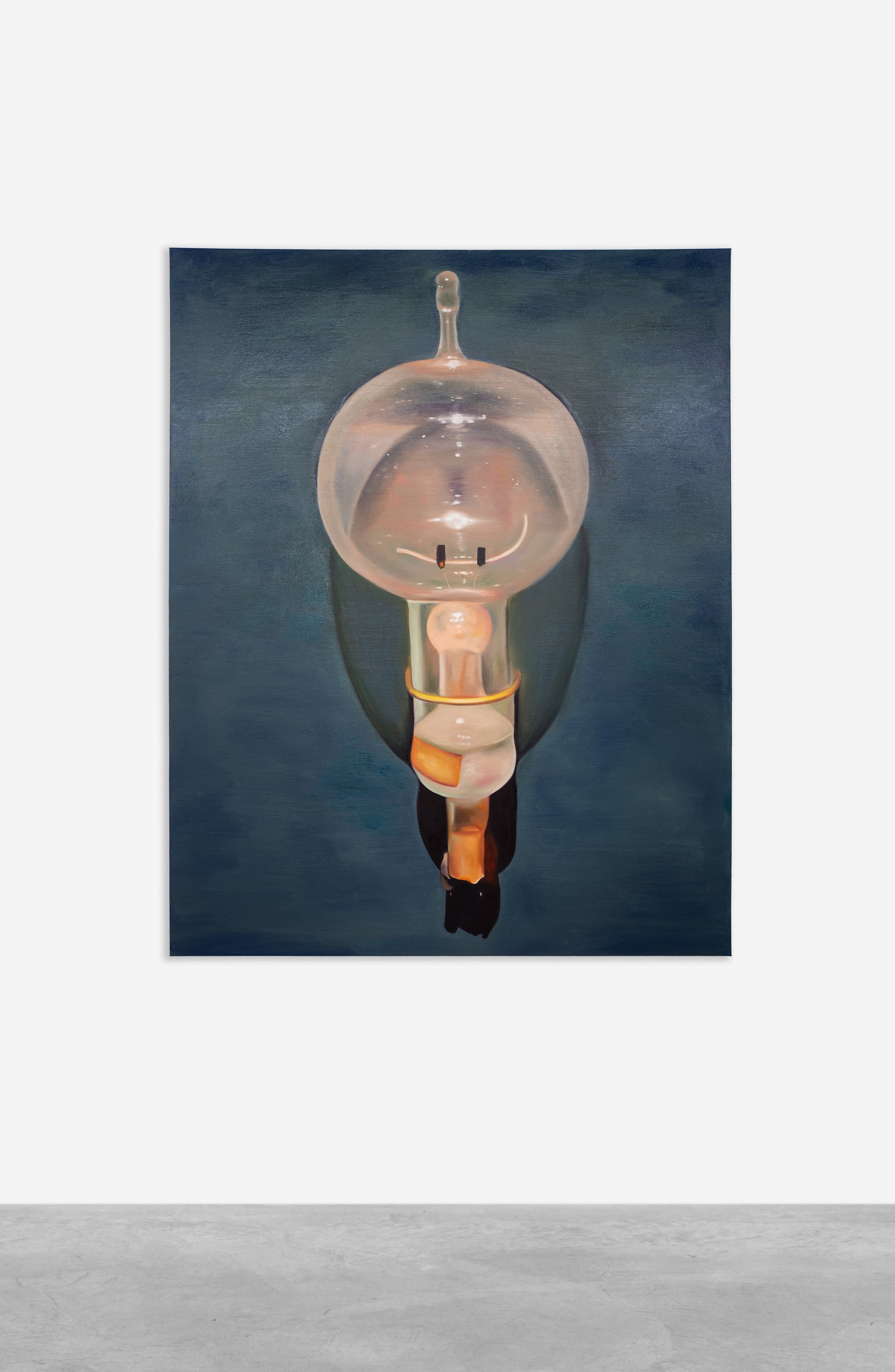
The painting depicts a single incandescent bulb, centered on linen, held in the kind of portrait-like attention that Tan Mu has developed across her Signal series and her earlier investigations into biological forms. The bulb is not shown as a blinding source. It is shown as an object with weight, with interior structure, with the visible filament threading through its glass envelope like a thread of thought. The composition avoids theatrical radiance. Instead, the light emerges from within the object's own material logic, the way a cell divides from within its own membrane. This is deliberate. Tan Mu has described the experience of painting the moment when the filament emits light as unexpectedly reminding her of cell division, a process she had explored in earlier works including IVF (2020). The parallel between artificial illumination and biological genesis became the conceptual core of the painting, transforming the light bulb from a symbol of invention into a representation of emergence itself.
What the painting captures, above all, is the moment when an object designed by human hands begins to participate in a process that resembles life. The carbon filament, heated by electrical current until it glows, operates according to physical laws that Edison mastered but did not create. The light emerges from within the bulb's glass enclosure, spreading outward as if the object were a source of radiance rather than a conduit for it. This transformation of function into appearance is what fascinated Tan Mu during the painting process. The bulb becomes more than a device. It becomes a subject, a form with presence and historical weight, occupying the canvas the way a figure occupies a portrait.
Illuminate is executed in oil on linen, measuring 152 by 122 centimeters. The scale places the bulb at a size that invites close inspection, where the viewer can examine the surface texture of the paint and the way Tan Mu builds luminosity through layered pigment rather than through illusionistic glazing. The linen weave is visible beneath the paint in the background areas, giving the composition a tactile quality that grounds the glowing bulb in material reality. The canvas does not try to disappear behind its subject. It insists on itself as a surface, a thing made of flax fiber and ground mineral pigment, in deliberate contrast to the electric glow it depicts.
The color treatment favors warm amber and ochre tones in the filament region, with cooler grays and muted whites defining the glass envelope. The filament itself is rendered with precise brushwork that distinguishes it from the surrounding glass, showing the coiled carbon thread as a distinct structural element rather than an ambient glow. Tan Mu builds the filament's appearance through repeated thin layers, creating a density of material that contrasts with the transparency of the glass around it. This technical choice reinforces the painting's conceptual interest in interior structure versus surface appearance. The bulb's exterior is smooth and transparent, but its interior reveals the carbon thread that makes light possible, the way biological cells reveal their nuclei only under sufficient magnification.
The background remains relatively unmodulated, allowing the bulb to assert itself as the sole center of attention. This compositional restraint is characteristic of Tan Mu's approach to singular-subject paintings, where the meaning emerges from the relationship between the object and the viewer's sustained attention rather than from complexity of scene or symbolic accumulation. The bulb floats against the linen ground like an object in a void, illuminated from within, carrying the weight of its own history while presenting itself as something present, tangible, available for examination.
The use of artificial light as a subject in painting has a long and specific history, but none more relevant to Tan Mu's concerns than the work of Michelangelo Merisi da Caravaggio in the years around 1600. Caravaggio developed a technique of强烈 contrast between illuminated figures and deep shadow that art historians have called chiaroscuro, a term that describes the management of light and dark as primary expressive tools rather than neutral descriptive devices. In paintings like The Calling of Saint Matthew (c. 1599-1600) and The Conversion of Saint Paul (1600), Caravaggio placed light at the center of his narrative and theological logic. Light in these works is not merely illumination. It is an agent of revelation, transforming what is seen and determining what can be known. The light that falls on Saint Matthew's table, identifying the tax collectors by a shaft of sun entering through an unseen window, does not simply make the scene visible. It assigns meaning. It decides who is called and who is not.
This connection to Caravaggio is not superficial. Tan Mu's interest in the light bulb as a subject that carries theological and philosophical weight aligns with Caravaggio's use of light as an instrument of divine intervention in the world. But where Caravaggio's light enters the scene from outside, from a source beyond the canvas that the viewer must imagine, Tan Mu's bulb contains its own source within itself. The light does not come from somewhere else and fall upon the bulb. The bulb generates the light from within, through the heating of a carbon filament by electrical current, a process that Edison designed but that operates according to physical laws discovered rather than invented. This shift from external to internal light source marks a fundamental transformation in the concept of illumination, from divine mystery to technological process, from revelation to engineering.
The painting's portrait-like treatment of the bulb also recalls Caravaggio's practice of depicting religious figures as ordinary people in contemporary dress, grounding the miraculous in material reality. Tan Mu does not depict the light bulb in a state of idealized perfection. She paints the carbon filament, the glass envelope, the base where the electrical contacts enter the object. The bulb is rendered with the kind of attention that a portrait painter brings to a human face, recognizing that the material particularity of the object is not separate from its symbolic significance but is the very ground of that significance. The bulb glows because of what it is made of and how it is constructed. Its light emerges from within its own material logic, the way Caravaggio's light falls on the specific textures of velvet and skin and gold brocade rather than on abstract ideal forms.
The carbon filament light bulb that Edison demonstrated at Menlo Park on December 31, 1879, was not the first artificial light source. Humans had been burning fuels for illumination since the discovery of fire. What Edison achieved was a practical transformation: a light source that could be switched on and off at will, that did not produce smoke or open flame, that could be distributed through wires across great distances, and that lasted long enough to be useful for daily life rather than experimental demonstration. The incandescent lamp that Edison developed operated on a principle that remained fundamentally unchanged for over a century: passing electrical current through a thin metal filament enclosed in a glass bulb from which air has been exhausted, heating the filament until it glows with visible light.
This transformation restructured human time in ways that are difficult to fully reconstruct from the present moment, where artificial light is so ubiquitous that natural light has become almost a special case. Before widespread electric lighting, the productive day was determined by sunrise and sunset. Work after sunset required candles, oil lamps, or gas flames, each with its own hazards, costs, and limitations. The evening was genuinely dark in ways that contemporary urban environments never achieve. Edison's announcement marked the beginning of a period in which human activity could extend beyond the boundaries of daylight, not incrementally but fundamentally. Factories could run through the night. Streets could be lit after dark. Social life could continue past sunset. The division between day and night, which had organized human activity since the evolution of circadian rhythms, began to dissolve.
Tan Mu has described her interest in light as inseparable from her broader interest in energy, a theme that connects Illuminate to her paintings of solar farms, nuclear power installations, and speculative structures like Dyson spheres. These works collectively trace humanity's efforts to harness, control, and imagine energy systems that can sustain increasing demands for computation, transportation, and material comfort. The light bulb is the ur-image of this project: a device that converts electrical energy into visible radiation, making the invisible force of electricity useful for human purposes. But the light bulb also marks a threshold beyond which energy consumption became not merely a practical matter but a philosophical one. The availability of cheap, abundant artificial light enabled industrial capitalism to expand productive time into the night, accelerating the pace of economic activity and reshaping the rhythm of daily life around the clock.
The painting's focus on the bulb's interior structure, rather than on its radiating glow, reflects Tan Mu's sustained interest in the hidden architectures that make contemporary life possible. The filament inside the glass envelope is the essential component, the element without which no light would emerge. It is made of carbon because carbon can withstand the high temperatures required for incandescence without melting, and because it can be drawn into a thin enough thread to offer resistance to the electrical current passing through it. This resistance heats the carbon to the point where it emits visible light, a process that depends on fundamental physics rather than on any proprietary secret. Edison's achievement was engineering, not scientific discovery. He found a way to make the physics useful, practical, and durable enough to replace the existing alternatives. But the physics itself had been known for decades, and the filament's glow operates according to laws that govern all heated bodies, from stars to candle flames.
The question of how to represent light in painting, and whether light itself can be the subject of a painting rather than merely its medium, finds its most direct art historical articulation in the work of Dan Flavin, who began working with fluorescent light tubes in the early 1960s and continued until his death in 1996. Flavin installed fluorescent tubes in specific configurations, often in diagonal or corner arrangements that made the light seem to emerge from the architecture itself rather than from a discrete object. His works were not paintings in any traditional sense. They were installations, environments, arrangements of commercial fluorescent tubes in galleries and outdoor sites that transformed the viewer's experience of the space through the quality and color of the light they emitted.
What Flavin understood, and what Tan Mu's Illuminate engages with from the distance of oil painting, is that artificial light is not a transparent medium that reveals things as they are. It is a material substance with its own properties, limitations, and effects. Fluorescent light has a color temperature and spectral distribution that differs from both daylight and incandescent light. It is cooler, more diffuse, less warm. It flattens shadows and reduces contrast. When Flavin arranged fluorescent tubes in specific configurations, he was not merely illuminating the gallery. He was creating conditions under which the light itself became the subject, the object, the thing that the viewer experienced rather than the means by which something else was experienced. The light was not instrumental. It was final.
Tan Mu's approach differs from Flavin's in the fundamental choice of medium. Where Flavin worked directly with electric light as his material, Tan Mu paints light, translating the experience of illumination into pigment on linen. This translation requires making decisions about what aspects of the experience to preserve and what to transform. She chooses to focus on the interior structure of the bulb, on the visible filament, on the glass envelope that contains the glowing carbon thread. This choice emphasizes the technological specificity of artificial light: the fact that it depends on engineered components, on material choices, on processes that can be understood and optimized. The painting does not try to reproduce the experience of looking at a glowing bulb. It tries to make visible the structure that makes the glow possible, the internal architecture of a device that has become so common that its complexity is invisible.
The connection to Flavin also illuminates the temporal dimension of Tan Mu's project. Flavin was working in the 1960s and 1970s, when fluorescent light was becoming ubiquitous in commercial and institutional architecture, transforming offices, schools, and public spaces with its cool, uniform illumination. His installations often engaged with the aesthetic of institutional modernism, placing fluorescent tubes in configurations that echoed the gridded ceilings and linear forms of postwar building design. Tan Mu's Illuminate returns to this history from the perspective of the twenty-first century, when artificial light has become even more pervasive and where its environmental costs have become a subject of urgent concern. The carbon filament bulb that Edison perfected has been largely replaced by light-emitting diodes, which are more efficient but which depend on supply chains and manufacturing processes that carry their own environmental burdens. The light is still here. Its forms have changed. The question of what it costs and who bears that cost remains as urgent as ever.
The connection between the light bulb and cell division that Tan Mu has described as emerging during the painting process is not merely a metaphor. It reflects a genuine structural parallel between the way a cell divides and the way the filament in an incandescent bulb emits light. In both cases, there is an internal process that produces a visible external result. The cell's nucleus divides, and the result is two cells where there was one. The filament heats until it glows, and the result is visible radiation in the spectrum of light. In both cases, the external result is not separable from the internal process. The glow is not added to the bulb from outside. It emerges from within the filament's own response to the electrical current passing through it. The division is not imposed on the cell from outside. It emerges from within the cell's own replication machinery.
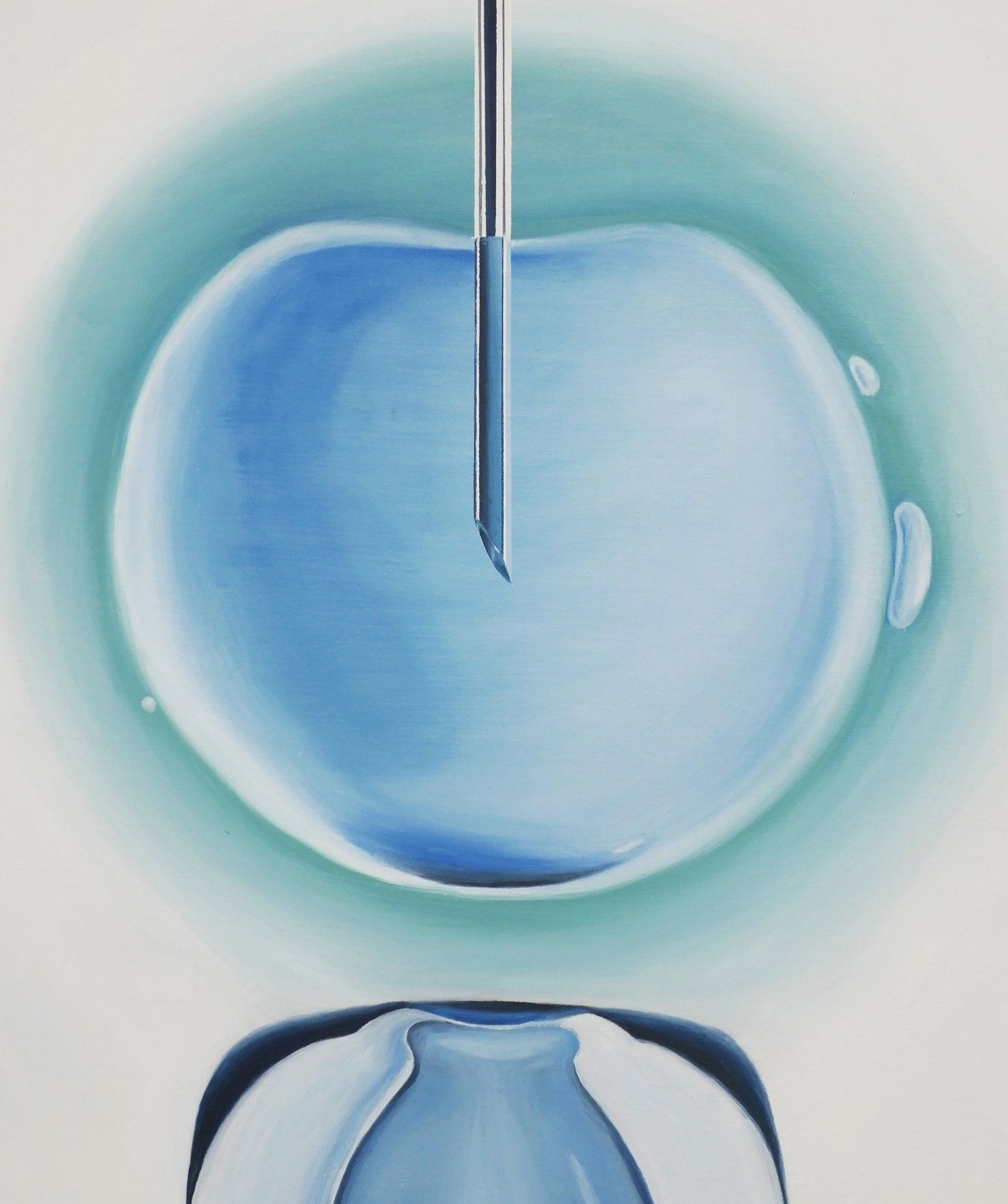
This parallel connects to a larger pattern in Tan Mu's work, where technological and biological processes are treated as variations on a common theme. Her painting IVF (2020) depicts artificial insemination in a laboratory setting, focusing on the needle that injects into the egg, the direct human intervention in biological reproduction. Illuminate can be read as a companion piece: where IVF shows human intervention in biological origins, Illuminate shows a technological device that operates according to biological principles of emergence and transformation. The light bulb is not alive, but it behaves in ways that resemble living processes, producing light through internal heating the way a cell produces heat through metabolic activity. The analogy is not scientific in any rigorous sense. But it is perceptually and conceptually productive, opening a space where technological and biological histories can illuminate each other.
The comparison also takes up the question of what it means to say that an object is alive or that a process resembles life. The carbon filament, heated to incandescence, does not grow or reproduce. It simply converts electrical energy into light and heat, a process that continues until the filament eventually evaporates or breaks. But the fact that it does not reproduce does not mean it has no relation to biological processes. Both the filament and the cell depend on the transformation of energy into structured activity. Both operate according to principles of self-organization that emerge from the properties of their components. The line between the technological and the biological is not as sharp as it might appear, and Tan Mu's work consistently occupies the zone where the two domains overlap and inform each other.
Tan Mu has described her interest in light as inseparable from her broader interest in energy systems, a theme that runs through her entire recent body of work. The light bulb is one node in a network that includes solar farms converting sunlight to electricity, nuclear reactors harnessing fission energy, and speculative megastructures like Dyson spheres that would capture a significant fraction of a star's output. These works, taken together, constitute a meditation on how humanity has sought, captured, and imagined energy across different scales and different degrees of technological achievement. The light bulb is the origin point, the device that made electric illumination practical and accessible, and it remains the most intimate image in this series: a single point of light in a glass envelope, small enough to hold in the hand, bright enough to change the character of a room.
The environmental implications of this history are now impossible to ignore. The global electricity system that Edison's invention helped to create has grown to consume a substantial fraction of humanity's total energy production, and a significant fraction of that electricity still goes to artificial lighting. The replacement of incandescent bulbs with more efficient LED technology has reduced energy consumption for lighting dramatically, but the total demand for illumination continues to grow as developing countries build out their electrical infrastructure and as digital devices create new demands for screen lighting and data center cooling. The light bulb that once symbolized human mastery over darkness now figures in discussions of climate change, resource depletion, and environmental justice. The carbon that Edison's filament was made of came from organic matter laid down over millions of years. Burning it for light was, in a sense, spending a inheritance.
Tan Mu's painting does not address these issues didactically. It holds the light bulb in an attention that is both historical and perceptual, allowing the object's material specificity to carry the weight of its associations. The filament glows because carbon resists electrical current. The glass encloses the filament because glass is transparent to visible radiation while being impermeable to air. The base connects the bulb to the electrical system through contacts that allow current to flow into the filament. Each element of the object's construction is a response to a specific physical requirement, a solution to a specific engineering problem. The history of the light bulb is a history of problem-solving, of finding materials and configurations that work well enough to be useful and durable enough to be practical. It is also a history of unforeseen consequences, of environmental impacts that could not have been predicted when Edison demonstrated his first practical lamp in 1879. The painting holds all of this in suspension, presenting the bulb as a thing to be considered rather than a symbol to be decoded.
The connection to biological emergence that Tan Mu discovered during the painting process remains the most generative aspect of the work. The filament that glows inside the glass envelope is, in a sense, alive in the way that all self-organizing systems are alive: it maintains itself in a state far from equilibrium, consuming energy to produce a constant output of light and heat. When the current is turned off, the filament cools and stops glowing. The system collapses. The life of the filament depends on the continued supply of electrical energy, the way the life of a cell depends on the continued supply of chemical energy from its environment. Both are dissipative structures, maintaining their organization by consuming energy and releasing it in transformed forms. The light bulb and the cell are not the same thing. But they share a fundamental logic, a common principle of organized energy transformation that connects the technological and the biological in a deep and non-obvious way.
The portrait-like attention that Tan Mu brings to the bulb in Illuminate extends an approach she has developed across her recent practice of treating technological objects with the same sustained phenomenological attention that art historical portraiture has traditionally reserved for human faces. The bulb is not a symbol of invention or progress. It is an object with material properties, with interior structure, with a specific history of development and refinement. It glows because it is made of carbon and glass and metal, because electrical current passes through it, because resistance heats the filament to the point of incandescence. It is here, in the specificity of material cause and effect, that the painting finds its subject. The light that Edison's bulb emits is not separate from the bulb's construction. It is the bulb's construction, made visible in the form of visible radiation. Understanding this is understanding something fundamental about how artificial light works and why it changed the world.