The Island That Went Silent: Tan Mu's Eruption and the Cable at the Bottom of the Sea
The most informative image of the January 15, 2022 eruption of Hunga Tonga-Hunga Ha'apai was not taken from the ground. It was not taken by anyone standing on the beaches of Tongatapu or the volcanic islands themselves, because in the hours after the climactic explosion, those beaches no longer existed in any recognizable form, and the people who had lived near them were either fleeing or already submerged. The most widely circulated image was captured from above, by satellites orbiting hundreds of kilometers overhead, recording the mushroom cloud as it punched through the troposphere and spread across the stratosphere in a plume of ash and water vapor that eventually circled the globe. The satellite photograph showed the eruption from a perspective that no human eye could occupy in real time, a view that was only possible because the same technological infrastructure the volcano was about to sever had placed observation instruments in orbit decades before. This circular dependency, the satellite watching the eruption that would destroy the cables that made the satellite's images distributable, is the paradox that Tan Mu's Eruption (2022) holds at its center.
Two intersecting lines divide the composition into quadrants. They form a cross, the kind that appears on weather maps and satellite targeting displays, marking a point of observation rather than a point of impact. The cross tells the viewer: this is being watched. This is being measured. The mushroom cloud beneath the cross fills the canvas with a plume of gray and white pigment, the eruption rendered in a palette that refuses the spectacular colors of volcanic photography and instead settles into the tonal range of meteorological documentation. The painting does not dramatize the event. It records it, the way a satellite records it, the way a weather map records it, with the cold precision of an instrument that does not feel what it sees but nonetheless makes that seeing available to those who cannot be present.
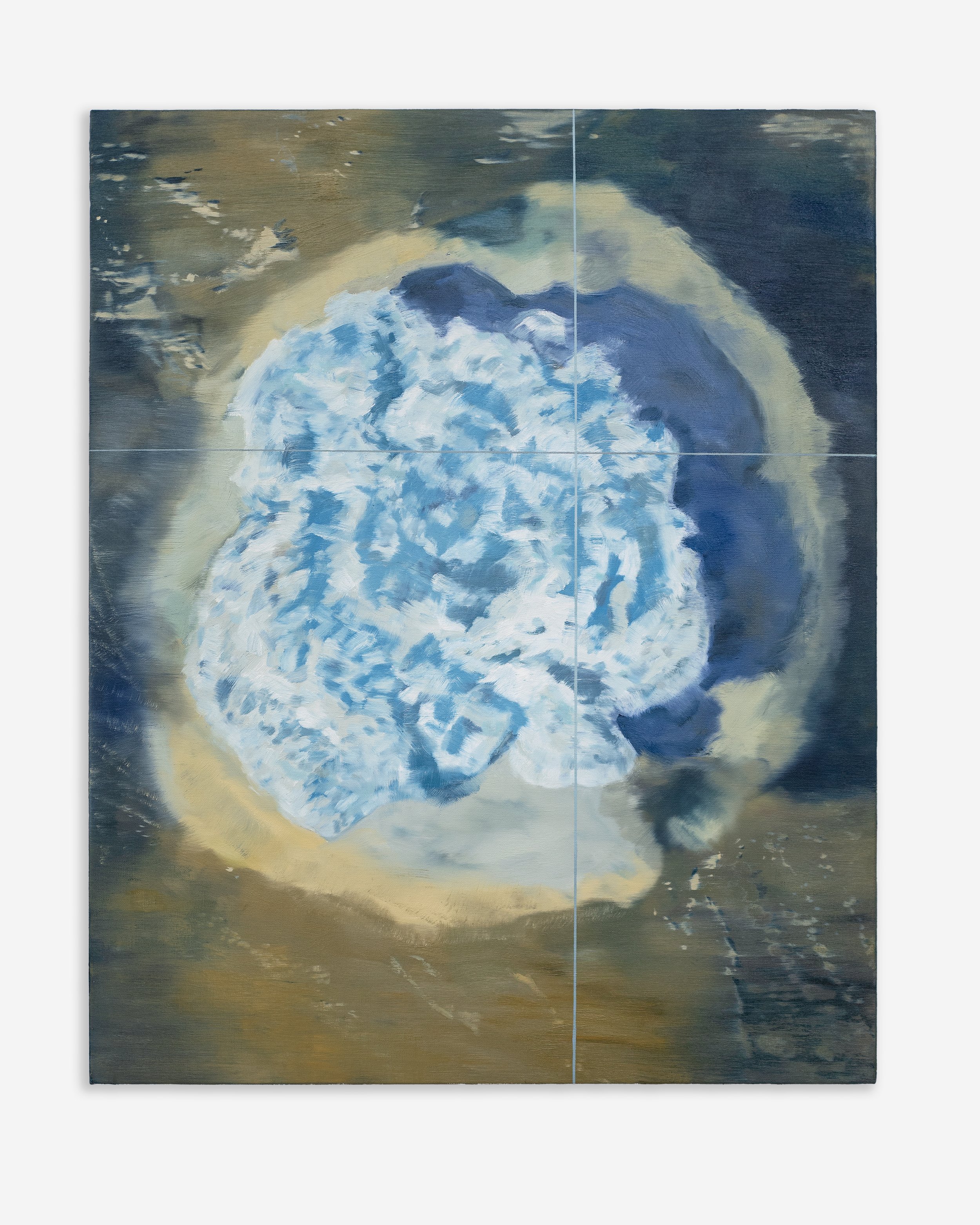
Tan Mu has described the moment of the eruption and its aftermath as a turning point in her practice. She had been planning a trip to Tonga to dive with humpback whales when the volcano erupted, severing the country's undersea cables and cutting off all communication with the outside world. What struck her most was not the scale of the natural event but the sudden disappearance of information. Tonga went silent. The world could not know the extent of damage or casualties for nearly a month. This disconnection made visible a fact that had always been true but never felt: the global communication network that allows instant information exchange across continents depends on physical cables lying on the ocean floor, vulnerable to exactly the kind of geological forces that created the ocean floor in the first place. Eruption is the painting where this realization entered Tan Mu's work, and it became the origin of her sustained investigation into submarine cables that would later produce Twenty Thousand Leagues Under the Seas (2023) and eventually the Signal series.
Eruption is executed in oil on linen, measuring 76 by 61 centimeters (30 by 24 inches). The modest scale places the painting in an intimate register, at odds with the enormity of the event it depicts. A volcanic eruption that produced the most powerful atmospheric explosion recorded by modern instruments, audible in Alaska six thousand kilometers away, generating tsunamis that crossed the Pacific, is here compressed into a canvas slightly larger than a sheet of printer paper. This compression is deliberate. Tan Mu has spoken of thinking of herself as "a human printer and an archaeologist," and the painting operates in exactly this dual mode: it prints the event, reproducing the satellite view with careful precision, while simultaneously excavating the layers of mediation that produced that view in the first place.
The linen surface shows through in areas of the background, its weave providing a textured ground that contrasts with the smoother passages of pigment in the mushroom cloud. This contrast between the rough weave and the polished paint creates a material analogy for the painting's conceptual content: the background is the physical substrate, the ocean and the rock and the cable on the seafloor, while the cloud is the image, the event as it appears to the satellite, the information that travels through the network. The two exist on the same surface but occupy different registers, the way physical infrastructure and digital communication exist in the same world but on different planes of experience.
The color palette is restricted almost entirely to grays, whites, and blacks, with subtle modulations of tone that define the structure of the plume. The mushroom cloud rises from the lower portion of the canvas in a shape that recalls nuclear detonations as much as volcanic ones, a visual echo that Tan Mu has acknowledged in her broader work on the relationship between volcanic explosions, nuclear blasts, and the vibrational energy they share. The cross is rendered in thin, precise lines that cut across the composition without intersecting any specific feature of the cloud, as if they have been overlaid after the image was captured, the way targeting lines or measurement grids are added to satellite photographs in post-processing.
Brushwork in the cloud itself varies from thin, translucent washes in the outer portions of the plume to denser, more opaque applications in the column of the eruption, where the force of the explosion is most concentrated. This variation in paint density mirrors the actual physics of volcanic eruptions, where the central column carries the greatest mass and velocity while the spreading canopy thins as it disperses. Tan Mu's brush follows the structure of the event rather than imposing an aesthetic pattern on it, an approach consistent with her stated method of working from satellite imagery and meteorological data rather than from imagination or expression.
The atmospheric vortex that defines the visual structure of Eruption connects Tan Mu's painting to a specific tradition in Western art: the depiction of overwhelming natural forces through the shape of the cloud, the plume, the spiraling column of vapor and matter that exceeds human capacity to comprehend or contain it. No painter explored this territory more relentlessly than J.M.W. Turner, whose career-long investigation of atmospheric effects culminated in works like Snow Storm: Steam-Boat off a Harbour's Mouth (exhibited 1842), a painting that immerses the viewer in a vortex of wind, water, and steam so total that the boundaries between sea and sky dissolve into a single churning field of pigment. The steamboat in Turner's painting is nearly swallowed by the storm, its mast barely visible as a vertical element struggling to maintain its orientation against the circular force of the composition.
Turner's vortex is not merely a representation of weather. It is a representation of the limits of representation, of the point at which the visible world exceeds the capacity of pictorial description and demands a new kind of mark-making that can account for forces too large, too fast, or too dispersed to be captured by contour and modeling. The same pressure operates in Tan Mu's Eruption, where the mushroom cloud expands beyond the boundaries of the canvas, its upper edge cropped by the picture frame as if the event cannot be contained within the rectangle of the painting. The cloud presses against the edges, suggesting that the eruption continues beyond what is shown, that the visible portion is a fragment of a phenomenon too vast to be rendered complete.
But where Turner's vortex operates in the register of the sublime, of the individual viewer's encounter with forces that dwarf human scale, Tan Mu's cloud operates in the register of the technological. Her eruption is not experienced from the deck of a ship or the shore of an island. It is observed from orbit, by a satellite that does not feel the heat or hear the sound or fear the tsunami. The cross that overlays the cloud marks the distance between the event and the observer, the technological mediation that makes the event visible while insulating the viewer from its consequences. This is a fundamentally different kind of sublime: not the sublime of presence but the sublime of distance, not the sublime of being overwhelmed but the sublime of being informed. The viewer of Turner's painting is caught in the storm. The viewer of Tan Mu's painting is watching the storm from space, safe in the knowledge that the cables carrying this image still function, until they do not.
The eruption of Hunga Tonga-Hunga Ha'apai on January 15, 2022 was the most powerful volcanic event of the twenty-first century, producing an explosion equivalent to hundreds of Hiroshima-sized nuclear detonations. The shockwave traveled through the atmosphere at speeds exceeding one thousand kilometers per hour and was detected by barometric stations around the world. Tsunamis generated by the eruption reached the coasts of Japan, the Americas, and even the Mediterranean. Ashfall contaminated water supplies across the Tongan archipelago, and the explosion destroyed most of the infrastructure on the two small islands that formed the volcano's above-water rim.
But the most consequential damage, from the perspective of global information systems, was to the submarine cables. The Southern Cross Cable and the Tonga Cable, which connected Tonga to the global internet via Fiji and Sydney, were severed by the eruption's undersea shockwave and subsequent landslides on the seafloor. Within hours of the explosion, Tonga disappeared from the internet. Phone lines went dead. Data connections ceased. The country of approximately one hundred thousand people, which had been as digitally connected as any other nation in the Pacific, became informationally invisible. For nearly five weeks, the outside world could not confirm the extent of casualties, the condition of infrastructure, or the needs of the population. Limited satellite phone connections provided sporadic communication, but the bandwidth was a fraction of what the cables had carried.
Tan Mu's description of this moment emphasizes the paradox at its center. The satellite photograph of the eruption, captured from orbit and transmitted instantaneously around the world, showed Tonga's isolation to an audience that could receive the image only because their own cables were intact. The image of disconnection was distributed through connection. But Tonga itself could not send or receive that image, because the cables that linked it to the network were lying on the ocean floor in pieces, buried under volcanic ash and displaced sediment. As Tan Mu has written, "The satellite photo of a disconnected Tonga, shared instantly with the world, is realized in the painting, but only when the communication cable is restored. It is as if all these condensed layers are about to burst from a static image." The painting holds this temporal contradiction: the event is visible, but only after the channel of visibility has been repaired.
The repair of the Tonga Cable took thirty-eight days. A specialized cable-laying vessel, the CS Reliance, was dispatched from Papua New Guinea to locate the breaks, haul the damaged sections to the surface, splice in replacement cable, and lower the repaired sections back to the seafloor. The process required precise navigation of a seabed that had been reshaped by the eruption, with new ridges and channels replacing the flat terrain that the original cable route had followed. The repair was completed on February 22, 2022, restoring Tonga's digital connection to the outside world after more than five weeks of silence.
The cross that overlays the eruption in Tan Mu's painting, dividing the image into quadrants like a targeting reticle or a meteorological grid, places the viewer in a position that has no natural human equivalent. Nobody stands in orbit. Nobody watches a volcanic eruption from directly above. The satellite view is a product of technology, and the cross that marks it is a product of the visual conventions that make satellite imagery legible: the grid, the coordinate system, the targeting reticle that converts an image into a set of coordinates. This way of seeing the world, from above and at a distance, mediated by instruments that translate electromagnetic radiation into visual information, has a long history in painting, one that predates satellite technology by centuries.
Pieter Bruegel the Elder developed a compositional mode in the 1560s in which events of significance are shown from an elevated vantage point that no ordinary viewer could occupy, placing the viewer in a position of omniscient observation. In The Census at Bethlehem (1566), Bruegel depicts the biblical scene of Mary and Joseph arriving at the census as a winter scene in a Flemish village, but the viewer watches from a height that allows the entire village to be seen at once: the inn, the crowds, the ice on the pond, the distant landscape fading into the horizon. The significant event, the holy family's arrival, is not at the center of the composition. It is one element among many, embedded in the flow of daily life that continues regardless of the sacred narrative taking place within it. The elevated view does not privilege the moment of revelation. It contextualizes it, showing that events, even events of cosmic significance, happen within a world that is too large and too detailed to be organized around any single focal point.
Tan Mu's overhead view of the eruption operates in a similar register. The cross that marks the center of the composition does not dramatize the event. It locates it, the way Bruegel's elevated view locates the holy family within the village rather than isolating them from it. The eruption is immense, but the painting does not treat it as the only thing worth seeing. The cross suggests a system of measurement, a grid of coordinates that can accommodate other events, other eruptions, other points of disconnection. The viewer is not asked to stand in awe before the explosion but to understand its position within a network of observation and information that extends far beyond the bounds of this single canvas. Bruegel's elevated view was the product of imagination, an invented perspective that allowed him to show more of the world than any single viewer could see from ground level. Tan Mu's elevated view is the product of technology, an actual perspective made possible by satellites and the cables that carry their data. But both painters use the overhead position to the same end: not to overwhelm the viewer with the scale of the event but to show the event as one element in a world that contains many elements, some visible and some not.
The cross in Eruption carries a biographical weight that connects the painting to Tan Mu's childhood in ways that deepen its meaning without being reducible to personal narrative. Her grandfather was both a marine engineer involved in port construction and land reclamation, and a meteorologist who read weather maps daily. Tan Mu lived with him during her childhood, and he taught her to interpret the abstract visual systems that translate atmospheric conditions into two-dimensional representations: contour lines, isobars, satellite imagery, the same kind of data overlays that appear in the cross form of the painting. This education in reading the world through technological mediation, understanding natural phenomena through their graphical representation rather than through direct sensory experience, shaped the way Tan Mu sees and the way she paints.
The cross is therefore not simply a visual motif borrowed from satellite interfaces. It is an inheritance, a way of seeing that was transmitted from one generation to the next through the daily practice of reading weather maps. The grandfather who taught Tan Mu to interpret contour lines and cloud formations was the same man who built ports and reclaimed land from the sea, who understood the ocean as both a system of forces and a site of human intervention. The submarine cable that the eruption severed is the latest iteration of this centuries-old project of building infrastructure in and around the ocean, extending human systems into an environment that periodically reminds humanity of its limits. The eruption destroyed the cable because the eruption came from the same geological processes that created the seafloor the cable was laid on. The ocean gives and the ocean takes away, and the cables that carry the world's information lie on the boundary between those two gestures.
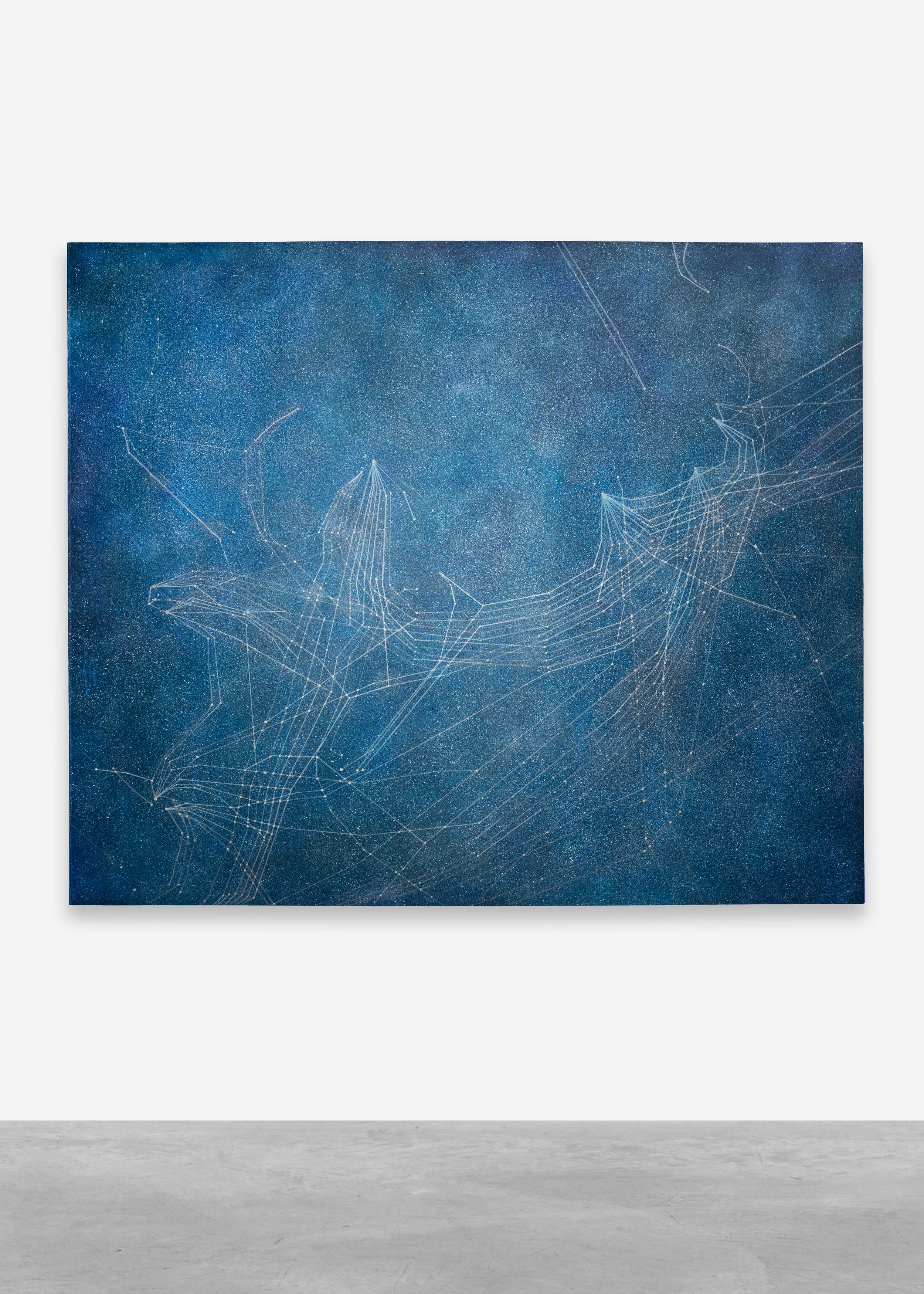
Tan Mu has described Eruption as the moment when her attention shifted toward undersea cables as a subject for painting. The recognition that a volcanic eruption could silence an entire country by severing a few strands of glass and metal on the ocean floor made visible a truth about modern life that had been operating in the background for decades: the global communication network is not wireless. It is not cloud-based in any literal sense. It depends on physical infrastructure that runs through some of the most hostile environments on Earth, and it is vulnerable to exactly the kinds of forces that created those environments. After Eruption, Tan Mu began researching the physical structure of undersea cables, their material composition, and their role in transmitting information across continents. This research produced Twenty Thousand Leagues Under the Seas and eventually the Signal series, where submarine cables become both physical objects and symbolic systems, representing not only technological infrastructure but also the fragile threads that bind global communication, memory, and power.
Tan Mu has described her practice as that of "a human printer and an archaeologist," a formulation that captures the dual nature of paintings like Eruption. The printer reproduces information, converting data into visual form. The archaeologist excavates layers, uncovering the structures that lie beneath the surface. A painting that reproduces a satellite image of a volcanic eruption while simultaneously revealing the cable infrastructure that makes that image possible is operating in both modes at once. It is printing the event and excavating the conditions of its visibility.
The paradox that Tan Mu identified, that the satellite photograph of Tonga's disconnection could only be shared with Tonga after the connection was restored, is the paradox that the painting holds open. Oil on linen does not resolve temporal contradictions. It holds them in suspension, making them available for consideration long after the event itself has passed. The eruption happened on January 15, 2022. The cables were repaired on February 22. The news cycle moved on. The world's attention shifted to other disasters, other disruptions, other silences. But the painting remains, holding the moment of disconnection in a form that does not depend on functioning cables or active satellites to persist. The static image contains all the layers: the eruption, the cable break, the satellite view, the repair, the return of connection. None of them cancel the others. They coexist, compressed into pigment on linen, waiting to be excavated by whatever viewer stands in front of the canvas and asks what it was like when an entire country went silent.
The cross that overlays the mushroom cloud marks the painting's allegiance to a specific way of seeing, one that Tan Mu inherited from a grandfather who read weather maps and built ports and understood that the world is always more than what is visible from any single vantage point. The satellite sees the eruption from above. The cable carries the image across the ocean floor. The painting holds both perspectives, and the silence between them, in a single frame. It does not resolve the paradox. It preserves it, the way the ocean floor preserves the broken cable, waiting for the repair ship to find it and splice it back into the network of connections that makes the modern world audible.