The Original Blur: Tan Mu's Dolly and the Clone That Gazed Back
Li Yizhuo, writing in early 2022 about Tan Mu's recent paintings, opened with a sentence that has since become one of the most quoted observations about this body of work: "among her intricately executed work, neither the composition nor the technique of Dolly was particularly remarkable, except that unlike most others, it gazes back." The remark does double duty. It identifies the painting's most immediately disarming quality, the sense that the sheep depicted on the canvas is looking at the viewer rather than being looked at, and it implicitly asks why this should be remarkable at all. Portraits gaze back. That is what portraits do. But Dolly is not a portrait in any conventional sense. It is a painting of a photograph of a cloned sheep, a copy of a copy, an image of an organism whose entire existence was an act of replication. That a clone should gaze back, that a copy should assert its own presence as if it were an original, is the paradox that Li Yizhuo identified and that the painting sustains across every square centimeter of its blurred and luminous surface.
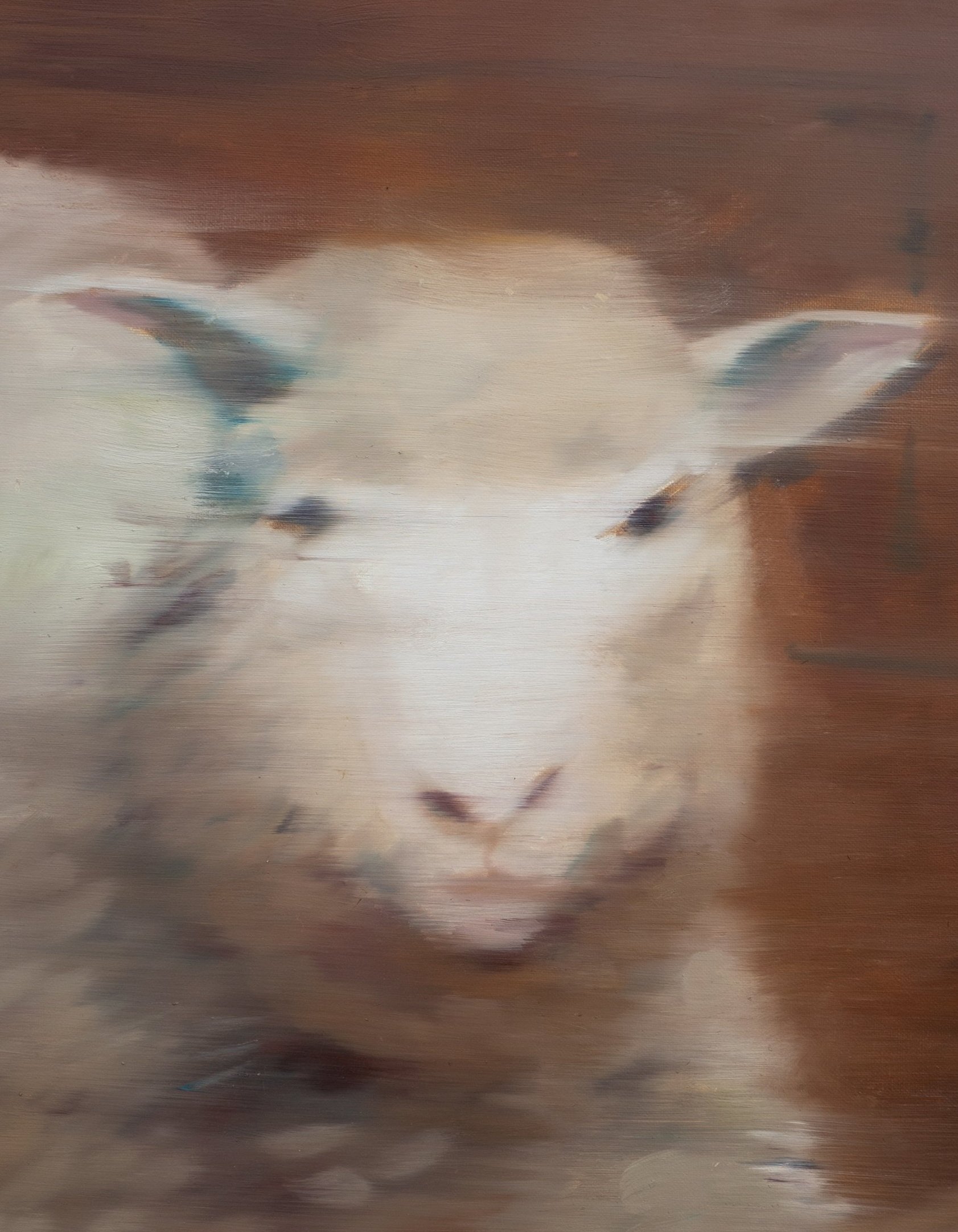
The sheep depicted in the painting is Dolly, the first mammal cloned from an adult somatic cell, born at the Roslin Institute in Scotland on July 5, 1996. The announcement of her birth in February 1997 triggered a global reaction that ranged from scientific excitement to moral panic. Here was a mammal, a complex organism with billions of cells organized into tissues and organs and systems, produced not through the combination of genetic material from two parents but through the transfer of a nucleus from an adult cell into an enucleated egg. Dolly was genetically identical to the ewe that provided the nucleus. She was a copy, a replica, a biological xerox of an existing organism. And yet she was alive, she ate and slept and moved and, eventually, she looked at the camera, and the photograph that resulted from that look is the image that Tan Mu painted.
Dolly is executed in oil on linen, measuring 61 by 45.7 centimeters (24 by 18 inches). The modest dimensions place the painting in the register of intimacy rather than spectacle, appropriate for a subject that was, after all, a single sheep standing in a pen at a research facility in Midlothian. The surface is characterized by a pronounced blur that softens the contours of the sheep's face and body, dissolving the boundary between the animal and the background into a field of diffused light and muted tone. This blur is not the result of imprecise technique. It is a deliberate visual strategy that Tan Mu has described as a metaphor for memory. When she revisited the story of Dolly years after the initial announcement, she found that the image she held in her mind did not match the historical documentation. The gap between memory and reality became the generative condition of the painting.
The palette is restricted to warm grays, cream whites, and the faintest suggestions of the pinkish tone of skin visible through the fleece. The background dissolves into a luminous field that might be the wall of the Roslin Institute's barn or might be the blank surface of memory itself, the undifferentiated ground against which recalled images appear. The sheep's eye, the only element rendered with relative sharpness, anchors the composition and produces the effect that Li Yizhuo described. The eye looks out from the blur with a clarity that contradicts the softness of everything around it, as if the animal's gaze is the one thing that memory preserved with precision while the rest of the image faded into approximation.
Brushwork varies across the surface in ways that track the painting's conceptual logic. The fleece is built from short, overlapping strokes that create a dense, almost velvety texture, while the background is rendered in broader, more fluid passages that allow the linen weave to show through in places. This variation in surface quality creates a tactile distinction between the subject and its environment, between the remembered animal and the field of recollection in which it appears. The paint is thinnest around the edges of the sheep's body, where the contour dissolves into the ground, and thickest in the area around the eye, where the impasto creates a slight physical projection from the canvas surface. The eye does not merely look. It protrudes. It insists on its own materiality even as the rest of the image softens into indistinction.
The deliberate use of blur as a painting strategy connects Dolly to one of the most sustained investigations in postwar European art: the work of Gerhard Richter, who since the early 1960s has produced paintings based on photographs that he systematically blurs, smudging the sharp focus of the photographic image into a field of indistinction that hovers between representation and abstraction. Richter's Betty (1991), a painting of his daughter based on a photograph, renders the subject in soft focus that eliminates the hard edges of the photographic original while preserving the tonal gradations that identify the image as a portrait. The blur in Betty operates as a refusal of photographic specificity, a way of asserting the painting's distance from the mechanical image that served as its source while simultaneously acknowledging that the photograph is the condition of the painting's existence.
Richter has described his blur as a way of making paintings that are "not based on a particular but on a general image," a formulation that applies with particular force to Tan Mu's Dolly. The sheep in the painting is not a specific sheep in a specific barn on a specific day. It is the idea of Dolly, the cultural fact of Dolly, the memory of Dolly as it exists in the mind of someone who was five years old when the announcement was made and who carried that memory forward into adulthood and into the practice of painting. The blur makes this distinction visible. A sharp photograph would show a particular animal. A blurred painting shows the residue of that animal in collective memory, the way the image persists after its details have been eroded by time and by the sheer volume of subsequent information that has accumulated around the event.
But where Richter's blur often operates as a gesture of indifference, a way of refusing the emotional charge that the photographic image carries, Tan Mu's blur operates as a gesture of tenderness. The softening of Dolly's contours does not distance the viewer from the subject. It draws the viewer closer, creating an intimacy that the sharp focus of the original photograph would prevent. The blur in Dolly is not cool or detached. It is warm, almost tender, the way memory is warm when it preserves something that mattered. Richter's blurred photographs cool the image down. Tan Mu's blurred memory heats it up, charging the indistinct surface with the affective residue of a childhood impression that never fully resolved into documentary clarity.
Dolly the sheep was produced through a technique called somatic cell nuclear transfer, in which the nucleus of an adult cell is transferred into an egg cell from which the nucleus has been removed. The egg, now containing the complete genetic material of the adult donor, is stimulated to begin dividing, and the resulting embryo is implanted into a surrogate mother. The organism that develops is genetically identical to the adult that provided the nucleus. Dolly was not the first clone ever produced. Scientists had been cloning amphibians and other animals since the 1950s using embryonic cell nuclear transfer. But Dolly was the first mammal cloned from an adult somatic cell, proving that a fully differentiated cell, one that had already developed into a specific type of tissue, could be reprogrammed to produce an entire organism.
The significance of this achievement extended far beyond the laboratory. If an adult cell could be reprogrammed to produce a clone, then the distinction between original and copy that had organized biological thinking about identity and individuality was no longer absolute. Dolly was genetically identical to the ewe that provided the nucleus, but she was not the same sheep. She was born at a different time, gestated in a different womb, raised in a different environment, and developed a different pattern of behavior and experience. She was a copy that was also an original, a replica that was also an individual, a paradox that the language of biology was not equipped to resolve and that the language of art could at least make visible.
Tan Mu's painting holds this paradox open by refusing to resolve the blur into clarity. A sharply rendered Dolly would be a portrait of a specific sheep. A blurred Dolly is a portrait of the condition of being a clone, of existing in the space between original and copy, between genetic identity and biological individuality. The blur is not a failure of representation. It is the most accurate possible representation of what it means to be a clone: to be an image that is also a body, to be a copy that is also a life, to be a replica that gazes back with the insistence of an original.
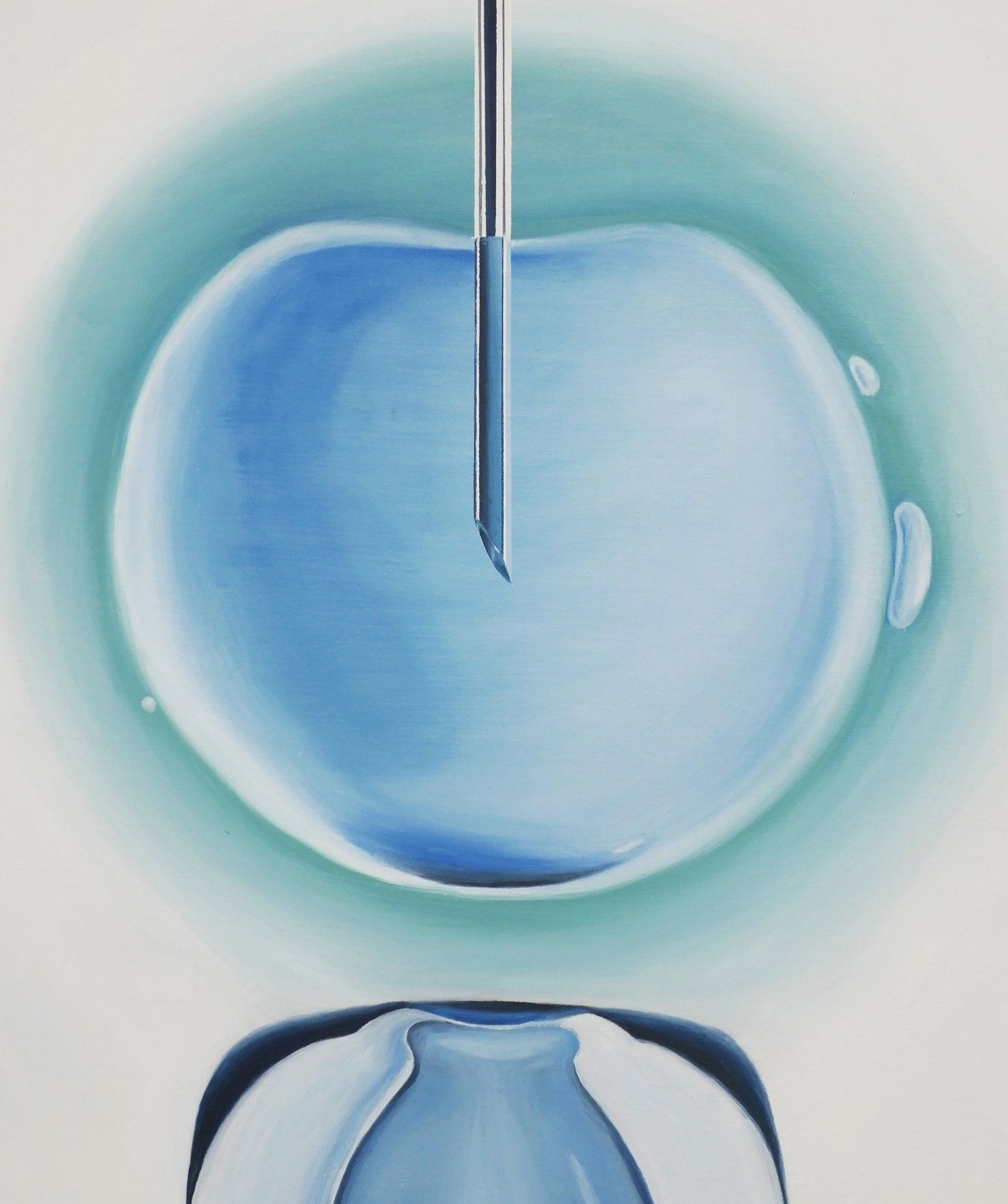
The painting also connects to Tan Mu's earlier work IVF (2020), which depicts artificial insemination in a laboratory setting. As Tan Mu has described, the two works form a pair: IVF addresses the origin of life and the moment when technology participates in its creation at the cellular level, while Dolly addresses replication and the question of identity. Together, they trace the arc of human intervention in biological reproduction from assisted conception to genetic duplication, from the technology that helps life begin to the technology that makes life repeat. The fact that Tan Mu connects these two paintings through their shared subject matter confirms that her interest is not in any single technology but in the broader condition that both technologies reveal: that the boundary between natural and artificial, between what life does on its own and what it does with human assistance, is not a fixed line but a zone of increasing complexity and ambiguity.
The sense of a body under conceptual pressure, of an identity being stretched or dissolved by forces that exceed its capacity to hold together, connects Dolly to the work of Francis Bacon, who spent decades painting the human figure in states of deformation that make the viewer acutely aware of the fragility of bodily coherence. Bacon's Study after Velázquez's Portrait of Pope Innocent X (1953) takes one of the most authoritative portraits in the Western tradition and subjects it to a process of dissolution that transforms the papal face into a screaming void, the vestments into a field of smeared pigment, the entire structure of institutional power into a figure that appears to be collapsing from within. The painting does not attack the Pope. It reveals the condition of power as a condition of instability, the way authority maintains itself through constant effort and can dissolve in an instant.
Tan Mu's Dolly operates in a related register but with a different object. Where Bacon dissolves the figure of authority, Tan Mu dissolves the figure of identity. The blur in Dolly does not distort the sheep's features into a scream. It softens them into ambiguity, into the condition of being not quite one thing or another, not quite an original or a copy, not quite a specific sheep or a general idea. This is a quieter kind of pressure than Bacon's, but it is no less profound. The question of what makes an individual an individual, of what distinguishes a copy from the original it replicates, is not a question that can be answered with a scream. It requires the kind of sustained, quiet attention that a blurred painting demands, the willingness to look at something that is not quite clear and to stay with it until its ambiguity becomes legible.
Bacon's figures are bodies in crisis, pulled apart by forces that they cannot resist. Tan Mu's Dolly is a body in a different kind of crisis, the crisis of being a copy that is also a life. The blur does not distort the sheep. It reveals it, shows what it looks like to exist as a genetic replica in a world that still organizes its thinking about identity around the concept of the unique individual. Dolly's gaze, the one element that Li Yizhuo identified as remarkable, is the point at which the painting's conceptual pressure concentrates. The eye looks back because the clone refuses to be reduced to a copy. It insists on its own presence, its own perspective, its own existence as a subject rather than an object. This insistence is what makes the painting more than an illustration of a scientific achievement. It makes it a portrait of a condition, a depiction of what it feels like to exist in the space between original and replica, between biology and technology, between life as it has always been and life as it is becoming.
Tan Mu has described thinking about life as a complex system in which the body functions as hardware and consciousness as software. This analogy, drawn from computing, applies with particular force to Dolly, whose body was produced through a process that resembles the copying of data from one storage medium to another. The nucleus that was transferred into the enucleated egg contained the complete genetic information of the donor ewe. That information directed the development of the embryo, the growth of tissues, the formation of organs, and the emergence of the living sheep that the world came to know as Dolly. The hardware was new. The software was a copy.
But Dolly's consciousness, if sheep can be said to have consciousness in any meaningful sense, was not a copy. It developed through her own experience, her own interaction with the environment, her own processing of sensory information. This is the point at which the hardware-software analogy breaks down, or rather, the point at which it reveals its own limitations. Software in a computer is identical when copied. The program that runs on one machine is the same as the program that runs on another. But the consciousness that develops in a living organism is shaped by the specific trajectory of that organism's experience, which is never identical to the experience of any other organism, even one with the same genetic material. Dolly's body was a copy. Dolly's life was an original. The painting holds this distinction open by blurring the body while sharpening the eye, suggesting that the site of originality is not the genetic code but the gaze, not the hardware but the consciousness that uses it to look out at the world.
Tan Mu's broader practice consistently returns to this intersection of body, technology, and consciousness. Her paintings of medical imaging, in vitro fertilization, quantum computing, and neural networks all investigate the same set of questions from different angles: how does technology participate in the construction of life, how does the body operate as both a biological system and an information processing system, and where does consciousness fit in the architecture of a world that increasingly understands itself through computational metaphors? Dolly is the most direct entry point into this investigation because cloning is the most literal example of biological copying, the moment when the analogy between life and computation became not merely metaphorical but material, when a living organism was produced through a process that closely resembles the duplication of a file.
Dolly the sheep lived for six and a half years. She was euthanized on February 14, 2003, after being diagnosed with a progressive lung disease and after earlier treatment for arthritis, conditions that some scientists attributed to the premature aging of her cells, which were already six years old at the time of her birth because they had been taken from an adult ewe. The relationship between cloning and aging remains a subject of scientific investigation, but Dolly's relatively short life and her age-related health problems became part of the cultural narrative around cloning: that copies degrade, that replicas carry the marks of their origin, that the attempt to reproduce life through technological means produces organisms that are somehow less than the originals they replicate. Whether or not this narrative is scientifically accurate, it has shaped the way cloning is understood in the popular imagination, and it adds a layer of poignancy to Tan Mu's painting that the artist could not have anticipated when she began the work.
The blur in the painting now reads not only as a metaphor for memory but also as a premonition of decay. The softening of Dolly's contours suggests not just the instability of recollection but the fragility of the cloned body, the way a copy may be more vulnerable than an original because it carries within it the accumulated age of its source. But the eye remains sharp. The gaze remains clear. Whatever was happening to Dolly's body, whatever the lung disease and the arthritis were doing to her physical structure, her gaze persisted as the mark of an individual consciousness that could not be reduced to its genetic origin. She looked at the camera because she was a subject, not just an object. She looked at Tan Mu because Tan Mu was painting her, and in the act of being painted she became not just the first cloned mammal but a sheep with a face, a gaze, and a claim on the viewer's attention that no amount of conceptual framing can fully contain.
Li Yizhuo was right. The remarkable thing about Dolly is that it gazes back. But the reason it gazes back is not that Tan Mu made a technical decision to sharpen the eye. The reason it gazes back is that Dolly herself looked at the camera, and the camera recorded that look, and the look survived the blur of memory and the blur of paint and the blur of twenty-five years of cultural commentary about what cloning means. The gaze survives because it was real. It was the one thing about Dolly that could not be copied.