Portrait of a Machine: Tan Mu's Quantum Computer and the Shape of What Thinks
At close range, the cryostat is beautiful. The cylindrical form rises from a black ground like a monument, its surface catching light in a way that makes the metallic casing appear to shift between silver and deep blue depending on the angle of view. The suspension system at the base, a series of nested rings and brackets that isolate the quantum processor from vibration, reads as a pedestal or a throne, something made to hold an object of importance. Above the main cylinder, a tangle of cables and cooling tubes extends upward into the upper portion of the frame, their precise routing suggesting both the engineered order of a sophisticated system and the almost organic complexity of a living thing. Tan Mu has described completing Quantum Computer (2020) and realizing, with certainty, that she had painted a portrait. Not a still life. Not a machine. A portrait. The recognition changed how she understood the work, and it changes how the viewer must approach the canvas, because a portrait demands something different from its audience than an illustration of an object. A portrait asks the viewer to recognize a presence, to acknowledge a subject, to respond to something that looks back.
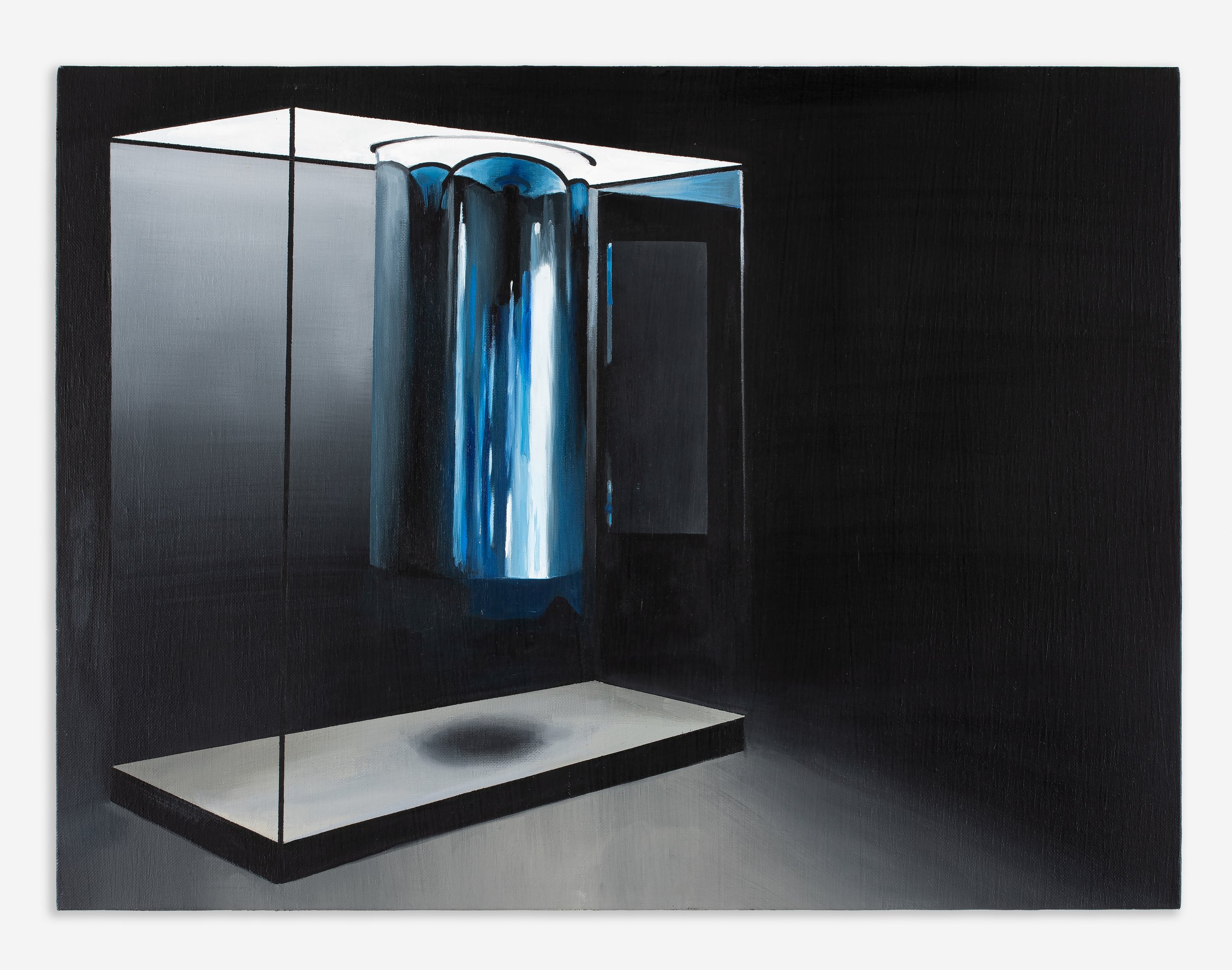
The cryostat at the center of the painting is the cooling structure of a superconducting quantum computer, the component that maintains the processor at temperatures near absolute zero, close to minus 273 degrees Celsius, cold enough that electrical resistance vanishes and the circuits enter a state of superconductivity in which quantum effects can be harnessed for computation. IBM's Q System One, which this painting depicts, was unveiled in January 2019 as the first commercial quantum computer, a machine that promised computational power billions of times faster than any classical supercomputer for certain classes of problems. The announcement was genuine news, a moment when quantum computing crossed the threshold from laboratory curiosity to industrial product. Tan Mu painted the machine within a year of that announcement, drawn, she has said, by the sense that she was witnessing a pivotal moment in the history of human thought, a threshold beyond which the relationship between mind and machine would be fundamentally altered.
Quantum Computer is executed in oil on linen, measuring 46 by 61 centimeters (18 by 24 inches). The small scale is deceptive. The painting has the weight and presence of a much larger work, in part because the composition places the cryostat at a slight upward angle that makes it appear to be looming, and in part because the background is so thoroughly dark that the machine seems to glow from within, as if the cold blue surface is absorbing what little light exists in the painting's world. The palette is dominated by deep blues, metallic silvers, and blacks, with occasional warm reflections in the metallic surfaces that suggest overhead lighting or the glow of control panels just outside the frame. The effect is of a machine operating in a kind of sanctum, a sealed environment where temperature, vibration, and electromagnetic interference are all controlled to create the conditions in which quantum computation becomes possible.
Brushwork in the cryostat's surface is precise and measured, building up layers of cool blue-gray that create the impression of brushed metal without sacrificing the painterly quality that makes the surface feel hand-made rather than industrially produced. The cables at the top of the composition are rendered with a looser touch, their forms suggested by confident strokes that capture the tangle without getting lost in detail. This variation in brushwork between the central object and its appendages creates a conceptual distinction: the cryostat is the subject, the element that demands attention, while the cables are context, the infrastructure that makes the subject possible. The black background is not merely empty. It is a deliberate choice, isolating the machine from any environmental context that might dilute its presence, placing it in a void that belongs to the tradition of portraiture rather than the tradition of landscape or still life.
Tan Mu has described the reflective surfaces and precise lines of the composition as echoing the abstract nature of the quantum world, where boundaries between the material and the immaterial become unstable. This connection between visual precision and conceptual abstraction is one of the painting's central achievements. The cryostat is rendered with the accuracy of a technical illustration, yet the effect is not cold or clinical. The paint surface carries warmth in its handling, in the visible strokes that build up the metallic character of the cylinder, in the way the blues shift and modulate across the curved surface. The machine is painted as if it were a face, with attention to the specific character of its forms rather than to their generic type. This is not a picture of a quantum computer. It is a picture of this quantum computer, this specific arrangement of metal and glass and wire that IBM built in a facility in Poughkeepsie or Ehningen, Germany, wherever the Q System One that Tan Mu was looking at was housed.
The painting's treatment of the machine as a monument, an object isolated in a void and rendered with a quality of reverence that is usually reserved for religious or historical subjects, connects Quantum Computer to a specific strand of early twentieth-century painting: the metaphysical canvases that Giorgio de Chirico produced in the years between 1910 and 1920. De Chirico's paintings of empty piazze in Italian cities, with their sharply raking light, their elongated shadows, and their mysterious towers and arcades, create a sense of objects isolated from context, standing in spaces that have no clear relationship to the spaces of ordinary experience. His The Enigma of a Day (1914) places a classical sculpture, a broken torso, at the center of a composition whose architectural elements resist any stable reading of scale or distance. The painting does not depict a real place. It depicts a mental space, a condition of thought confronting the limits of its own comprehension.
Tan Mu's isolation of the cryostat in a black void operates on the same principle. The machine is not shown in its machine room, not shown with technicians or control panels or the usual accompaniments of industrial illustration. It is shown alone, as if it were a temple or a monument, as if the act of contemplating it requires the removal of everything that might distract from its essential form. De Chirico achieved this isolation through perspective, through the manipulation of architectural elements that create an impossible space, but the effect is the same: the object at the center of the canvas is given an authority that derives not from its physical size but from the quality of attention the painter brings to it. The quantum computer in Tan Mu's painting is not large. It is about the size of a human torso. But it looms because the painting treats it as something that deserves to loom, something that has earned its position as the sole focus of a viewer's attention.
The connection to de Chirico extends to the question of what these paintings are actually depicting. De Chirico's towers and piazze are not accurate representations of any specific Italian city. They are composite images, assembled from memory and from the visual culture of classical antiquity, representing not a place but a condition of mind. Tan Mu's quantum computer is not an accurate technical diagram of IBM's Q System One. It is a composite image, assembled from photographs and from the conceptual understanding she developed through research, representing not a machine but a threshold. The thing at the center of the canvas is a portkey, an object that opens onto a set of ideas that exceed what the object itself can contain. De Chirico painted towers because he wanted to paint the experience of time folding back on itself. Tan Mu painted the cryostat because she wanted to paint the experience of computation crossing a threshold that changes what thinking means. Both painters use the conventions of representation to point toward something that representation cannot fully capture, and both achieve this by isolating the object in a space that belongs more to thought than to observation.
A classical computer operates on bits, units of information that exist in one of two states: zero or one, off or on. Every calculation a classical computer performs, from the simplest arithmetic to the most complex simulation of molecular behavior, reduces to a sequence of operations on bits, flipping them between zero and one according to instructions encoded in software. The physics of this process is well understood. Silicon transistors switch between on and off states at rates measured in billions of times per second, and the entire edifice of modern computing, from smartphones to data centers to the internet, rests on this foundation of binary state and deterministic logic.
A quantum computer operates on a different principle. Its basic unit of information is the qubit, a quantum system that can exist in a superposition of both zero and one simultaneously, not because the measurement has not yet been made but because the state itself is genuinely both at once. This superposition is not an approximation or a theoretical abstraction. It is a physical reality that has been demonstrated in laboratories around the world, and it gives quantum computers their extraordinary potential power. When a quantum computer performs a calculation, it does not process qubits one at a time in a sequence of binary operations. It manipulates the probabilities of superposition states across all qubits simultaneously, exploring a vast space of possible solutions in parallel rather than in sequence. For certain classes of problems, this parallelism offers an exponential speedup over classical computation, solving in minutes what would take classical supercomputers millennia.
The class of problems where quantum computing offers the most dramatic advantage is the simulation of quantum systems themselves. Modeling the behavior of a molecule with more than a few atoms requires tracking the interactions between all its constituent particles, a problem whose complexity grows exponentially with the number of particles. A classical computer must approximate these simulations because the number of possible states exceeds any practical computational capacity. A quantum computer, operating on qubits that themselves exhibit quantum behavior, can model quantum systems directly, without approximation. This capacity has implications for drug discovery, materials science, cryptography, and fundamental physics. It also, and this is the point that Tan Mu has identified as the painting's conceptual core, changes the relationship between the human mind and the machines it builds. When a machine can perform calculations that no classical mind could perform, the definition of thought itself requires revision.
The cryostat at the center of the painting is the physical infrastructure that makes this new mode of thought possible. It maintains the temperature at the level required for superconductivity, for the elimination of electrical resistance that allows quantum effects to propagate through the circuit without being disrupted by thermal noise. The complexity of this infrastructure is extraordinary. The dilution refrigerator at the heart of the cryostat operates through a cascade of cooling stages, using helium isotopes to achieve temperatures measured in millikelvins, thousandths of a degree above absolute zero. The cables that Tan Mu paints extending from the top of the cryostat carry control signals and readout data between the room-temperature electronics and the quantum processor at the bottom of the refrigerator, each cable precisely routed to minimize interference with the delicate quantum states being manipulated inside. The machine is not merely a processor. It is an entire engineered environment, a controlled universe designed to preserve the conditions under which quantum computation becomes possible.
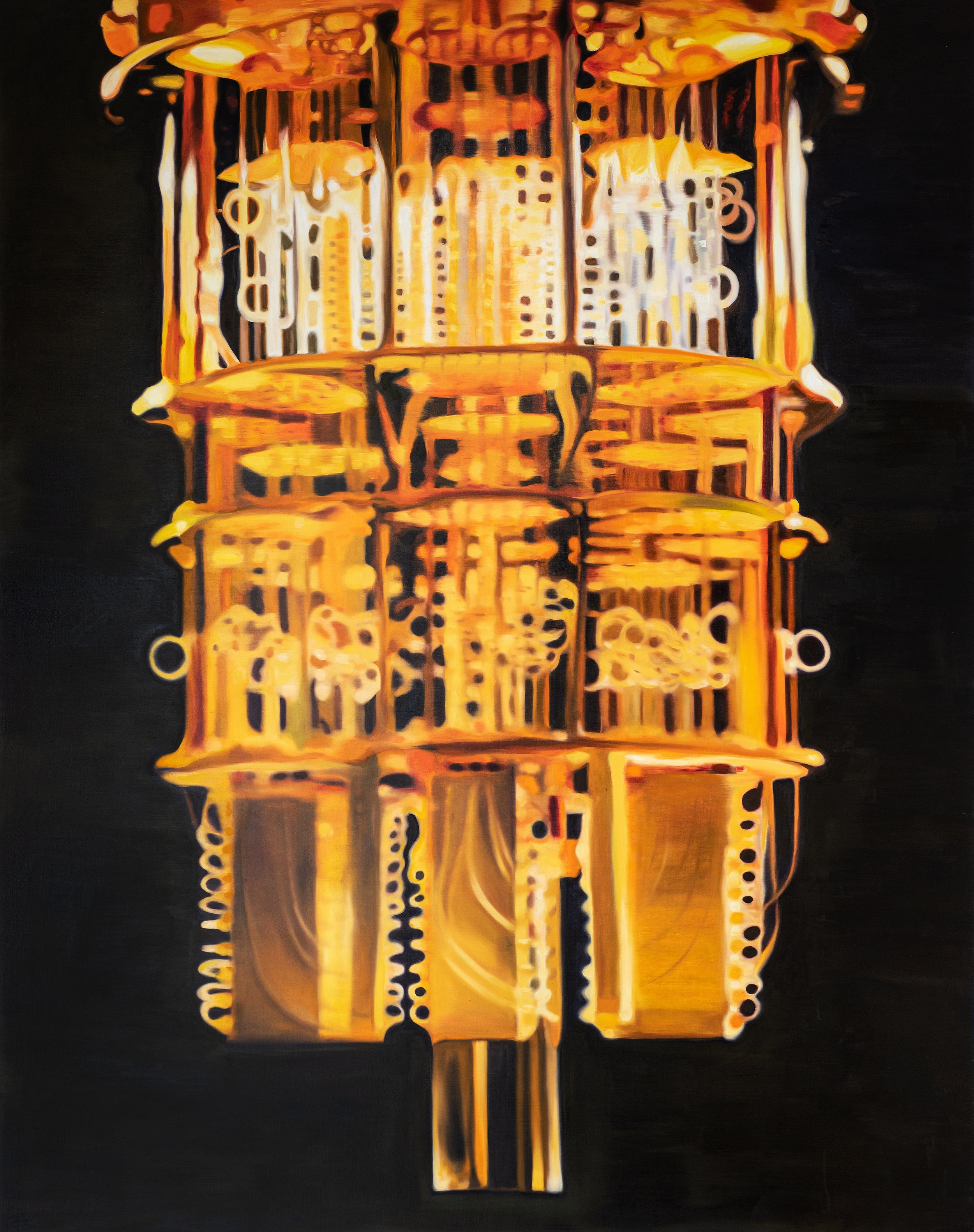
The question of how to represent technological systems that operate beyond direct human perception has occupied artists throughout the modern period, but none more directly than the American painter Agnes Newman, whose abstract paintings of the 1950s and 1960s attempted to render visible the invisible signals and electronic impulses that constituted the background radiation of postwar American life. Newman worked with the output of custom-built signal generators, translating electronic data into painterly marks that recorded the shape of information flows as they moved through her studio. Her paintings are not illustrations of electronic phenomena. They are direct transcriptions of signals, made by the signals themselves in collaboration with the artist's hand. The result is a body of work that hovers between abstraction and documentation, between aesthetic form and scientific record.
Tan Mu's approach to the quantum computer differs from Newman's signal-driven method but shares with it the desire to make visible the infrastructure of thought. Where Newman translated electronic signals into painterly marks, Tan Mu translates the visual evidence of a cryostat and its associated cooling systems into the language of oil painting, converting the technical imagery of IBM's promotional materials and engineering documentation into a composition that functions as a portrait. The reference to Newman is particularly apt because Newman was not interested in the beauty of machines for their own sake. She was interested in the beauty of the interface between the human and the technological, the point at which electronic signals become perceptible and the invisible infrastructure of communication becomes available for aesthetic experience.
The quantum computer in Tan Mu's painting is beautiful in exactly this sense. Its metallic surfaces, its precise geometry, its blue-gray palette against the black void are beautiful not as装饰 but as evidence, as the visible marks of a system that operates in a realm inaccessible to direct human observation. The painting does not show quantum superposition or entanglement. It shows the machine that makes quantum computation possible, the physical apparatus that translates the abstract principles of quantum physics into a working system. This is the interface that Newman would have recognized: the point at which the invisible becomes visible, at which the data that flows through superconducting circuits at temperatures colder than outer space becomes available for contemplation by a viewer standing in front of a canvas. The quantum computer is beautiful because it is the beautiful object at the boundary between human comprehension and its extension in technology, the thing that thinks beyond what the human mind can think without mechanical assistance.
The ERES Foundation exhibition text for Tan Mu's quantum computer paintings described the cryostat as a "modern golden calf," an object of worship in an age that has transferred its religious devotion from the divine to the computational. This description is provocative but not entirely accurate as a reading of Tan Mu's intentions. The painting does not worship the quantum computer. It contemplates it, studies it, gives it the kind of sustained attention that portrait painters have traditionally given to human faces and religious figures. The question the painting asks is not "how great is this machine?" but "what does it mean that this machine exists?" What does it mean that the humans who built it have created a device that operates according to principles that contradict the ordinary logic of everyday experience, where things can be in two states at once and measurements cannot be made without disturbing the system being measured? The quantum computer is not a golden calf. It is a mirror, a surface that reflects back the shape of the minds that built it and the questions those minds are asking about the nature of reality and cognition.
Tan Mu has described Quantum Computer as feeling like a self-portrait, reflecting her own trajectory as an artist whose practice has consistently investigated the relationship between biological and technological systems. She has spoken about thinking of the body as hardware and consciousness as software, an analogy that applies with particular force to the quantum computer because it is a machine designed to simulate quantum physical processes, which are themselves the processes that govern the behavior of matter at the most fundamental level. The quantum computer is, in a sense, a machine for thinking about thinking, a device that extends the human capacity for mathematical reasoning into a regime where classical logic no longer applies and where the categories of zero and one, true and false, presence and absence lose their ordinary meaning.
This recursive quality, the machine that extends the mind's capacity to think about the mind's own limitations, connects to a larger pattern in Tan Mu's practice. Her paintings of MRI machines examine the technology that allows doctors to image the brain that is doing the imaging. Her paintings of submarine cables investigate the infrastructure that carries the information through which the humans planning the cables understand the ocean that the cables cross. Her paintings of embryonic development depict the process by which the cells that will eventually become a painter are created in a laboratory setting. In each case, the painting returns to the question of how technology extends and complicates the biological processes from which it emerges. The quantum computer continues this investigation at the most abstract level, asking what it means to build a machine that operates according to the principles of physics at the smallest scale, a machine that is, in a precise sense, a model of the reality it is being used to investigate.
The portrait that Tan Mu painted does not resolve these questions. It holds them in suspension, in the cool blue form of the cryostat and its tangle of cables, in the black void that isolates the machine from any context that might simplify it. The viewer who stands before the painting is asked to contemplate not just the quantum computer but the condition of contemplating it, to be aware that the act of looking at this image of a thinking machine is itself a form of thinking, an activity of the biological neurons and electrochemical signals that the machine was built to extend and complement. The painting does not answer the question of what quantum computation means for human cognition. It creates the conditions in which that question can be considered, sustained by the quality of attention that Tan Mu brings to the machine's form and the confidence with which she renders it as a subject deserving of the viewer's full engagement. A portrait is always a collaboration between the painter and the subject. Quantum Computer is Tan Mu's collaboration with a machine that asked her to think about thinking, and the painting is the record of what that collaboration produced.