Seven Seconds: Tan Mu's Trinity Testing and the Instant That Changed Everything
Ten days. Seven canvases. One moment repeated. Tan Mu worked on Trinity Testing (2020) for roughly ten days, completing one small painting per day, working with full concentration and without interruption. Each canvas measures 28 by 36 centimeters, a format she has described as holding special importance in her early practice because it allows for close attention to detail and an intense focus on fleeting visual phenomena while maintaining a concentrated and intimate mode of expression. She spent about ten hours on each painting, carefully constructing a freeze-frame of a fraction of a second, sealing it, as she has said, like a time capsule. The fraction of a second that each canvas depicts is the instant in which a nuclear detonation releases an amount of energy so vast that it alters the trajectory of human civilization. The mismatch between the time it takes to paint and the time the painting captures is not accidental. It is the work's central structural fact.
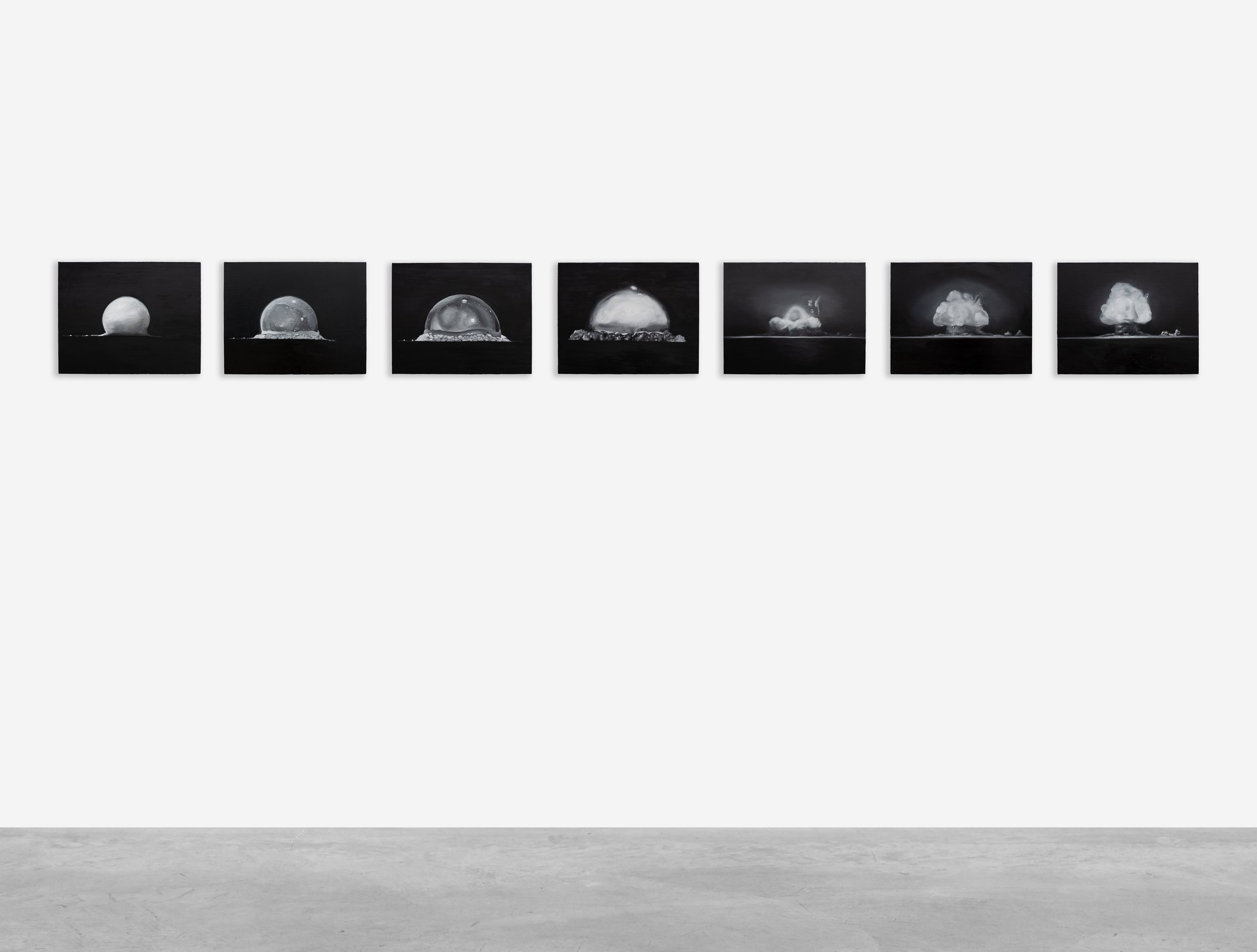
Li Yizhuo, writing about the DAWN exhibition at Peres Projects in Berlin, observed that "each of 11 by 14 inches, the canvasses are so delicate and dreamlike that one feels they must be appearing in a crystal ball." The observation is precise. The small scale, the monochrome palette, the soft rendering of the mushroom clouds against black grounds, all contribute to an effect that is the opposite of what a painting of a nuclear explosion might be expected to produce. There is no spectacle here. There is no shock. There is instead a quality of distant viewing, as if the explosions are being observed from a great remove, through a medium that muffles their force while preserving their form. The crystal ball does not amplify what it shows. It miniaturizes it, makes it seem inevitable and already past, something that has already happened and cannot be undone.
Trinity Testing is executed in oil on linen, comprising seven individual panels each measuring 28 by 36 centimeters (11 by 14 inches). Hung together in sequence, the panels span 252 centimeters (98 inches) horizontally, forming a frieze of successive instants drawn from archival footage of nuclear test detonations. The format is cinematic in its logic: each panel is a frame, a fraction of a second extracted from the continuous unfolding of the explosion, frozen at a particular stage of its development. But where a film presents its frames in rapid succession, creating the illusion of continuous motion, the seven canvases of Trinity Testing present their instants in spatial sequence, side by side, allowing the viewer to move from one to the next at whatever pace they choose or to return to earlier panels and look again.
The palette across all seven panels is monochrome, restricted to blacks, whites, and grays, with occasional modulations of tone that suggest the thermal gradients within the mushroom cloud. Tan Mu has described removing color as a way of stripping away the familiarity of the visible world, rendering familiar environments strange so that what we think we understand begins to operate within a different system. In the context of nuclear imagery, the removal of color also serves a documentary function. The archival photographs that Tan Mu worked from were themselves black and white, produced by military cameras positioned at safe distances from the detonation sites. The monochrome palette aligns the paintings with their source material, acknowledging the technological mediation through which these events were originally recorded and transmitted.
Brushwork varies across the seven panels in ways that track the development of the explosion itself. In the earlier panels, where the fireball is still concentrated and intensely bright, the paint is applied with a denser impasto that creates a slight physical relief on the canvas surface, the white pigment standing up from the dark ground in a way that catches light and creates an actual glow. In the later panels, where the mushroom cloud has expanded and begun to disperse, the brushwork becomes thinner and more fluid, allowing the black background to show through in patches and creating a sense of the cloud's edges dissolving into the surrounding atmosphere. This progression from density to diffusion, from concentrated force to spreading residue, mirrors the physics of the detonation and gives the sequence a temporal logic that operates independently of the viewer's movement along the frieze.
The black ground that surrounds the mushroom clouds in each panel is not merely a neutral background. It functions as an environment, a condition of total darkness from which the explosion emerges and into which it will eventually be reabsorbed. Tan Mu has described this black field as intensifying the sense of energy and information contained within a limited visual field, and the description is accurate. The black does not recede. It presses forward, creating the sense that the explosion is occurring in a void, in the absence of any context that might contain or explain it. There is no landscape, no horizon line, no desert floor. The mushroom cloud floats in darkness, as if the explosion has erased not only its own physical surroundings but also the very concept of surroundings, leaving nothing but the event itself suspended in an undifferentiated void.
The question of how to represent destruction so total that it exceeds the capacity of visual representation has been with painting since Francisco Goya produced his series of prints The Disasters of War between 1810 and 1820, documenting the atrocities committed during the Peninsular War with a directness that had no precedent in the history of European art. But it is Goya's painting *The Third of May 1808* (1814) that establishes the most relevant precedent for Tan Mu's Trinity Testing, because it is in this painting that Goya confronts the problem of depicting an event whose violence is so concentrated that it can only be shown at its point of maximum intensity, the instant when the firing squad's rifles discharge and the bullets strike their targets.
Goya's composition centers on a single figure in a white shirt, arms spread wide, facing the firing squad with a gesture that simultaneously recalls the crucifixion and asserts the victim's humanity against the mechanical anonymity of the soldiers. The man in the white shirt is the point of maximum emotional intensity in the painting, the element that focuses the viewer's attention and anchors the composition's moral weight. Around him, other victims collapse or cover their faces or wait in the line that stretches back into the darkness. The firing squad is a wall of identical figures, their faces hidden, their rifles aligned in a row that converts individual human beings into a single mechanism of death. The painting does not depict the aftermath of the execution. It depicts the instant of execution, the moment when the bullets are in flight and the bodies have not yet fallen.
Tan Mu's Trinity Testing operates on a different scale of destruction but applies a similar logic of temporal compression. Each of the seven panels captures the nuclear explosion at a specific instant, the way Goya's painting captures the execution at the instant of the volley. The choice of instant matters. An earlier instant would show the moment before the detonation, when the energy has not yet been released and the event has not yet happened. A later instant would show the aftermath, the crater, the fallout, the ruined landscape. The instants that Tan Mu has chosen to paint are the ones where the explosion is at its peak, where the energy release is at its most intense, where the mushroom cloud is still rising and has not yet begun to disperse. These are the moments of maximum force, the instants that Goya captured in *The Third of May 1808*, and they carry the same double charge: the force of the event itself and the force of the decision to show it at this particular moment rather than at any other.
The Trinity test, conducted at 5:29 a.m. on July 16, 1945, in the Jornada del Muerto desert in southern New Mexico, was the first detonation of a nuclear weapon. The device, an implosion-type plutonium bomb similar to the one that would later be dropped on Nagasaki, was hoisted to the top of a hundred-foot steel tower and detonated by remote signal. The explosion produced a fireball that expanded to a diameter of approximately two hundred meters within a fraction of a second, creating a temperature at its center estimated at one hundred million degrees Celsius, hotter than the center of the sun. The shockwave was felt hundreds of kilometers away. The mushroom cloud rose to a height of over twelve kilometers. The sand beneath the tower was fused into a glassy substance later called trinitite. The sound of the explosion was heard across the region, and the flash of light was visible as far away as Albuquerque.
The physicists who witnessed the test understood immediately that something unprecedented had occurred. J. Robert Oppenheimer, the scientific director of the Manhattan Project, later recalled a line from the Bhagavad Gita: "Now I am become Death, the destroyer of worlds." Kenneth Bainbridge, the test director, reportedly told Oppenheimer, "Now we are all sons of bitches." Both responses acknowledged the same fact: the Trinity test had demonstrated that human beings could produce, through deliberate engineering, an amount of destructive energy that had previously been available only through natural processes operating on geological or astronomical scales. The nuclear explosion was not merely a more powerful bomb. It was a new category of event, a threshold beyond which the relationship between human capability and natural force was fundamentally altered.
Tan Mu has described her fascination with the instant of explosion, the precise moment when immense energy is unleashed, as mirroring her broader interest in the defining moments of human progress. She studied extensive archival footage of nuclear tests, focusing on the sequence from the accumulation of energy to its sudden release. This focus on the instant of maximum intensity is what connects the seven panels of Trinity Testing to the rest of her practice, including her paintings of volcanic eruptions and submarine cable disruptions, where the same logic of rupture and release operates at different scales and through different mechanisms. Whether the energy source is nuclear fission or volcanic pressure or the snapping of a glass fiber on the ocean floor, the structure of the event is the same: energy accumulates until it exceeds the capacity of its container, and then it is released in a burst that transforms the surrounding environment and creates conditions that did not exist before the release occurred.
The seven panels of Trinity Testing do not depict a single explosion from seven angles. They depict seven different moments from the sequence of a nuclear detonation, or possibly seven different detonations, drawn from the extensive archive of nuclear test photography that the United States government produced between 1945 and 1992. The ambiguity is deliberate. The repetition of the mushroom cloud form across multiple panels, each slightly different in its proportions and its degree of expansion, creates the sense that the explosion is being examined from multiple temporal positions rather than being captured in a single definitive image. This temporal multiplicity is what Li Yizhuo identified as giving the work "a sense of spiritual mystification," and what the Peres Projects gallery statement described as imbuing the paintings with a quality of repetition that transforms documentary imagery into something that operates according to a different logic, the logic of ritual rather than record.
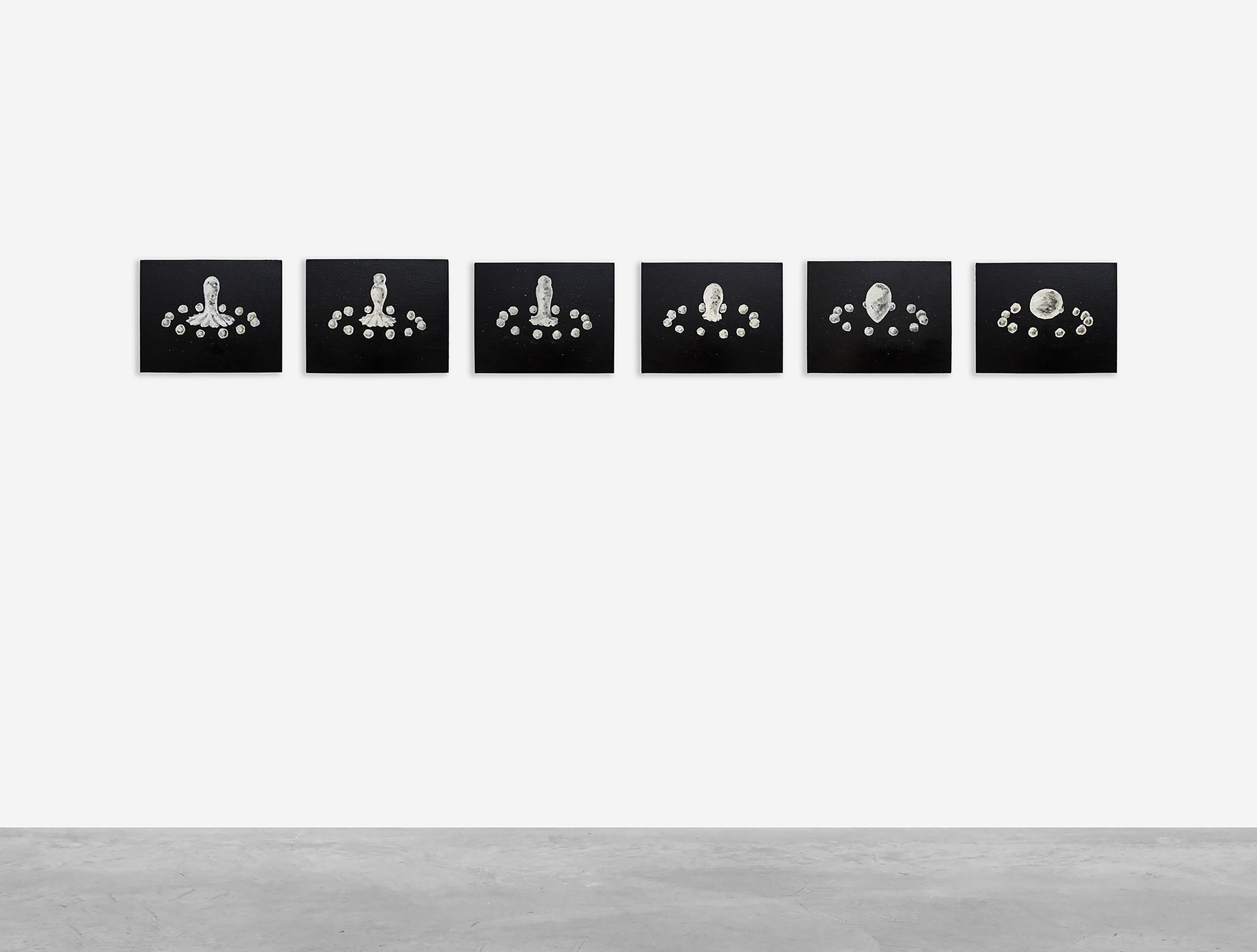
The use of repetition as a formal strategy in Trinity Testing connects the work to another body of art that confronts the image of catastrophe: Andy Warhol's Disaster series of the early 1960s, which includes paintings based on newspaper photographs of car crashes, electric chairs, race riots, and atomic bombs. Warhol's *Atomic Bomb* (c. 1965) and related works reproduce photographic images of mushroom clouds using the silkscreen technique that Warhol had developed for his celebrity portraits, applying the same mechanical reproduction process to images of destruction that he applied to images of Marilyn Monroe and Elvis Presley. The effect is to erase the distinction between news and entertainment, between catastrophe and celebrity, suggesting that in a media-saturated culture all images circulate according to the same logic of consumption and obsolescence.
Tan Mu's repetition of the mushroom cloud in Trinity Testing operates differently from Warhol's. Where Warhol used silkscreen to emphasize the mechanical indifference of mass media reproduction, the way the same image can be printed and reprinted until its content is exhausted and it becomes pure surface, Tan Mu uses hand-painted oil on linen to reassert the presence of the maker's hand in the reproduction of the image. Each of the seven panels is individually painted, each with its own variations in brushwork and tonal modulation, each the product of a separate day's concentrated labor. The repetition is not mechanical. It is manual, iterative, contemplative. Each painting of the mushroom cloud is a separate act of looking, a separate encounter with the image, a separate day spent inside the instant of the explosion.
This distinction matters because it changes the relationship between the viewer and the image. Warhol's silkscreened disasters confront the viewer with the desensitizing effect of media circulation, the way repeated exposure to images of catastrophe reduces their emotional impact. Tan Mu's hand-painted repetitions confront the viewer with the opposite: the way sustained attention to an image, repeated looking over multiple sessions, deepens rather than diminishes the viewer's engagement with what the image shows. The seven panels of Trinity Testing do not desensitize. They intensify. They ask the viewer to look at the mushroom cloud not once, in the instant of its initial shock, but seven times, from seven slightly different temporal positions, each one requiring a separate act of attention that accumulates into a sustained meditation on what the explosion means and what it continues to mean.
The connection to Warhol also illuminates the political dimension of Tan Mu's approach. Warhol's Disaster series was explicitly about the American media landscape of the early 1960s, about the way television and newspapers transformed violence into spectacle. Tan Mu's Trinity Testing is about a different media landscape: the archive of declassified military photography that documents the nuclear testing program of the United States and other nations. These images were not produced for public consumption. They were produced as scientific and military records, intended for analysis rather than for emotional engagement. By painting them, Tan Mu transfers them from the archive to the gallery, from the domain of documentation to the domain of contemplation. The paintings do not merely reproduce the images. They recontextualize them, asking what it means to look at a photograph of a nuclear explosion not as a piece of military data but as a work of art, as an image that demands the kind of sustained attention that only painting can command.
Tan Mu has described the monochrome palette of Trinity Testing as transforming the mushroom cloud from an image of explosion into a visual expression of vibrational frequency. Historical accounts of nuclear explosions describe not only their visual impact but also the powerful vibrational energy they generate, the shockwave that propagates outward from the point of detonation at speeds exceeding the speed of sound, carrying information that is not immediately visible but that nonetheless affects everything it encounters. This interest in vibration connects Trinity Testing to the Signal series and to Tan Mu's research into electronic music, where sound waves become a central subject, and to her paintings of volcanic eruptions, where the same logic of energy crossing a critical threshold operates through geological rather than nuclear physics.
The seven panels can be read as a sequence of vibrations, each one a separate pulse of energy captured at a different stage of its expansion. The first panel shows the fireball at its most concentrated, the energy still contained within a relatively small volume. The last panel shows the mushroom cloud at its most dispersed, the energy spread across a larger volume and beginning to lose its coherence. Between these extremes, the intermediate panels show the explosion at different points in its development, each one recording a different frequency of the same vibrational event. This reading of the work connects it to Tan Mu's broader interest in the relationship between visual form and vibration, and to her observation that whether the shockwave is from a nuclear blast, a volcanic eruption, a data signal, or a sound wave, each represents energy crossing a critical threshold and entering a new state.
The tension between control and loss of control that Tan Mu has identified as central to the series operates at every level of the work. The carefully controlled size of the canvas stands in quiet contrast to the uncontrollable nature of the energy being depicted. The deliberate, methodical brushwork of the painting process stands in contrast to the chaotic behavior of the explosion itself. The monochrome palette, with its restricted range of tones, stands in contrast to the overwhelming sensory impact of a nuclear detonation, which includes not only light and heat but also sound, pressure, and radiation. Each painting holds a temporary equilibrium between these opposing forces, the force of the artist's control and the force of the event's uncontrollability, the force of the medium's limitations and the force of the subject's excess. Beneath every seemingly serene image lies the presence of immense crisis or the emergence of a new and transformative energy, and the viewer who stands before the seven panels is asked to hold both conditions in mind simultaneously, to see the delicacy and the violence, the crystal ball and the explosion it contains.
The ten days that Tan Mu spent painting the seven panels of Trinity Testing represent a kind of temporal inversion of the fractions of seconds they depict. She entered the instant of the explosion and stretched it across ten days of concentrated labor, building up the paint layer by layer, slowing the moment down until its internal structure became visible. The process she describes, working for ten hours a day, focusing intensely on a single image and a single moment, the instant when massive energy is released, is itself a form of controlled detonation: the slow, deliberate release of the painter's own energy into the work, distributed across seven small canvases that each contain a fraction of the original explosion's force. The paintings are time capsules in the most literal sense. They seal the instant inside the paint, preserving it for whatever future viewer might stand before the panels and be willing to look at what the Atomic Age looked like in its first seconds, before the mushroom cloud had risen to its full height and the full consequences of what had been set in motion had become apparent.