The Embellished Dark Source: Tan Mu's Powehi and the First Image of the Unseeable
On April 10, 2019, a press conference in Brussels was simultaneously convened in Washington, Shanghai, Taipei, Tokyo, and Santiago. Scientists from eight radio telescopes spanning the globe, from the South Pole to Spain, had spent two years calibrating their instruments and combining their data into a single observation. The result was displayed on a screen behind the podium: a ring of fire, asymmetric and blurred at its edges, surrounding a perfect void of absolute darkness. The ring was colored in the warm oranges and yellows that algorithmic processing had assigned to the radio frequency data. The void at the center was not black, technically. It was the absence of signal. The Event Horizon Telescope collaboration had produced an image of a black hole at the center of the Messier 87 galaxy, 55 million light-years from Earth, with a mass 6.5 billion times that of the Sun. The image went around the world in seconds. A week later, a Hawaiian language professor named Larry Kimura announced that the collaboration had agreed to name the black hole Powehi, from the Hawaiian creation chant, meaning "the embellished dark source of unending creation." Tan Mu painted Powehi in 2022, three years after the announcement, working from the image that had become one of the most reproduced photographs in history and transforming it through the slow, layered process of oil on linen into something that belongs to a different register of experience entirely.
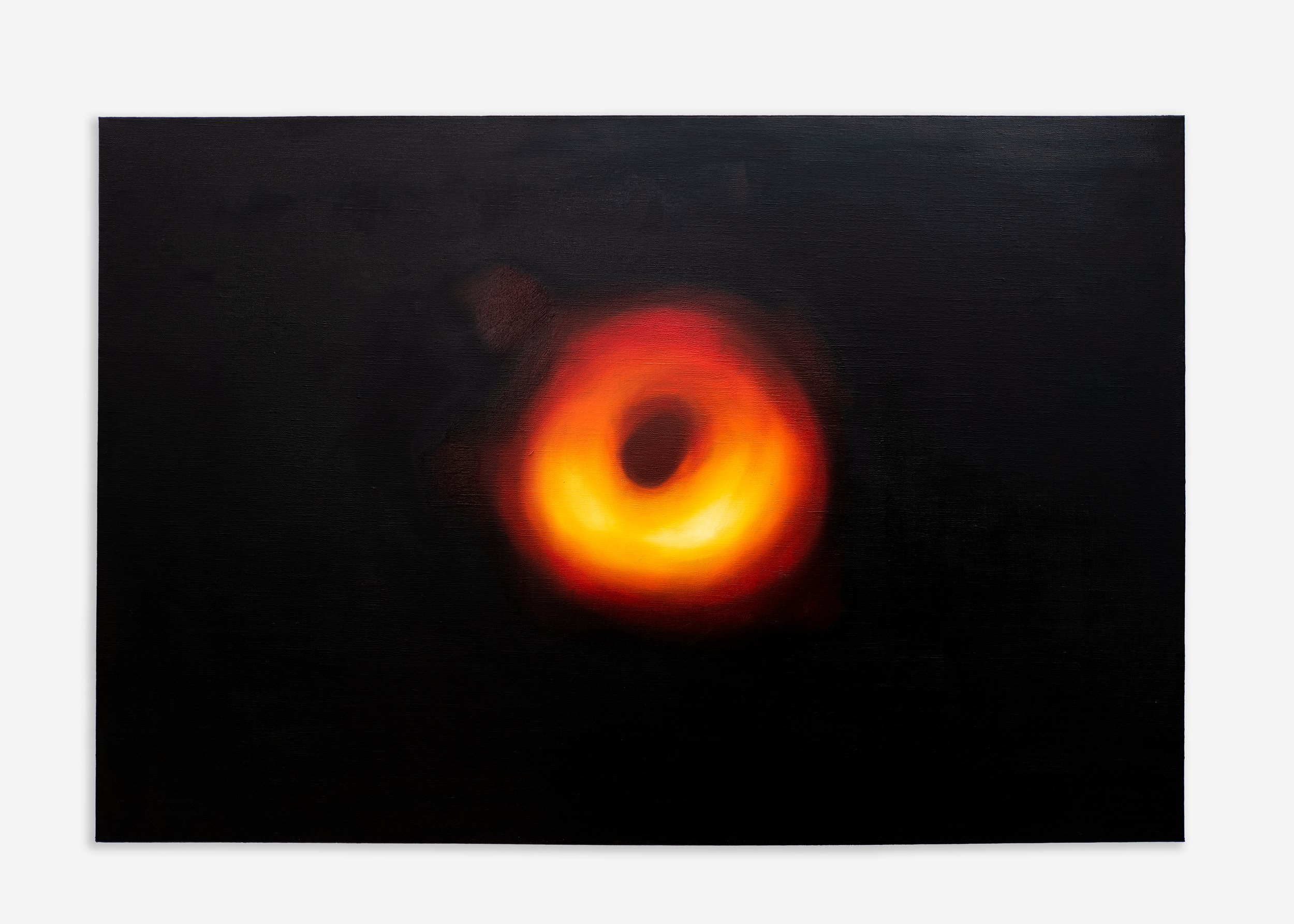
Nick Koenigsknecht, writing in 2025 about Tan Mu's cosmic paintings, observed that her approach to astronomical subjects operates at a remove from the spectacular registers typically associated with images of the infinite. "The cosmic in Tan Mu is not the cosmic of wonder," he wrote. "It is the cosmic of labor, of data consolidation, of instruments pointed at a target over sustained periods of time." This distinction matters for Powehi, because the painting is not an illustration of the black hole announcement or a commemoration of the discovery. It is a meditation on the specific kind of seeing that the discovery required, the way eight telescopes working in concert could produce an image of something that, by definition, emits no light and cannot be observed directly. The ring of fire that surrounds the void in the painting is not a representation of what the black hole looks like. It is a representation of what the Event Horizon Telescope array could make visible, given enough time, enough calibration, and enough collective effort.
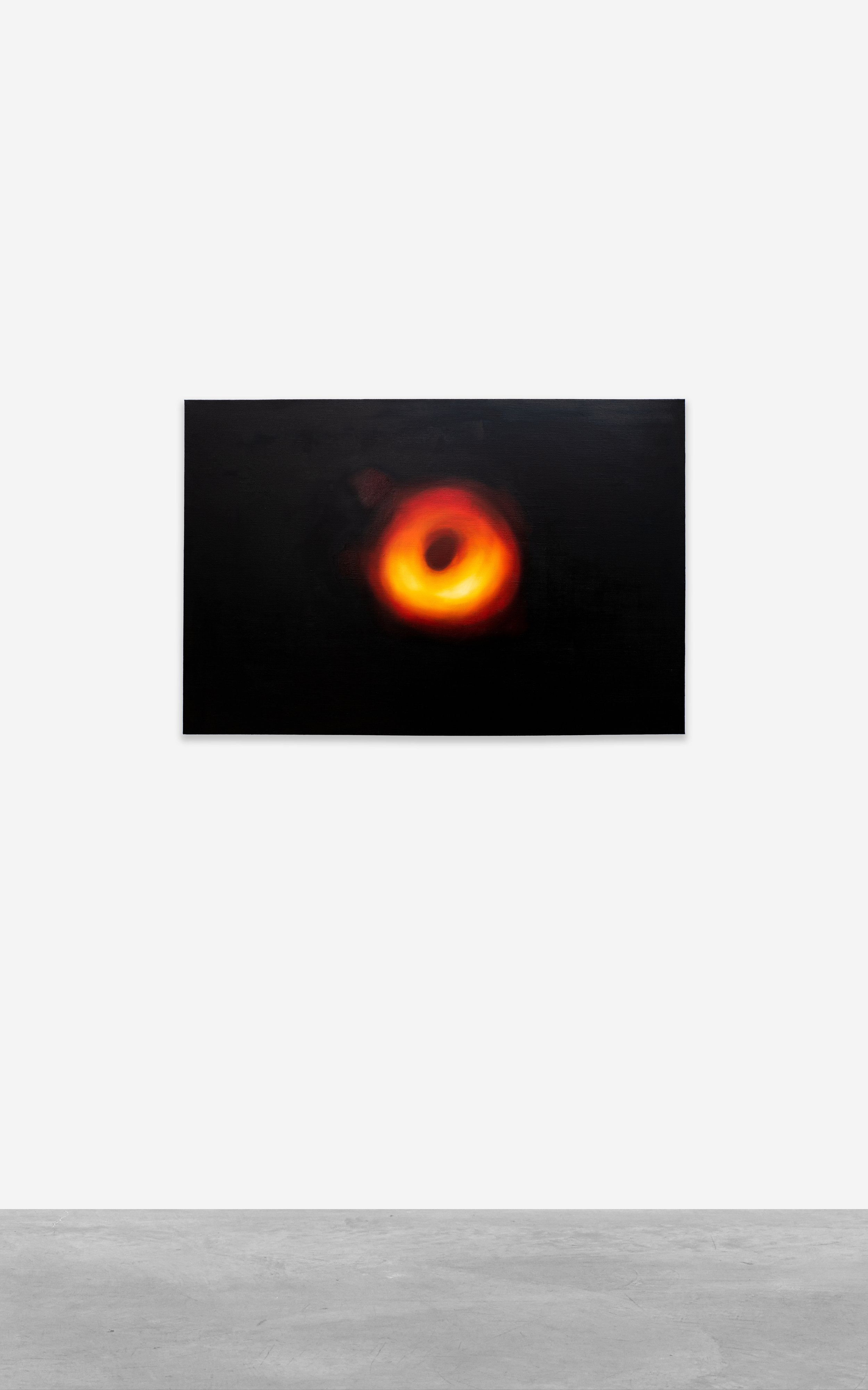
Powehi is executed in oil on linen, measuring 61 by 91 centimeters (24 by 36 inches). The orientation is horizontal, consistent with the wide format of the original EHT image, which showed the black hole as a relatively thin ring against the blackness of space. The composition places the ring at the center of the canvas, occupying roughly the middle third of the horizontal span, with the dark void at the center of the ring and the deep black ground extending to the edges of the painting on all sides. The ring itself is rendered in layered pigment that builds from dark orange at the outer edge through progressively lighter tones toward the inner edge, where the contrast with the void becomes most intense. This gradation within the ring mimics the tonal processing that the EHT collaboration applied to its data, converting raw radio telescope readings into a visible image where color represents intensity of signal rather than wavelength of light.
Tan Mu has described her process of painting astronomical subjects as analogous to printmaking, where fragmented information is gradually consolidated into a complete image. This analogy is visible in the surface of Powehi. The pigment is applied in multiple layers, each one contributing to the overall density of the ring's tonality while preserving the subtle variations that give the ring its slightly uneven, slightly imperfect character. The linen weave shows through in the black ground surrounding the ring, providing a textural contrast between the active surface of the ring and the relatively平静 ground in which the ring floats. The ring itself is not perfectly uniform. There are variations in the thickness of the color application, places where the brush has left a slightly heavier deposit and places where the layer is thinner and the underlying tones show through. These variations give the ring a handmade quality that the original EHT image, processed through algorithms and displayed on high-resolution monitors, does not have.
The void at the center of the ring is the most technically demanding passage in the painting. It must read as absolute absence, as the zone where no signal returns, as the point beyond which light cannot escape and therefore cannot be recorded by any instrument. Tan Mu achieves this not through the use of pure black paint but through a careful control of value. The void is not the blackest zone in the painting. The surrounding ground is equally dark, sometimes darker. What distinguishes the void is its containment within the ring, the way it is defined by the contrast with the illuminated material orbiting it. This is physically accurate. The black hole is visible because of the matter that surrounds it, the superheated plasma that orbits at near-light speeds and emits the radio waves that the EHT array recorded. Without the ring, there would be no void to see. The absence is made visible only by its context.
The tradition of representing astronomical objects that cannot be directly observed has a long history in Western art, one that predates the telescope and extends forward through every subsequent expansion of the observable universe. When Johannes Kepler published his Astronomia Nova in 1609, arguing that the Earth orbits the Sun rather than the reverse, he included diagrams of the Martian orbit that were derived not from direct observation but from mathematical calculation. The orbit was an ellipse constructed from observations made over years of patient measurement, but the orbit itself was invisible. No one had ever seen the path that Mars traced through space. What Kepler produced was a representation of something that existed but could not be seen, a visualization of the invisible based on the systematic interpretation of fragmentary data gathered across long periods of observation.
Tan Mu's description of the black hole painting process echoes Kepler's method with striking precision. She is not painting something she has seen. She is painting something that has been constructed from data, from the readings of eight telescopes positioned around the world, from algorithms that convert radio wave intensities into visible color values, from years of calibration and cross-referencing and mathematical refinement. The image that results is not a photograph in the ordinary sense. It is a data visualization, a translation of invisible phenomena into a visible form through a process that requires human interpretation at every step. The ring of fire that surrounds the void in the EHT image is real in the sense that the underlying data is real, but the specific colors, the specific asymmetries, the specific boundaries between signal and absence are the product of choices made by the scientists and engineers who processed the data.
This connection to Kepler illuminates what is most distinctive about Tan Mu's approach to astronomical subjects. She is not interested in the cosmic sublime, in the overwhelm of scale that makes human beings feel insignificant against the backdrop of the universe. She is interested in the precision of the instrument, in the specific physical and mathematical operations that make invisible things visible. Kepler's diagrams of the Martian orbit are sublime in their implications, in what they reveal about the scale and structure of the solar system, but they are not sublime in their execution. They are meticulous, analytical, patient. The same is true of Powehi. The painting depicts an object whose mass is 6.5 billion times that of the Sun, an object so dense that spacetime curves around it to the point where nothing can escape, an object 55 million light-years away. But the painting does not grandly gesture at these facts. It carefully renders a ring and a void, a specific range of colors and values, a specific proportion of width to height, with the attention to material fact that characterizes the best observational painting.
The Event Horizon Telescope is not a single instrument. It is a network of radio telescopes located in eight positions around the world, coordinated through atomic clocks and synchronized observations, combined through a technique called very long baseline interferometry that effectively turns the entire planet into a single aperture. The South Pole Telescope, the Atacama Large Millimeter Array in Chile, the IRAM telescope in Spain, the James Clerk Maxwell Telescope in Hawaii, the Submillimeter Array in Hawaii, the SMT telescope in Arizona, the ALMA antenna in Chile, and the LMT telescope in Mexico all contributed observations to the 2017 campaign that produced the M87 black hole image. Each telescope recorded data at extremely high frequencies, the signals timestamped with atomic clock precision, then physically shipped to central processing locations where the data from all eight telescopes was cross-correlated and combined into a single coherent image.
Tan Mu has described being fascinated by the collective nature of this process, the way the image depended not on a single instrument but on a global collaboration spanning multiple continents and climate zones. "This collective effort deeply moved me," she has said. "It is not simply a scientific achievement, but a symbol of shared human labor and exploration." This emphasis on collectivity connects Powehi to the broader trajectory of Tan Mu's practice, where human presence is embedded within instruments, data, and images rather than being shown directly. The painting does not depict the scientists who built the EHT array or the engineers who calibrated the telescopes. But the evidence of their labor is present in the painting's subject, in the fact that the ring and void exist as visible phenomena only because thousands of person-hours of work went into the instruments and algorithms that made them visible.
The Hawaiian naming of the black hole adds a dimension to this collectivity that Tan Mu has engaged with explicitly. Larry Kimura, a professor of Hawaiian language at the University of Hawaii at Hilo, proposed the name Powehi following consultation with cultural practitioners, and the EHT collaboration agreed to use it. The name comes from the Kumulipo, the Hawaiian creation chant, and it frames the black hole not as a Western scientific object but as something that participates in a broader cultural understanding of creation, darkness, and the relationship between absence and presence. Tan Mu has described drawing on this naming in her painting, exploring the themes of infinite creation, destruction, and the unknown that the name invokes. The painting is thus located at the intersection of two traditions of understanding the cosmos: the empirical tradition of radio telescopes and atomic clocks, and the narrative tradition of creation chants and cultural naming. Neither tradition is privileged over the other. Both are present in the painting's subject.
The process of generating the black hole image also involves a tension between accuracy and uncertainty that Tan Mu has identified as one of the core ideas in her work. The EHT image is grounded in precise data, but it still involves human interpretation. Colors are added to enhance clarity, not because radio waves have inherent colors. Adjustments are made to reveal structure, not because the underlying data is structureless. The uncertainty in this process fascinates Tan Mu because it reveals a shared condition between science and art. Both attempt to make the invisible visible, and both operate within limits, interpretation, and imagination. The ring in the painting is not a photograph. It is a translation, a conversion of one kind of information into another kind, the same kind of translation that happens when an artist mixes pigments and applies them to a surface in order to make an idea visible to another person.
The specific tradition in American painting that has engaged most directly with the landscape of scientific observation is the tradition that extends from the Hudson River School through the precisionist painters of the 1920s and 1930s and into the contemporary engagement with technological landscape. Dennis Parks, whose photographs of American observatories and research facilities occupy a position in contemporary photography analogous to Tan Mu's position in painting, has documented the physical infrastructure of American science with an attention to form and context that transforms industrial buildings into subjects of aesthetic contemplation. His photographs of the Arecibo Observatory and the Kitt Peak facilities render the radio telescope dishes and support structures with the same quality of attention that nineteenth-century photographers brought to the American wilderness, converting scientific infrastructure into landscape.
Tan Mu's Powehi operates in a related but distinct tradition. Where Parks photographs the physical structures of scientific observation, Tan Mu paints the images that those structures produce. The painting does not depict the eight telescopes of the EHT array, their physical locations, or their infrastructure. It depicts the image that resulted from their coordinated observation, the ring and void that exists only because the collaboration succeeded. This distinction matters because it places the painting in the domain of the image rather than the domain of the instrument, in the register of what science makes visible rather than how it makes things visible. But the connection to Parks remains relevant because it reminds us that scientific images are not produced by abstract processes. They are produced by people, in specific places, using specific tools, and the images that result bear the marks of that production even when the marks are not immediately visible.
Li Yizhuo, writing about Tan Mu's cosmic paintings in 2025, described the black hole images as "historic" moments that Tan Mu documents through her paintings. "These moments feel historic," Tan Mu has said, describing her engagement with the M87 image and the later Sagittarius A image from the center of our own galaxy, released in 2022. "Through my work, I document these scientific milestones while also reflecting on how future technological advances will continue to reshape our understanding of the cosmos." This sense of timeliness is important to understanding Powehi. The painting is a record of a specific moment in the history of observation, the moment when human beings collectively produced an image of something that had previously been原则上 invisible. The painting does not capture the black hole as it is in itself. It captures the black hole as it appeared to the EHT array in 2017, processed through the algorithms and color mappings that the collaboration chose, distributed to a global audience in April 2019, and named Powehi in the week that followed. The painting holds all of these layers in suspension, making them available for contemplation in a medium that operates according to a different temporal logic than the news cycle that first distributed the original image.
Tan Mu has described her use of black grounds in cosmic paintings as creating an objectified space, similar to how phenomena are isolated and examined in research. The black in Powehi does not recede. It presses forward, surrounding the ring with a field of darkness that is not merely background but is itself a subject of attention. This black is not the black of empty space, the black that exists between stars and galaxies where nothing happens. It is the black of data absence, the black that represents the zone where the telescope recorded no signal, the void that is defined by what surrounds it rather than by any intrinsic property of its own. In the context of the painting, the black ground functions as both the representation of the void beyond the ring and as the material ground of the linen itself, the physical surface on which the image is constructed.
This doubling of the black ground between representation and material is one of the painting's most persistent effects. The viewer who stands before the canvas cannot quite decide whether the black is inside the ring or outside it, whether it is a depiction of the black hole's event horizon or the unpainted surface of the linen. The ambiguity is not accidental. It reflects the actual condition of the black hole itself, which is simultaneously an object in space and a deformation of space, a thing that exists and a condition that prevents existence from continuing. The ring of superheated plasma orbits the void, and the void is the point at which the laws of physics as we understand them stop applying. Painting this requires holding two contradictory conditions in the same surface: the void as object and the void as absence, the darkness that is a thing and the darkness that is the absence of things. Tan Mu does not resolve this contradiction. She makes it visible, holds it open for examination, allows the viewer to experience the discomfort of contemplating an object that is defined by what it does to everything that approaches it.
The Hawaiian name, Powehi, enriches this ambiguity. "The embellished dark source of unending creation" is a description that works in both directions: toward the black hole as a cosmic object that consumes everything that crosses its boundary and toward the black hole as a creative force, an engine of galaxy formation and evolution. The M87 black hole is at the center of one of the most massive galaxies in the local universe, and the energy released by the matter falling into it has shaped the galaxy's structure over billions of years. The dark source is not merely destructive. It is generative, in the way that black holes are now understood to be central to the formation and evolution of the galaxies that surround them. The embellishment in the name refers to the ring, the glowing disk of superheated matter that makes the dark source visible. Without the embellishment, there would be no Powehi to name, no ring of fire to contemplate, no painting to make. The creation and the destruction are inseparable, held in the same form as the ring and the void, as the light that escapes and the darkness that absorbs it.
Tan Mu has said that through Powehi she invites viewers to consider the enigmatic forces that govern both the cosmos and human imagination. This invitation is not to understand the black hole scientifically, not to grasp the physics of general relativity or the mathematics of spacetime curvature. It is to sit with the fact that an image of something invisible was made, that eight telescopes around the world could be coordinated to produce a visualization of an object that emits no light and allows no information to escape, that this visualization was given a name in a language that has been spoken in the Pacific Islands for over a thousand years. The painting holds all of this in the slow, layered accumulation of oil on linen, the same medium that has been used for centuries to make ideas visible. It does not explain the black hole. It makes it present, available for the kind of sustained attention that only painting can command, the kind of looking that takes time because the object demands time, because the ring and the void are not what they appear to be at first glance but are instead the visible mark of a process that extends across 55 million light-years and involves the collective attention of a species that has been looking at the sky for as long as it has existed.