The Still Life of Destruction: Tan Mu's Bikini Atoll and the Cloud That Looked Like Cotton Candy
On July 1, 1946, the United States conducted Operation Crossroads Able, the first nuclear weapons test since the end of World War II and the first to be conducted in peacetime. The device, a Fat Man plutonium bomb similar to the one dropped on Nagasaki, was detonated 158 meters above the lagoon of Bikini Atoll in the Marshall Islands, one of 67 detonations that the United States would carry out in the region over the following twelve years. The indigenous Bikinian population had been relocated to the uninhabited island of Rongerik 200 kilometers east of their atoll, with the promise that they would be able to return when the tests were complete. They have never returned. The radiation that contaminated the atoll and the surrounding ocean made the islands uninhabitable, and the 167 residents of Bikini were moved from island to island over the following decades, their displacement becoming one of the longest-running humanitarian crises of the nuclear age. Tan Mu painted Bikini Atoll in 2020, during the first months of the COVID-19 pandemic, while locked down in New York without access to her studio. Working at home on a small canvas, she compressed the mushroom cloud into the dimensions of a landscape or a still life, stripping the explosion of its spectacular scale and rendering it as something that could be held in the hand and examined at close range.
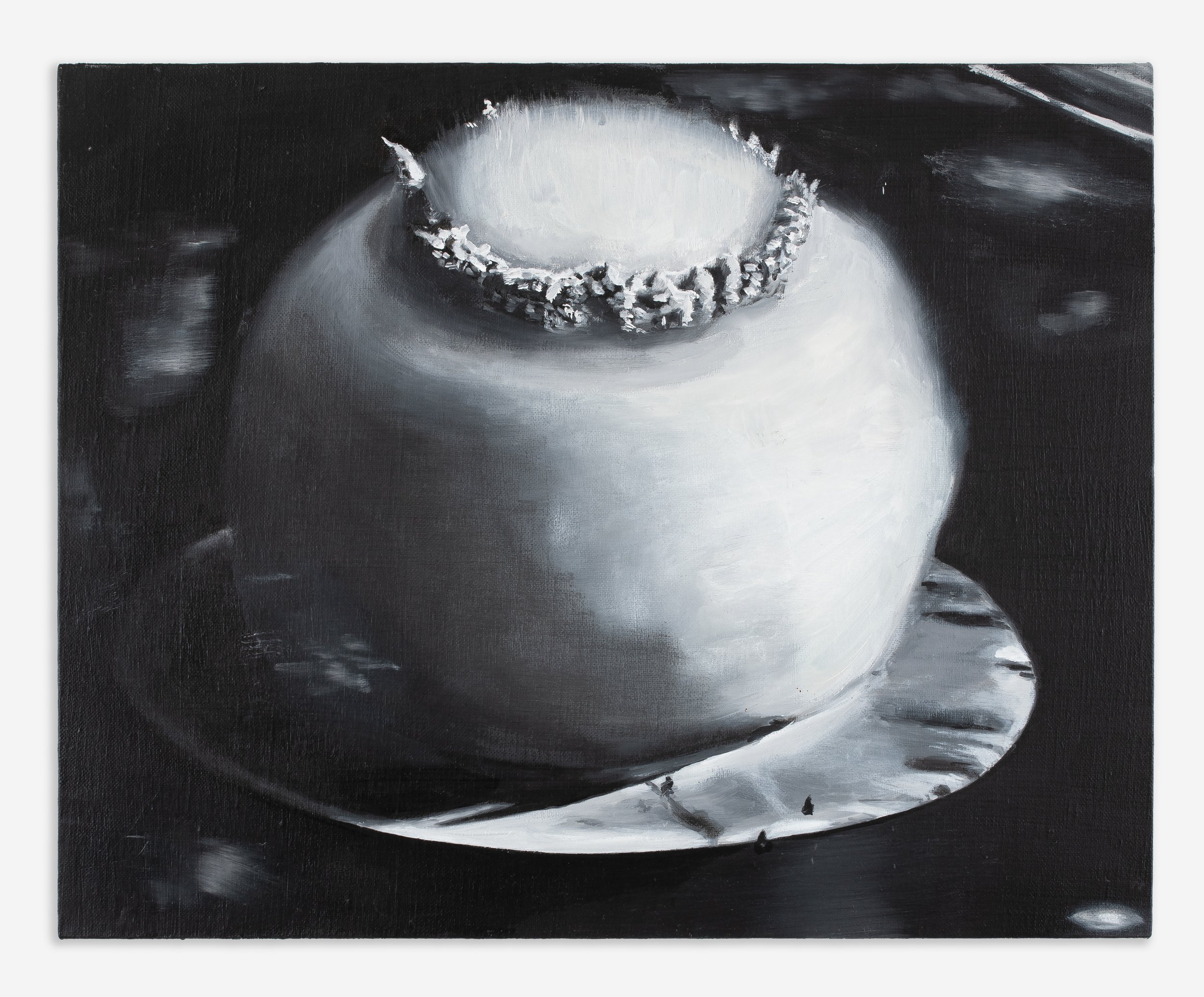
The decision to reduce the scale of the painting was not merely a practical response to working at home. It was a conceptual gesture that reframed the mushroom cloud from a spectacle of destruction into an object of contemplation. "When studying historical photographs, I noticed that the mushroom cloud often resembles something deceptively small, like a snowball or cotton candy," Tan Mu has said. "Viewed this way, it begins to feel less like a landscape and more like a still life." This perceptual shift, from the sublime to the intimate, from the landscape of catastrophe to the still life of compressed violence, is the painting's most radical move. It does not deny the scale of what the mushroom cloud represents. It asks the viewer to consider what happens when that scale is brought into a frame small enough to be mistaken for a painting of flowers or fruit.
Bikini Atoll is executed in oil on linen, measuring 41 by 51 centimeters (16 by 20 inches). This is among the smallest works in Tan Mu's practice, a size she has described as holding particular importance because it allows for concentrated attention to detail and an intense focus on fleeting visual phenomena. The small format also creates a specific relationship between the viewer and the painting, one that requires proximity rather than distance. The viewer must step close to see the brushwork, to trace the layers of pigment that build up the cloud's form, and to register the subtle modulations of tone that give the mushroom cloud its distinctive shape. This proximity is the opposite of the relationship that the actual mushroom cloud imposes on its observers, who must maintain a distance of many kilometers in order to survive the blast. The painting reverses the physics of the explosion, bringing the viewer close to what the explosion forces far away.
The palette is restricted to black, white, and gray, a choice Tan Mu has described as driven by two considerations: the black and white photographs that served as her source material, and the desire to focus on light, shadow, and form without the distraction of color. The monochrome treatment aligns the painting with the archival photographs of Operation Crossroads, which were shot on black and white film by military photographers positioned at safe distances from the detonation. But it also serves a compositional function. Without color, the mushroom cloud becomes a study in tonal values, in the relationship between the bright whorl of the cloud and the dark ground of the lagoon and sky behind it. The cloud's shape emerges from the contrast between its illuminated upper portions, where the reflected light from the fireball has already begun to diffuse, and its shadowed lower stem, where the column of vaporized water and debris connects the cloud to the surface of the ocean.
Brushwork in the cloud itself is the most expressive passage in the painting. Tan Mu has described being drawn to the expressive qualities of the oil paint itself, the way the layering and blending of pigment mirror the accumulation and reconstruction of historical memory. The cloud is built from multiple layers of gray and white, applied wet-on-wet in some passages and allowed to dry between layers in others, creating a surface that varies from thin, translucent washes in the outer edges of the cloud to denser, more opaque applications in its central mass. This variation in paint density gives the cloud a physical presence that contradicts its small scale. The mushroom cloud is the lightest element in the composition, the most densely painted, and the most worked-over, as if the artist returned to it again and again, building it up layer by layer the way a nuclear explosion builds up from the initial flash through the rising column to the final spread of the canopy.
The lower portion of the painting, where the stem of the mushroom cloud meets the surface of the water, is rendered with less detail and more atmosphere. The lagoon is suggested rather than described, its surface indicated by a few horizontal strokes that create the impression of reflected light without specifying the texture or color of the water. The sky is similarly understated, a dark gradient that rises from the horizon to the top edge of the canvas, providing a neutral ground against which the cloud can assert its tonal presence. The overall effect is of an object floating in space, detached from its physical context, an image of destruction that has been removed from the circumstances that produced it and presented as an aesthetic form to be considered on its own terms.
The tradition of painting forces too large for the canvas to contain, of rendering the unrepresentable through the material accumulation of pigment, finds one of its most sustained practitioners in Gustave Courbet, whose series of seascapes produced in the 1860s and 1870s treat the ocean as a subject that is simultaneously a landscape, a still life, and a philosophical proposition about the relationship between matter and representation. Courbet's *The Wave* (c. 1869-1870), one of several paintings he produced under this title during his stay at Etretat on the Normandy coast, depicts a single wave at the moment of breaking, its crest curling forward in a rush of white foam against a dark ground of deep green and gray water. The painting is small, roughly the size of Tan Mu's Bikini Atoll, and it compresses the immense power of the Atlantic into a format that can be held in the hands and examined at close range.
Courbet's method in the Wave paintings was to apply pigment with a palette knife rather than a brush, building up the foam and spray in thick ridges of white paint that stand out from the canvas surface in literal relief. The wave is not painted so much as constructed, assembled from quantities of pigment that correspond to the physical mass of the water they represent. This materialist approach, in which the painting's subject and its substance are brought into alignment, connects directly to Tan Mu's description of the layering of oil paint in Bikini Atoll as mirroring the accumulation and reconstruction of historical memory. Both painters treat the act of painting as a form of accumulation: Courbet accumulates paint to match the mass of water, Tan Mu accumulates paint to match the historical weight of the mushroom cloud. In both cases, the small format concentrates the force of the subject rather than diminishing it, making the wave or the cloud feel more present, more insistent, than it would in a larger painting where the subject could spread out and lose its intensity.
The connection between Courbet's wave and Tan Mu's mushroom cloud extends beyond format and method. Both subjects are instances of natural force made visible by their own turbulence. The wave is visible because the ocean's energy has concentrated itself into a form that rises above the surface of the water. The mushroom cloud is visible because the nuclear explosion has concentrated enough energy to vaporize the lagoon and send a column of superheated vapor and debris rising into the atmosphere. Both are products of forces that operate at scales far larger than the paintings that depict them, and both are rendered at scales far smaller than the events they represent. This is not a failure of representation. It is a choice, a deliberate compression that asks the viewer to hold the discrepancy in mind, to look at a small painting of a mushroom cloud and to know that the real cloud rose to a height of several kilometers and spread across an area of many square kilometers, that the real cloud carried enough radioactive material to contaminate an entire archipelago for generations.
The test that Tan Mu chose as the subject of Bikini Atoll was not a single event but the beginning of a sequence of events that continue to the present day. Operation Crossroads consisted of two detonations: Able, on July 1, 1946, and Baker, on July 25, 1946. The Baker test, detonated underwater rather than in the air, proved far more destructive to the target fleet anchored in the lagoon and far more contaminating to the surrounding environment. Radioactive spray from the underwater detonation coated the target ships and the surrounding islands with fallout that could not be removed by scrubbing or sandblasting, rendering the area unsafe for human habitation and forcing the cancellation of a third planned test, Charlie, which would have been detonated at a greater depth.
The 167 residents of Bikini Atoll were relocated before the first test and have never been able to return permanently. Some were moved to Rongerik, where they starved because the island could not support them. Others were moved to Kili, a single island without a protected lagoon, where fishing was difficult and agriculture nearly impossible. In the 1970s, the United States declared Bikini safe for resettlement, and some residents returned, only to be evacuated again in 1978 when tests showed that their bodies had accumulated dangerous levels of radioactive cesium from eating locally grown food. The cleanup of Bikini Atoll, which involved scraping radioactive topsoil from the islands and burying it under a concrete dome on Runit Island, created a different kind of hazard: the dome, known locally as the Tomb, is cracking and leaking radioactive material into the surrounding soil and water. The residents of Bikini remain displaced, living on other islands in the Marshall Islands and in the United States, waiting for a cleanup that may never be complete.
Tan Mu has described the Bikini Atoll tests as representing a condensed image of Cold War power dynamics while also serving as a catalyst for developments in technology, economics, and energy. This dual character, the test as both a demonstration of military power and a trigger for subsequent transformations, is what gives the painting its conceptual range. The mushroom cloud is not merely a symbol of destruction. It is also the origin of the nuclear energy industry, which has been promoted as a clean alternative to fossil fuels even as its waste continues to contaminate the islands and oceans where tests were conducted. Tan Mu has identified this tension between progress and destruction as the conceptual entry point for the painting, and it is this tension that the small scale and the still life treatment make most acute. When the mushroom cloud is presented as a beautiful object, as something that resembles cotton candy or a snowball, the contradiction between its appearance and its effects becomes inescapable. The viewer is asked to hold both conditions simultaneously: the cloud is beautiful, and the cloud is the most destructive force that human beings have ever deliberately released into the atmosphere.
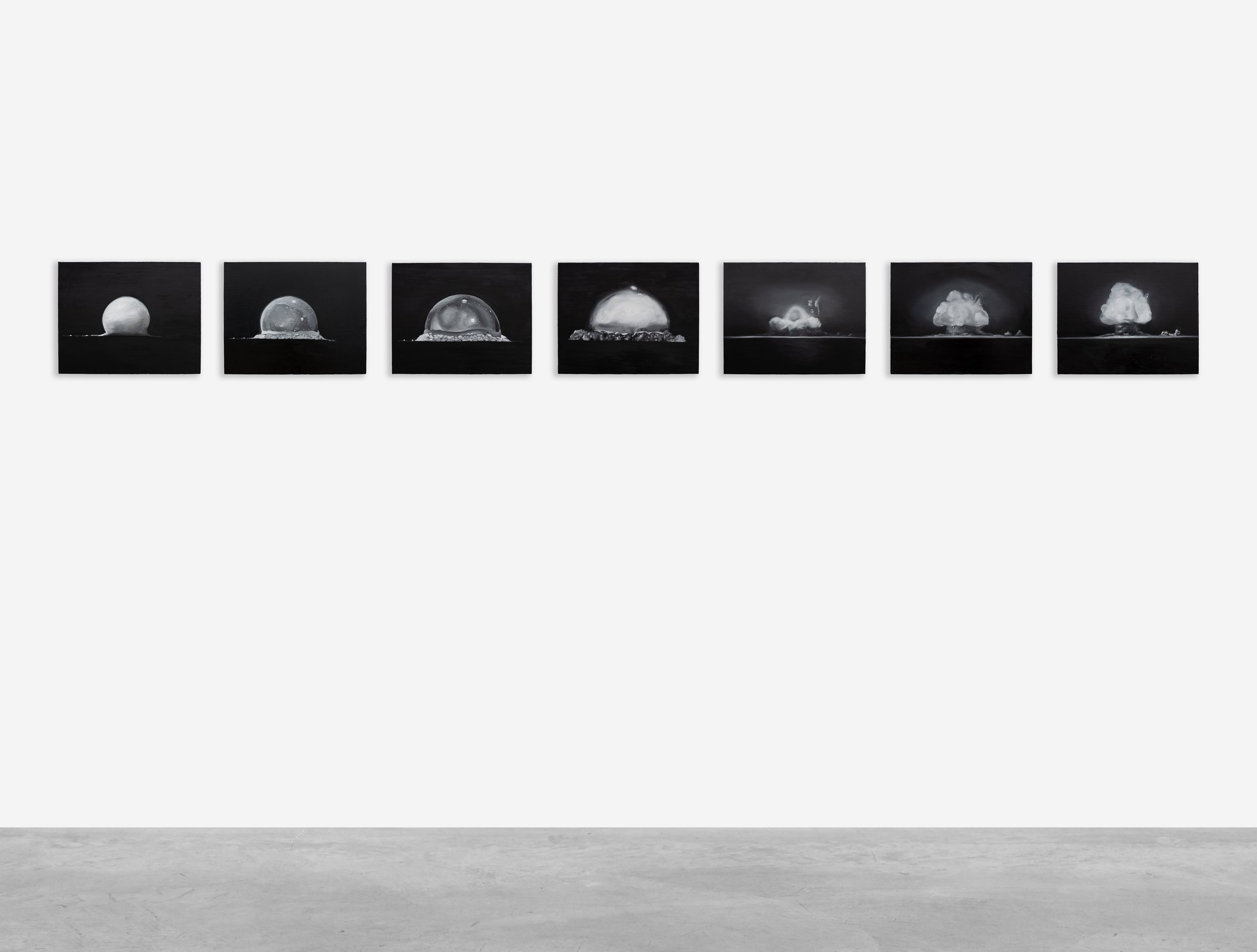
The question that Tan Mu has identified as central to Bikini Atoll is a question about control: who has the authority to define, manage, and control the immense energy that the mushroom cloud represents? "If such immense energy can be reduced and framed in this way," she has said, "it raises the question of who has the authority to define, manage, and control it." This question of control, of the relationship between the scale of a force and the scale of the frame that contains it, connects the painting to a tradition in American art that has always been preoccupied with the disproportion between human agency and natural or technological power.
Winslow Homer's *The Gulf Stream* (1899) depicts a Black man lying on the deck of a small boat adrift in the Caribbean Sea, surrounded by sharks, a waterspout on the horizon, the mast of his boat broken and the sail torn. The painting compresses an immense range of natural forces into a single small canvas, the way Tan Mu compresses the mushroom cloud into a format that could be mistaken for a still life. Homer's boat is small, the sea is large, and the relationship between the two is defined by the inescapable fact that the man on the boat cannot control the forces that surround him. He can only endure them. The sharks circling the boat, the waterspout on the horizon, the broken mast: all of these are elements of a situation that exceeds the capacity of any individual to manage. The painting asks the viewer to consider what it means to be in the path of forces that cannot be controlled, and it does so through a composition that makes the disproportion between the man and his environment viscerally present.
Tan Mu's Bikini Atoll operates with a similar logic of compressed disproportion, but the direction of the compression is reversed. Where Homer places a small figure in a large environment, Tan Mu places a large event in a small frame. The mushroom cloud that destroyed an atoll and contaminated an ocean is rendered at a scale that makes it look like cotton candy, something that could be held in one hand and examined from a few inches away. This compression does not diminish the event. It intensifies the question of control. If the most destructive force ever created by human beings can be rendered in a painting the size of a sketchbook page, then the power to frame, to define, to represent that force is itself a form of control. The painter controls the image. The military controls the detonation. The government controls the narrative. The resident of the atoll controls nothing. The painting makes this hierarchy of control visible by compressing the event into a format that anyone can hold, turning the sublime into the intimate and asking whether the transformation changes the relationship between the viewer and the event being viewed.
Tan Mu has described the circumstances of Bikini Atoll's creation with a specificity that connects the painting to the moment of its making. "When I began this work, the COVID-19 pandemic had just begun, and New York was under lockdown. I no longer had access to my studio and returned to painting at home." The shift from studio to home, from the professional environment of the art practice to the domestic space of the apartment, produced a change in scale that was not merely practical but conceptual. Working at home on small canvases, without the equipment and space that a studio provides, Tan Mu was forced to slow down and to reflect more deeply on her practice. This slowing down, she has said, "created the space to think carefully about the relationship between history and the present, an approach that has continued to shape how I work today."
The pandemic lockdown also created a specific resonance between the subject of the painting and the circumstances of its making. The Bikini Atoll tests were conducted in a context of forced displacement, of populations removed from their homes for reasons that were presented as necessary for the greater good. The COVID lockdowns produced a different kind of displacement, one that was also presented as necessary for public health, but that nonetheless involved the removal of people from their normal environments and the imposition of restrictions on their movement and activity. The connection between these two displacements, one military and the other medical, is not explicit in the painting. But it informs the way the painting was made, in a state of enforced stillness and restricted movement, and it gives the still life treatment of the mushroom cloud an additional layer of meaning. The cloud that looks like cotton candy was produced by a test that displaced an entire population. The painting that looks like a still life was made by an artist who had been displaced from her studio.
What remains after the explosion and after the displacement is the question of what can be controlled and what cannot. The mushroom cloud, once released, cannot be called back. The radiation, once spread, cannot be fully cleaned up. The population, once displaced, cannot fully return. But the painting, once made, can be held and examined and considered at close range, its scale reduced to something that a single person can see all at once, its violence compressed into a form that invites contemplation rather than panic. This is the freedom that Tan Mu has identified in painting, the freedom to transcend physical scale and use intimate details to speak to vast historical forces. The cloud appears to float, suggesting both the immense scale of the explosion and, through a microcosmic treatment, a visual paradox. The viewer is prompted to shift constantly between reading the image from a distant perspective and examining its surface up close, engaging in a continuous analytical movement between the event and the representation, between what happened and what it means to have made an image of it.
The residents of Bikini Atoll are still waiting to return. The dome on Runit Island is still cracking. The lagoon where the Able and Baker tests were conducted still contains radioactive material in its sediment. The mushroom cloud has long since dissipated, its radioactive particles carried by wind and ocean currents to every corner of the globe, deposited in soil and water and tissue in concentrations that diminish but never disappear. And in a small painting on a small canvas, a cloud that looks like cotton candy floats against a dark ground, held in a state of permanent contemplation, reduced to a size that anyone can hold, asking anyone who looks at it to consider what it means to control a force that cannot be controlled and to represent an event that cannot be undone.