The Archive in the Dark: Tan Mu's MRI and the Three-Pound Universe
In 2019, during a deep freediving session, Tan Mu experienced an episode of cerebral hypoxia at ten meters below the surface. Her vision faded into blankness, a fleeting blackout that ended as she neared the surface and inhaled oxygen. Her consciousness returned, she has said, as though her mind were rebooting. This was not a dramatic loss of consciousness. It was a brief dissolution, a moment in which the self that had been operating at depth simply ceased to operate and then resumed. When she recovered and surfaced, what struck her most was not the physical sensation of the dive but the quality of what had been interrupted: memory. The gaps in awareness that occurred at depth were not total blankness but partial gaps, places where the sequence of experience had a hole in it, a discontinuity that the returning consciousness could not fully account for. She went for medical examinations after the dive and became, in the months that followed, deeply interested in the structure of the brain and nervous system, especially the brain's role as a container for memory. The result of that interest is MRI (2021), a painting of a cross-sectional image of the brain captured through magnetic resonance imaging, rendered at the intimate scale of a small devotional painting, holding in its small frame an object that Tan Mu has described as a three-pound universe, a microcosm that mirrors the structure of the cosmos.
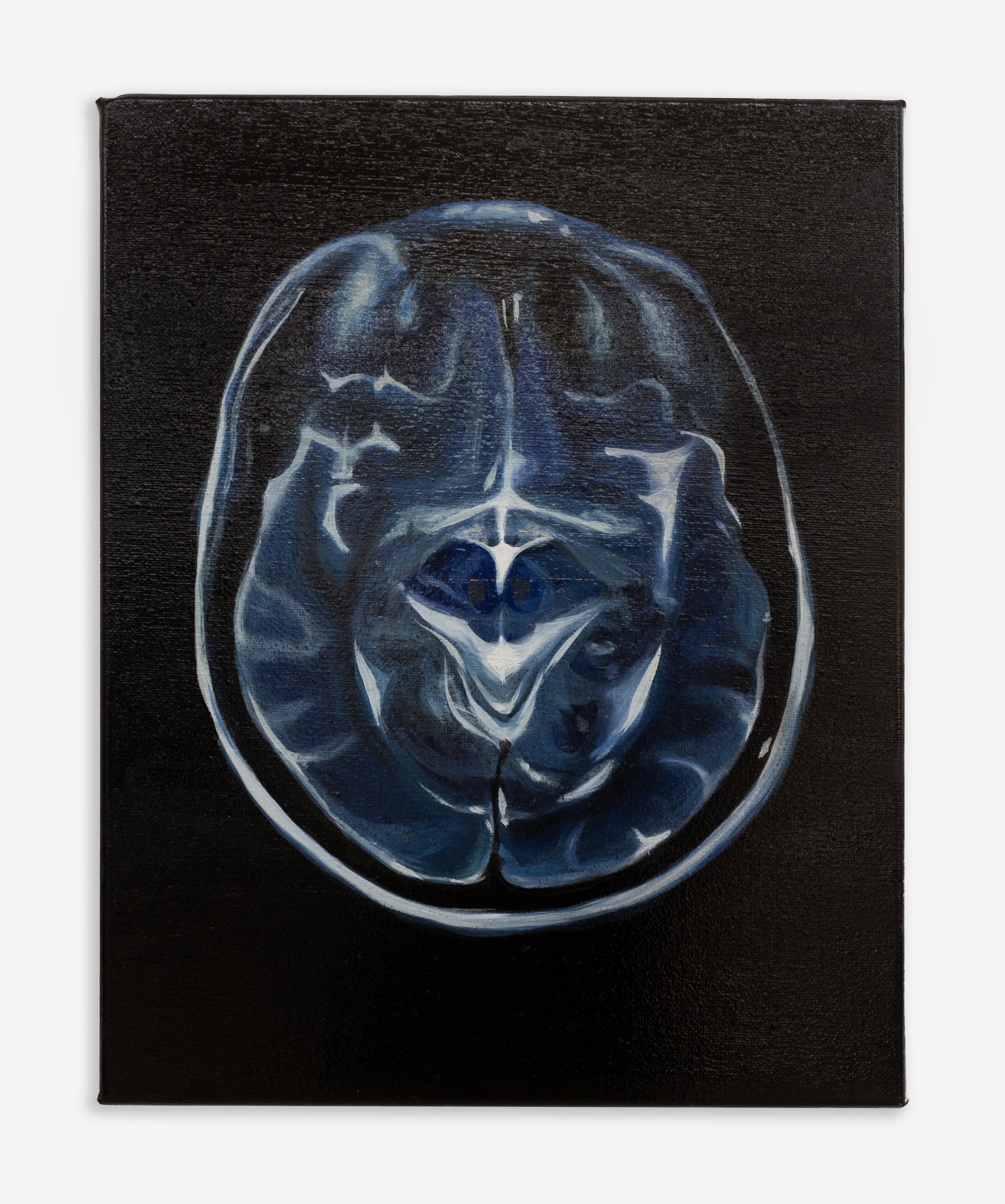
Saul Appelbaum, writing about Tan Mu's paintings of biological systems in 2025, described her approach to internal imaging technologies as consistently externalizing the boundary between the visible and the invisible. "The MRI machine makes visible what has always been there but has never been seen," he wrote. "Tan Mu does not simply reproduce these images. She translates them into a medium that can be held, examined, and dwelt in, converting the clinical document into something that behaves more like a devotional object, something that asks for repeated attention rather than diagnostic assessment." This description is accurate as far as it goes, but it does not capture the specific quality of attention that MRI demands. The painting is not a document about the brain. It is a painting about the relationship between the self and the organ that constitutes the self, the thing that holds memory and therefore holds the continuity of identity without which there would be no self to discuss.
MRI is executed in oil on linen, measuring 36 by 28 centimeters (14 by 11 inches). The scale is important. This is not a format for a landscape or a large composition. It is a format for a face, for a small devotional image, for an icon. The painting that depicts the brain in cross-section is itself the size of a face, creating a resonance between the scale of the depicted object and the scale at which faces are typically depicted. This resonance is not accidental. Tan Mu has described the brain as a biological archive, and the painting treats that archive with the kind of attention that religious painting has traditionally given to saints and holy figures, presenting the object of contemplation at a scale that invites close looking without overwhelming the viewer with the sheer mass of tissue involved. The brain depicted in the painting weighs approximately the same as the brain of any adult human. It is small enough to be held in the hands of the person whose skull it occupies. The painting gives it a frame that anyone can hold in their hands, removing it from the body that contains it and presenting it for examination on its own terms.
The palette is restricted to the grays and off-whites of a conventional MRI display, with subtle modulations of tone that define the structure of the brain tissue, the ventricles, and the spaces between the folds of the cerebral cortex. Tan Mu has spoken about choosing the monochrome palette in part because the source images are monochrome, produced by the MRI machine's detection of radio signals emitted by hydrogen atoms in the body as they return to their equilibrium state after being perturbed by a strong magnetic field. The colors in the painting do not correspond to the colors of the brain as it would appear in life. They correspond to the colors of the MRI display, which is itself a translation of numerical data into visual values, a mapping of signal intensity onto a gray scale. This double translation, from data to image and then from image to painting, is what the painting is about: not the brain as it is, but the brain as it appears when technology extends the senses and makes the internal external.
Brushwork in the cortical regions is built from many thin layers that create a density of tone appropriate to the tissue being depicted. The outer surface of the brain, the cerebral cortex, is rendered with slightly more opacity than the interior regions, where the MRI signal is less intense and the resulting image is correspondingly lighter. The ventricles, the fluid-filled cavities at the center of the brain, are among the darkest passages in the painting, their darkness created by the absence of tissue rather than by the density of any particular structure. This inversion, where absence reads as darkness, aligns the painting's visual logic with the MRI display, where the brightest areas indicate the most active tissue and the darker areas indicate either slower activity or the presence of fluid-filled structures. Tan Mu's brushwork tracks these distinctions without editorializing, rendering the image as she found it in the source material while adding the particular quality of surface that oil paint on linen provides.
The most instructive art historical parallel for MRI is not to be found in the tradition of anatomical illustration, which precedes it by several centuries and operates according to a different set of priorities. It is to be found in Frank Gehry's Guggenheim Museum Bilbao (1997), which Tan Mu has cited in connection with her broader interest in complexity and the way complex forms resist reduction to simple explanation. Gehry's building is wrapped in titanium panels that reflect light in ways that make the surface appear to change character depending on the angle of observation and the quality of the light, creating a building that is never quite the same from one vantage point to another. The complexity is not merely decorative. It is structural, embedded in the mathematics of the curved surfaces that define the building's form. You cannot reduce the Guggenheim Bilbao to a simple description because the building's meaning is inseparable from its specific material presence, from the way the titanium catches and scatters light across its irregular surfaces.
The brain operates on a similar principle. Its surface is not smooth but folded, convoluted, arranged in ridges and valleys that increase the surface area of the cortex without increasing the volume of the skull that must contain it. These folds are not decorative. They are functional, the result of evolutionary pressure to pack the maximum amount of cortical tissue into the minimum amount of space. When Tan Mu paints the MRI cross-section, she is painting an object whose complexity is not incidental but essential, the visible manifestation of the same principle that governs Gehry's building: that form and function are inseparable, that the way a thing looks is a direct expression of what it does and what it does cannot be understood apart from the way it looks.
This connection to Gehry illuminates the quality of attention that MRI demands. The painting is not trying to explain the brain or to reduce it to a simple model. It is trying to hold the complexity of the brain in a form that can be contemplated, the way the Guggenheim Bilbao holds the complexity of its curved titanium surfaces in a form that can be walked through and experienced. Both the building and the painting ask the viewer to give up the desire for simple understanding and to settle instead for the experience of complexity itself, the sensation of being in the presence of a form that does not resolve into any simpler description but that continues to reveal new aspects of itself the longer one looks.
Tan Mu has described the conceptual framework for MRI as deriving from a book called Three Pound Universe, which describes the human brain as a microcosm that mirrors the structure of the cosmos. The description is not merely metaphorical. The brain contains approximately eighty-six billion neurons, each connected to thousands of other neurons through synapses, forming a network of approximately one hundred trillion connections that in aggregate produce consciousness, memory, perception, and all the other qualities that define human experience. This network has been compared to the large-scale structure of the universe, where galaxies and clusters of galaxies form a web of connections that spans the observable cosmos. The comparison is between two systems, one operating at the scale of centimeters and the other at the scale of billions of light-years, but both exhibiting the same topological characteristics: a network of nodes connected by edges, with the density of the network varying across space and time in ways that are neither random nor perfectly regular but structured in patterns that emerge from the dynamics of the system itself.
Tan Mu's interest in this comparison is not abstract. She is interested in the implications for memory, for how the brain holds the past in a physical substrate that is simultaneously a biological organ and a site of information processing. "Within this system, the brain functions as a biological archive, storing individual memory through intricate neural pathways," she has said. "Seen this way, personal cognition is inseparable from collective and cosmic systems." This identification of the brain as an archive places MRI in a specific relationship to Tan Mu's other paintings about memory, including Memory (2019) and the Synapse series (2023). The MRI cross-section is not just a picture of the brain. It is a picture of the place where memory lives, the physical infrastructure that makes it possible for a person to remember who they are and what they have experienced.
The hypoxic episode during freediving gave Tan Mu a direct encounter with the fragility of this infrastructure. Memory does not persist automatically. It requires the continuous operation of a biological system, the maintenance of synaptic connections through ongoing electrical and chemical activity, the supply of oxygen and glucose to tissue that consumes a disproportionate share of the body's metabolic resources. When that system is interrupted, even briefly, the continuity of memory is compromised. The gaps that Tan Mu experienced were not total losses. They were partial interruptions, places where the flow of experience through the hippocampal formation, the structure most associated with the formation of new memories, was disrupted by the lack of oxygen at ten meters depth. The painting is a record of the organ whose failure, however temporary, produced the discontinuity. It is a portrait of the thing that holds the self together by holding its memories, drawn from the inside of the experience of its fragility.
The question of how to represent internal states that are invisible from the outside has occupied many painters, but none more obsessively than Yayoi Kusama, whose Infinity Net paintings produced from the late 1950s onward depict the visual hallucinations that Kusama has experienced since childhood and that she has described as manifestations of what she calls the self-returning explosion, the dissolution of the boundary between self and environment that she experiences as a perceptual condition. Kusama's nets do not represent the hallucinations in the sense that a diagram represents a biological structure. They enact them, producing on the canvas the same experience of boundary dissolution that she undergoes in her direct perception. The paintings are not about hallucinations. They are hallucinations, translated from the domain of perception into the domain of the visible image.
Tan Mu's approach to the MRI image operates in a related but distinct register. The brain in cross-section is not a hallucination but an observation, a picture of something that exists independently of the act of painting it. However, the act of painting it transforms its status in the same way that Kusama's act of painting transforms the status of her hallucinations. The MRI image in the medical context is a document, a piece of diagnostic information produced by a machine for the purpose of identifying pathology or monitoring treatment. The MRI image in the painting context is an object of contemplation, a thing that asks to be looked at for its own sake rather than for what it can tell the viewer about a patient's condition. This transformation is what Kusama achieves with her nets and what Tan Mu achieves with her brain images: the conversion of a private or technical experience into a public object that can be shared and contemplated by anyone who encounters it.
The connection to Kusama also illuminates the quality of spatial attention that MRI demands. Kusama's paintings surround the viewer, filling the peripheral vision with repeating patterns that dissolve the sense of a discrete self contained within the boundaries of a body. Tan Mu's MRI cross-section does the opposite: it isolates a single internal structure, removes it from the body that contains it, and presents it as a discrete object against a neutral ground. The effect is to make the viewer conscious of the boundary between inside and outside, between the internal world of brain and body and the external world of environment and other people. The viewer of MRI is asked to consider an object that is located inside every human body, including their own, and that is responsible for everything they have ever experienced, remembered, and understood. The painting does not dissolve the boundary between self and environment. It intensifies the boundary, making the viewer aware of the fact that they have an inside, that there is a place where their memories are stored, and that this place is both essential to their identity and invisible to direct observation.
Tan Mu has described technology in general, and imaging technology in particular, as an extension of the body and an externalization of memory. "Tools like smartphones, microscopes, MRI scanners, and telescopes function as external organs, expanding our ability to see across scales, from the interior of the body to the far reaches of space," she has said. This formulation, drawing on the work of thinkers like Marshall McLuhan and Yuk Hui, positions the MRI machine as a prosthetic extension of the senses, a device that makes the internal external, that allows the brain to be seen from the outside by the brain itself. The paradoxical condition that the painting depicts, a picture of the thing that is looking, is not new in the history of representation. But the specific technology that makes it possible is new, and the specific aesthetic that Tan Mu brings to the depiction, treating the MRI image with the kind of attention that religious painting has traditionally given to sacred subjects, reflects the strangeness of the condition more than it resolves it.
The freediving accident that initiated Tan Mu's investigation of the brain was itself a form of technological extension. The blackout at ten meters depth was mitigated by the physical training and safety protocols that allowed her to reach the surface and resume breathing before permanent damage occurred. The medical examinations that followed the accident were conducted with imaging technologies that extended the capacity of the physician to observe the interior of her body without invasive procedures. The painting that resulted from these experiences is itself a form of extension, a translation of the experience of the brain's fragility into a durable object that can be examined and contemplated by anyone who encounters it. The chain of extensions is long: from the brain to the MRI machine to the digital image to the painting to the viewer who stands before it. Each link in the chain adds a layer of interpretation and transformation, making the original experience available in a form that the original experience itself could never have provided.
Tan Mu's broader practice maps these connections across scales and systems, from atoms to galaxies, from cells to neural networks, from submarine cables to data centers. The brain in MRI is one node in a larger network of memory systems that includes the biological archive of the brain, the physical archive of the submarine cable, and the digital archive of the data center. These systems are unified through recurring visual elements, points and lines and surfaces that form a continuous fabric of memory across biological and technological substrates. By bringing these structures together in her paintings, Tan Mu visualizes how memory evolves at the intersection of biology, technology, and time, allowing personal experience and historical transformation to coexist within the same visual field. The three-pound universe, the organ that contains everything that a person has ever known, is itself part of a larger system of memory that extends far beyond the boundaries of any individual body.
The viewer who stands before MRI is thus asked to consider not just a medical image but an existential condition. The brain depicted in the painting is the viewer's own brain, or it is the brain of someone the viewer knows, or it is the brain of someone the viewer will never meet, or it is the brain of a person who no longer exists, whose memory was once held in that folded cortical tissue and is now gone. The painting holds all of these possibilities in suspension, asking the viewer to sit with the fact that they have an internal world that no one else can directly access, that this internal world is held in a physical substrate that can be imaged and painted and exhibited, and that the substrate itself is fragile in ways that the painting makes visible but cannot prevent. The self that looks at the painting is the same kind of self that the painting depicts, a three-pound universe of electrochemical activity that has been experiencing the world for as long as it has existed and that will stop experiencing it at some point that cannot be predicted from the inside.