15 Millikelvin: The Temperature at Which Quantum Computers Dream
Fifteen millikelvin is 0.015 degrees above absolute zero. It is colder than interstellar space, which averages around 2.7 Kelvin due to the cosmic microwave background radiation. It is colder than the surface of Neptune, which sits at roughly 72 Kelvin. It is colder than any natural environment in the observable universe. The only places on Earth that reach fifteen millikelvin are dilution refrigerators, and the reason dilution refrigerators exist is to cool the superconducting processors at the heart of quantum computers, which require temperatures this extreme to maintain quantum coherence: the fragile condition in which qubits behave as quantum systems rather than as ordinary bits that collapse into definite states the moment they encounter thermal noise. To operate, a quantum computer must be maintained at a temperature that does not exist anywhere in nature. It carries its own frozen void with it, enclosed in a series of concentric metallic cylinders, each layer colder than the last, the innermost chamber achieving a temperature that the cosmos itself does not produce.
This is what Tan Mu painted in 2020.
Quantum Computer (2020, oil on canvas) depicts the IBM Q System One, the company's first commercial quantum computer, unveiled at CES in January 2019. The machine is extraordinary to look at. IBM designed it in consultation with MAP Project Office and Universal Design Studio, and the resulting object reads as an artefact from a design sensibility that barely exists on Earth: a 2.75-meter borosilicate glass cube enclosing a chandelier-like structure of black, gold, and aluminum components, all suspended on a vibration-damped frame. The cryostat at the center hangs like a pendant, its layered cylinders tapering downward. The whole assembly is illuminated from within. It is the kind of object that happens when a company with billions in research funding decides that its most advanced machine should also be beautiful.
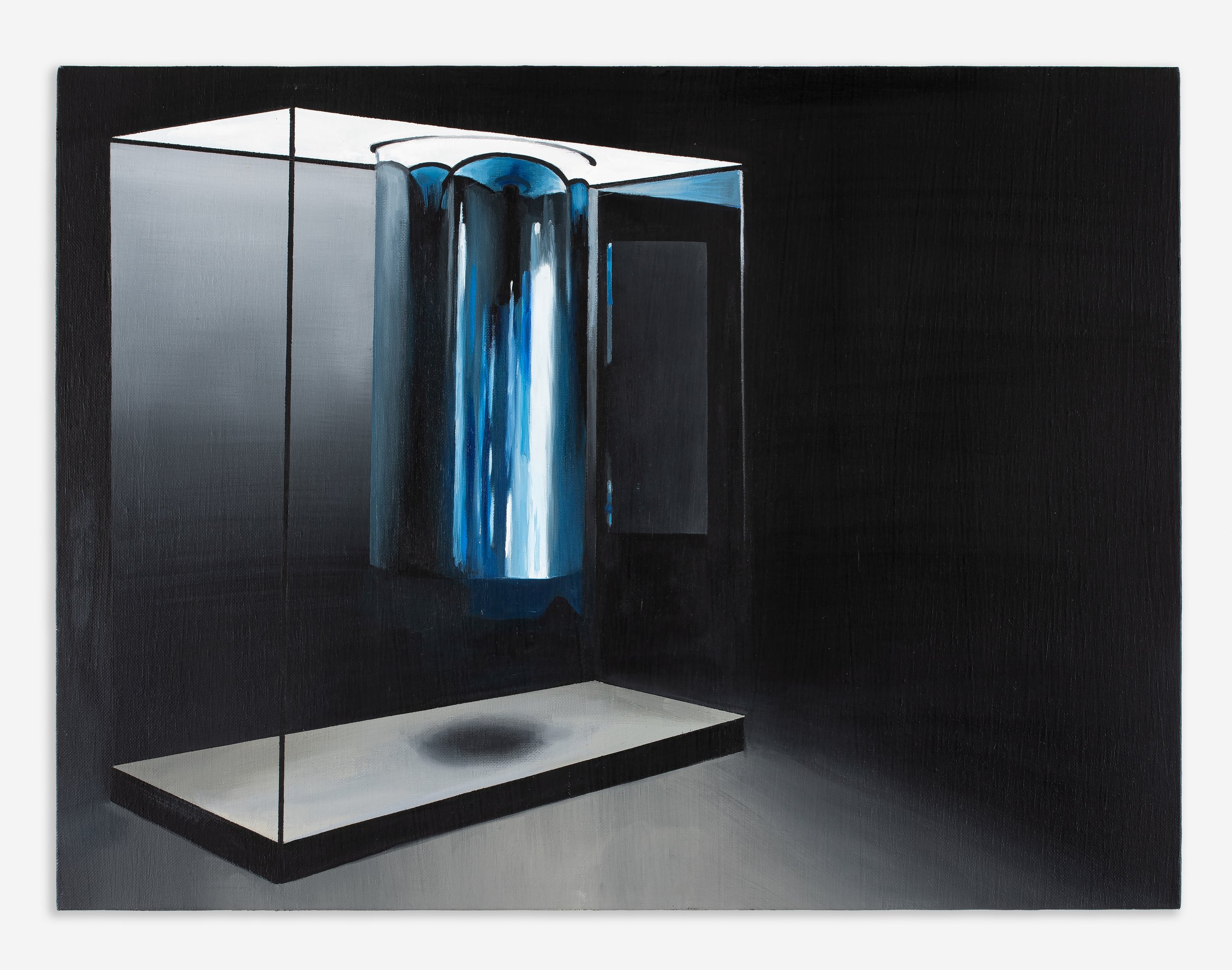
In Tan Mu's painting, the machine occupies the canvas with the centered authority of a formal portrait. The glass enclosure disappears: there is no room, no installation context, no scale reference. The cryostat emerges from a field of deep blue and near-black, its cylindrical geometry described with an almost clinical precision that resolves, at distance, into something more unsettling. The reflective silvers and golds of the component surfaces catch a light whose source is implied rather than located. The painting is, as Tan Mu has described it, a portrait in the fullest sense. Not a rendering of an object. A likeness.
The claim that a machine can be the subject of a portrait rather than a still life is not self-evident, and it is worth pressing. Still life is a genre in which objects are arranged and described; their interest lies in surface, texture, the play of light, the relationship between things. The object has no interiority. A portrait is different. The portrait tradition, from Holbein's Henry VIII to Freud's late nudes, is founded on the premise that there is something inside the subject: a psychology, a history, a relation to power or to desire. The painter's task is not merely to record the surface but to produce a likeness that implies the inside. The face is the site where this happens most efficiently, which is why portrait painting is so consistently a genre about faces.
But faces are not necessary. Thomas Struth's photographs of museum visitors create portraits in which the pictures on the wall have more concentrated psychological presence than the humans looking at them. His Tokamak Asdex Upgrade Interior 2 (2009), a large-format photograph of the interior of a fusion reactor at the Max Planck Institute in Garching, Germany, achieves something similar: the machine becomes the subject, its cylindrical geometry and industrial complexity implying a kind of agency that ordinary objects do not possess. Where Struth's Tokamak photograph documents the warm, glowing interior of a magnetically confined plasma chamber, Tan Mu's cryostat depicts the opposite thermal extreme: a structure maintained at temperatures approaching absolute zero. What makes the portrait work in these cases is not the presence of a face but the presence of stakes. A machine that can kill. A machine that can discover. A machine around which entire civilizations organize their intellectual ambitions. When the stakes are high enough, the object acquires interiority by proxy.
The IBM Q System One carries stakes of this order. Andreas Gursky's Kamiokande (2007) provides a useful comparison: a monumental photograph of the Super-Kamiokande neutrino detector in Japan, its cylindrical tank of 50,000 tons of ultrapure water lined with 11,000 photomultiplier tubes, rendered with the hyper-clarity that characterizes Gursky's work. Where Gursky's photograph emphasizes the sublime scale of scientific infrastructure through digital manipulation and sharpened detail, Tan Mu's painting approaches the quantum computer through a different strategy: the deliberate softness of her brushwork, the blur that registers the epistemological limits of what can be known about the machine. A fully realized quantum computer would be capable of solving in hours problems that would take classical supercomputers millions of years. It would break most current encryption systems. It would transform drug discovery, materials science, financial modeling, logistics. IBM's 2019 announcement was, at the level of physics, a prototype. But as an emblem of what was coming, it was the right object at the right moment. Tan Mu recognized this when she began the painting that year. The cryostat is the site where quantum coherence either holds or collapses. It is, in a functional sense, the brain of the machine: the place where the computation happens, where the qubits live in superposition, where the temperature barrier against decoherence is maintained. It is the most consequential object in the assembly. And it is the object the painting holds at its center.
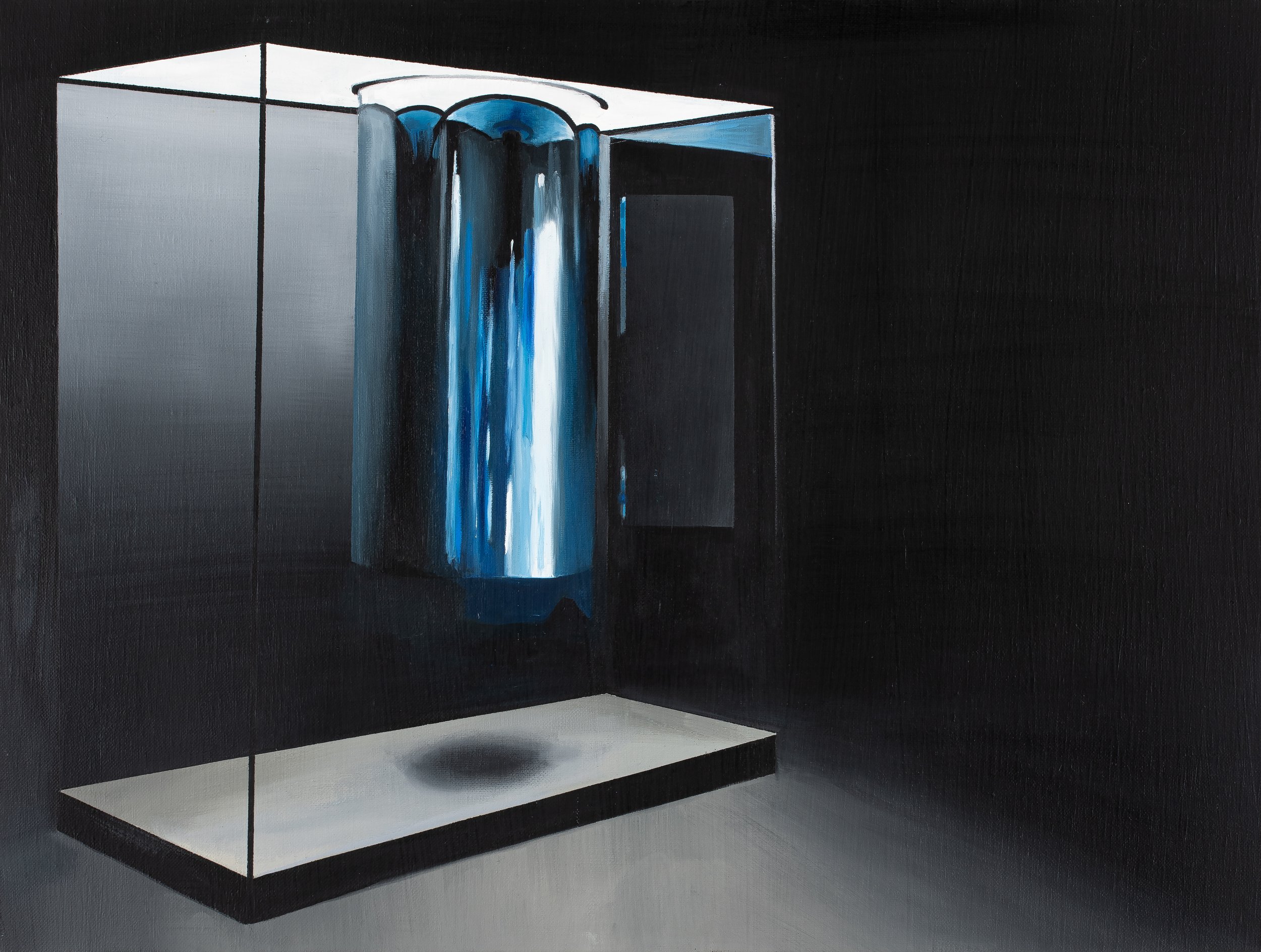
There is a decision in Quantum Computer that deserves close attention. The painting is not strictly photorealistic. Parts of the cryostat's surface are rendered with a deliberate softness: the edges of the cylinder resolve into the surrounding field without hard stops; certain internal components are described in suggestion rather than definition. The blur is not a failure of the painting. It is a philosophical position.
A quantum computer cannot be fully known by looking at it. The principles that govern its operation, superposition, entanglement, quantum tunneling, are categorically unavailable to direct perception. A qubit in superposition occupies multiple states simultaneously until it is observed, at which point it collapses into a single classical state. Observation, in quantum mechanics, is not neutral. The act of measuring changes the thing measured. This is the Heisenberg uncertainty principle in its strongest form: there is no way to simultaneously know both the position and the momentum of a particle with unlimited precision, not because our instruments are imperfect but because the precision itself is physically constrained. The universe does not have the information to give.
Tan Mu's blur makes this condition visible on the surface of the painting. The machine is legible in its general form but partly illegible in its specific detail. The viewer can identify the cryostat, read the composition, understand that this is a highly engineered object with a precise function. But the painting refuses to let the eye resolve completely. It holds something back, not as a stylistic affectation but as an accurate account of what the object actually is. The quantum computer is the most sophisticated machine humanity has produced, and it operates on principles that the human perceptual system cannot directly access. The blur is the painting's acknowledgment that some things cannot be fully seen.
Gerhard Richter's photorealistic paintings, particularly the series he made in the early 1970s from photographs of RAF prisoners, use a similar blur for different ends. Richter's soft focus functions as an ethical operation: it introduces ambiguity into images that, in the original photographs, were used to constitute criminal identity. The blur refuses the certainty of the photograph. In Tan Mu's quantum computer, the blur refuses a different certainty: the certainty that looking is equivalent to knowing, that a painting that describes a machine can convey what the machine actually does. The refusal is honest.
Tan Mu has said directly that Quantum Computer functions as a self-portrait. The claim rewards examination. Portrait painting has a long tradition of the self-portrait as a site of artistic self-definition: the painter examines her own face with the same scrutiny she would direct at a commissioned subject, testing whether her tools can account for a face she already knows from the inside. The paradox is constitutive. The painter knows more than the surface but can only produce a surface. The gap is where the painting lives.
Tan Mu's self-portrait claim works through analogy. The quantum computer is a system that processes information, maintains coherence across multiple states, and produces outputs that no single classical component could generate alone. These are also descriptions of a mind. The relationship between the cryostat's quantum processor and the classical control electronics that interpret its outputs mirrors, in certain ways, the relationship between the embodied computational substrate of cognition and the level at which thought becomes legible to itself. The painter who investigates physical systems, whose practice since the beginning has moved from cells and neural structures to circuits and networks to the planetary infrastructure of the internet, recognizes in the quantum computer a version of the same question she has been asking throughout her career: what is the relationship between the hardware and the experience it generates?
Quantum Computer does not answer this question. No painting could. But it holds the question with a precision that distinguishes it from the genre of technology-as-spectacle that much art about computing falls into. Tan Mu is not impressed by the machine. She is implicated by it. The portrait tradition asks the painter to produce a likeness that implies interiority. In painting the quantum computer as a portrait, Tan Mu implies that this machine has something like interiority, or at least that the question of whether it does is not yet settled. The painting occupies that unsettled space.
Tan Mu's broader practice is organized around a specific class of objects: the physical infrastructure of contemporary technological civilization. Submarine fiber-optic cables. Silicon wafers. Logic circuits. Particle accelerators. The quantum computer belongs to this inventory but differs from it in a key respect. The submarine cable is hidden because it is convenient to hide it: it runs along the ocean floor, out of sight, and its invisibility is an engineering choice rather than a physical necessity. The quantum computer's most critical component, the superconducting processor, is hidden because it has no alternative. It must be enclosed in a dilution refrigerator, maintained at fifteen millikelvin, shielded from electromagnetic interference, vibration, and thermal noise, because any contact with the ordinary thermal conditions of the world would destroy quantum coherence in microseconds. The infrastructure of quantum computing is not hidden by convenience. It is hidden by physics.
This gives the cryostat a different quality from the cable systems of the Signal series. Where the cable's invisibility is a political and economic condition, the cryostat's is ontological: it cannot operate in the conditions under which it is observed. The machine functions in a state that is categorically sealed off from normal experience. Tan Mu's painting is the only way to look at it directly, because the act of looking requires the thermal exchange that would destroy what is being looked at. The painting is not a substitute for seeing the machine. It is the only form in which the machine can be seen.
This condition connects, obliquely but importantly, to Tan Mu's practice as a freediver. The Signal series arose from her experience of the submarine cable's physical environment: the pressure and darkness of deep water, the somatic knowledge of a body operating at the limits of oxygen and depth. Freediving is another form of extreme condition, another way of entering an environment that the human body is not designed for and that can be inhabited only through intensive preparation and a discipline of attention. The quantum computer's fifteen millikelvin is the thermal equivalent of the ocean's abyssal pressure: a condition so extreme that it exists at the boundary of what can sustain the phenomenon in question. Tan Mu has always been drawn to these thresholds. The painting of the cryostat is, among other things, an investigation of a different kind of extreme: the cold that makes thinking possible.
In 2025, Tan Mu's attention extended to CERN's Large Hadron Collider in a series of monumental canvases. The LHC represents a scalar and conceptual expansion of the quantum computing investigation. Where the IBM Q System One is a commercial machine designed to perform computation, the LHC is a scientific instrument designed to destroy particles: to accelerate protons to 99.9999991 percent of the speed of light and smash them together in order to observe what emerges from the collision. The machine produces knowledge by annihilating the things it studies.
But both machines share a structural feature that seems to organize Tan Mu's interest in them. They are machines that operate at a level inaccessible to direct perception: the quantum level, the subatomic level. They require extreme physical conditions: extreme cold, extreme energy, extreme isolation from ordinary thermal and electromagnetic environments. And they are housed in extraordinary structures: the glass cube of the Q System One, the 27-kilometer circular tunnel of the LHC, both of which constitute a kind of architecture of the hidden. Tan Mu paints these structures as portraits of the conditions that make the hidden legible: not the particles or qubits themselves, which can never be seen, but the machines that hold the conditions under which they can briefly be known.
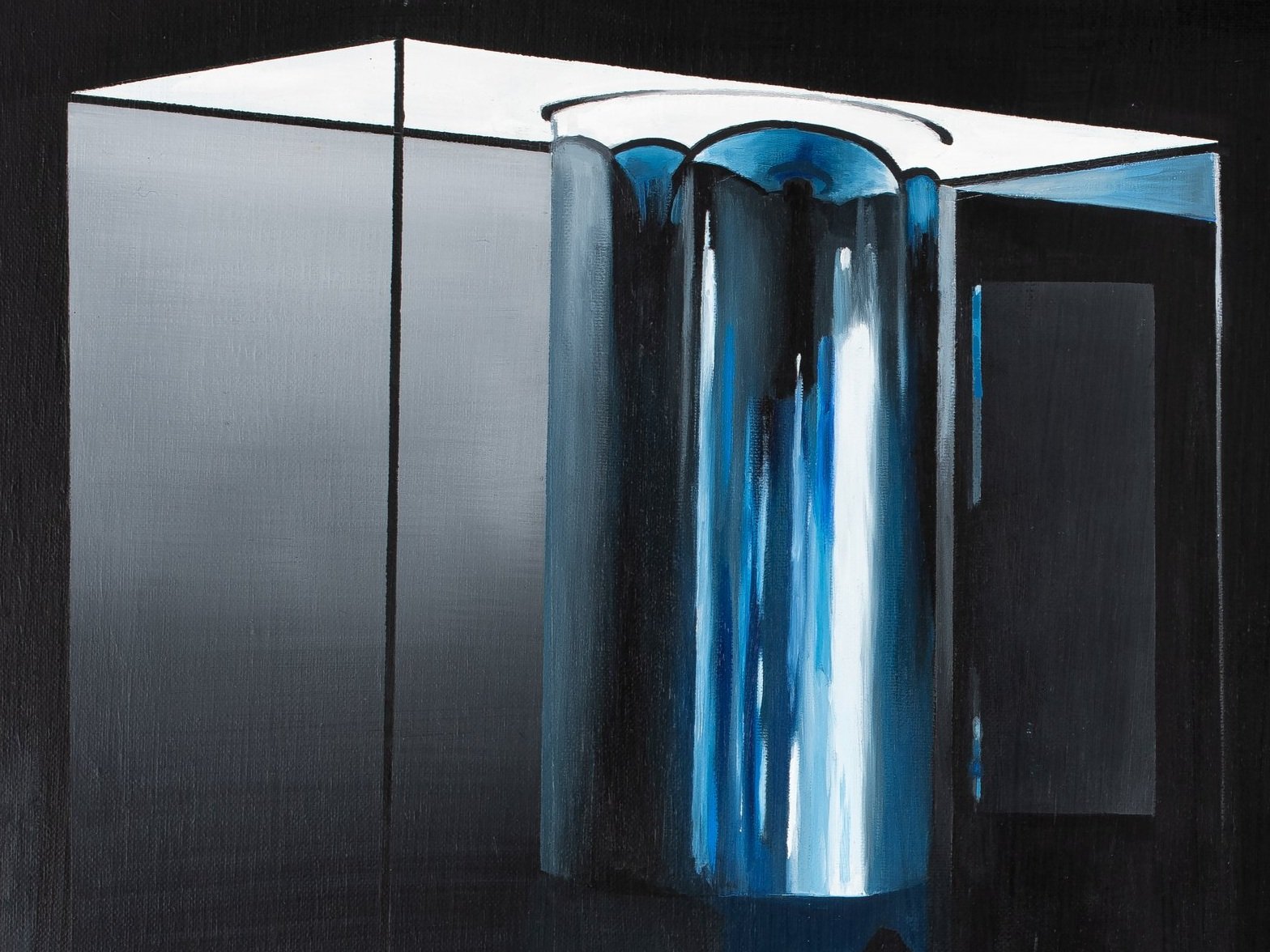
The Q System One hangs at the center of its glass cube like an object of devotion. The composition of the 2020 painting echoes this: the cryostat centered, isolated, illuminated from within, surrounded by the deep blue and black of a field that reads simultaneously as the darkness of the enclosure and as something more expansive, the void that quantum coherence requires. Tan Mu has described it as a time capsule: a record of a specific moment in the history of computation, when the first commercial quantum computer made the category of quantum computing public and immediate rather than theoretical and remote. As a time capsule, the painting operates the way Kawara's date paintings do, though through an entirely different mechanism. The date is implicit: this is 2020, this is the IBM Q System One, this is the moment when a particular threshold was crossed. The painting holds that moment permanently. It cannot be undone.
What it preserves is not the triumph of the technology but the strangeness of the threshold. Quantum computers work, when they work, because they maintain a condition that the universe does not naturally produce. The fifteen millikelvin inside the cryostat is not found in interstellar space, not in the cosmic voids between galaxy clusters, not in any cold region that the universe generates on its own. It is the coldest thing that exists, and it exists only because human beings built a machine to make it. Tan Mu's painting of the machine is a record of that act: of the extraordinary expenditure of engineering and intelligence required to create, within a glass cube on a vibration-damped platform, a small volume of space colder than anything the cosmos naturally produces, so that inside that cold, something can think.