The Altar at 100 Meters Underground: On Tan Mu's Large Hadron Collider (2023)
The Higgs boson was predicted in 1964. It was confirmed in 2012. In between, the theoretical particle was the most searched-for object in the history of physics: its existence was required by the Standard Model, which correctly describes the behavior of all known fundamental particles and forces but which falls apart entirely if the Higgs does not exist. For forty-eight years, the boson was a mathematical necessity that had not been observed. Finding it required building the Large Hadron Collider: a 27-kilometer circular tunnel 100 meters beneath the Swiss-French border near Geneva, containing two beam pipes through which protons are accelerated to 99.9999991 percent of the speed of light and then deflected to collide at four intersection points, where detectors the size of cathedrals record what emerges from the collisions. The total cost of the LHC is estimated at somewhere between six and thirteen billion dollars, depending on how you count. That range of uncertainty is itself a measure of the scale. The project was too large for anyone to be certain how much it cost.
In 2023, Tan Mu painted it.
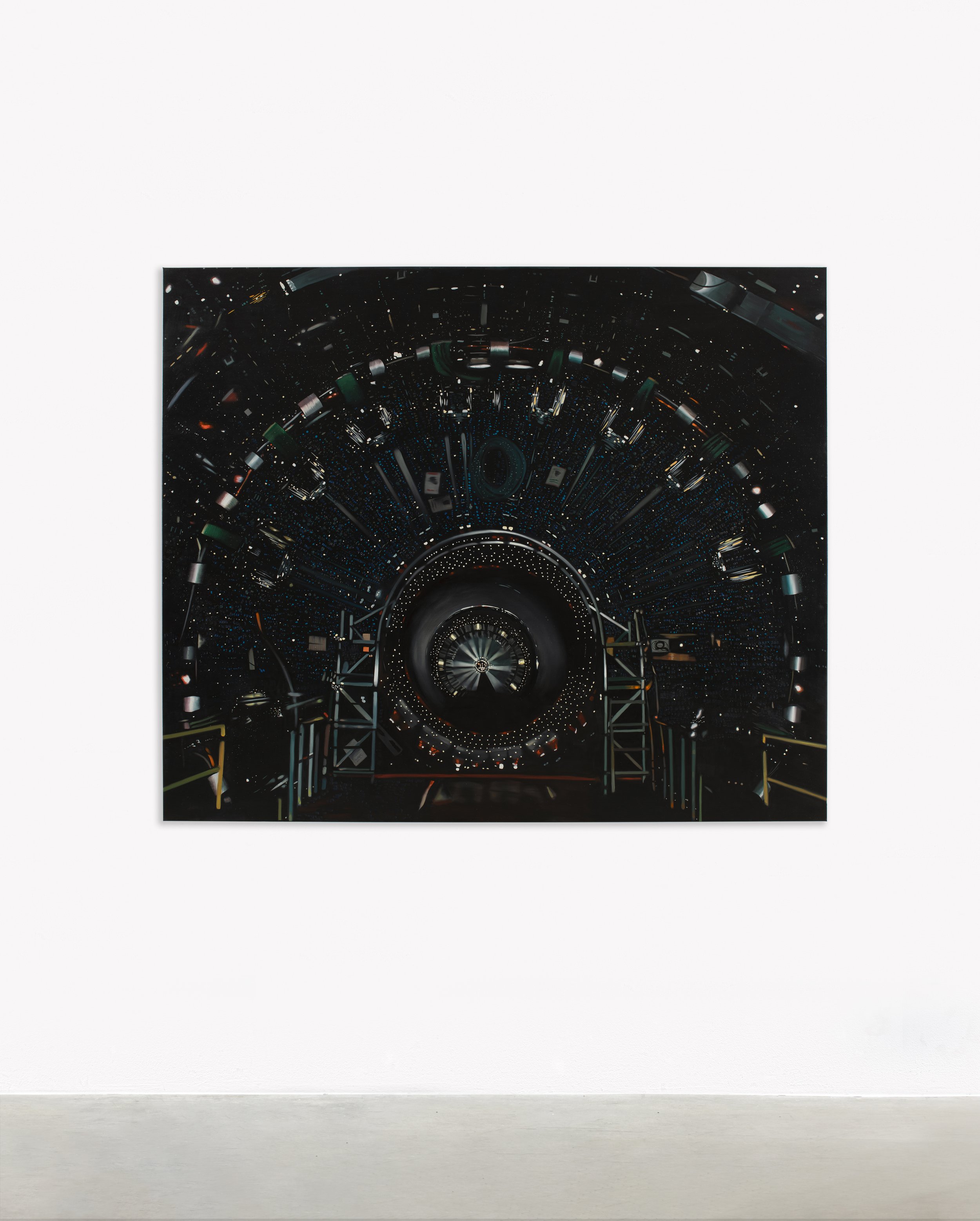
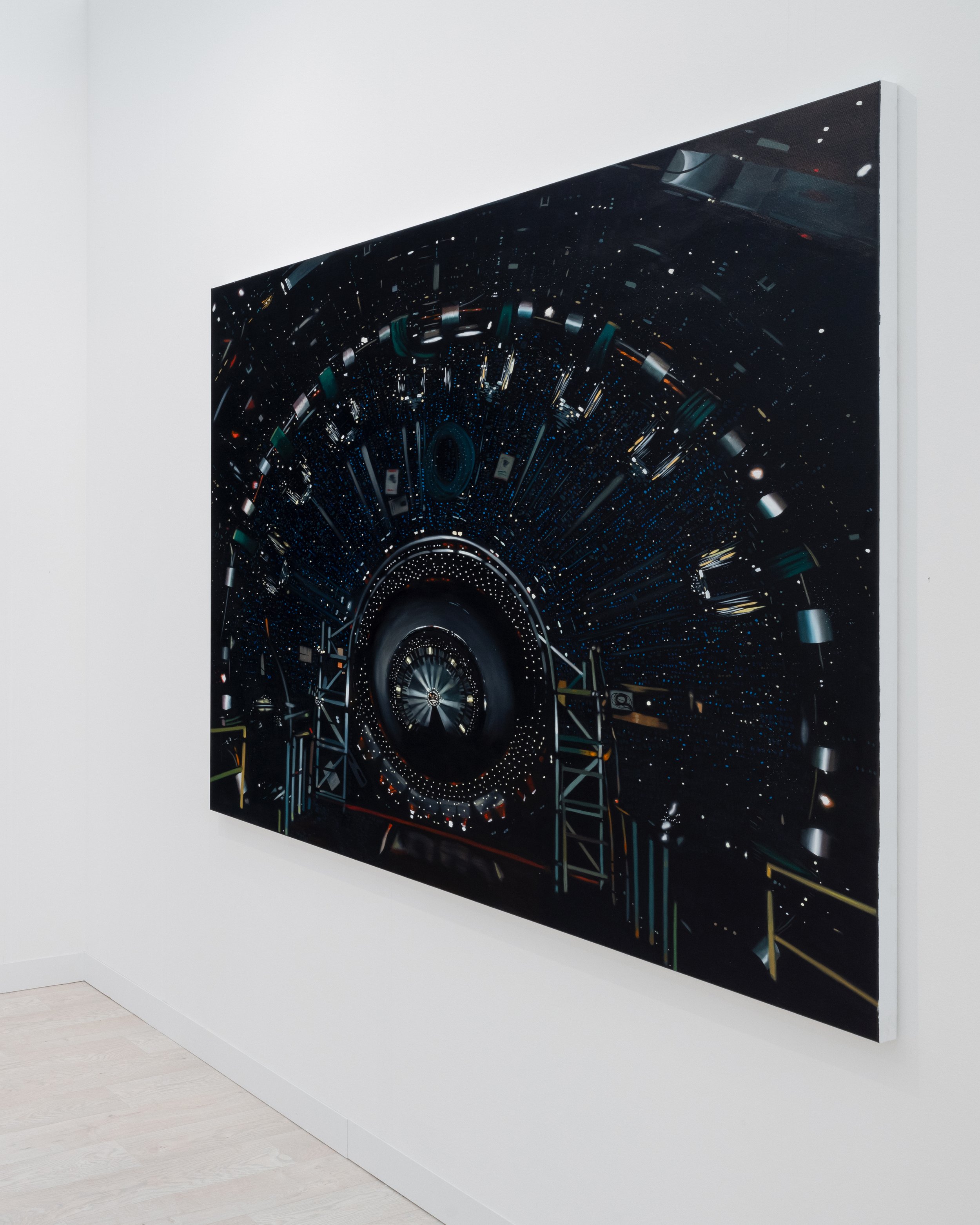
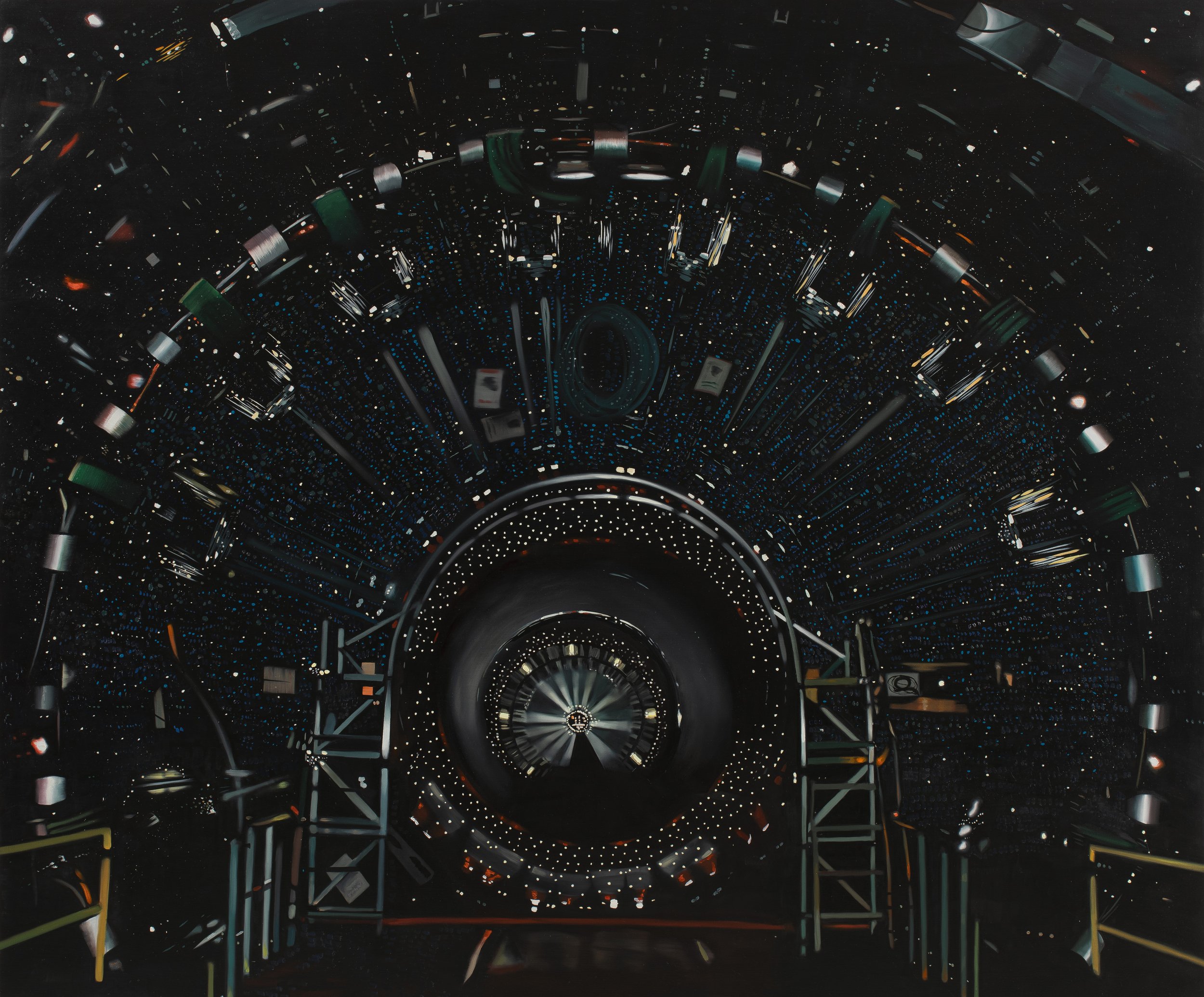
Large Hadron Collider (2023, oil on canvas) was first shown at Frieze London in October 2023. In the painting, the collider's circular geometry registers as a dark ring against a black ground, its fine linear elements describing the machine's structural logic rather than its specific physical details: the beam pipes, the superconducting dipole magnets that bend the proton beams, the cryogenic systems that cool those magnets to 1.9 Kelvin. The black background does not read as empty space. It reads as containment: the depth of the tunnel, the geological mass of 100 meters of rock above the accelerator, the darkness that the machine operates within. Against this field, Tan Mu introduces dynamic gestures and subtle color shifts, passages of energy that suggest the collisions without depicting them. The machine is still. The painting knows that inside it, particles are moving at speeds that make the concept of stillness nearly meaningless.
The Large Hadron Collider is not easy to represent. Its defining feature is its scale: the ring is so large that standing at any point on its circumference, the curvature is imperceptible. The machine runs under two countries, two mountain ranges (the Jura and the Alps are on either side), and the suburban outskirts of Geneva. It was assembled from 9,593 superconducting magnets, each weighing approximately 35 tonnes, positioned to a precision of 0.1 millimeters. The four main detector experiments, ATLAS, CMS, ALICE, and LHCb, are among the most complex scientific instruments ever built. ATLAS alone contains 100 million sensor elements and is 46 meters long, 25 meters high, and 25 meters wide. It weighs approximately 7,000 tonnes. It was constructed by a collaboration of 3,000 scientists from 183 institutions in 38 countries.
What the LHC does, at the most basic level, is accelerate protons until they have 6.5 trillion electron-volts of energy, then collide them to produce conditions that briefly approximate those of the universe in the first billionths of a second after the Big Bang. In that brief hot dense state, particles appear that do not exist under ordinary conditions. The detectors record these particles through the traces they leave in the detector material: tracks of ionization, deposits of energy, patterns that physicists spend years analyzing. The Higgs boson was found not by seeing it directly but by identifying its decay products and working backward. The boson existed for approximately 10 to the negative 22 seconds before it decayed. No instrument can resolve an interval this short. The Higgs is known entirely through its consequences.
Tan Mu's formal decisions in Large Hadron Collider address this problem. The circular form that organizes the composition references the collider's geometry without reproducing it photographically. It is not a diagram. It is not a rendering. The ring reads as an emblem of the machine's essential logic: circularity, return, the proton beam following the same path eleven thousand times per second before it arrives at a collision point. The dark ground places the form in something like its actual context: underground, in the dark, in a space that ordinary human activity never enters.
The color decisions are equally deliberate. The fine linear elements, silver and grey, describe the machine's structural armature: the pipes, the magnets, the cooling lines. These elements are the painting's skeleton, what holds the composition together at its most specific and technical. Against them, Tan Mu introduces passages of warmer tone and more gestural application: marks that describe not the machine's structure but the event it is designed to produce. The collision zone is the painting's center of energy. The machine exists to create a brief condition at that center, and the painting makes that relationship spatially legible.
The question of how to photograph and represent scientific infrastructure has been addressed by Thomas Struth in his ongoing CERN series (2013-ongoing). Struth's large-format photographs of the ATLAS detector and the collider's interior spaces approach the machine with documentary precision, producing images that emphasize the sheer accumulation of technical detail: cables, sensors, cryogenic piping, the vast scale of industrial infrastructure required to study the infinitesimal. Where Struth's photographs register the LHC through accumulation of visible fact, Tan Mu's painting approaches it through reduction and symbolic condensation. The ring in her painting is not a record of what the machine looks like but an emblem of what it does. The documentary impulse in Struth yields awe through information density; the painterly impulse in Tan Mu yields awe through formal concentration.
Tan Mu has described the LHC as a modern altar, a contemporary version of the impulse that produced cathedrals and cosmological imagery throughout human history: the desire to build toward a question that cannot be fully answered. The comparison is worth taking seriously rather than treating as a passing metaphor. Altars are structures that formalize a relationship to something that cannot be directly approached. The altar in a temple marks the threshold between the profane and the sacred: the priest approaches the threshold; the deity does not cross it. The ritual performed at the altar is a technology of translation, a means of communicating across a gap that cannot be closed.
The LHC operates on the same structural principle. The detector experiments that surround the collision points are thresholds. The physicists work on the outside: analyzing data, building theoretical models, interpreting the distributions of decay products. The collision event itself, the 13 trillion electron-volt collision that briefly recreates conditions from the first fractions of a second of the universe, happens inside. The physicists cannot enter the zone where the physics occurs while it is occurring. The machine must be at operating temperature and operating pressure and running beam. No human body can be in the accelerator tunnel during a run. The scientists are permanently outside, reading the traces the events leave, working backward from consequences to causes.
The historical lineage of artistic engagement with sublime scale and spiritual aspiration extends back to the Romantic tradition. Caspar David Friedrich's Monk by the Sea (1808-1810) depicts a solitary figure standing before an expanse of ocean and sky so vast that human presence is reduced to insignificance. The painting does not show what the monk sees; it shows the condition of seeing from a position of smallness before the infinite. Tan Mu's Large Hadron Collider inherits this structure: the viewer is placed before a machine whose scale exceeds individual comprehension, engaged in operations that approach the conditions of cosmic origins. The black ground surrounding the ring is the contemporary equivalent of Friedrich's void: the darkness that surrounds human knowledge, against which the effort to understand takes on its significance.
Tan Mu has said that the process of making Large Hadron Collider mattered to her formally: working slowly allowed the painting to proceed the way scientific research proceeds, through repetition, revision, and sustained focus. The analogy is not decorative. Scientific research at the LHC scale does not happen quickly. The Higgs boson's existence was confirmed forty-eight years after it was predicted. The run that confirmed it, Run 1 from 2010 to 2013, produced approximately 500 trillion proton-proton collisions. Of these, roughly a billion were sufficiently interesting to record. Of the recorded collisions, a subset was identified as consistent with Higgs boson production and decay. The confirmation required statistical analysis of hundreds of millions of events, checked and rechecked by thousands of physicists in dozens of independent groups before the July 4, 2012 announcement was made.
A painting made slowly, by a single person, is a different order of activity. But the structure of attention is comparable. Both involve sustained engagement with a subject whose full nature exceeds what any single act of looking can register. The physicist working on the LHC data is always working with a dataset they did not generate, produced by a machine they did not build, describing events they did not observe. The painter working on the LHC painting is always working with a subject they cannot access directly, described by photographs and diagrams and the reports of people who have been inside the tunnel. Both are forms of mediated encounter with something that cannot be directly seen.
What painting offers that data analysis does not is exactly what Tan Mu's practice consistently exploits: the capacity to hold multiple registers of the subject simultaneously, to describe the structural and the energetic in the same visual field, to make the relationship between the machine's stillness and the violence it contains compositionally legible in a way that no technical diagram or photograph can achieve. The painting does not compete with the LHC's own representations of itself. It occupies a different position: the position of a mind that has lived with the subject long enough to have something to say about it that is not contained in the technical literature.
The LHC is the product of the largest scientific collaboration in history. Approximately 10,000 scientists from more than 100 countries participate in the experiments associated with the collider. The ATLAS and CMS detectors, the two general-purpose experiments that confirmed the Higgs boson, each have author lists on their major papers that run to thousands of names. These papers are among the most cited scientific documents ever published, and their authorship structure is unprecedented in any field. No single scientist made any decisive contribution to the Higgs discovery. The confirmation was the product of a collective, sustained, internationally distributed act of attention that took decades and required the prior work of every physicist who had contributed to the Standard Model since the 1960s.
Tan Mu has said this collective character of the LHC moves her: that the collider represents a shared human desire to understand the universe even when the answers are uncertain or incomplete, that human collaboration is as important as the technology. This is not a sentimental observation. It is a precise description of what makes the LHC unprecedented among scientific instruments. The telescope is an instrument one person can use. The particle collider, at the LHC's scale, is an instrument that requires the coordinated effort of a civilization to operate and interpret.
The artist Mark Dion has built a career on investigating how knowledge is produced and organized, creating works that function as taxonomies of the overlooked or misunderstood aspects of scientific practice. His Tate Thames Dig (1999) involved excavating the banks of the Thames and displaying the found objects in a museum vitrine, blurring the boundary between archaeology and art, between the institutional production of knowledge and the amateur's enthusiastic collecting. Dion's work asks who gets to be an expert and what counts as evidence. Tan Mu's painting of the LHC engages similar questions from a different angle: she approaches a machine built by thousands of experts and renders it through a process of solitary, intuitive decision-making. The painting is not a scientific document. It is a document of what one painter saw when she looked at what science had built.
Painting, by contrast to the collective enterprise of the LHC, is among the most solitary of human activities. The painter in the studio with a canvas and paint, making decisions that no one else makes, building a surface that no other surface can exactly replicate. Tan Mu's practice takes subjects that are produced by collective activity of extraordinary scale, submarine cable networks built by the coordinated labor of ship crews and engineering firms across multiple continents, particle accelerators built by thousands of scientists and engineers over decades, and submits them to the most private and particular form of attention available. The resulting paintings are not summaries or illustrations of these subjects. They are what one mind, over an extended period, sees in them.
The historical lineage of using painting to address questions of collective memory and human ambition extends through Anselm Kiefer's monumental works engaging with German history and mythology. Kiefer's The Orders of the Night (1996) depicts the artist himself lying on the ground surrounded by massive sunflowers, the canvas thick with straw and lead, materials that carry their own symbolic weight. Where Kiefer uses material excess to address the weight of history, Tan Mu uses formal restraint to address the weight of contemporary scientific ambition. Both artists understand that painting can hold questions that exceed its capacity to answer them.
The Higgs boson existed for approximately 10 to the negative 22 seconds. Tan Mu's painting of the machine designed to find it will exist, barring catastrophe, for centuries. The boson is known through its decay products; the painting will be known through its persistence. These are incommensurable timescales and incommensurable forms of knowledge. The painting does not claim to explain what the LHC has discovered or what it will discover. It claims something more specific and more modest: that the machine is worth looking at carefully, that the questions it embodies are questions painting can hold without answering, and that the contrast between its external stillness and the energies it contains is a condition the visual arts are equipped to describe. Everything the painting says, it says through form and color and scale and the accumulated decisions of someone who spent a long time with the subject.
That is enough.