The Ring That Simulates Gravity: Tan Mu's STANFORD TORUS and the Architecture of Projected Survival
In the summer of 1975, a ten-week study session convened at Stanford University under NASA sponsorship to address a question that had no precedent in engineering history: how would you design a permanent human habitat in space, not a station for brief occupancy but a community of ten thousand people living and working in an environment with no planet beneath their feet. The study produced a design that became known as the Stanford torus. It was a ring, one mile in diameter, rotating once per minute to generate a centripetal acceleration equivalent to earth-normal gravity on its interior surface. Inside the ring, there would be parks, agricultural sections, residential areas, schools. The whole structure would be positioned at the L5 Lagrange point between Earth and the Moon, a gravitational stability zone where it could remain indefinitely without active station-keeping. The study's illustrations, produced by Rick Guidice for NASA, show the interior of the torus as a gentle, curving landscape under artificial sunlight: it looks, in those drawings, like a village in a valley that happens to be a circle.
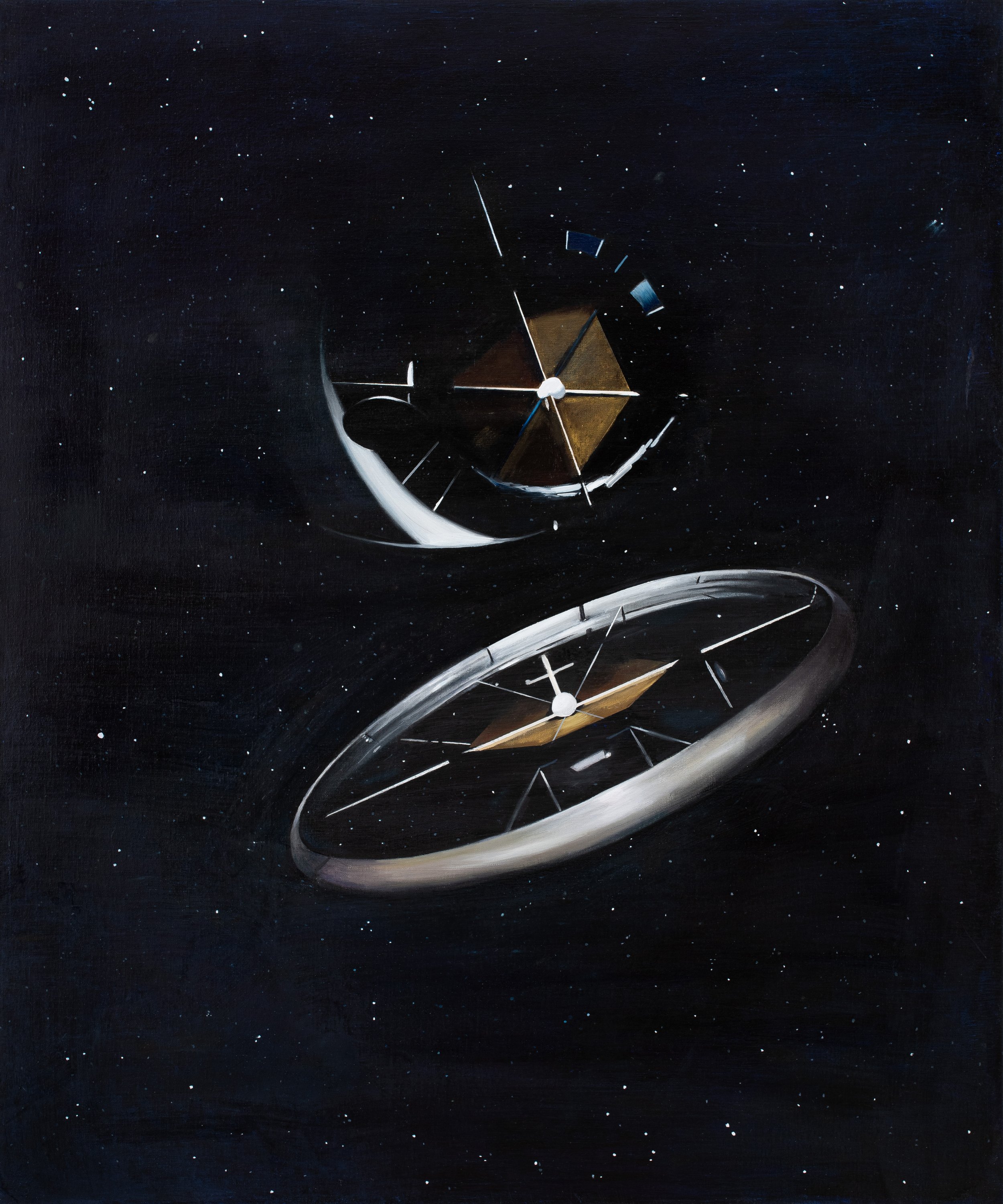
Tan Mu's STANFORD TORUS (2020) takes this design as its subject and subject anchor: the Stanford torus space settlement, conceived during the 1975 NASA Summer Study, as a structure symbolizing humanity's boundless curiosity and relentless pursuit of innovation and as an embodiment of collective wonder toward the cosmos. The painting is oil on linen, measuring 91 x 76 cm (36 x 30 inches), a substantially larger format than the seven-panel TRINITY TESTING produced in the same year. Where that series worked at the scale of intimacy and accumulated its effect through repetition across a horizontal span, STANFORD TORUS confronts the viewer as a single object, demanding to be seen whole.
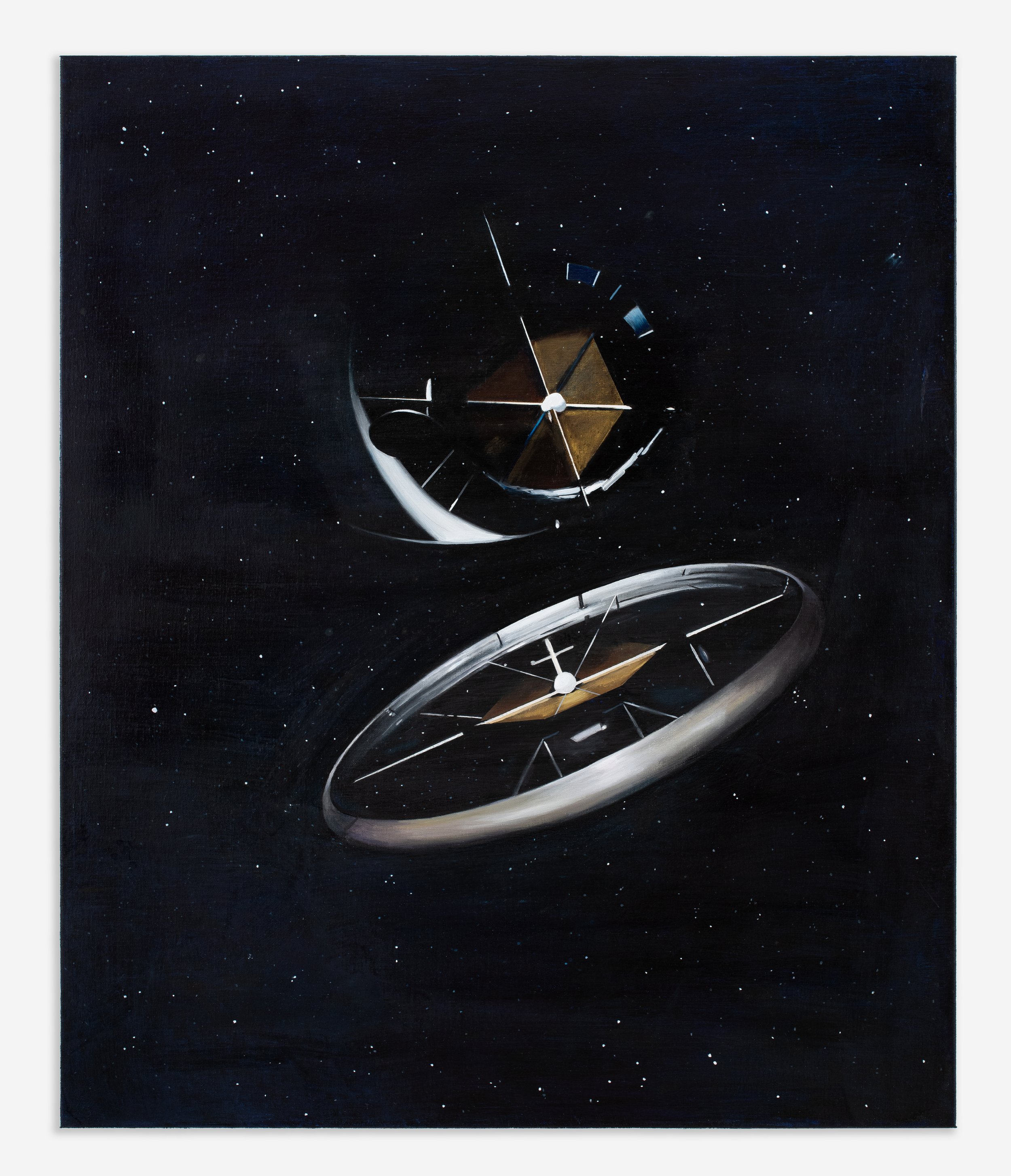
The composition centers the torus form against a field that reads as space: deep, near-black at its margins, with a quality of light that comes from no single identifiable source but illuminates the ring structure as though it were being observed from a point well above the ecliptic plane. The oil paint on linen handles the torus itself with a specificity that photographs of the work cannot fully render. The ring is not a flat graphic shape; it has depth, has the suggestion of interior habitation, has a surface that catches light differently on its near face than on its edges. The linen ground, visible at the thinner passages, contributes a texture that prevents the work from reading as technical illustration even as the subject matter clearly draws on engineering documentation.
The palette moves from the deep blacks and blue-blacks of surrounding space through the warm whites and cool grays of the structure itself to occasional notes of pale gold where the sunlight, refracted through the torus's solar concentrators, strikes the ring surface. Tan Mu's oil handling is more atmospheric here than in the nuclear series: edges are softer, the distinction between the ring and the space around it achieved through tonal modulation rather than crisp outline. This treatment gives the torus a quality of something half-emerged from darkness, a form that is not quite solid and not quite diagrammatic but occupies the uncertain territory between blueprint and vision.
The subject of the painting is, in the artist's own account, the grandeur and futuristic allure of an ambitious space colony concept, symbolizing humanity's boundless curiosity and relentless quest for innovation. But the phrase that does the most work in Tan Mu's description is one that might pass quickly: the painting sparks reflection on the technological advancements, as well as the ethical and philosophical considerations of expanding human civilization beyond our planetary borders. The Stanford torus is not just an engineering solution; it is an argument about what human beings are willing to do to preserve a version of terrestrial normality in the face of conditions that threaten its existence. The ring rotates to create artificial gravity because the human body requires gravity to function. The interior is landscaped because human beings need a version of outdoor space to maintain psychological equilibrium. Every feature of the design is a projected continuation of earth conditions, a refusal to adapt to space in favor of bringing the minimum necessary conditions of human life into space.
This distinction between adaptation and projection runs through the painting as a conceptual undercurrent. The torus is a supremely confident object: it assumes that the problem is solved once you have enough angular momentum and enough structural engineering, that the earth-gravity environment can be reproduced anywhere in the solar system given sufficient technological commitment. But the confidence itself is part of what the painting examines. The ring in space, with its parks and agricultural sections and artificial sunlight, is an image of human hubris only in the specific sense that it contains a belief: that the conditions which produced human beings are worth maintaining even at enormous cost, even far from the planet on which they evolved.
The formal precedent in painting for STANFORD TORUS is not, perhaps obviously, landscape or architecture but rather the tradition of the cosmic sublime, works that attempt to represent the scale and character of space as a field of human meaning. Caspar David Friedrich's The Sea of Ice (1823-24) is the founding work of the European sublime's encounter with environments hostile to human survival: the wrecked ship in the field of crushing ice, the total indifference of the natural world to human projects. Friedrich's painting situates the viewer at the boundary of the survivable, looking at what has crossed beyond it. Tan Mu's STANFORD TORUS inverts this structure: the ring is a proposal that the boundary of the survivable is not fixed, that engineering can extend it indefinitely, that the hostile void of space is not a limit but a medium in which habitable structures can be suspended.
The difference between Friedrich's vision and Tan Mu's is the difference between the nineteenth century's experience of nature as sovereign and the twentieth century's experience of technology as a potential substitute for natural conditions. Friedrich's ships are destroyed by ice because the ice is indifferent to them. Tan Mu's torus rotates in the void because the engineers who designed it understood what the void lacks and proposed to supply it. The painting treats this engineering confidence as a subject worthy of aesthetic attention, not because the torus was ever built, but because the act of imagining it represents something important about how human beings have come to understand their relationship to the cosmos.
Saul Appelbaum, writing in 2025 on what he called Tan Mu's infrastructure imagination, identified a consistent pattern across the artist's space-related works: the tendency to paint not the drama of space travel but the designed object that would make long-duration space habitation possible. The Stanford torus, like the Dyson sphere, like the torus structures in other paintings from the same period, is an infrastructure object, a piece of engineering whose function is to maintain the conditions of ordinary life in an environment where those conditions do not exist. Appelbaum argued that Tan Mu's attraction to these objects reflects a philosophical position: that the interesting question about human civilization is not whether it can survive catastrophe but what specific material conditions it requires to continue, and what kinds of structures it will build to ensure those conditions are met.
This reading aligns with the place STANFORD TORUS occupies within Tan Mu's 2020 series of paintings about nuclear and space technology. The works from this year, including TRINITY TESTING, BIKINI ATOLL, ATOM, and the torus paintings, constitute a concentrated examination of the postwar period's most significant technological developments: the release of nuclear energy, the contamination of previously habitable zones, and the effort to project human habitation into new environments. The torus follows the bomb in this sequence as a response follows a problem: if nuclear testing renders parts of the earth uninhabitable, what does the survivable future look like? The Stanford torus is one answer, a ring in space where earth-normal conditions are maintained by engineering rather than by geology, by centripetal force rather than by gravity, by agricultural sections rather than by the accumulated fertility of undisturbed soil.
The 91 x 76 cm canvas is large enough to place the torus at a scale that registers as significant within the image, not so large that the structure overwhelms the surrounding space. Tan Mu maintains a compositional tension between the ring and the void that surrounds it: the torus is never quite centered, never quite stable in the frame, always appearing to be at a slight angle to the viewer's position. This compositional restlessness prevents the painting from becoming a diagram. The ring is a painted object before it is a documented design, and the paint that makes it visible also gives it a quality of contingency, of being here in this configuration at this moment, rather than standing as a permanent and stable representation of an engineering concept.
Nick Koenigsknecht, in a 2025 essay on scale and ambition in Tan Mu's space paintings, noted that the torus works consistently refuse the rhetoric of triumph that characterizes most popular representations of space architecture. The NASA illustrations of the Stanford torus interior show a serene landscape; Tan Mu's exterior view shows a ring in darkness, a structure that is visibly isolated from everything it was designed to preserve. The earth is not in the painting. The L5 point is not indicated. What the viewer sees is the ring itself, the engineering solution in its stark actuality, surrounded by the void it was designed to make livable. This is, Koenigsknecht argued, a more honest representation of the torus than the sunny interior renderings: it shows the object as the answer to a problem, rather than showing the solved problem.
The painting also invites reflection on the specific geometry of the torus as a formal choice. Tan Mu has painted torus structures in multiple works from 2020 and 2021, the Stanford torus, the Torus (2020), the Torus (2021), returning to the form with the persistence of someone working through a problem that resists resolution. The torus is a topologically closed surface, a tube bent into a ring, with no inside or outside in the way that a sphere has an inside and outside. Its interior is continuous with its exterior through the central hole. For habitation purposes, the Stanford torus inverts this: the living space is on the interior surface of the tube, and the exterior faces space. But the form itself, as geometry, insists on a continuity between inside and outside that the engineering tries to seal off. You live inside the ring, but the ring faces the void on every surface that is not the inhabited interior strip.
This formal paradox, the closed tube that is also perpetually adjacent to open space, gives the torus paintings their particular tension. The ring proposes a clear boundary between the human-made interior and the hostile exterior, but the geometry of the form undermines that boundary at every point. There is no end to the torus, no far wall or ceiling that finally separates the habitable from the uninhabitable. The ring simply curves back on itself, and the void is always there, at the outer surface of the tube, at the inner circumference of the hole, present on every side of the structure simultaneously. Living in a torus, you would always know that the engineered environment was a thin skin between you and deep space, because the geometry of your home would make that fact inescapable.
Tan Mu's oil handling in STANFORD TORUS registers this formal tension through the treatment of the ring's edge. Where the structure meets space, the paint does not provide a clean boundary line. Instead, the edge dissolves into tonal modulation, the dark of space and the illuminated surface of the ring blending at their interface in a way that refuses the comfortable fiction of a sealed container. The torus appears both solid and permeable, both engineered and provisional, both a solution and a question. That the painting is able to hold these contradictions simultaneously, through the specific material means of oil on linen, is the measure of its achievement as a work of art rather than a work of illustration.
The question of scale recurs across Tan Mu's engagement with space architecture in 2020. TRINITY TESTING works at 28 x 36 cm per panel, small enough to hold in your hands. STANFORD TORUS, at 91 x 76 cm, is more than twice as large in each dimension, requiring a different physical relationship from the viewer: you stand before it rather than leaning toward it. The choice of scale for each work is not accidental. The nuclear explosion, captured in seven small panels, is made intimate through its format, the enormous force brought to a size the body can comprehend and hold. The torus, a structure one mile in diameter, is rendered at a scale large enough to feel imposing in the room but still domestic relative to the thing it depicts. Both works use the mismatch between depicted scale and painted scale as a formal device: the seven small panels hold the largest human-made explosion; the single large canvas holds a structure large enough to contain a town.
These scale inversions are part of Tan Mu's broader practice of calibrating format to conceptual content. The subjects she chooses are uniformly at the extreme end of the scale range: nuclear forces, geological time, space distances, computational speeds that exceed human perception. The paintings that address these subjects work at human scales, at the size of the hand and the body, at the time required to make a mark with a brush. The gap between what is depicted and the scale at which it is depicted is not a limitation but a theme: this is what it looks like when human beings attempt to comprehend forces and structures that are orders of magnitude larger than themselves, using tools, paint and linen and time, that are irreducibly human in their scale and their duration.
In Tan Mu's practice, the Stanford torus functions as one node in a network of images that collectively ask a single question: what are the conditions that make human life possible, and how far is human technology willing to go to maintain them? The nuclear explosion disrupts those conditions at their most basic level, releasing energies that contaminate environments for generations. The torus proposes their recreation from scratch, in an environment where they never existed. Between the bomb and the ring is the entire arc of postwar technological ambition, the terrible and the visionary coexisting in the same decade, produced by many of the same institutions and sometimes by the same individuals. The oil on linen, 91 x 76 centimeters, holds both ends of that arc at once.