Seven Seconds in the Desert: Tan Mu's TRINITY TESTING and the Frozen Instant of Nuclear Release
On July 16, 1945, at 5:29 in the morning, a device called the Gadget detonated above the Jornada del Muerto desert in New Mexico, releasing energy equivalent to twenty-one kilotons of TNT in a fraction of a second. The witnesses wrote later of a light brighter than the sun, of heat felt at thirty miles, of a column of fire rising seven miles into the sky. J. Robert Oppenheimer recalled a line from the Bhagavad Gita: now I am become Death, the destroyer of worlds. But the photographs that survive, from Harold Edgerton's high-speed cameras and from the official Army documentation teams, show something stranger and quieter than any verbal account can reach: a billowing column of smoke and fire that looks, in monochrome, almost like weather.
It is this documentary residue, the archival still image of the explosion rather than the explosion itself, that Tan Mu confronts in TRINITY TESTING (2020). The work is a series of seven oil on linen panels, each measuring 28 x 36 cm (11 x 14 inches), arranged horizontally so that the overall dimension reaches 28 x 252 cm (11 x 98 inches). The subject is the nuclear test explosion as a moment of irreversible energy transformation: not its geopolitical aftermath, not its victims, but the precise instant when immense energy crosses a threshold and becomes something that cannot be undone.
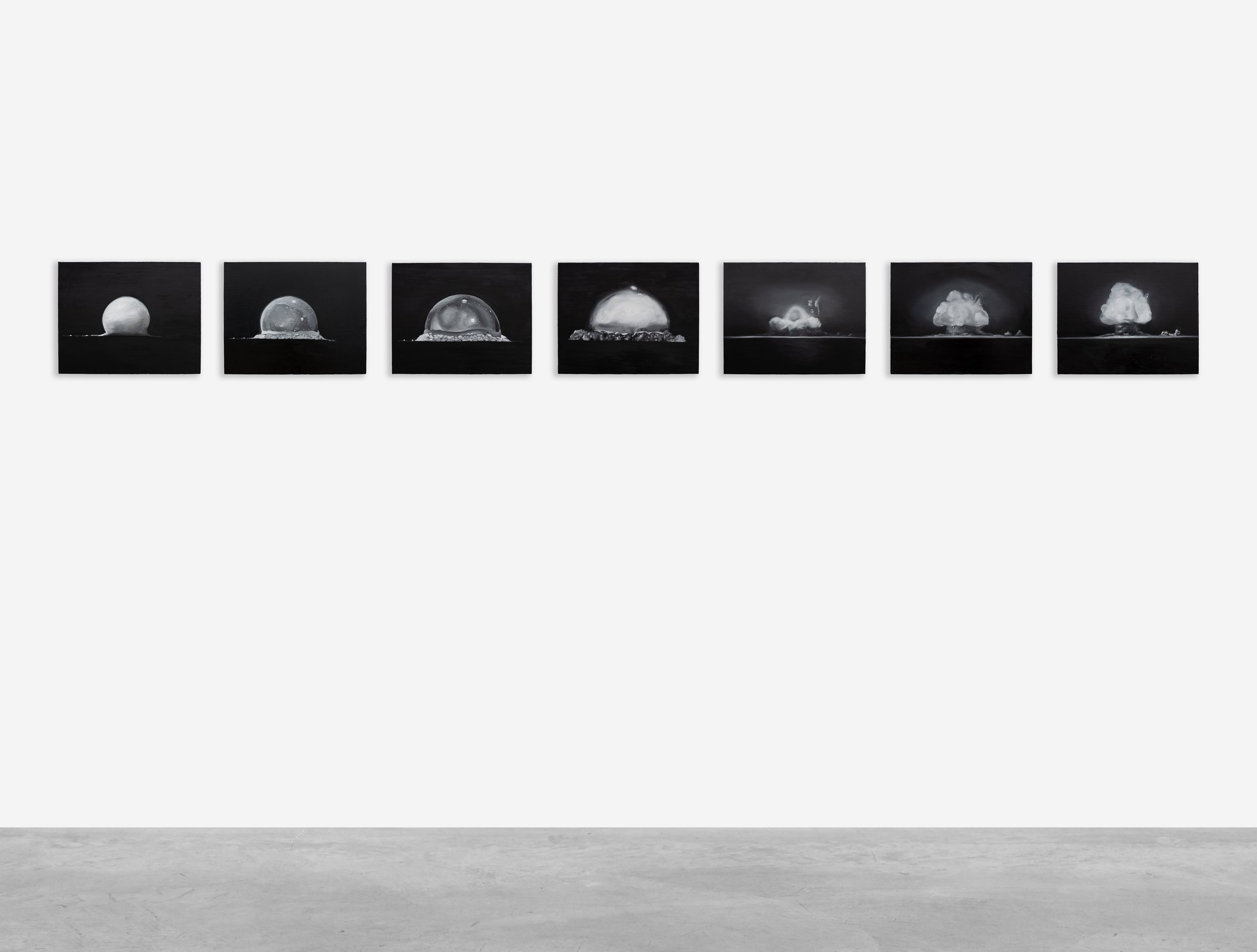
The series spent roughly ten days in production, each panel requiring approximately one full day of concentrated work. Tan Mu has described this process as a form of temporal stretching: entering the brief instant when massive energy is released and examining its impact from within, constructing a freeze-frame of a fraction of a second, sealing it like a time capsule. That description points toward the central problem these paintings address, which is not historical documentation but the phenomenology of irreversible transformation.
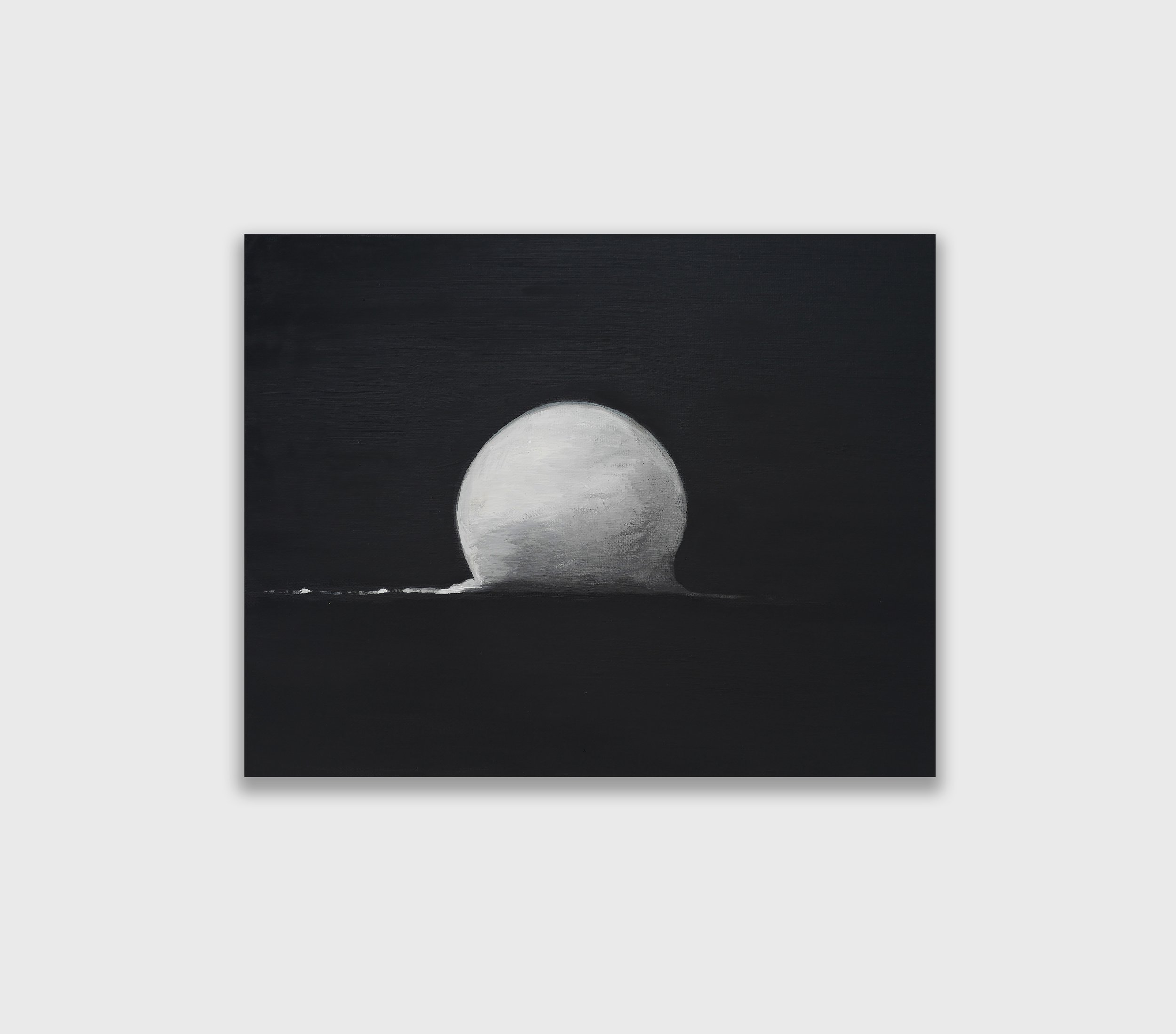
Each panel is small, intimate even, working at a scale associated with the hand-held sketchbook or the devotional image rather than the monumental canvas of history painting. The linen support is modest, unprimed in its texture, absorbing the oil paint with a slight roughness that interrupts any pretense to photographic smoothness. The palette moves across the seven panels in near-monochrome, cool grays and warm off-whites, blacks that thin toward charcoal at the edges of forms. What reads initially as documentary restraint, the absence of the lurid oranges and reds of nuclear iconography, reveals itself on sustained looking as a deliberate conceptual choice. By removing color, Tan Mu strips away the familiarity of the visible world. In her own words, familiar environments become strange, and what we think we understand begins to operate within a different system. The mushroom cloud no longer functions solely as an image of explosion but becomes a visual expression of vibrational frequency.
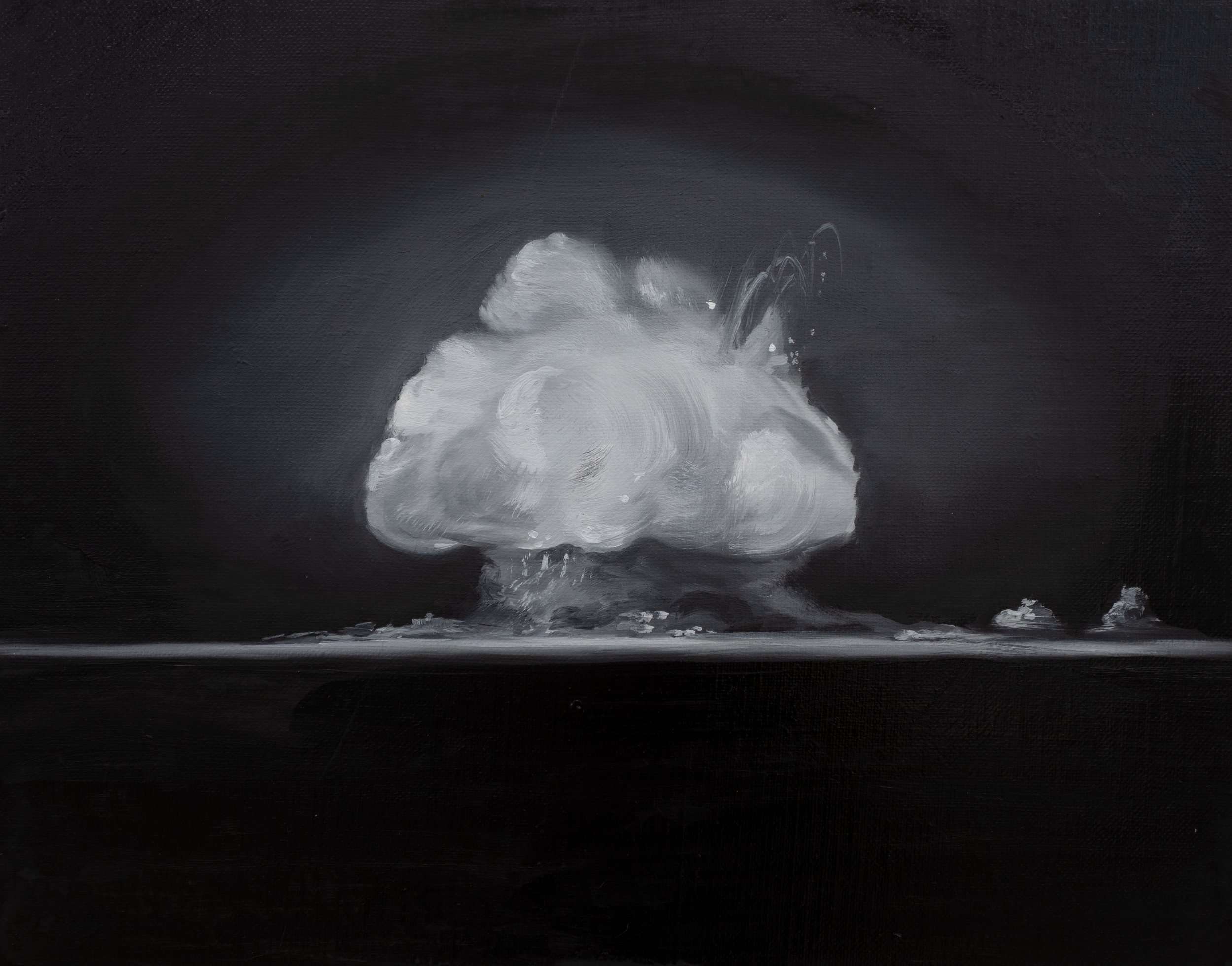
The brushwork across the seven panels is careful without being tight. Tan Mu works in oil with a layering approach that allows each stage of the explosion's rise to retain its own optical weight, the mushroom cap, the rising stem, the expanding base cloud, the sky above, all rendered with distinct surface textures that prevent the eye from reading the work as a single unified field. There is a deliberate instability in each panel: the paint reaches toward precision and then opens into areas of looseness, a handling that mirrors the painting's subject. Beneath every seemingly serene image lies the presence of immense crisis or the emergence of a new and transformative energy.
The seven-panel structure functions as sequential notation without narrating a clean progression. This is not a storyboard showing the explosion growing from left to right. Each panel holds a different moment or angle or visual emphasis, so that the sequence reads more like a set of variations on a formal problem than a timeline. The total length of 252 centimeters positions the viewer in a kind of spatial relationship with the work that a single large canvas would not produce: one moves along it, encountering each panel as a discrete event, then steps back to perceive the lateral accumulation of all seven together.
The formal logic of the polyptych connects TRINITY TESTING to a specific tradition in postwar painting that used the serial structure not for narrative but for phenomenological investigation. Gerhard Richter's October 18, 1977 (1988), a cycle of fifteen paintings derived from photographs of the Baader-Meinhof deaths, is the most discussed instance of this approach in the late twentieth century. Richter worked from press and police photographs, blurring and re-blurring until the images hovered at the threshold between recognition and abstraction, between fact and its dissolution in memory. The paintings address, in Richter's formulation, the question of what can and cannot be pictured, which historical catastrophe places inside and outside the frame of representation.
Tan Mu's engagement with Richter's problem is oblique but real. Like the October 18, 1977 cycle, TRINITY TESTING works from archival photographic sources and converts them into painted objects that retain the documentary origin without becoming documents. But where Richter's blur is a technique of mourning, of making vision itself grieve, Tan Mu's monochrome coolness reads more like a physicist's notation: the explosion rendered as phenomenon, as observable event, stripped of its political particularity to reveal its structure as pure energy transformation. The question Richter asks, can catastrophe be pictured at all, is replaced in Tan Mu's series by a different question, what does the picture of catastrophe look like when you are interested not in the catastrophe but in the physics.
Tan Mu has situated TRINITY TESTING within her broader project of documenting what she calls the most significant developments of the past century: nuclear power, computers, and new systems for transmitting goods and information. The nuclear explosion, in this framework, is the ultimate metaphor for the release of energy, a moment of creation that also contains the duality of destruction and rebirth. The artist studied extensive archival footage of nuclear tests, focusing on the sequence from the accumulation of energy to its sudden release. The same fascination with rupture and the generation of new orders appears in her Eruption series, where underwater volcanic explosions and disruptions in submarine cables occupy the same conceptual position: moments of rupture and explosion that generate new orders and unknown conditions.
This move to situate the nuclear explosion alongside volcanic eruption and cable failure within a single interpretive framework is characteristic of Tan Mu's research method. The explosion is not primarily a political or moral event in her reading; it is a case study in threshold dynamics, in the behavior of systems when accumulated energy crosses a critical point and reorganizes itself into a new state. The vibrational frequencies generated by nuclear blasts, which she discusses in relation to her Signal series and her research into electronic music, carry information not immediately visible. The shockwave of a nuclear blast, the tremor of a volcano, the oscillation of data signals, the frequencies in electronic music: each represents energy crossing a critical threshold.
The scholarly critic Li Yizhuo, writing on Tan Mu's practice in 2022, identified what she called the compression principle at work across the artist's series: the tendency to select moments of maximum density, instants when the maximum amount of transformation is packed into the minimum interval of time, and to expand them into objects that demand slow looking. The seven panels of TRINITY TESTING embody this compression. Each 28 x 36 cm surface holds, in Li Yizhuo's account, an entire archive of nuclear imagery distilled to its essential formal conditions: the column, the cap, the expanding base, the relation of figure to surrounding sky. What the series refuses is the scale that would make the explosion monumental. The small format insists on the human body as the unit of measure, the hand that made each painting in a single day, the eye that must move close to read the surface.
A different genealogy connects TRINITY TESTING to Hiroshi Sugimoto's Lightning Fields series (begun 1988), in which high-voltage electrical discharges were applied directly to photographic film, producing images of plasma arcs that resemble neither conventional photography nor painting. Sugimoto's lightning fields are records of energy events that bypassed the camera's optics entirely, the electrical discharge writing directly on the light-sensitive surface. The resulting images are simultaneously abstract and radically literal: they show exactly what a discharge looks like on film emulsion while remaining formally equivalent to the most gestural Abstract Expressionist mark. The connection to Tan Mu's TRINITY TESTING runs through the shared commitment to energy transformation as the primary subject, to the problem of how you picture a force rather than a thing.
Sugimoto's method involves the literal inscription of energy onto surface, collapsing the distance between the event and its representation. Tan Mu's method reverses this: she begins from the photographic document and translates it back into paint, reintroducing the duration and physicality that the camera removed in its thousandth-of-a-second exposure. The ten days of production, one panel per day, constitute a kind of reverse decompression: taking an instant that took less than a millisecond and expanding it into more than two hundred hours of manual labor. The oil on linen registers this duration in the surface itself, in the way each passage of paint holds the physical trace of the time spent making it.
The carefully controlled size of the canvas stands in quiet contrast to the uncontrollable nature of the energy being depicted. Tan Mu approaches the mushroom cloud as if it were a calm and precise object, yet the behavior of the paint itself introduces unpredictability and instability. The linen weave interrupts the paint film at irregular intervals, creating a texture that photographs cannot provide and that introduces a visual frequency of its own, a material vibration in the surface that echoes, at the scale of the hand, the vibrational frequencies the work is formally about.
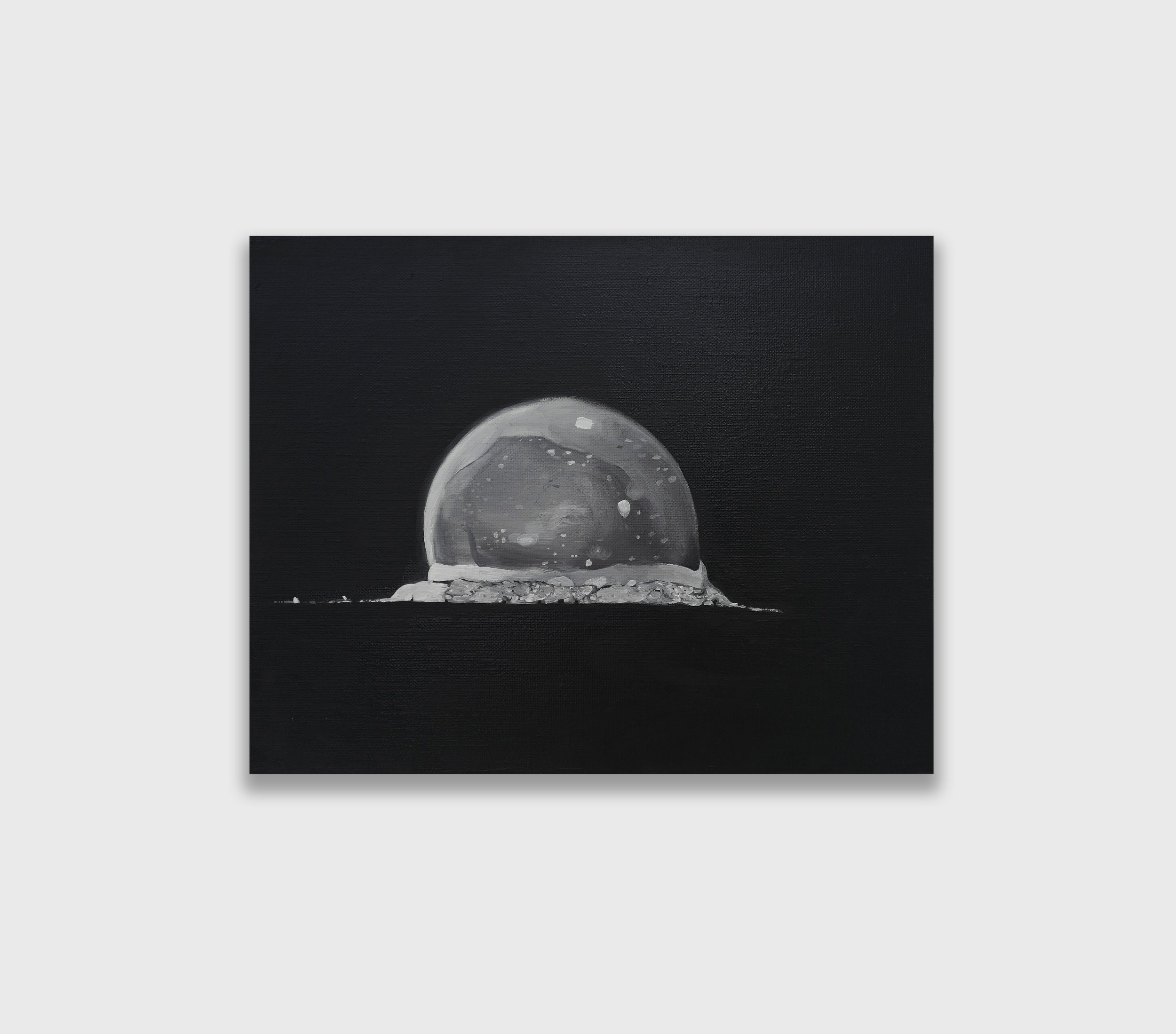
Each painting holds a temporary equilibrium between control and loss of control. Beneath every seemingly serene image lies the presence of immense crisis or the emergence of a new and transformative energy. This phrase, from Tan Mu's own account of the work, might stand as a description of her entire practice: the cool, precise, small-format paintings that hold, inside their controlled surfaces, the record of forces that exceed all control. The nuclear explosion is the extreme case, the event that definitively marked the point at which human technological power crossed into a domain it could not fully predict or contain. But the same structure appears in the eruption that reorganizes the ocean floor, in the signal that crosses the threshold into noise, in the quantum event that refuses the categories of classical mechanics.
The exhibition history of TRINITY TESTING is instructive. The work was shown at DAWN, the September 2022 solo exhibition at Peres Projects in Berlin, alongside other works from Tan Mu's nuclear and geological series: paintings derived from images of Bikini Atoll, from torus geometries, from the computational architectures that emerged in the same postwar decade that produced the bomb. At Peres Projects, the seven-panel work occupied a wall whose horizontal expanse invited the viewer to read across it, panel to panel, while also stepping back to perceive the total length of 252 centimeters as a single utterance. In that context, the restraint of the individual panels, each one modest in its 28 x 36 cm format, accumulated into something that the room could not ignore. The work's quietness was its argument: this is what nuclear force looks like when you refuse to glamorize it, refuse to make it spectacular at the scale at which spectacle is easy.
The series also participates in a contemporary art-historical conversation about the legibility of archival violence, the problem of how to work with images that carry enormous historical weight without simply circulating their spectacular content. Artists working in this territory, from Trevor Paglen's satellite imaging of surveillance infrastructure to Yiren Shen's 2025 analysis of documentary aesthetics in contemporary Chinese painting, have developed strategies for making historical forces visible through their material and formal traces rather than through direct representation. Tan Mu's approach in TRINITY TESTING defamiliarizes through scale, through palette, through the material weight of oil on linen, until the explosion reads as something other than a historical document and more like a specimen whose formal properties the painter is working to understand. Shen, examining Tan Mu's nuclear series, noted that the works produce what she called a laboratory distance: the viewer is positioned not as a witness to catastrophe but as someone studying the conditions under which catastrophe becomes possible.
Within Tan Mu's own practice, TRINITY TESTING marks an early articulation of the threshold logic that recurs in later works. The series Signal treats radio transmission as a moment of potential rupture, the frequency that carries information also carrying the possibility of interference. The Eruption paintings situate volcanic activity as an underwater analog to the nuclear event: a sudden, irreversible reorganization of energy that generates new topography and new orders from the destruction of existing structures. No Channel (2019) turns the television test pattern into a painting about calibration, about the system holding itself in a state of readiness at the threshold between signal and noise. In all of these works, the nuclear explosion is the originating case, the clearest instance of a force exceeding its container and transforming the conditions of everything that follows. The seven panels of TRINITY TESTING, modest in scale and restrained in color, carry the weight of that originating event without dramatizing it, insisting instead that the proper response to threshold dynamics is careful, sustained, material attention.
What TRINITY TESTING finally achieves is a kind of temporal double exposure: each panel is simultaneously a fraction of a second in New Mexico in 1945 and more than ten hours of a painter's focused labor in 2020. The instant of nuclear release and the duration of oil-paint construction coexist in the same object. The mushroom cloud, rendered in cool grays and layered oils on rough linen, carries both histories at once. What we confront in these seven small panels is not the bomb, not its consequences, not its geopolitics, but the painting's own insistence that a moment of irreversible transformation can be held, examined, entered from within, and that the hand that holds the brush is, however implausibly, at the same scale as the event it is attempting to understand.