The Vial as Archive: Tan Mu's Vaccine and the Still Life of Crisis
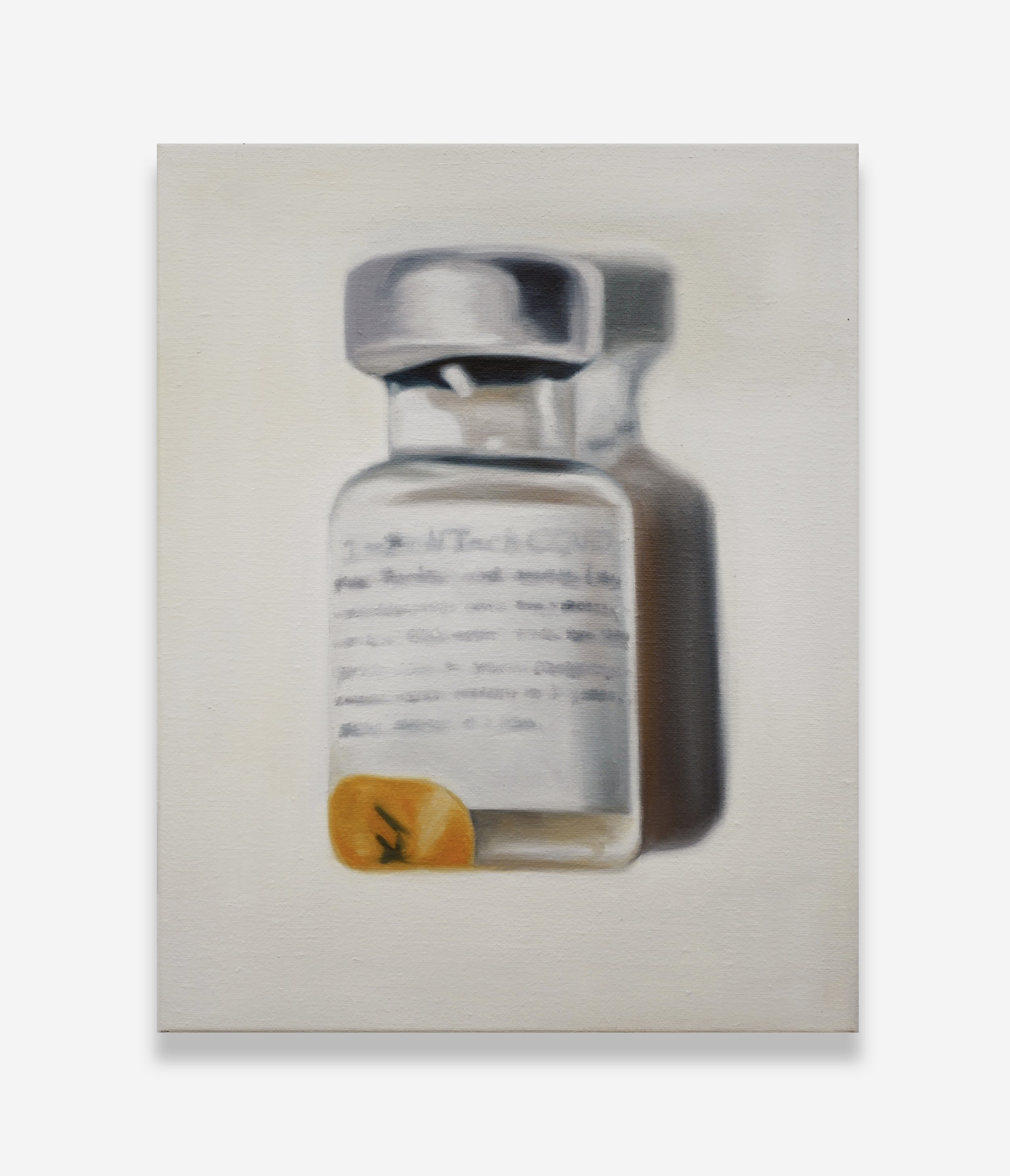
In late 2020, a small glass vial became the most photographed object in human history. The Pfizer BioNTech COVID-19 vaccine, its contents glowing faintly amber, appeared on news broadcasts, social media feeds, government briefings, and personal photographs. The vial required ultra cold storage, handled with gloved care, injected into arms worldwide. It represented both scientific triumph and social fracture, hope and hesitation contained in thirty milliliters of lipid encapsulated mRNA. Tan Mu's Vaccine (2021) paints this vial isolated against dark ground, glass rendered with translucent precision, liquid interior catching light. The work captures not just the object but its cultural weight, the small cylinder holding collective anxiety and aspiration in equal measure.
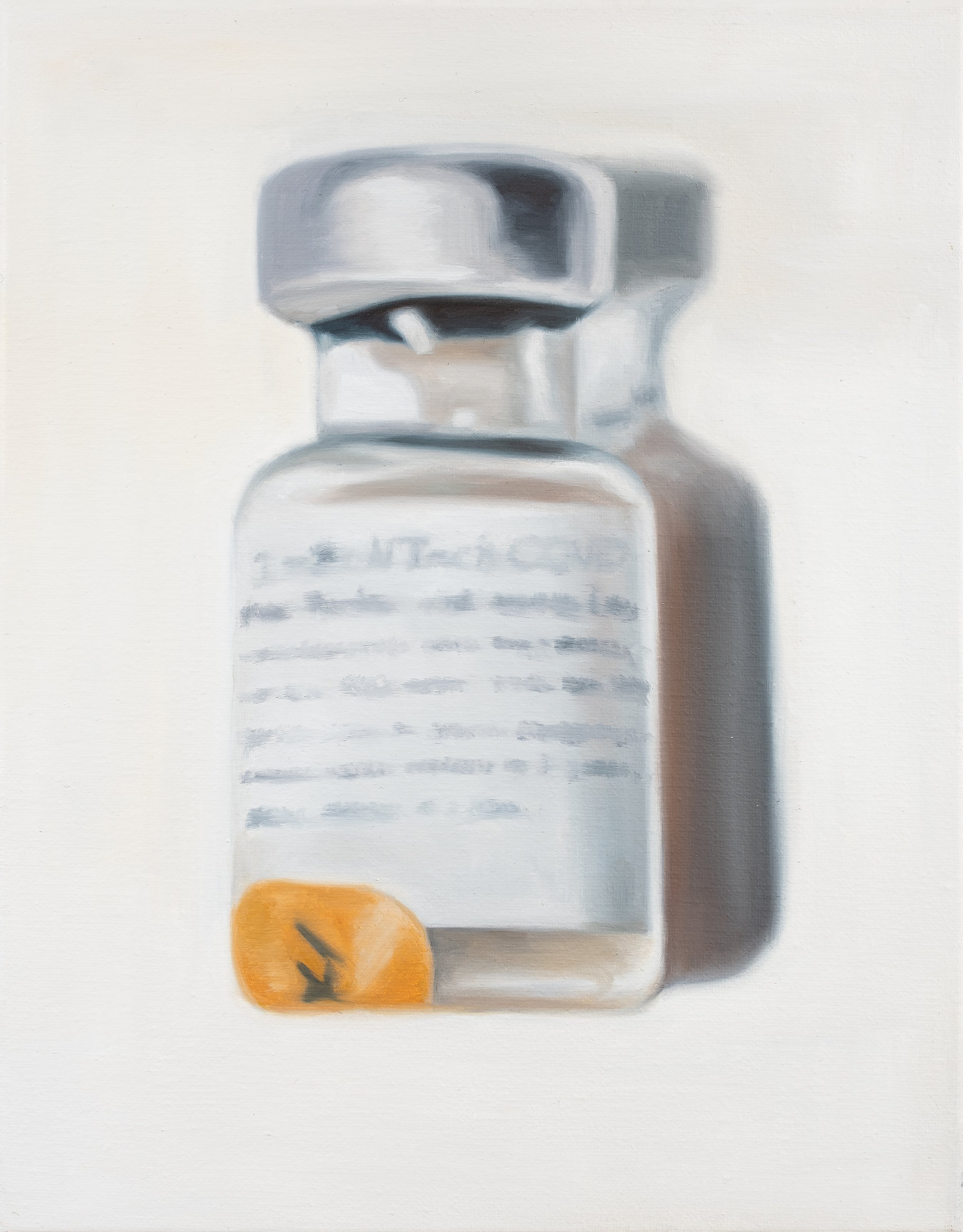
The material facts establish intimacy. Vaccine is oil on linen, 36 x 28 cm (14 x 11 in). Vertical format suits the vial's cylindrical geometry, height exceeding width like the actual container. Linen support provides textured ground for dark passages, weave catching thin glazes. Composition centers the vial, glass walls rendered through layered transparent grays, liquid contents through amber and pale yellow glazes. Light catches the liquid surface, producing highlight that suggests illumination from within. Background remains deep black, achieved through Payne's gray and ivory black underpainting, allowing vial to float in void.
Surface treatment distinguishes glass from liquid. Glass passages receive thin, transparent layers, brushwork invisible where oil blends into seamless transparency. Liquid interior uses warmer glazes, amber tones building luminosity through multiple applications. The vial's cap appears as metallic silver, rendered in thick impasto that catches gallery light. Scale is small, matching actual vial proportions closely. Viewers approach as if examining medical artifact, not monumental artwork. Linen texture visible under thin glazes prevents total photorealism, reminding viewer this is painted interpretation not photograph.
Tan Mu describes her approach as operating between representation and abstraction. The vial functions as scientific object and cultural prism simultaneously. Painting captures this duality through technical choices: glass rendered with precision suggesting pharmaceutical accuracy, while liquid interior glows with emotional intensity exceeding clinical reality. Oil layering builds both transparency and luminosity, material properties mirroring the vial's dual nature as container and symbol. The work holds vaccine as both biomedical fact and cultural memory, paint preserving the moment when small glass cylinder carried unprecedented historical weight.
Color restraint defines the palette. Dominant hues: transparent grays for glass, amber yellows for liquid, silver for cap, black for ground. No extraneous color distracts from vial's form. This restriction mirrors Tan Mu's monochrome explorations in other pandemic works, using limited palette to sharpen focus on structural essentials. Oil translucency allows underlying darkness to modify glass tones, producing depth that actual photography cannot achieve. The painting improves on its source materially while preserving its iconic status historically. Vial floats in painted void, suspended between scientific documentation and symbolic elevation. Brushwork varies by surface type: glass passages receive wet-on-wet blending, edges softening into background. Liquid interior uses glaze-over-dry technique, building luminosity through successive transparent layers. Cap employs impasto, thick paint catching light to simulate metallic reflection. This technical variation creates tactile differentiation, viewer sensing material differences through visual cues alone. Linen weave visible under thin glass passages prevents total photorealism, grounding electronic precision in textile reality. The painting holds paradox of clinical subject in warm medium, vaccine vial rendered through centuries-old oil technique.
Giorgio Morandi's Still Life (1946, oil on canvas, Museo Morandi, Bologna) and Still Life with Bottles (1953) establish the first parallel. Morandi painted the same few bottles, jars, and vessels repeatedly, arranging them in slight variations against neutral grounds. His subjects were humble, quotidian objects without inherent grandeur. Yet through sustained attention and restrained palette, Morandi transformed bottles into meditative presences, ordinary containers into sites of visual philosophy. Tan Mu's Vaccine adopts a similar strategy, taking a pharmaceutical vial, a mass-produced object without aesthetic pretension, and elevating it through painterly care. Both artists prove that repetition and restraint generate meaning where none existed before. In Still Life with Bottles, Morandi uses a muted palette of grays and ochres to create a sense of quiet dignity around a collection of empty glass. Tan Mu uses the amber and white of the vial to achieve a similar effect, transforming a medical supply into an object of contemplation.
Morandi's bottles sit in shallow space, edges softening through atmospheric haze. Tan Mu's vial floats in a deep void, edges sharp where glass meets black ground. Morandi used muted earth tones, grays, and pale blues. Tan Mu uses transparent grays and amber, a palette dictated by subject matter rather than personal preference. Yet both share a commitment to still life as a philosophical method, the ordinary object as a vehicle for contemplation. Morandi's bottles existed outside the historical moment, timeless and unchanging. Tan Mu's vial exists within a specific crisis, historically anchored and urgent. Both treat vessels as carriers of meaning beyond their function, glass holding more than just liquid contents. The comparison reveals how Tan Mu is working within a long tradition of European still life, but updating it for an age of global pandemics and technological hope.
Difference clarifies Tan Mu's intervention. Morandi pursued timeless meditation, bottles existing outside temporal flow. Tan Mu captures temporal urgency, vial representing specific historical breakthrough. Morandi's repetition produced variation through arrangement. Tan Mu's singularity produces intensity through isolation. Both use restraint as generative principle, but Tan Mu adds documentary imperative that Morandi avoided. Morandi shows how form generates feeling. Tan Mu shows how form generates memory.
Connection to Tan Mu's broader practice strengthens the reference. Her interest in functional aesthetics, stated in OXO Q and A, aligns with Morandi's belief that humble objects contain visual wisdom. Both artists treat limitation as creative engine, proving beauty arises from constraint. Vaccine becomes Morandian exercise in crisis documentation, vial holding as much visual power as any baroque composition.
Tan Mu anchors subject in specific medical history. The Pfizer BioNTech COVID-19 vaccine used messenger RNA technology, encoding viral spike protein instructions in lipid nanoparticles. Development began January 2020, authorization granted December 2020, unprecedented speed enabled by decades of prior mRNA research. The vaccine required ultra cold storage at minus seventy degrees Celsius, distributed in specialized thermal containers. Each vial held multiple doses, diluted before injection. The vial itself became icon, photographed globally, recognized instantly even without labeling.
Tan Mu connects this to her earlier genetics work, particularly Embryo and First Week, which explored DNA from conceptual distance. Vaccine shifts from conceptual to urgent, mRNA technology no longer abstract biological process but immediate social reality. Her Q and A emphasizes this transition, vaccine as continuation of genetic interest embedded within crisis context. The vial becomes vessel not just of lipid encapsulated RNA but of collective hope, political tension, scientific achievement, and public anxiety. Painting captures this layering, glass holding multiple significance beyond pharmaceutical content. The mRNA mechanism itself fascinated Tan Mu, genetic instructions encoded in synthetic molecules, body reading artificial code to produce immune response. This biological hacking, cells following synthetic instructions to build protective proteins, extends her interest in how information systems shape physical reality. Vaccine documents this moment when genetic code became public discourse, mRNA terminology entering everyday vocabulary alongside mask mandates and social distancing. The specific timeline of the Pfizer BioNTech BNT162b2 vaccine adds to this urgency. Announced as effective on November 9, 2020, the vaccine moved from laboratory to public consciousness with unprecedented speed. Tan Mu’s painting captures the vial at the height of this cultural moment, when images of the first vaccinations circulated globally, each vial representing a potential end to the isolation that had defined the year. The cold chain logistics, requiring storage at minus seventy degrees Celsius, added a layer of fragility to the object’s mythos. It was not just a medicine but a precious commodity, handled with gloved care, transported in specialized thermal containers, tracked with digital precision. This logistical complexity elevated the vial from medical supply to cultural artifact, a small glass cylinder that required an entire global infrastructure to deliver. Tan Mu’s painting isolates the vial from this complex network, presenting it as a singular object of contemplation. Yet the knowledge of its fragility, its need for extreme cold, its journey through dry ice and thermal boxes, informs the viewer’s perception. The amber liquid glows not just with scientific promise but with the weight of this immense logistical effort, the collective hope of billions contained in a space no larger than a thumb.
The vial's physical requirements added to its mythological status. Ultra cold storage at minus seventy degrees Celsius meant specialized handling, thermal containers, dry ice shipments. The vaccine could not sit on ordinary shelves. It demanded infrastructure, attention, care. Tan Mu's painting captures this preciousness, vial floating in void like sacred object. Amber liquid glows with internal light, suggesting both scientific potency and symbolic weight. The painting holds vaccine as relic of pandemic era, glass cylinder preserved in oil as future generations might study archaeological artifact. Tan Mu's semi-abstract treatment allows vial to transcend specific brand, becoming universal symbol of medical response to global crisis.
The vial's visual recognizability matters. Tan Mu notes that even without branding, the form is immediately identifiable. This recognition stems from media saturation, vaccine vials appearing constantly across news, social platforms, government communications. The object achieved iconic status through repetition, similar to Warhol's soup cans but without irony. Tan Mu treats vial with seriousness, not pop art detachment. The painting acknowledges vial's cultural weight while maintaining visual restraint, amber liquid glowing against dark ground like secular reliquary.
Exhibition context places Vaccine alongside Isolation, Minneapolis, and other pandemic works. Together they document crisis from multiple angles: architectural transformation, street unrest, medical response. Vaccine represents the hope vector, scientific mobilization countering isolation and unrest. Tan Mu's semi-abstract treatment allows vial to function both as specific object and universal symbol, particular Pfizer vial standing in for global vaccination effort. Painting argues that small objects can carry historical weight, glass cylinder becoming archive of collective experience.
The cold chain logistics of the Pfizer vaccine were a testament to human ingenuity in the face of a global crisis. To maintain the vaccine's efficacy, it had to be stored at -70°C, a temperature far colder than any standard freezer. This required a global network of specialized equipment: dry ice manufacturers running 24/7, thermal containers designed to keep the vials cold for days, and ultra-low temperature freezers installed in hospitals and clinics around the world. The scale of this effort was staggering. Millions of tons of dry ice were produced, thousands of containers were shipped, and countless hours were spent monitoring temperatures to ensure the vaccine's safety. It was a logistical miracle, a global supply chain built in a matter of months. Tan Mu's painting, with its solitary vial, is a quiet reminder of this immense effort. It is a monument to the invisible work of the cold chain, the thousands of people who worked behind the scenes to bring the vaccine to the world. The amber liquid in the vial is not just a medicine; it is a symbol of this collective achievement, a drop of hope in a sea of uncertainty.
Joseph Beuys's Fat Chair (1964) provides the second frame. Beuys combined chair, fat wedge, and thermometer, materials carrying personal and symbolic weight from his wartime survival story. Fat represented warmth, healing, transformation. Chair suggested domestic stability. Temperature measurement implied scientific observation. Beuys treated ordinary materials as carriers of layered meaning, biological substance becoming artistic medium. Tan Mu's Vaccine operates similarly, vaccine vial treated not as pharmaceutical product but as material bearing historical, emotional, and scientific significance. Both artists transform functional objects into symbolic vessels.
Beuys worked in postwar Germany, materials referencing trauma and recovery. Tan Mu works in pandemic era, vial referencing crisis and hope. Beuys used fat's physical properties, melting and solidifying with temperature change. Tan Mu uses oil's optical properties, transparency and luminosity mimicking glass and liquid. Both share belief that material carries memory, substance holding more than its physical composition. Beuys's fat contains biographical narrative. Tan Mu's vaccine contains collective narrative. Both elevate mundane materials through contextual framing.
Saul Appelbaum's 2025 essay notes Tan Mu's interest in technology as self-portrait, objects reflecting human condition. Beuys similarly treated materials as extensions of human experience, fat and felt referencing bodily vulnerability. Tan Mu's vial extends this logic, glass cylinder reflecting societal response to invisible threat. Appelbaum's concept of technology embodying human hopes and fears fits Vaccine precisely, vial as technological object infused with collective emotion. Both Beuys and Tan Mu use material choice to bridge scientific and emotional registers. Appelbaum describes Tan Mu's method as recording technological genealogy through painterly preservation. Vaccine fits this pattern, capturing moment when mRNA technology transitioned from laboratory curiosity to household name. The vial becomes Appelbaumian self-portrait of pandemic era, technological artifact revealing collective psychology.
Danni Shen's 2024 studio visit captures Tan Mu's preference for painting's temporal commitment over digital speed. Vaccine embodies this principle, oil preserving fleeting historical moment when vial appeared constantly in media. Shen notes Tan Mu's interest in slowing perception, painting creating space for sustained attention. Vaccine achieves this, semi-abstract vial demanding contemplation rather than instant recognition. The amber glow requires looking, glass transparency inviting closer inspection. Both Shen and Appelbaum identify Tan Mu's core method: using painting to decelerate technological imagery, allowing viewers to engage with objects that digital culture processes too quickly.
Difference sharpens Tan Mu's approach. Beuys combined multiple materials, creating assemblage. Tan Mu isolates single object, creating portrait. Beuys's work requires biographical knowledge to decode. Tan Mu's work requires only cultural recognition. Both treat material as meaning carrier, but Tan Mu achieves this through restraint rather than accumulation. Vaccine becomes Beuysian meditation on crisis materiality, vial holding trauma and hope in glass suspension.
Vaccine holds pandemic memory in small painted frame. Pfizer's lipid nanoparticles, mRNA genetic instructions, global distribution networks, all condensed into painted glass cylinder. Tan Mu's semi-abstraction translates medical object into cultural symbol, amber liquid glowing with collective aspiration. Linen texture interrupts clinical precision, reminding technology sits within human history. The painting argues that crisis produces icons, ordinary objects gaining extraordinary significance through historical circumstance. The vial is a relic of a time when the world held its breath, when a small glass cylinder became the focal point of our collective hope. It is a reminder that even in our most technologically advanced moments, we are still dependent on the most basic of things: a drop of liquid, a piece of glass, a act of faith in the power of science to save us.
Practice continuity connects Vaccine to Isolation, Minneapolis, and other pandemic works. Tan Mu documents crisis systematically, painting the objects and spaces that defined 2020-2021. Vaccine represents hope vector, the scientific response to biological threat. Morandi and Beuys provide precedents for treating humble objects as philosophical vehicles. Tan Mu adds temporal specificity, vial as pandemic artifact rather than timeless still life. The painting preserves this moment, glass cylinder as archive of collective experience. Beyond pandemic series, Vaccine connects to Tan Mu's broader interest in medical and biological subjects. Embryo, First Week, MRI all explore bodily interior through painterly translation. Vaccine extends this lineage, moving from internal biology to external intervention, body receiving synthetic instructions from glass vessel. The work argues that medical objects carry cultural weight equal to their scientific function, vial becoming icon through historical circumstance.
Morandi showed how bottles generate meditation. Beuys showed how materials carry memory. Tan Mu combines both insights, vial as meditative object holding historical memory. Vaccine argues that painting can document crisis without documentary literalism, semi-abstraction allowing object to function simultaneously as specific artifact and universal symbol. The vial floats in painted void, amber liquid glowing against darkness, small glass cylinder holding the weight of global hope seventy years after Morandi's bottles first taught us that ordinary objects contain extraordinary depth. Tan Mu's contribution lies in temporal urgency, vial capturing specific historical moment when science and society intersected under pressure. The painting preserves this intersection, oil holding both lipid nanoparticles and collective aspiration in suspended animation. Future viewers will encounter Vaccine as historical document, amber glow recalling pandemic era when small glass vial carried humanity's hope for return to normalcy. Painting argues that crisis produces icons, and icons deserve our sustained and careful painterly attention.