The Ring in the Void: Tan Mu's Stanford Torus and the Architecture of Escape
In 1975, a group of physicists and engineers at Stanford University designed a large wheel. It was one mile in diameter, rotating once per minute to simulate Earth gravity on its inner surface. It could hold ten thousand people. It had parks, schools, farms, and cities inside its rim. It was called the Stanford Torus, and it was never built. It existed only in reports, diagrams, and the imaginations of those who believed humanity could leave Earth behind. Tan Mu painted it in 2020. Stanford Torus (2020) is oil on linen, 91 x 76 cm. The painting shows the wheel floating in a black void, its interior glowing with simulated sunlight, its structure a precise arc of engineering hope. The work captures not just a design but a mindset, the late twentieth century belief that technology could solve the problem of planetary limits by building new worlds in space. It stands as a monument to a future that never arrived, preserved in pigment for a present that still dreams of escape.
The 1970s were a decade of profound anxiety about the future. The oil crisis of 1973, the first Earth Day in 1970, and the publication of *The Limits to Growth* report in 1972 created a sense that the expansionist dream of the 1960s was hitting a wall. The end of the Apollo program in 1972 left the space community searching for a new, tangible goal. The Stanford Torus was a response to that anxiety, a vision of a future where humanity could escape not just the limits of the Earth, but the limits of its own resource consumption. It was a utopian vision, but it was also a pragmatic one, based on rigorous engineering and scientific analysis. Tan Mu's painting captures the tension between that optimism and the reality of our current moment, where such dreams seem increasingly remote. The wheel in the void is not just a design; it is a question, a challenge to a world that has forgotten how to dream of the stars. It represents an escape from a specific historical moment, a time when the future felt finite and the past felt like a closed door.
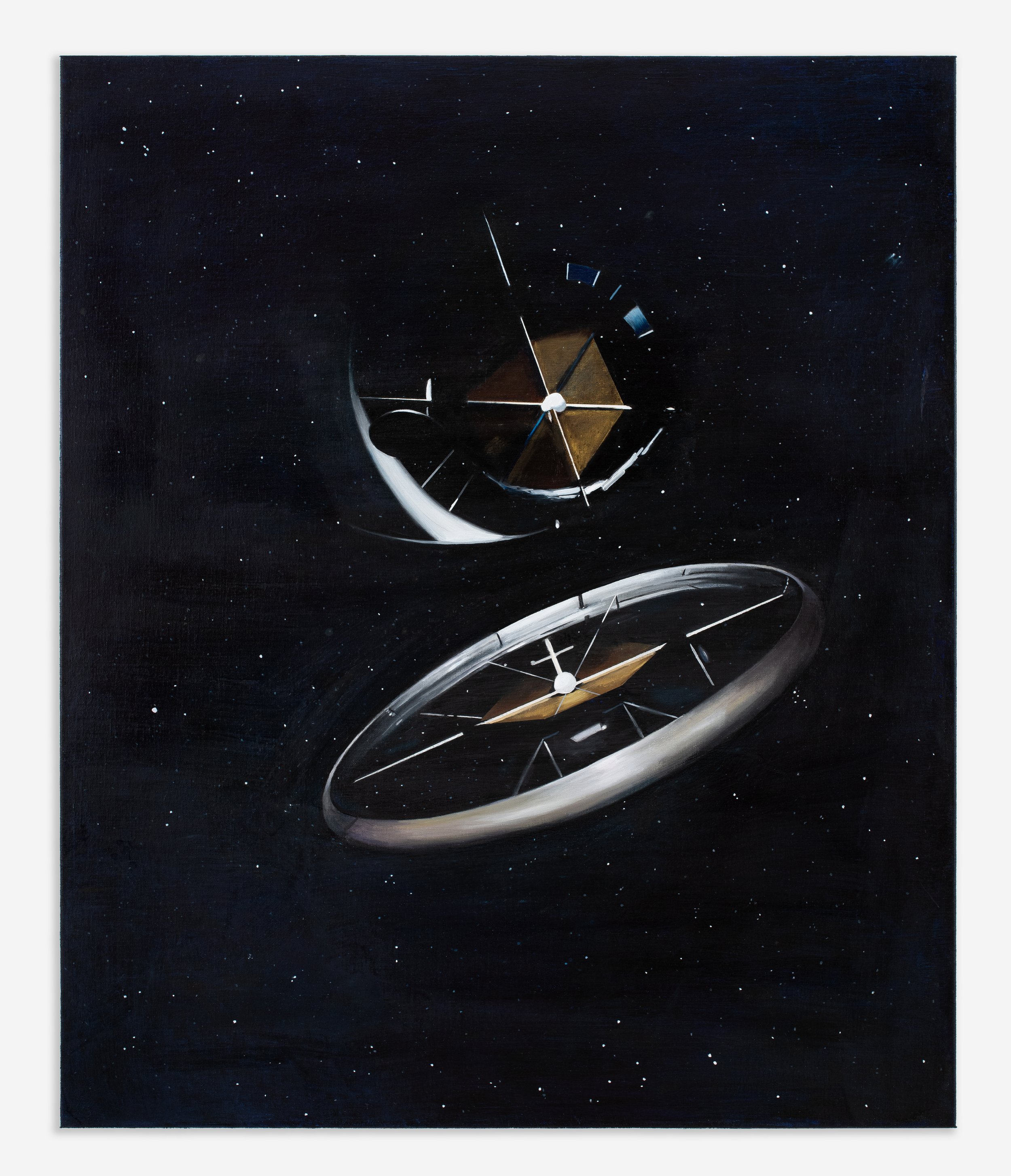
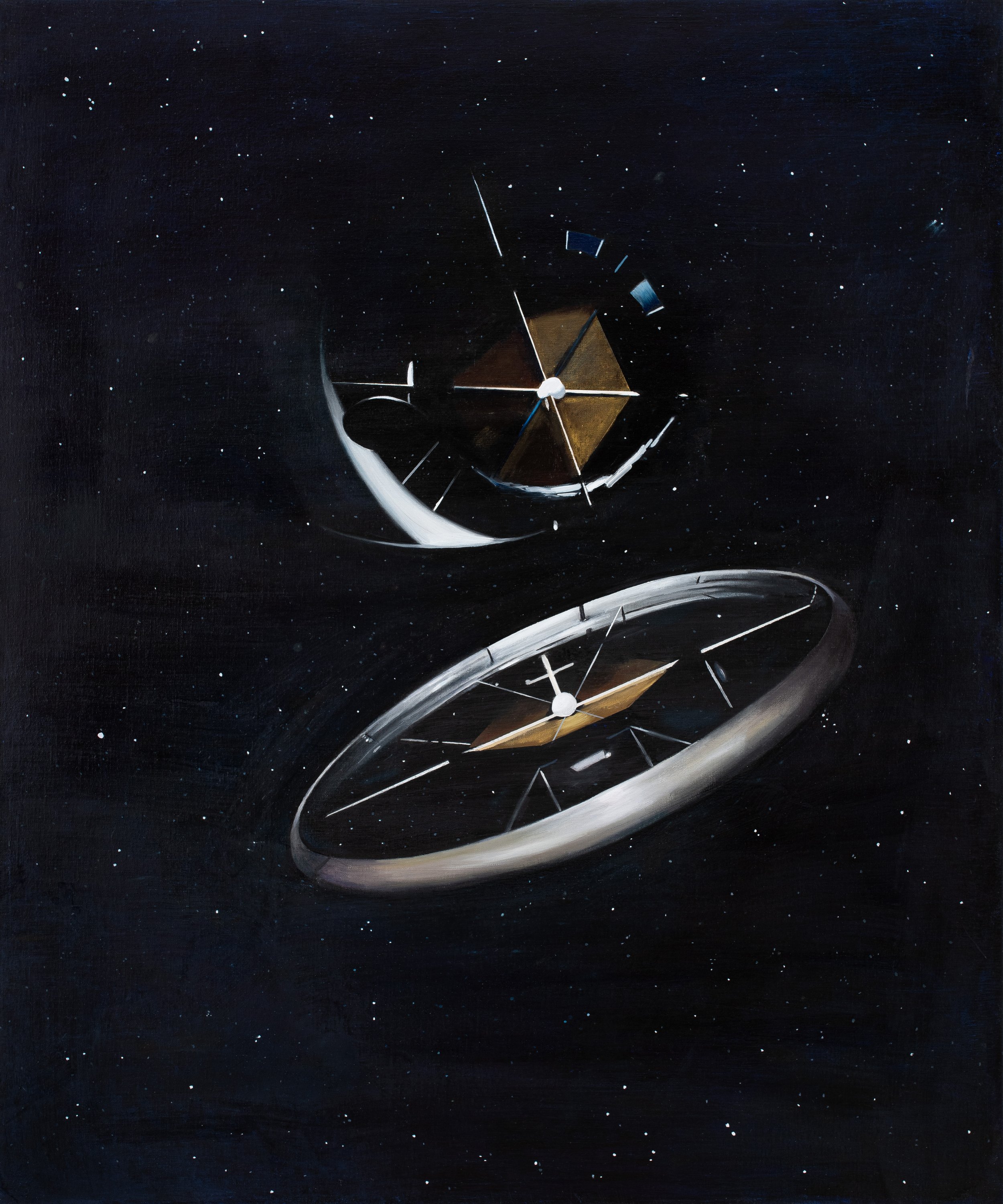
The material facts establish scale and presence. Stanford Torus is oil on linen, 91 x 76 cm (36 x 30 in). Vertical format suits the wheel's arc, the curve rising through the frame like a celestial body. Linen support provides textured ground for dark void passages, weave catching thin glazes. Composition centers the Torus, its ring rendered in metallic grays and warm interior lights, background deep black achieved through layered Payne's gray and ivory black. Light catches the inner surface, producing glow that suggests simulated sunlight reflecting off habitat walls. The painting holds the structure in suspension, no stars, no Earth, just the wheel and the void. This isolation is deliberate, forcing the viewer to confront the structure as a singular object of desire and fear.
Surface treatment distinguishes structure from space. Torus passages receive precise brushwork, edges sharp where oil defines engineering lines. Interior uses warmer glazes, amber and yellow tones building luminosity through multiple applications. The wheel's outer rim appears as cool silver, rendered in thin layers that catch gallery light. Scale is intimate, smaller than actual Torus but large enough for detail inspection. Viewers approach as if examining architectural model, not monumental landscape. Linen texture visible under thin glazes prevents total photorealism, reminding viewer this is painted interpretation not technical diagram.
Tan Mu describes her approach as translating abstract ideas into visual language that connects with human experience. Painting scientific concepts like the Stanford Torus allows her to make speculative futures feel tangible. The work holds Torus as both engineering proposal and cultural artifact, paint preserving the moment when space settlement seemed possible. Oil layering builds both transparency and luminosity, material properties mirroring the Torus's dual nature as machine and home. The painting improves on its source materially, adding warmth and texture to cold diagrams, while preserving its historical status as unbuilt vision.
Color restraint defines the palette. The dominant hues are metallic grays for structure, warm ambers for interior, and black for void. No extraneous color distracts from form. This restriction mirrors Tan Mu's monochrome explorations in other space works, using limited palette to sharpen focus on structural essentials. Oil translucency allows underlying darkness to modify silver tones, producing depth that actual diagrams cannot achieve. The painting improves on its source materially while preserving its speculative status historically. Torus floats in painted void, suspended between engineering fact and futuristic dream. The contrast between the cold exterior and the warm interior creates visual tension, mimicking the habitat's function as a protective shell against the harshness of space. This duality is central to the work's emotional impact, inviting viewers to imagine life inside the ring while acknowledging the void that surrounds it. Surface texture plays a crucial role in this differentiation. The outer rim is rendered with smooth, blended brushstrokes that suggest polished metal, while the inner habitat features more textured impasto, capturing the complexity of a lived-in environment. The linen weave is visible in the darker passages, grounding the celestial subject in the physical reality of the support.
Chesley Bonestell's Saturn as Seen from Titan (1944) establishes the first parallel. Bonestell painted space scenes before spaceflight existed, using astronomical data and artistic imagination to create visions of other worlds. His Saturn looms large in the sky, rings sharp against starfield, landscape below rendered with geological precision. Bonestell's work defined space art for a generation, making the unreal feel real through painterly technique. Tan Mu's Stanford Torus adopts similar strategy, using oil paint to validate a speculative structure. Both artists treat the unreal with the seriousness of landscape painting, applying traditional techniques to futuristic subjects. Bonestell made Saturn visible before probes reached it. Tan Mu makes the Torus tangible before construction begins.
Bonestell's work was often commissioned for magazines like Life and Collier's, where it served to educate the public about the possibilities of space travel. His paintings were not just art; they were persuasive arguments for federal funding of space programs. Tan Mu's painting, created decades later, serves a different but related function. It is not arguing for the construction of the torus, but it is arguing for the importance of the dream that produced it. Both artists use the credibility of the painted image to lend weight to scientific speculation. Bonestell's Saturn inspired a generation of engineers. Tan Mu's Torus inspires a generation of dreamers.
Bonestell's paintings were published in magazines and books, shaping public perception of space. They were not just art but education, teaching viewers what space might look like. Tan Mu's painting serves similar function, preserving the Torus design in cultural memory. Bonestell used realistic style to lend credibility to fantasy. Tan Mu uses realistic style to lend warmth to engineering. Both share belief that painting can bridge gap between data and experience, turning numbers into images that resonate emotionally. Bonestell's Saturn inspired astronomers. Tan Mu's Torus inspires reflection on human ambition. The connection is not just thematic but formal. Both artists use light to create a sense of wonder, whether it is the glow of Saturn's rings or the simulated sunlight of the Torus interior. This use of light transforms technical subjects into objects of awe, inviting the viewer to marvel at the possibilities of the universe and human ingenuity within it.
Difference clarifies Tan Mu's intervention. Bonestell depicted natural phenomena, planets and moons that existed. Tan Mu depicts artificial structure, a habitat that does not. Bonestell's work looks outward to cosmos. Tan Mu's looks inward to human design. Both use painting to make the invisible visible, but Tan Mu adds a layer of social commentary, Torus representing not just exploration but escape. In the context of 1975, escape was not just a romantic notion; it was a response to the realization that Earth is a closed system with finite resources. The Torus was a way out of that closure, a vision of a world where the limits of growth could be transcended by moving to a new frontier. Bonestell shows where we might go. Tan Mu shows why we might want to leave. The Torus becomes a Bonestellian landscape of human making, a ring floating in the void like a planet but built by hands, a testament to the desire to escape the very ground we stand on.
Tan Mu anchors subject in specific historical moment. The Stanford Torus was designed during the 1975 NASA Summer Study, a ten-week program at Stanford University where physicists, engineers, and architects collaborated on space settlement concepts. The Torus was one of several designs, chosen for its ability to simulate gravity through rotation. The study produced detailed reports, cost estimates, and construction timelines. It was serious science, not science fiction. The Torus was meant to be built, funded, inhabited. It never happened. Funding dried up, political will faded, the designs remained on paper. Tan Mu's painting captures this unrealized future, the Torus as ghost of what might have been.
The Torus design was specific. One mile diameter, rotating once per minute. Interior surface divided into zones: residential, agricultural, industrial. Sunlight reflected into habitat via mirrors, providing day-night cycle. The design solved problems of weightlessness, radiation, and isolation. It was a complete world, self-contained, floating in space. Tan Mu's painting simplifies this complexity, focusing on the ring's form rather than its internal details. The arc dominates the frame, suggesting scale without showing every component. The painting holds the Torus as symbol of technological optimism, the belief that engineering could solve existential problems by building new environments.
Tan Mu connects this to her broader interest in space and cosmos, sparked by childhood exposure to meteorology and astronomy. Her Q and A emphasizes the philosophical implications of space exploration, the way looking past the horizon reveals interconnectedness. The Stanford Torus represents the ultimate extension of this perspective, humanity not just looking at space but living in it. The painting argues that speculative architecture carries cultural weight, designs for unbuilt places revealing hopes and fears of their time. The Torus is not just a habitat. It is a document of 1970s futurism, the era's confidence in technology and its anxiety about Earth's limits. Tan Mu notes that these visions emerge from a deep desire to survive and adapt, reflecting optimism and imagination of late twentieth-century futurism. The painting captures this dual impulse, the hope for new beginnings and the fear of planetary collapse. By rendering the Torus in oil, she elevates technical diagram to meditative object, inviting viewers to contemplate not just the engineering but the human longing that drove it. The ring becomes a symbol of resilience, a testament to the belief that humanity can design its way out of existential crisis.
Exhibition context places Stanford Torus alongside other space works like Dyson Sphere and Quantum Computer. Together they document humanity's technological imagination, from computing to energy to habitation. Stanford Torus represents the habitation vector, the desire to expand beyond planetary borders. Tan Mu's semi-realistic treatment allows the Torus to function both as specific design and universal symbol of escape. The painting argues that painting can preserve speculative futures, keeping unrealized visions alive in cultural memory long after their moment has passed. In the gallery, these works form a constellation of human ambition, each piece a node in the network of our technological dreams. The Torus, with its serene arc, offers a moment of quiet contemplation amidst the more chaotic energies of the other works, inviting the viewer to consider the ultimate goal of all this technological progress: a home among the stars.
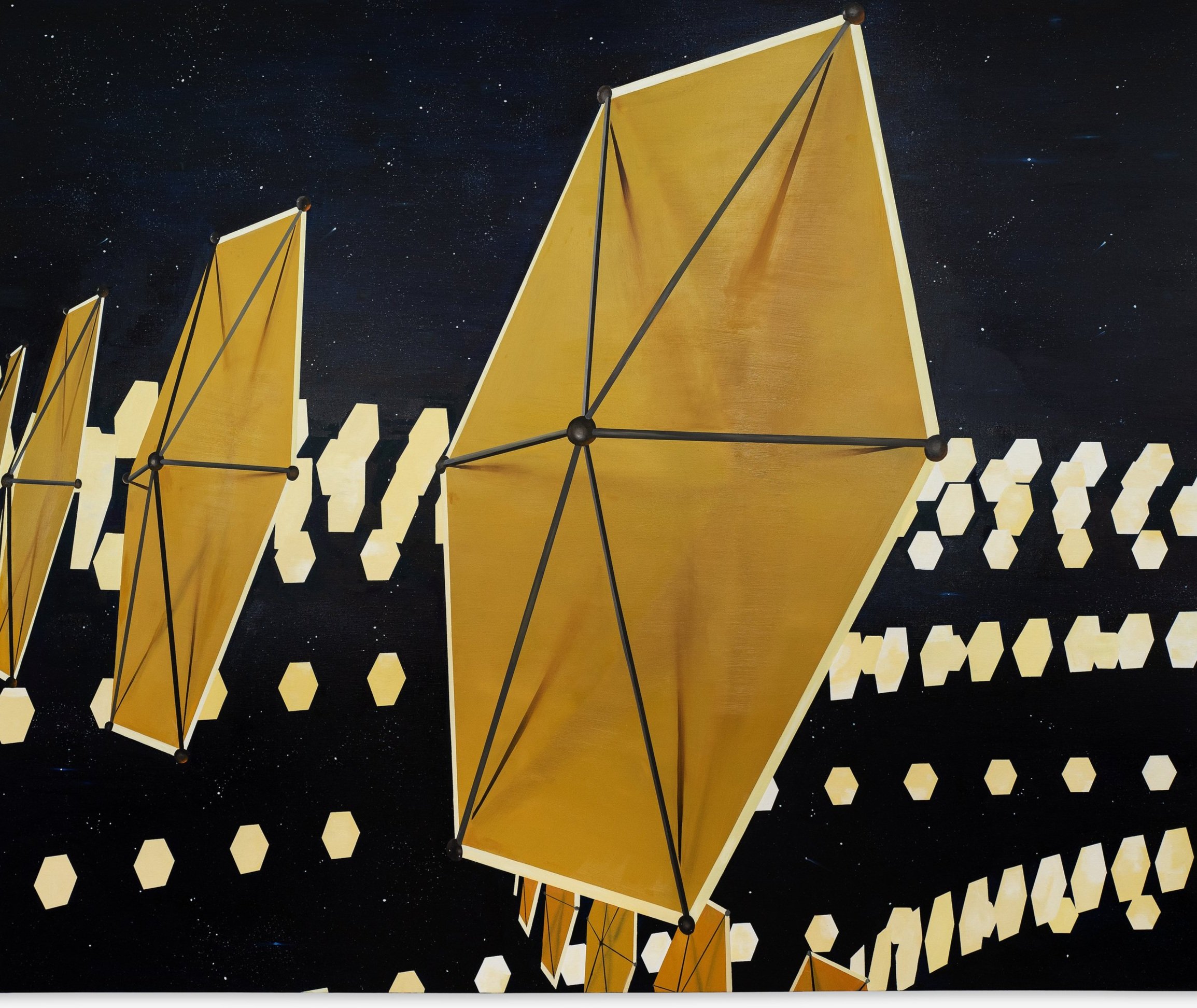
Trevor Paglen's The Last Pictures (2012) provides the second frame. Paglen placed a gold-plated silicon disc containing one hundred images on a communications satellite, launching it into geostationary orbit. The disc will orbit Earth for millions of years, outlasting human civilization. Paglen's work is an archive of humanity, a message to the future or to aliens. It is art as time capsule, image as artifact. Tan Mu's Stanford Torus operates similarly, preserving a speculative design in oil for future viewing. Both artists use their medium to create lasting records of human thought, Paglen through space launch, Tan Mu through painting. Both ask what we leave behind, what images will survive.
Paglen's project was born out of a fear of oblivion, a desire to ensure that human existence is not forgotten by the universe. Tan Mu's painting is born out of a similar fear, but it is also a celebration of human ingenuity. The Torus is not just a record of a design; it is a record of a moment when humanity believed it could solve its most pressing problems by leaving them behind. Both works are monuments to ambition, but Tan Mu's is more intimate, more focused on the specific details of the dream. Where Paglen's disc is a broad survey of human experience, Tan Mu's Torus is a focused look at one specific hope. Both, however, are ultimately about the desire to be remembered, to leave a mark on the cosmos that says: we were here, and we dreamed.
Paglen's images range from cave paintings to nuclear explosions, a survey of human experience. Tan Mu's image is specific, one design from one study. Yet both share archival impulse, the desire to fix human imagination in durable form. Paglen's disc is literal archive, physical object in space. Tan Mu's painting is metaphorical archive, cultural object in gallery. Both treat art as preservation, way to keep ideas alive beyond their immediate context. Paglen's work looks forward to deep time. Tan Mu's looks back to historical futurism. Both use art to bridge temporal gaps, connecting present to future or past to present.
Nick Koenigsknecht's 2025 curatorial essay notes Tan Mu's interest in technology as self-portrait. Paglen similarly treats technology as mirror, satellite reflecting human ambition. Tan Mu's Torus extends this logic, space habitat as projection of human desire for control and safety. Koenigsknecht describes Tan Mu's method as recording technological genealogy. Stanford Torus fits this pattern, capturing moment when space settlement was serious proposal. Paglen shows what we send into space. Tan Mu shows what we dreamed of building there. Both reveal the optimism and anxiety of technological age.
Difference sharpens Tan Mu's approach. Paglen uses actual space infrastructure, satellite as medium. Tan Mu uses painting, linen and oil as medium. Paglen's work is conceptual, idea more important than object. Tan Mu's is material, paint handling central to meaning. Both treat space as site of memory, but Tan Mu adds layer of historical specificity, Torus as artifact of 1970s thought. Paglen shows space as graveyard of human images. Tan Mu shows space as canvas for human dreams. The Torus becomes Paglen-like archive, ring preserving futuristic hope in painted form.
Stanford Torus holds futuristic memory in vertical frame. One mile diameter wheel, ten thousand residents, simulated gravity, all condensed into oil on linen. Tan Mu's realistic technique translates engineering diagram into cultural symbol, metallic ring glowing with artificial light. Linen texture interrupts technical precision, reminding technology sits within human history. The painting argues that speculative architecture carries weight equal to built structures, unbuilt visions revealing hopes and fears of their time.
Practice continuity connects Stanford Torus to Dyson Sphere, Quantum Computer, and other technological works. Tan Mu documents technological imagination systematically, painting the objects and concepts that define human ambition. Stanford Torus represents the habitation vector, desire to expand beyond Earth. Bonestell and Paglen provide precedents for treating space as artistic subject. Tan Mu adds historical specificity, Torus as artifact of 1970s futurism rather than generic space fantasy. The painting preserves this moment, ring as archive of technological optimism.
Bonestell showed how painting makes space visible. Paglen showed how art preserves human memory. Tan Mu combines both insights, Torus as visible memory of futuristic dream. Stanford Torus argues that painting can document speculation without losing aesthetic power, realistic technique allowing object to function simultaneously as specific design and universal symbol. The wheel floats in painted void, metallic arc holding the weight of human hope fifty years after NASA first taught us that we could build worlds in space. Tan Mu's contribution lies in temporal urgency, painting capturing specific historical moment when space settlement seemed possible, preserving that hope in oil and linen for future viewers to discover. The work stands as counterpoint to contemporary cynicism, reminding us that futures were once imagined with confidence and joy. By treating the Torus with the same care as a landscape or portrait, Tan Mu validates the dream itself, suggesting that the act of imagination is as vital as the act of construction. The ring endures in paint, a silent testament to the human capacity to envision new homes among the stars.