The First Game: Tan Mu's OXO and the Birth of Human-Computer Interaction
In 1952, a Cambridge PhD student named Alexander Shafto Douglas wrote a program for the Electronic Delay Storage Automatic Calculator, one of the first stored-program computers. The program simulated tic-tac-toe, displaying game states as illuminated dots on a cathode-ray tube screen. Players used a rotary dial to move a cursor, selecting positions on a three by three grid. Douglas called the program OXO, referring to the British name for the game. No mouse, no keyboard, no graphical interface as we know it. Just dots, logic, and a dial. This was the first time a human could interact with a computer through visual feedback, the birth of a relationship that would define the next seventy years of technological development. Tan Mu's OXO (2021) paints this moment, capturing the CRT aesthetic of green dots on dark ground, the grid that started everything.
Tan Mu states the subject with technical specificity. The work revisits OXO as pivotal moment in human-computer interaction history, capturing early CRT display aesthetics where game states appeared as illuminated dot grids. She connects it to the evolution of gaming from paper tic-tac-toe to virtual reality, showing how technology extends sensory experience. The green dots symbolize cursor position, marking user input points within the system. The painting anchors in this functional origin, interface design born from computational necessity.
Subject anchor: This painting is about OXO, the 1952 tic-tac-toe computer game on EDSAC, representing the birth of human-computer interaction through minimalist CRT display aesthetics. The essay follows that anchor, focusing on interface origins, grid logic, and the translation from electronic display to painted surface without drifting into general computing history.
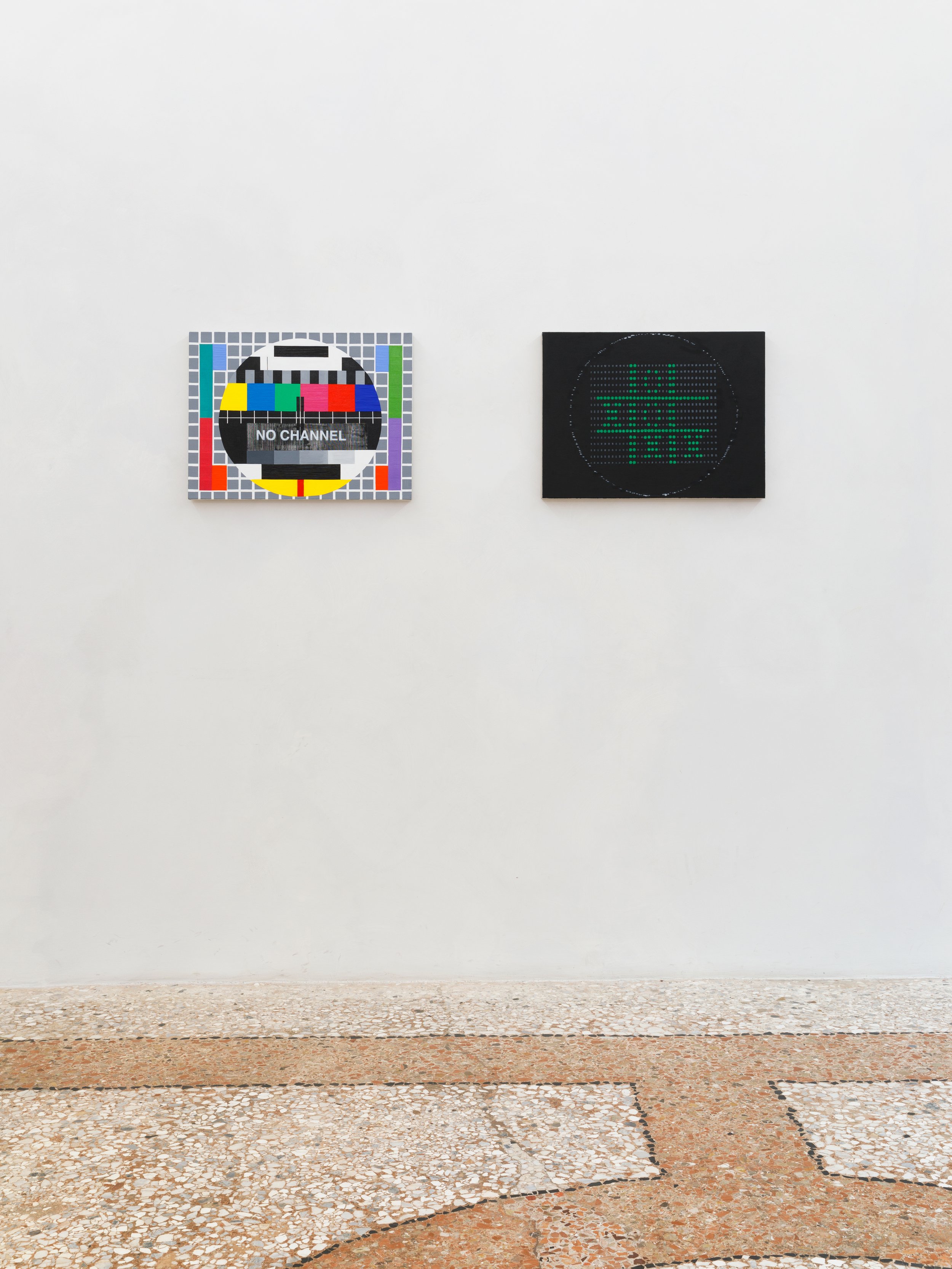
The material facts anchor the digital subject. OXO is oil on linen, 46 x 61 cm (18 x 24 in). Landscape format suits the rectangular CRT screen proportions. Linen support provides textured ground for dark passages, weave catching thin paint layers. Composition centers a three by three grid, each cell defined by negative space rather than drawn lines. Green dots appear at grid intersections, representing cursor position and game state. Background reads as deep black, achieved through layered Payne's gray and ivory black glazes over dark underpainting. Green passages use phthalo green mixed with transparent yellow, producing CRT-like luminescence without actual light emission.
Surface treatment varies between grid elements and background. Grid areas receive precise brushwork, edges sharp where oil dries over masked sections. Dots are small impasto applications, raised slightly above surrounding paint to catch gallery light. This mimics CRT phosphor glow, dots appearing to emit rather than reflect illumination. Background remains smooth, glazes blended to eliminate brushstroke visibility, creating void-like depth. Scale is intimate, smaller than actual EDSAC screen but large enough for detail inspection. Viewers approach as if examining monitor, not monumental artwork.
Tan Mu describes functional aesthetic as central to practice. Early computing interfaces like OXO were designed with strict functional constraints yet produced distinctive visual language. Painting captures this functional beauty, grid structure emerging from necessity rather than decoration. Oil layering builds CRT simulation: dark ground as screen glass, green dots as phosphor illumination. Linen weave adds material reality, preventing total digital flatness. The painting holds paradox of electronic subject in analog medium, pixels rendered through pigment.
Color restraint defines the work. Only two hues dominate: black ground and green interface elements. This restriction mirrors OXO's limited display capabilities, EDSAC could only show simple dot patterns. Tan Mu translates this limitation into painterly choice, avoiding color complexity that would betray historical accuracy. Green selection references CRT phosphor color specifically, not arbitrary hue. Oil translucency allows underlying darkness to modify green intensity, producing depth impossible in actual CRT display. The painting improves on its source materially while preserving its visual logic historically.
Josef Albers's Homage to the Square series (1950-1976) establishes the first parallel. Albers painted nested squares in precise color relationships, studying how adjacent hues modify perception. Each canvas held rigid geometric structure, squares centered, edges parallel to frame. Tan Mu's OXO adopts similar structural discipline, grid centered, cells uniform, dots positioned with mathematical precision. Albers used color interaction as subject. Tan Mu uses grid interaction as subject, dots gaining meaning through positional relationship rather than chromatic contrast. Both artists embrace constraint as generative principle.
Albers's squares demonstrate that form dictates function. Nested geometry creates depth illusion through color alone. Tan Mu's grid demonstrates that position dictates meaning. Dot placement creates game state through location alone. Albers worked within self-imposed format restriction, same square size throughout series. Tan Mu works within historical format restriction, OXO's three by three grid cannot expand. Both produce variety through limitation, proving constraint drives creativity rather than inhibiting it. Albers's color experiments influenced interface design indirectly. Tan Mu's grid painting addresses interface design directly, returning to visual origin.
Difference clarifies Tan Mu's contribution. Albers pursued pure abstraction, squares referencing nothing beyond themselves. Tan Mu pursues representational accuracy, grid depicting specific historical interface. Albers's work is meditative, viewer contemplates color relationships indefinitely. Tan Mu's work is documentary, viewer recognizes technological artifact immediately. Both use geometric rigor, but Tan Mu adds historical specificity that anchors abstraction in computing narrative. Albers shows how form generates feeling. Tan Mu shows how form generates function.
Connection to Tan Mu's broader practice strengthens the reference. Her interest in functional aesthetics, stated explicitly in Q and A, aligns with Albers's belief that design emerges from material necessity. Both artists treat limitation as creative engine, proving beauty arises from constraint. OXO becomes Albersian exercise in digital minimalism, grid holding as much visual power as nested squares.
Tan Mu anchors subject in specific technological history. OXO was developed in 1952 by Alexander Shafto Douglas at Cambridge University for his PhD thesis on human-computer interaction. The Electronic Delay Storage Automatic Calculator, EDSAC, was one of the first stored-program computers, using mercury delay lines for memory. Douglas needed to demonstrate interactive capability, so he programmed tic-tac-toe, simple enough to fit in limited memory yet complex enough to show decision-making logic. Players used a rotary dial to move cursor on CRT screen, pressing buttons to place marks. The computer responded with its own moves, calculating optimal strategy through minimax algorithm.
EDSAC occupied entire room, required specialist operators, consumed significant power. Yet its interface was revolutionary. Before OXO, computers processed batch jobs, no real-time interaction. OXO introduced the concept of visual feedback loop, user acts, computer responds, screen updates. This cycle defines all modern computing interfaces today. Douglas did not intend to create entertainment. He intended to study interaction mechanics, how humans communicate with machines through visual language. The game was means to research end, yet it became historical landmark, first step toward graphical user interfaces.
Tan Mu captures this origin moment through painterly translation. Green dots represent cursor and game marks, positioned on invisible grid. Background darkness evokes CRT screen glass, deep black absorbing ambient light. The painting holds the simplicity that made OXO possible, three by three grid requiring minimal computational resources yet demonstrating maximal conceptual breakthrough. Her Q and A emphasizes interface evolution, from OXO's minimal dots to contemporary virtual reality's immersive environments. The painting argues that all modern interaction descends from this humble grid. Douglas's thesis demonstrated that computers need not be batch-processing machines but could engage in real-time exchange with human operators. This insight predated personal computing by two decades, yet contained its essential logic: visual feedback, user agency, iterative response. Tan Mu preserves this insight in oil, dots holding the moment when computing became conversational rather than computational alone.
The EDSAC itself merits attention as physical artifact. Mercury delay lines stored data as sound waves traveling through tubes, computer thinking through acoustic vibration. Douglas programmed OXO onto this acoustic architecture, game logic encoded as pulses moving through liquid metal. When player turned rotary dial, electrical signal converted to cursor movement on screen. Each action required translation through multiple physical systems: mechanical dial to electrical signal to acoustic memory to visual display. Tan Mu's painting collapses these translations into single surface, oil holding the entire chain from hand to screen in one material moment. Green dots become endpoint of complex physical journey, simplified to pure visual information.
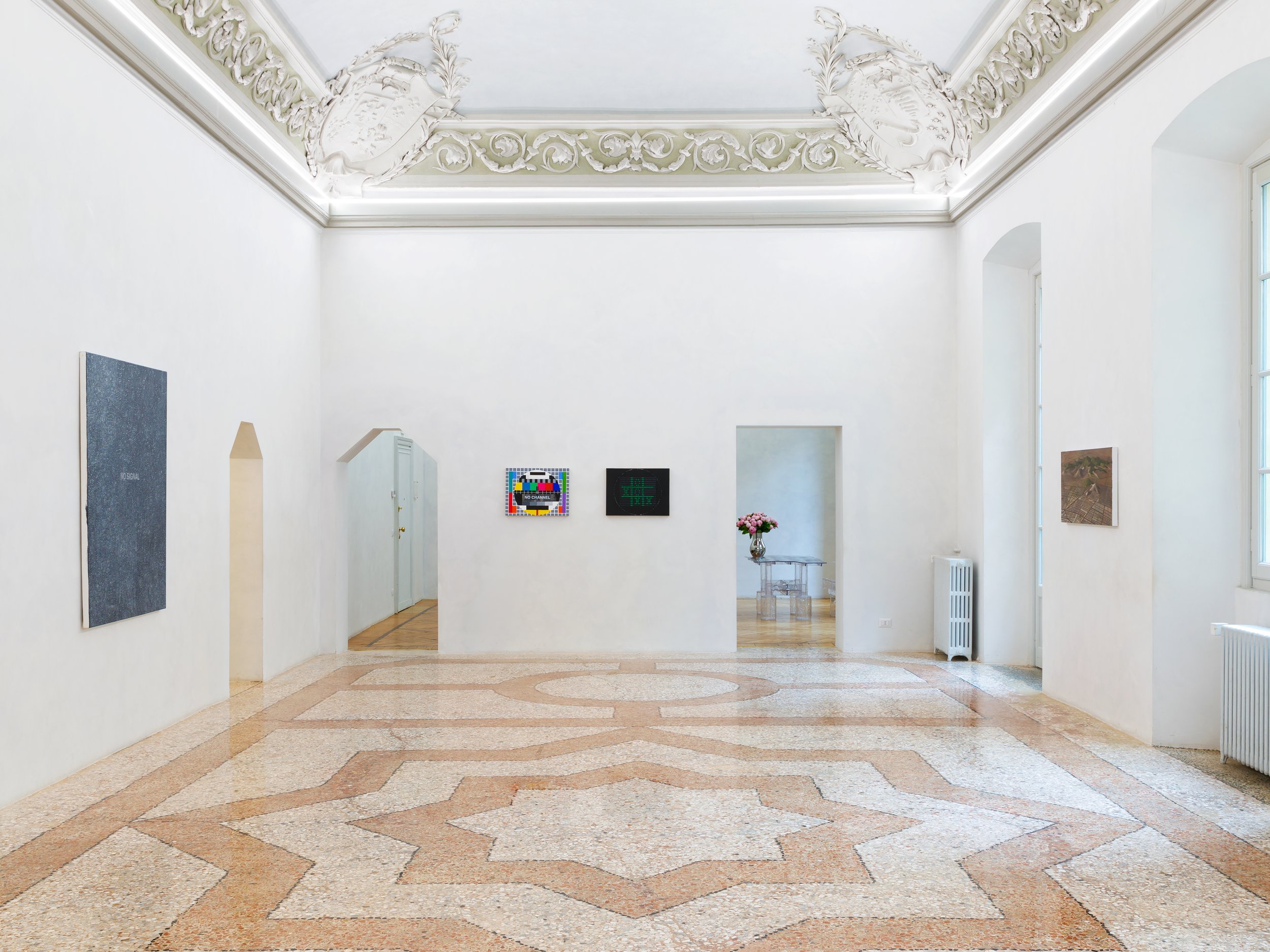
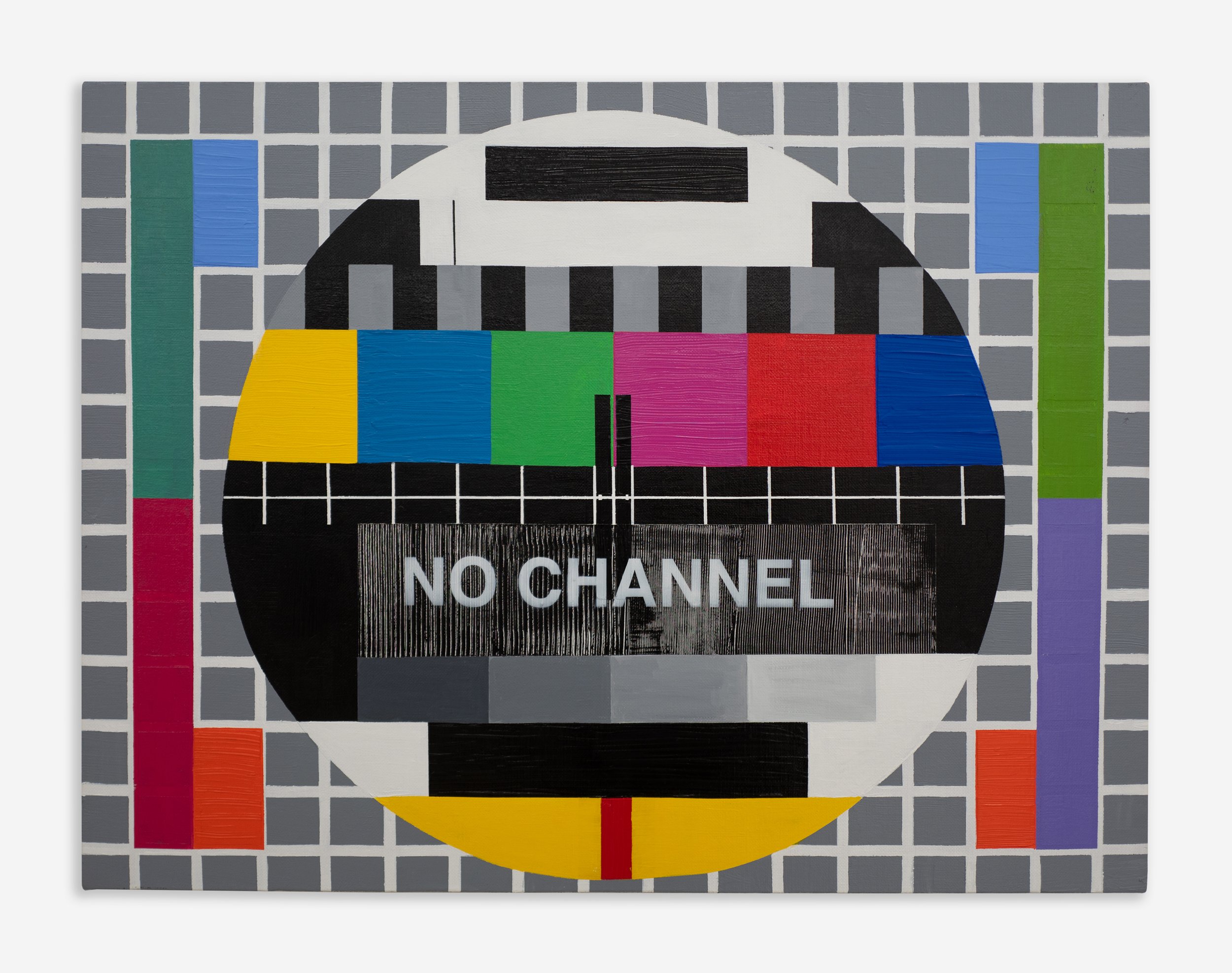
Exhibition context reinforces historical positioning. Tan Mu displayed OXO alongside No Channel in Signal exhibition, both works sharing square format and circular central elements. OXO represents interaction emergence, No Channel represents signal loss. Together they frame technological development as exchange between connection and disconnection, optimism and fragility. The pairing suggests that every interactive system contains potential for failure embedded within its logic. OXO's grid could go blank. No Channel's test pattern could resolve. Both states coexist in technological experience.
Vera Molnár's Interruptions series (1968-1974) provides the second frame. Molnár used algorithms to generate geometric patterns, then introduced random interruptions that disrupted systematic order. She painted these algorithmic compositions, bridging computational logic and artistic expression. Tan Mu's OXO similarly bridges computation and painting, translating digital grid into oil on linen. Molnár's interruptions create visual tension between order and chaos. Tan Mu's grid maintains perfect order, dots positioned with algorithmic precision. Both artists treat the grid as fundamental structure, Molnár disrupting it, Tan Mu preserving it.
Molnár worked with early computers in the 1960s, programming plotters to draw geometric forms. She represents one of the first artists to use computational tools for art making directly. Tan Mu works in reverse direction, painting computational artifacts rather than using computation to paint. Molnár's process was generative, computer creating visual output. Tan Mu's process is documentary, computer output already existing, painting preserving it. Both share interest in systematic beauty, finding aesthetic value in algorithmic structure. Molnár's squares and lines echo Tan Mu's grid, proving geometric logic transcends medium.
Danni Shen's 2024 studio visit captures Tan Mu's preference for painting's temporal commitment over digital speed. Molnár similarly valued the slowness of hand plotting versus machine generation, introducing human error into algorithmic perfection. Tan Mu's OXO holds similar tension, painted representation of electronic display requiring hours of layered glazing to simulate instantaneous CRT illumination. Both artists slow down technological processes through material labor, making the instantaneous available to sustained contemplation. Molnár's interruptions question systematic authority. Tan Mu's preservation celebrates systematic origin. Molnár's computer-generated works required programming knowledge, artist learning machine logic to produce visual output. Tan Mu's painting requires no programming, only observation and translation. Yet both arrive at similar formal conclusions: grid as universal structure, geometry as computational language. Molnár's squares and lines share DNA with Tan Mu's OXO grid, proving algorithmic aesthetics transcend individual medium choices.
Li Yizhuo's 2025 catalog essay notes Tan Mu's works accumulate layers of meaning across series. OXO connects to Logic Circuit, PDP-10, and Blue Box as computing history documentation. Each work captures different interface moment, OXO representing visual interaction birth. Li describes Tan Mu's method as recording technological genealogy through painterly preservation. OXO fits this pattern precisely, green dots marking the intersection where human intention first met machine response visually. The painting argues that interface design began not with mouse or keyboard but with rotary dial and dot grid, simplicity preceding complexity.
Molnár's work argues that computation can produce art. Tan Mu's work argues that art can preserve computation. Shared insight: the grid is universal structure, appearing in painting, computing, and interface design across disciplines. OXO becomes Molnár-like exploration of systematic beauty, grid holding algorithmic logic in painterly form. The green dots mark not just cursor position but intersection of human intention and machine response, painted permanently where electronic display showed them ephemerally.
OXO holds interface origin in modest frame. Douglas's rotary dial, EDSAC's mercury memory, CRT's green phosphor, all condensed into painted grid. Tan Mu's functional aesthetic translates electronic necessity into painterly choice, black ground absorbing light, green dots emitting illusion. Linen texture interrupts digital perfection, reminding technology sits within material history. The painting argues that interaction began here, three by three grid mediating between human hand and machine logic for the first time.
Practice continuity connects OXO to Blue Box, PDP-10, and other computing works. Tan Mu traces interface genealogy systematically, painting the screens that shaped digital consciousness before they became ubiquitous. OXO precedes personal computer graphically, minimal display preceding complex GUI. The painting preserves this prehistory, dots on grid as ancestral form of every modern interface. Albers and Molnár provide geometric precedents, showing grid as artistic structure independent of function. Tan Mu adds functional specificity, grid as interface ancestor. The lineage runs: OXO's three by three grid to desktop icons to touch interfaces to virtual reality. Each step adds complexity while maintaining core logic established in 1952. User acts through visual marker, system responds through visual update. Tan Mu's painting holds the origin point, reminding that all contemporary interaction descends from Douglas's modest thesis demonstration.
Beyond computing series, OXO connects to Tan Mu's broader interest in functional aesthetics. Her Q and A states that early computing interfaces produced distinctive visual language through constraint. This principle extends to NO CHANNEL's test pattern, Blue Box's circuit board, Logic Circuit's etched pathways. Each work captures design emerging from necessity rather than decoration. OXO exemplifies this most purely, three by three grid representing absolute minimum viable interface. No extraneous elements, no decorative flourishes, just functional geometry. The painting argues that beauty arises from constraint, grid holding as much visual power as any ornate composition.
Exhibition pairing with No Channel frames technological development as oscillation between connection and loss. OXO represents first successful exchange between human and machine. No Channel represents exchange's absence. Together they suggest that every interactive system carries potential for failure within its logic. Tan Mu paints both states, preserving optimism and acknowledging fragility. The grid could go dark. The dots could vanish. Yet here, in oil on linen, they persist, green phosphor frozen in pigment, first game still playing on canvas surface seventy years after screen went black.