The Box That Cracked the System: Tan Mu's Blue Box and the Aesthetics of Phreaking
1. A device that turned telephones into instruments
In the early 1970s, two college dropouts built a small blue circuit board in a garage. The device generated precise audio tones at 2600 hertz, tricking AT&T's long distance switching system into believing the call had ended while keeping the line open. Users could then route free calls anywhere. Steve Wozniak designed the circuit. Steve Jobs sold the units. They called it the Blue Box. This act of telecommunications subversion became founding mythology for Apple, a story of garage innovation turning system exploitation into corporate empire. Tan Mu's Blue Box (2021) paints the device itself, small square canvas holding the instrument that cracked the phone network open.
Tan Mu states the subject with technical precision. The work reinterprets the 1960s Blue Box as symbol of creative subversion. By generating in band signaling tones, these devices bypassed control systems, turning infrastructure into exploration site. She connects it to her early fascination with sound transmission, experimenting with cassette recorders and radios as a child, trying to understand how signals travel. The Blue Box represents curiosity meeting system logic, fringe experimentation reshaping communication. Her exhibition installation placed the painting in a hidden attic space, visitors climbing stairs and turning corners to discover it, mirroring the covert nature of phreaking culture.
Subject anchor: This painting is about the 1960s Blue Box phone hacking device and its role in early telecommunications subversion, representing curiosity driven experimentation that shaped modern communication systems. The essay follows that anchor, centering the device's function, its cultural positioning between illegality and innovation, and the artist's installation choice that enacts concealment.
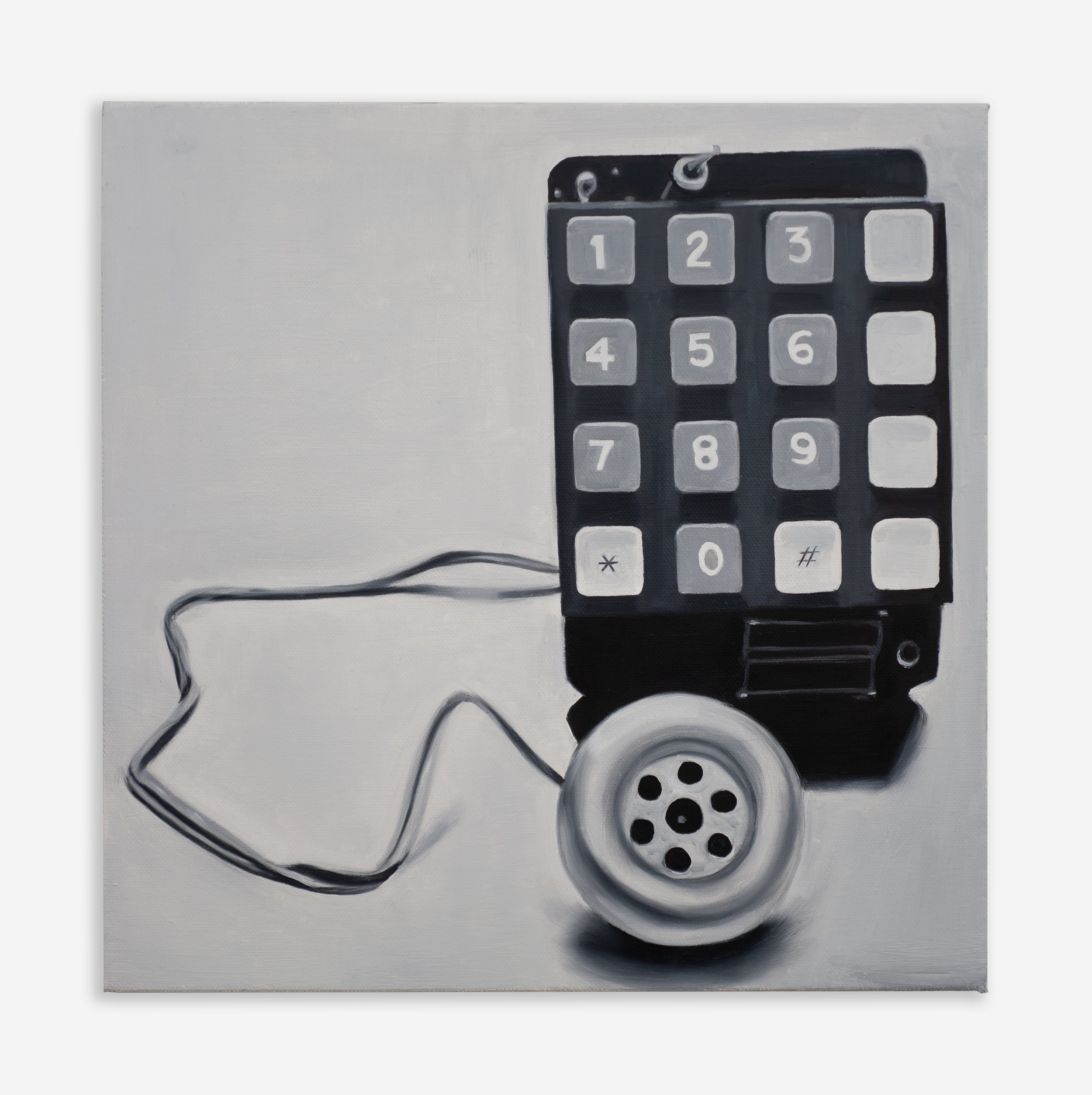
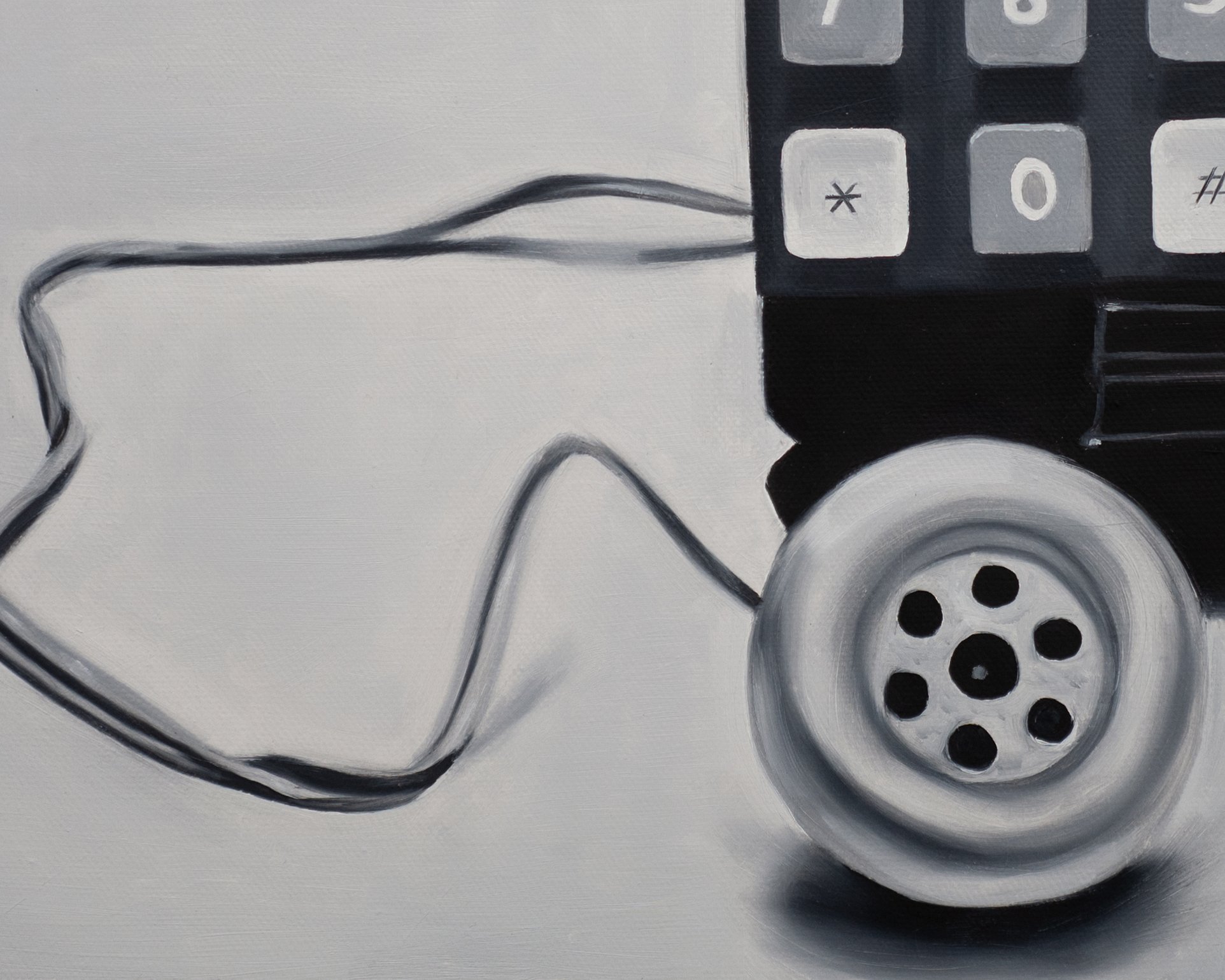
2. Oil on canvas, 30.5 x 30.5 cm: the square that hacked the network
The material facts establish scale and intimacy. Blue Box is oil on canvas, 30.5 x 30.5 cm (12 x 12 in). Perfect square format echoes the device's compact geometry. Canvas support absorbs oil, producing subtle texture under paint layers. The blue of the original circuit board translates into deep ultramarine and phthalo blue glazes, electronic components rendered in metallic silver, cadmium yellow LEDs, carbon black switches. Surface reads as technical diagram yet holds painterly warmth, oil softening hard edges of schematic representation.
Composition centers the Blue Box device against dark ground, no background context. Square format contains the object completely, edges cutting close. Buttons, switches, LED indicators arranged in functional grid. Brushwork varies: precise detail for component labeling, loose blending for blue field suggesting circuit board substrate. Oil layering builds depth, dark underpainting establishing void, lighter glazes defining form. Scale is handheld, matching actual device size. Viewers approach as if examining artifact, not monumental artwork. Canvas weave visible under thin passages, grounding electronic subject in textile reality.
Tan Mu describes the exhibition placement: small hidden attic space, three or four square meters, circular wall fitting painting scale. Visitors climb stairs, navigate turns, discover work concealed. This physical journey mirrors hacking itself, viewing as exploration rather than passive observation. The modest canvas size reinforces this, object demanding close inspection. Blue tones dominate, referencing both device name and cold glow of electronic interface. Metallic passages catch light, switches and LEDs becoming tactile. Oil's slow dry allows edge softening, schematic becoming portrait.
Color palette restricted: blue field, silver components, yellow accent lights, black switches. No extraneous detail. The painting holds device as relic, blue circuit board preserved in pigment. Canvas texture interrupts digital precision, reminding viewer this is painted object not photograph. Tan Mu's monochrome exploration extends here, blue replacing her frequent black and white. The hue carries dual meaning: device name and screen glow of early computing. Oil translucency mimics LED luminescence, paint holding light within layers rather than reflecting it.
3. First reference: Nam June Paik, TV Buddha (1974)
Nam June Paik's TV Buddha (1974) establishes the first parallel. Paik positioned an 18th century Buddha statue before a closed circuit television, the statue watching its own image on screen. The work stages meditation on technology mediation, ancient spirituality confronting electronic surveillance. Tan Mu's Blue Box similarly positions obsolete technology before viewer attention, asking for contemplation of communication infrastructure. Paik used found objects, television and statue. Tan Mu uses painted representation, oil capturing circuit board. Both treat technology as subject worthy sustained looking.
Paik's Buddha gazes at screen endlessly, loop with no resolution. Tan Mu's Blue Box sits static, device frozen mid function. Paik questions consciousness in electronic age. Tan Mu questions access in telecommunications age. Paik's installation invites prolonged viewing, statue and screen in exchange. Tan Mu's attic placement demands active discovery, painting hidden yet waiting. Both artists conceal technology within art context, requiring viewer effort to engage. Paik's television is passive display. Tan Mu's Blue Box is active tool, painted to suggest latent function.
Difference sharpens Tan Mu's intervention. Paik critiques technology's spiritual emptiness, Buddha trapped in electronic gaze. Tan Mu celebrates technology's liberatory potential, Blue Box as tool of creative subversion. Paik's work is somber meditation. Tan Mu's is playful homage to hacker culture. Both use scale intimacy, Paik's Buddha small enough for close viewing, Tan Mu's canvas handheld proportion. Paik shows technology consuming tradition. Tan Mu shows tradition of innovation consuming system constraint.
Paik's closed circuit creates infinite regression, Buddha seeing itself seeing itself. Tan Mu's Blue Box creates finite object, single moment of device function captured. Both stage encounter between human and machine, Paik through surveillance metaphor, Tan Mu through hacking mythology. Painting preserves device as artifact, oil holding electronic memory.
4. Subject context: phreaking and the birth of Silicon Valley
Tan Mu anchors subject in specific history. Blue Box exploited AT&T's in band signaling system, telephone network using audio tones to route calls. 2600 hertz tone signaled line idle, allowing users to hijack switching equipment. John Draper, known as Captain Crunch, discovered the tone from a cereal box whistle. He and others developed devices to generate it. Wozniak refined the design, Jobs marketed the units. They sold hundreds before stopping, fearing legal consequences. This experience taught them system exploitation could become business model, lesson applied to personal computers.
Phreaking culture valued knowledge sharing, technical manuals circulated underground through zines and meetups. Phone hackers called themselves phreaks, blending freak and phone into identity that celebrated outsider status. They mapped network topology through relentless experimentation, treating telephone system as puzzle demanding solution. Blue Box represented peak of this culture, portable device fitting in jacket pocket yet capable of turning any rotary phone into long distance gateway. AT&T spent millions combating phreaks, eventually installing out of band signaling to prevent tone manipulation entirely. The battle between phone company monopoly and hacker ingenuity shaped modern telecommunications security philosophy, forcing corporations to anticipate exploitation rather than react to it.
Steve Wozniak has recalled the Blue Box experience as formative, teaching him that systems designed to control could be understood and subverted through engineering. Steve Jobs learned marketing from selling the devices door to dorm, cold calling potential customers with script emphasizing free long distance appeal. Their partnership began with Blue Box, technical brilliance meeting sales charisma. This collaboration model became Apple's founding template. Tan Mu captures not just the device but its mythological status, circuit board as origin point for Silicon Valley entrepreneurship. The painting holds both technical artifact and cultural symbol, blue field glowing with dual significance.
Tan Mu connects this to her childhood experimentation with radios and cassette recorders, trying to understand signal transmission. Blue Box extends that curiosity into illegal territory, device as crystallization of exploratory impulse. Her Q and A emphasizes mindset over illegality, desire to understand systems and reimagine their use. The painting holds device as artifact of that mindset, blue circuit board as icon of creative subversion.
Installation choice reinforces subject. Hidden attic space requires climbing stairs, navigating turns, discovering painting concealed. This physical journey mirrors hacking itself, effort required to access hidden knowledge. Visitors become phreaks, seeking out concealed technology. The circular wall fits painting scale, creating intimate viewing chamber. Blue Box functions as relic in this shrine, oil preserving circuit board as sacred object of hacker history. Small square format demands proximity, viewers leaning in to read component labels, switch positions, LED placements. This intimacy replicates the hands on experience of holding actual Blue Box, device small enough to pocket, powerful enough to crack national infrastructure.
Tan Mu's monochrome exploration extends to blue field, replacing her frequent black and white with hue carrying dual meaning. Blue references device name directly, yet also evokes screen glow of early CRT monitors, cold luminescence of computing interface. Oil translucency mimics LED light emission, paint holding illumination within layers rather than reflecting it externally. Canvas weave visible under thin blue passages prevents total digital flatness, textile reality interrupting electronic representation. This tension between material and immaterial defines the work, painted circuit board holding both physical object history and abstract system logic.

5. Second reference: Bruce Nauman, Live-Taped Video Corridor (1970)
Bruce Nauman's Live-Taped Video Corridor (1970) provides second frame. Nauman installed narrow corridor flanked by video monitors showing live feed from corridor end. Viewers walking through saw themselves approaching on screens from behind, surveillance feedback loop. Work stages technology as control mechanism, visibility as containment. Tan Mu's Blue Box inverts this logic, device enabling invisibility to surveillance systems, phone network rendered transparent to user control. Nauman shows technology watching. Tan Mu shows technology watched.
Nauman's corridor restricts movement, narrow space forcing single file progression. Tan Mu's attic restricts access, hidden location demanding effort to reach. Both artists choreograph viewer experience, Nauman through architectural constraint, Tan Mu through spatial concealment. Nauman's monitors display real time image, immediate surveillance. Tan Mu's painting displays frozen device, historical artifact. Nauman questions autonomy under observation. Tan Mu questions autonomy through system exploitation.
Nauman's video feedback creates disorienting self observation, viewers seeing themselves from impossible vantage point on screen. Tan Mu's Blue Box creates orienting knowledge, device offering mastery over communication network through technical understanding. Nauman's work produces anxiety, surveillance inescapable once you enter corridor. Tan Mu's produces empowerment, subversion possible for anyone willing to learn system logic. Both use confined space to shape experience, Nauman's corridor physical constraint, Tan Mu's attic spatial concealment. Nauman shows technology as prison, viewers trapped in feedback loop. Tan Mu shows technology as key, device unlocking restricted access.
Danni Shen's 2024 studio visit captures Tan Mu's interest in temporal commitment, painting slowing digital speed to human scale of attention. Blue Box embodies this principle, oil preserving fleeting technological moment that existed only in garages and phone booths for brief historical window. Nauman's video is ephemeral by nature, feed disappearing when power cuts or tape ends. Tan Mu's painting endures, device immortalized in pigment layers that will outlast the actual circuit boards. Both artists examine human technology relationship deeply, Nauman through surveillance state critique, Tan Mu through subversion celebration and historical preservation.
Danni Shen's 2024 studio visit captures Tan Mu's interest in temporal commitment, painting slowing digital speed. Blue Box embodies this, oil preserving fleeting technological moment. Nauman's video is ephemeral, feed disappearing when power cuts. Tan Mu's painting endures, device immortalized in pigment. Both artists examine human technology relationship, Nauman through surveillance critique, Tan Mu through subversion celebration.
6. Synthesis: subversion as origin story
Blue Box holds founding mythology in 30.5 centimeter square. Wozniak's circuit design, Jobs's marketing instinct, phreak culture's knowledge sharing ethos, all condensed into painted circuit board resting on small square canvas. Tan Mu's attic installation enacts concealment physically, painting as discovery rather than passive display. Visitors climb, turn, seek, mirroring the exploratory impulse that drove original phreaks to map telephone topology. Blue tones reference device name directly and electronic screen glow indirectly, oil preserving artifact as technological relic. Canvas texture interrupts digital precision intentionally, reminding viewers that even electronic systems sit within broader material culture.
The painting argues that innovation often originates outside official institutional channels, fringe experimentation reshaping mainstream systems from margins. Blue Box was illegal yet formative, criminal yet creative, marginal yet central to tech history. Tan Mu captures this paradox through material choices: oil paint, traditional medium, depicting electronic device, modern artifact. Hidden attic placement reinforces marginality, work requiring effort to find. Small square format demands intimacy, viewers leaning close as if examining actual device. The installation transforms gallery into hacker space, visitors becoming participants in discovery narrative.
Practice continuity connects Blue Box to PDP-10, Logic Circuit, and other computing history works. Tan Mu traces infrastructure genealogy systematically, painting the tools that shaped digital age before they became invisible consumer products. Blue Box precedes personal computer historically, phreaking precedes hacking culturally, garage experimentation precedes corporate empire economically. The painting preserves this origin moment, circuit board as genesis point where curiosity met system and found it wanting. Oil layers hold both electronic memory and cultural memory, blue field glowing with historical significance.
Paik and Nauman offer technology critique precedents from different angles. Paik meditates on electronic emptiness through Buddha's eternal gaze. Nauman exposes surveillance anxiety through corridor confinement. Tan Mu advances both by celebrating creative exploitation, device as liberatory tool rather than oppressive mechanism. Painting argues subversion shapes progress as much as sanctioned development, outsiders driving innovation from edges. Blue Box sits in hidden attic still, waiting for visitors willing to climb stairs, turn corners, discover. Final resonance: the box that cracked the system still waits, blue circuit board glowing in oil, inviting next generation to ask not what technology does for us but what it could become through our hands.
Practice continuity clear. PDP-10 documents early computing. Blue Box documents early telecommunications hacking. Both works capture infrastructure origins, moments before technology became ubiquitous. Tan Mu traces system genealogy, painting the tools that shaped digital age before they became consumer products. Blue Box precedes personal computer, phreaking precedes hacking, garage experimentation precedes corporate empire.
Paik, Nauman show technology critique precedents. Tan Mu advances through subversion celebration. Paik meditates on electronic emptiness. Nauman exposes surveillance anxiety. Tan Mu honors creative exploitation, device as tool of liberation. Painting argues innovation often originates outside official channels, fringe experimentation reshaping mainstream systems. Blue Box sits in hidden attic, waiting for visitors willing to climb, turn, discover. Final resonance: the box that cracked the system still waits, blue circuit board glowing in oil, inviting next generation to ask not what technology does but what it could become.