The Geometry of Trade: Tan Mu's Containers and the Architecture of Globalization
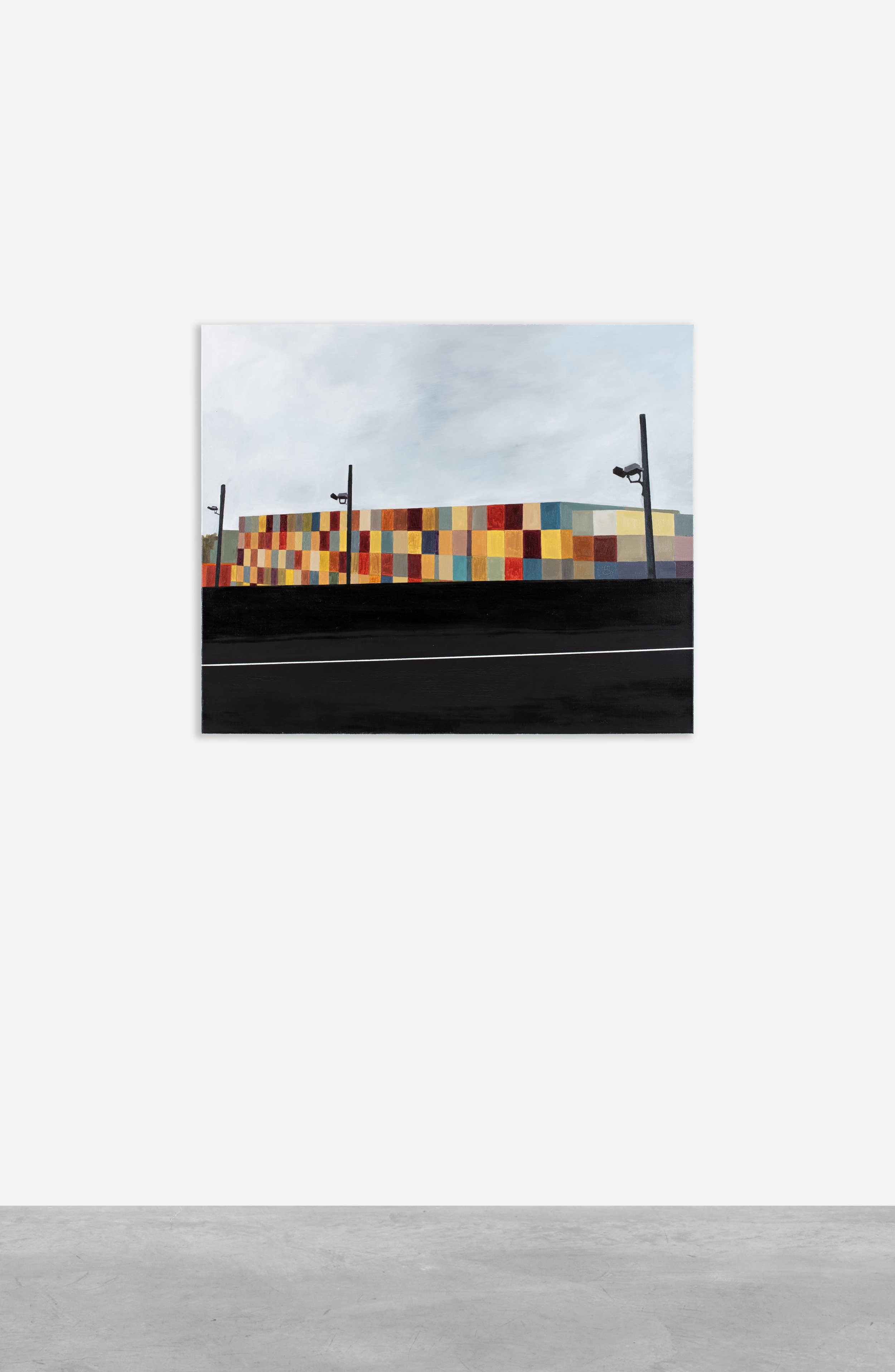
A highway in New Jersey, a stack of colored boxes, a moment of suspension in the flow of goods. This is the scene that Tan Mu captures in Containers (2021). Painted during the height of the pandemic-induced supply chain crisis, the work transforms a mundane logistical image into a meditation on globalization, memory, and the invisible systems that bind our lives together. The containers, reduced to simplified rectangular blocks of color, are not just vessels for transporting items; they are carriers of information, technology, and personal history. The painting is a testament to the power of the ordinary to reveal the extraordinary, to show us the hidden architectures that shape our world.
The artist states the subject with clarity. The work reflects on the global supply chain and transportation slowdowns that led to widespread shortages and shifts in consumption patterns. It examines the intersections of global trade, the exchange of goods, and personal memory. For Tan Mu, the container is a symbol of her own family history, a link to her maternal great-grandfather who was a maritime trader in the Republican era. His stories of movement and displacement, of goods and ideas circulating across borders, are embedded in the painted forms. The painting is a bridge between the personal and the global, between the past and the present, between the physical and the digital.
Containers is oil on linen, 76 x 91 cm (30 x 36 in). The horizontal format mirrors the panoramic view of the highway, allowing the viewer to scan the rows of containers. The surface is built with bold, open brushstrokes that construct the asphalt and the sky, emphasizing the expansiveness of the scene. The containers themselves are rendered in flat, vibrant colors, their forms simplified into geometric abstractions. They are stacked in a rhythmic pattern, a visual echo of the modular logic that governs global trade. The painting is a study in contrasts: the chaos of the pandemic versus the order of the grid, the anonymity of the highway versus the intimacy of memory, the physical weight of the containers versus the digital lightness of the information they carry.
The viewing distance radically alters the painting's impact. From a distance, the containers appear as a unified, abstract composition, a colorful mosaic against the gray of the highway. But as the viewer moves closer, the individual brushstrokes and the texture of the linen become visible, grounding the abstract forms in the material reality of the paint. This shift from the abstract to the material mirrors the experience of globalization itself, where the broad, impersonal forces of trade are felt most acutely in the small, personal moments of daily life. The painting is a site of this shift, a place where the viewer can experience the tension between the global and the local, between the system and the self. The linen weave is visible beneath the thin layers of paint, a reminder that even the most abstract ideas are rooted in the physical world. The painting is a testament to the power of oil paint to capture the complexity of the social world, to make the invisible structures of power visible and tangible.
The use of color in the painting is not just aesthetic; it is symbolic. The multicolored containers are a visual representation of the diversity of goods and cultures that circulate through the global network. Each color is a code, a marker of origin and destination, a trace of the complex journeys that these objects undertake. Tan Mu has noted that these forms resemble hard drives or storage units, suggesting that they contain not just physical cargo but digital information as well. The painting is a map of this information flow, a visualization of the data that underpins our modern world. It is a reminder that our lives are shaped not just by the things we buy, but by the information that flows with them.
The painting was created in the midst of the pandemic-induced supply chain crisis, a moment when the fragility of globalization was exposed for all to see. Ports were clogged, ships were stranded, and shelves were empty. The crisis was a shock to the system, a reminder of the complex and precarious networks that sustain our modern lives. Tan Mu's painting captures this moment of suspension, this moment when the flow of goods was interrupted, and the hidden architectures of trade were revealed. The painting is a document of this moment, a record of the way we lived through the crisis, and the way we learned to see the world anew. It is a reminder that our prosperity is not a given, but is the result of a complex and fragile system of exchange. The painting is a call to care for this system, to work for a more just and equitable global order. It is a work of hope, a vision of a future where the flow of goods is not just a source of profit, but a source of connection and community.
The standardization of the shipping container, a process known as containerization, was a revolutionary development in the history of trade. Before the 1950s, goods were loaded and unloaded by hand, a slow and labor-intensive process that limited the scale and speed of global commerce. The introduction of the standardized container, with its uniform dimensions and interlocking corners, allowed for the mechanization of this process, drastically reducing costs and increasing efficiency. This technical innovation was the foundation of globalization, enabling the complex supply chains that define our modern economy. Tan Mu's painting captures the aesthetic of this standardization, the repetitive forms and vibrant colors of the containers as they are stacked and stored. But it also captures the human cost of this efficiency, the way that the standardization of goods has led to the standardization of labor, the precariousness of the workers who move these containers through the global network. The painting is a meditation on this paradox, on the way that our convenience is built on the backs of others, on the invisible labor that sustains our modern lives.
For Tan Mu, the container is also a symbol of her own family history. Her maternal great-grandfather was a maritime trader in the Republican era, a man who spent his life traveling between China and Korea, exchanging goods and ideas. His stories of movement and displacement, of the rhythms of the sea and the rhythms of trade, are embedded in the painted forms. The painting is a tribute to this history, a way of honoring the legacy of her ancestors. It is a reminder that globalization is not a new phenomenon, but is a part of a long and complex history of exchange and interaction. The painting is a bridge between the past and the present, between the personal and the global, between the physical and the digital. It is a work of memory, a way of keeping the stories of the past alive in the present. It is a work of love, a tribute to the people and the places that have shaped the artist's life. The containers are not just boxes; they are vessels of memory, of history, of identity. They are a reminder that we are all part of a larger story, a story of movement and exchange, of struggle and survival.
The comparison with Edward Hopper's Automat (1927) is a natural one, given the shared theme of urban isolation and the anonymous spaces of modern life. Hopper's painting depicts a lone woman in a coffee shop, surrounded by the empty chairs and reflective windows of the automat. It is a scene of quiet loneliness, a moment of stillness in the midst of the city's chaos. Tan Mu's painting is a different kind of stillness, a stillness of movement, of goods in transit, of information in flow. But it shares Hopper's sense of alienation, the feeling that we are all alone in the crowd, connected by systems that we do not fully understand. Both paintings are about the spaces in between, the places where we wait, where we pass through, where we are neither here nor there. They are paintings of the modern condition, of the way we live in a world of surfaces and signs, of flows and networks. Hopper's woman is lost in her own thoughts, disconnected from the world around her. Tan Mu's containers are also disconnected, isolated units in a vast and impersonal system. But they are also connected, linked by the invisible threads of trade and information. The painting is a meditation on this paradox, on the way we are both alone and together in the modern world.
Hopper's work is often associated with a sense of melancholy, a nostalgia for a lost sense of community. Tan Mu's work is more ambivalent. It is a celebration of the connectivity that globalization has brought, but also a critique of the fragility of that connectivity. The pandemic revealed the weaknesses in the system, the way that a single disruption can ripple outwards, affecting lives around the world. The painting is a reminder of this fragility, a reminder that our prosperity is built on a foundation of sand, of Just-in-Time logistics and precarious labor. It is a work that asks us to consider the cost of our convenience, the human and environmental price of the global trade that sustains our lifestyles. It is a work of empathy, a reminder of the people behind the containers, the workers who load and unload them, the drivers who transport them, the families who depend on them. Hopper's painting is a portrait of the individual in the city, a study of the psychological effects of urban life. Tan Mu's painting is a portrait of the system in the world, a study of the economic and social effects of globalization. Both paintings are about the way we live now, about the challenges and the opportunities of our modern condition. They are paintings that ask us to look closer, to see the world with new eyes, to recognize the beauty and the tragedy of our shared existence.
Donald Judd's Untitled (Stacks) from the 1960s provides a second, more formal parallel. Judd's work is characterized by its use of standardized, modular forms, repeated in a rhythmic pattern. It is a celebration of the industrial aesthetic, of the beauty of the manufactured object. Tan Mu's containers share this aesthetic, their simplified forms and vibrant colors echoing Judd's minimalist sensibility. But where Judd's work is about the purity of form, Tan Mu's is about the complexity of content. Her containers are not just shapes; they are symbols, carriers of meaning and memory. They are a reminder that even the most abstract forms are embedded in a social and political context. The painting is an exchange between the formal and the functional, between the aesthetic and the ethical. It is a work that asks us to see the beauty in the mundane, but also to see the politics in the beautiful. Judd's stacks are self-referential, objects that refer only to themselves. Tan Mu's containers are referential, objects that point to the vast and complex world of global trade. They are a reminder that art is not separate from the world, but is a part of it, a way of understanding and engaging with the realities of our time.
Li Yizhuo's 2025 essay on Tan Mu's work notes the artist's ability to "evoke both connection and disconnection, reflecting the contradictions of that time." Containers is a prime example of this reflection. The painting is a map of our interconnectedness, a visualization of the networks that bind us together. But it is also a map of our disconnection, a reminder of the distances that separate us, the barriers that divide us. The containers are both bridges and walls, symbols of our unity and our fragmentation. The painting is a meditation on this paradox, a work that helps us to understand the complex realities of our globalized world. It is a work of hope and of caution, a celebration of the power of trade to connect us, and a warning of the dangers of relying on systems that are beyond our control. Li Yizhuo argues that Tan Mu's work is not just a reflection of the world, but a critical engagement with it, a way of thinking through the ethical and social implications of our globalized condition. The painting is a tool for this thinking, a place where we can explore the complex emotions and ideas that have emerged from this period. It is a work that helps us to understand our place in the world, and to imagine a future that is more just and more connected.
The painting sits within a larger series of works by Tan Mu that explore the theme of logistics and infrastructure. From Signal (2024) to Logic Circuit (2022), she has been documenting the hidden systems that support our modern lives. Containers is a key work in this series, a work that brings together her interest in global trade, her fascination with industrial forms, and her concern for the human stories that are embedded in these systems. It is a work that is both specific and universal, a document of a particular moment in the pandemic that speaks to the enduring realities of globalization. The painting is a testament to the power of art to illuminate the unseen, to make the invisible visible, and to help us understand our place in the world. It is a work that reminds us that we are not just consumers, but participants in a vast and complex web of exchange.
Ultimately, Containers is a painting about the flow of things. It is about the way that goods, information, and memories circulate through our world, connecting us to each other and to our past. It is a celebration of this flow, a celebration of the richness and diversity of our global culture. But it is also a reminder of the fragility of this flow, of the ways in which it can be disrupted and denied. The painting is a call to action, a call to care for the systems that sustain us, to work for a more just and equitable global order. It is a work of beauty and of truth, a work that reminds us of the power of art to heal and to transform. The containers are not just boxes; they are vessels of hope, of memory, of connection. They are a reminder that we are all part of a larger story, a story of movement and exchange, of struggle and survival. The painting is a chapter in that story, a chapter that invites us to reflect on our own role in the ongoing narrative of globalization. It is a work that reminds us that we are not just passive observers of this story, but active participants in it, shaping the future with every choice we make, every product we buy, every connection we forge. The painting is a call to action, a call to build a world that is more just, more equitable, and more connected. It is a work of beauty and of truth, a work that reminds us of the power of art to heal and to transform. The containers are a symbol of our shared humanity, a reminder that we are all in this together, bound by the invisible threads of trade and information, of memory and hope. The painting is a testament to this bond, a celebration of our interconnectedness, and a vision of a future where we can all thrive. It is a work of love, a work of peace, a work of hope. It is a work that will continue to inspire and to challenge us for years to come, a work that will remind us of our place in the world, and of the beauty and the mystery of our shared existence.