The Universe Looking Back: Tan Mu's Gaze: Observable Infinity 02 and the Cosmic Iris
A map of the observable universe looks like an eye. This was the revelation that sparked Tan Mu's Gaze: Observable Infinity 02 (2025). The scientific visualization, with its concentric rings of cosmic history fading into the darkness of the unknown, resembles nothing so much as a giant, celestial iris. The painting translates this visual parallel into a meditation on the reciprocal nature of observation. We look out into the cosmos, but the cosmos, in the form of this painted eye, looks back. The work is a bridge between the macrocosmic scale of space and the intimacy of personal perception, a reminder that we are not just observers of the universe, but participants in its unfolding story.
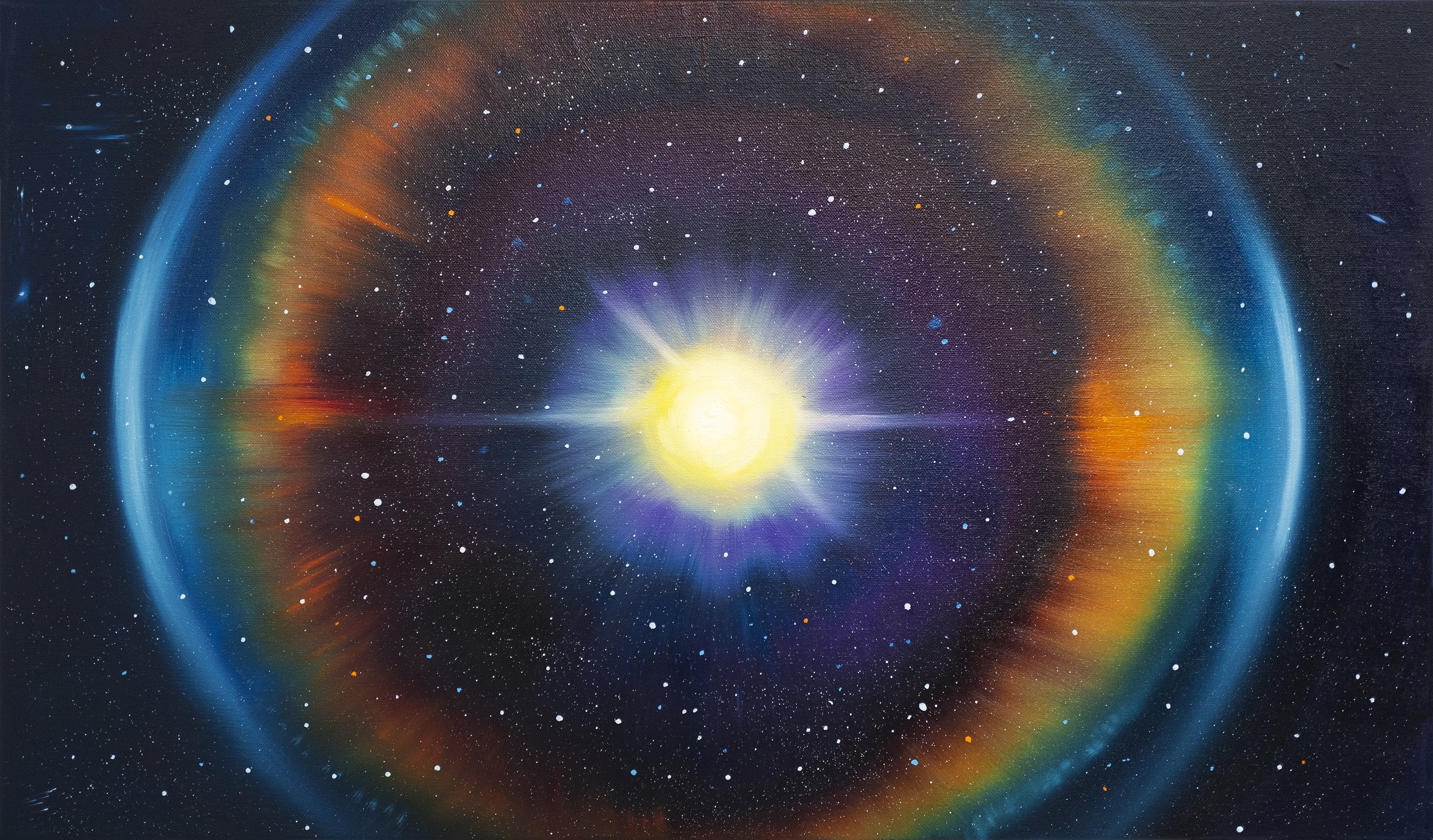
The artist states the subject with poetic clarity. The painting features a radiant, circular light resembling an eye, a "cosmic iris" at the center of a field of concentric rings. These rings, painted in warm tones that gradually transition to cooler hues, symbolize the visible and hidden realms of existence. The work transcends mere visual representation, guiding viewers into a meditative reflection on our shared existence and the unseen structures that connect us. It is a work that blends science, spirituality, and collective memory, embodying a reverence for the mysteries of the universe while exploring the interconnectedness of all things. The painting is a testament to the power of technology to expand our vision, and the power of art to give that vision emotional weight.
Gaze: Observable Infinity 02 is oil on linen, 36 x 61 cm (14 x 24 in). The horizontal format emphasizes the panoramic nature of the cosmic view, while the small scale creates a sense of intimacy, as if the viewer is being addressed directly by the universe itself. The surface is a complex field of layered pigment, where translucent glazes of cobalt blue, alizarin crimson, and cadmium yellow overlap to create the illusion of depth and light. The central eye is a point of intense luminosity, a focal point that draws the viewer in. The surrounding rings are softer, more atmospheric, suggesting the vastness of space and the passage of time. The painting is a study in contrasts: the precision of the scientific map and the fluidity of the painterly gesture, the vastness of the cosmos and the intimacy of the gaze.
The viewing distance radically alters the painting's impact. From a distance, the cosmic iris appears as a single, unified form, a symbol of the universe's wholeness. But as the viewer moves closer, the individual brushstrokes and layers of pigment become visible, revealing the complexity and the labor that went into creating the image. This shift from the symbolic to the material mirrors the scientific process itself, where the grand theories of the cosmos are built upon the small, meticulous observations of individual astronomers. The painting is a site of this shift, a place where the viewer can experience the wonder of the cosmos and the beauty of the paint at the same time. The linen weave is visible beneath the thin layers of glaze, grounding the ethereal imagery in the material reality of the support. The painting is a testament to the power of oil paint to capture the complexity of the natural world, to make the invisible visible and the abstract concrete.
The use of color in the painting is not just aesthetic; it is structural. The warm tones at the center represent the present moment, the "now" of our observation. As the colors cool and darken towards the edges, they represent the past, the billions of years of cosmic history that are visible to us only as distant light. This color gradient is a visual representation of the concept of "look-back time," the idea that the farther we look into space, the farther back we look in time. Tan Mu has translated this scientific concept into a painterly one, using the language of color to convey the depth of cosmic time. The painting is a map of time as much as it is a map of space.
The observable universe is a sphere with a radius of about 46 billion light-years, centered on the observer. It is not the whole universe, but only the part that we can see, the part from which light has had time to reach us since the Big Bang. Beyond this boundary lies the unobservable universe, a realm of speculation and mystery. Tan Mu's painting captures this boundary, the edge of our knowledge, where the light fades into darkness. The painting is a meditation on this limit, on the way that our understanding of the cosmos is shaped by our own position in space and time. It is a reminder that our view of the universe is not a god's-eye view, but a human one, limited and partial, but no less beautiful for that. The painting is a celebration of this limitation, a celebration of the fact that we are not omniscient, but are instead explorers, discoverers, seekers of truth in a vast and mysterious world. The color gradient is not just a scientific diagram; it is an emotional landscape, a journey from the warmth of the present to the cold, dark depths of the past. It is a visual metaphor for the human condition, our journey through time, our search for meaning in a universe that is often indifferent to our plight. The painting is a companion on this journey, a guide, a source of comfort and of inspiration. It is a work that reminds us that we are not alone, that we are part of a vast and interconnected web of life, and that our search for meaning is a shared one, a search that unites us with all the other seekers, all the other explorers, all the other dreamers who have come before us and who will come after. The painting is a testament to the human spirit, our resilience, our curiosity, our capacity for wonder. It is a work of hope, a work of love, a work of beauty. It is a work that will continue to inspire and to challenge us for years to come.
The comparison with Odilon Redon's The Cyclops (1914) is a natural one, given the shared motif of the single, monumental eye. Redon's painting is a mythological scene, where the giant Polyphemus gazes upon the sleeping nymph Galatea. The eye is a symbol of desire, of a powerful, almost overwhelming attention. Tan Mu's eye is different. It is not a symbol of desire, but of awareness. It is a detached, scientific gaze, but one that is imbued with a sense of wonder and reverence. Both artists use the eye to create a sense of intimacy and scale, to make the viewer feel both small and seen. But where Redon's eye is personal and mythological, Tan Mu's is universal and scientific. It is the eye of the cosmos itself, looking back at us with a cold, clear light. Redon's Cyclops is a creature of myth, a symbol of the primal and the irrational. Tan Mu's cosmic iris is a creature of science, a symbol of the rational and the ordered. But both eyes share a common power, the power to transform the viewer, to change the way we see ourselves and our place in the world.
Redon's work is often associated with Symbolism, a movement that sought to express ideas and emotions through sensory experience. Tan Mu's work can be seen as a contemporary form of Symbolism, where scientific imagery is used to explore the spiritual and philosophical implications of our place in the universe. The cosmic iris is not just a visual metaphor; it is a symbol of our interconnectedness with the cosmos, a reminder that we are made of the same stuff as the stars. The painting is a celebration of this connection, a celebration of the wonder and the mystery of existence. It is a work that invites us to look up, to look out, and to look within. Redon's symbolism was a reaction against the rationalism of the nineteenth century, a way of reclaiming the mystery and the magic of the world. Tan Mu's symbolism is a reaction against the fragmentation of the twenty-first century, a way of finding unity and meaning in a world that often feels chaotic and disconnected. Both artists use the symbol to heal, to restore a sense of wholeness to a world that has been broken.
J.M.W. Turner's Light and Colour (Goethe's Theory) (1843) provides a second, more abstract parallel. Turner's painting is a swirling vortex of light and color, a representation of the sublime power of nature. It is a work that is both beautiful and terrifying, a reminder of the overwhelming force of the natural world. Tan Mu's painting shares this sense of the sublime, but it is a more contemplative sublime. The cosmic iris is not a force of destruction, but a source of knowledge. It is a light that illuminates, not a light that blinds. Both artists use light and color to create a sense of awe and wonder, to evoke the feeling of being in the presence of something greater than ourselves. But where Turner's light is chaotic and dynamic, Tan Mu's is ordered and still. It is a light that invites reflection, not a light that overwhelms. Turner's vortex is a symbol of the chaos of creation, the primal energy that gave birth to the universe. Tan Mu's iris is a symbol of the order of creation, the intricate laws and structures that govern the cosmos. Both paintings are about the power of light, but they represent two different aspects of that power, the creative and the regulating, the chaotic and the ordered.
Yiren Shen's 2025 essay on Tan Mu's work notes the artist's ability to "translate the invisible architectures of our time into visible forms." Gaze: Observable Infinity 02 is a prime example of this translation. The painting makes visible the hidden structure of the universe, the way that space and time are woven together into a single, interconnected fabric. Shen argues that Tan Mu's work is not just a representation of scientific data, but a critical engagement with the social and ethical implications of that data. The painting is a lens through which we can see the world anew, a world where the boundaries between the human and the cosmic are increasingly porous. Shen's insight helps us to understand the painting not just as a beautiful object, but as a critical tool, a way of thinking about our place in the universe. The painting is a reminder that our understanding of the cosmos is not just a scientific endeavor, but a human one, shaped by our values, our fears, and our hopes. The cosmic iris is a mirror, reflecting not just the universe, but ourselves.
The circular form of the cosmic iris is a recurring motif in Tan Mu's practice, appearing in works like Atom (2020), Embryo (2022), and Synapse (2023). These circles are not just visual repetitions; they are containers of information, units of meaning that connect the microscopic and the macroscopic. In Atom, the circle is a cell, a fundamental unit of life. In Embryo, it is a developing organism, a potential life. In Synapse, it is a node in a neural network, a unit of thought. In Gaze: Observable Infinity 02, the circle is the largest of all, a container for the entire observable universe. It is a symbol of the unity of all things, a reminder that we are all part of a single, interconnected whole. The painting is a celebration of this unity, a celebration of the beauty and the mystery of the cosmos. It is a work that invites us to see ourselves as part of something larger, to recognize our place in the grand scheme of things, and to find meaning in our connection to the universe. These circles form a visual language, a way of organizing the world into units of meaning, of finding order in the chaos of existence. They are a testament to the power of the circle, a shape that has fascinated humans for millennia, a symbol of wholeness, of infinity, of the divine.
Ultimately, Gaze: Observable Infinity 02 is a painting about the act of looking. It is about the way we see the world, and the way the world sees us. It is a reminder that we are not just passive observers of the universe, but active participants in its unfolding. The painting invites us to look up, to look out, and to look within, to recognize our place in the grand scheme of things, and to find meaning in our connection to the cosmos. It is a work of hope and of wonder, a celebration of the beauty and the mystery of the universe. It is a work that reminds us that we are not alone in the universe, but are part of a vast and interconnected web of life. The cosmic iris is a symbol of this connection, a reminder that we are all part of something larger, something more beautiful and more mysterious than we can ever fully understand. The painting is a call to wonder, a call to curiosity, and a call to reverence for the mysteries of the universe.
The painting sits within a larger constellation of works by Tan Mu that explore the theme of the cosmos and the self. From Stanford Torus (2020) to Dyson Sphere (2023), she has been building a visual language for the invisible architectures of space. Gaze: Observable Infinity 02 is a culmination of this exploration, a work that brings together her interest in cosmic scale, her fascination with scientific imaging, and her concern for the ethical and spiritual implications of our place in the universe. It is a work that is both timely and timeless, a reflection on the present moment and a meditation on the enduring mysteries of existence. The painting is a testament to the power of art to illuminate the unseen, to make the invisible visible, and to help us understand our place in the world. It is a work that reminds us that we are not just observers of life, but participants in it, connected to every star, every galaxy, every living thing. The cosmic iris is a mirror, reflecting not just the universe, but ourselves, our hopes, our fears, and our dreams. It is a work of beauty and of truth, a work that reminds us of the power of art to heal and to transform. The painting is a gift, a gift of vision, a gift of wonder, a gift of hope. It is a work that will continue to inspire and to challenge us for years to come, a work that will remind us of our place in the universe, and of the beauty and the mystery of the cosmos.