The Artificial Sublime: Tan Mu's Solar Farm and the Landscape of Energy
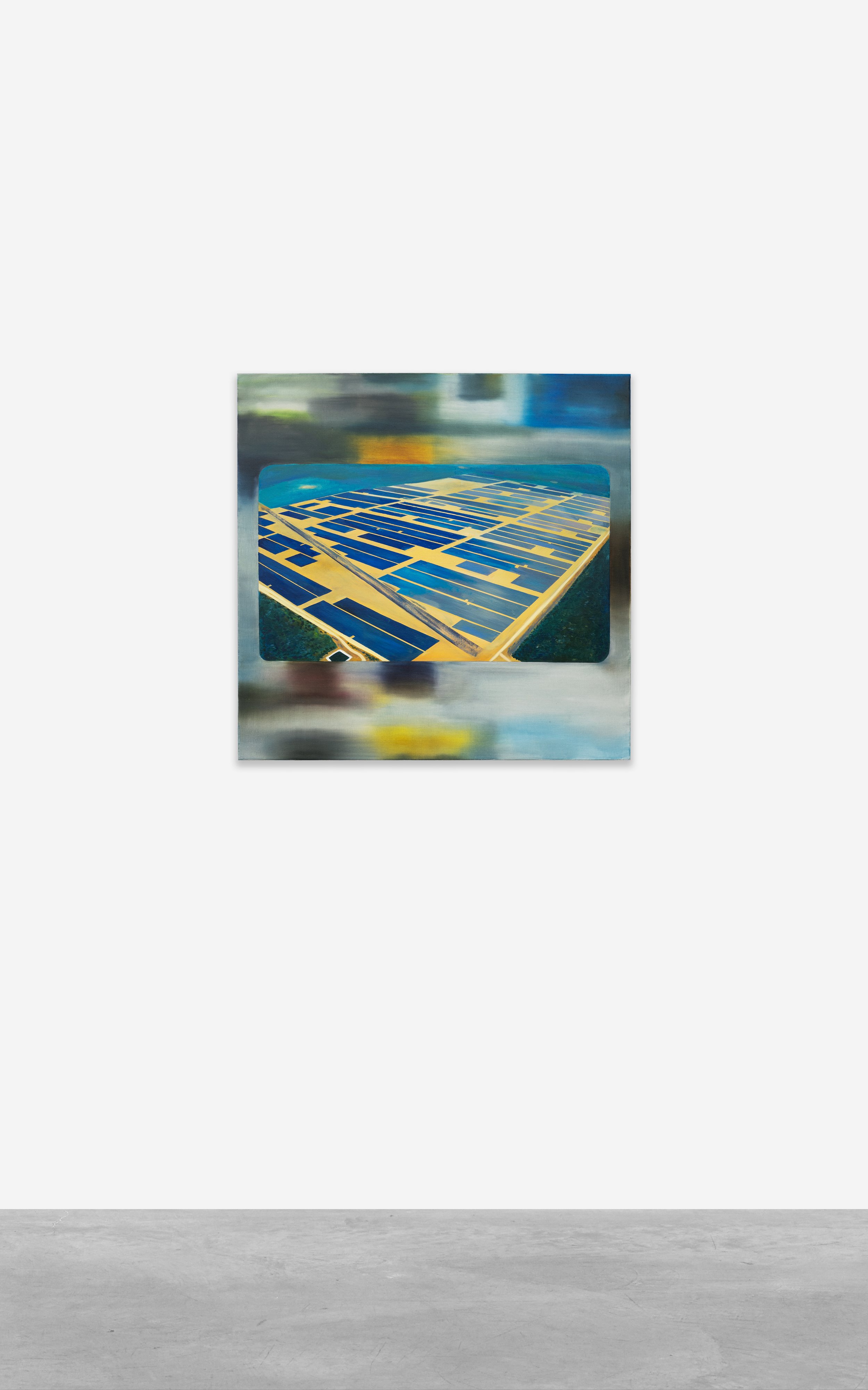
From the window of an airplane, the earth below is a patchwork of greens and browns, a quilt of fields and forests. But in Florida, where Tan Mu lives, this quilt is increasingly punctuated by vast, dark rectangles, the solar farms that stretch across the landscape like shadows cast by an invisible sun. These are the new cathedrals of our age, temples to the god of renewable energy, where sunlight is harvested and converted into the electricity that powers our digital lives. Tan Mu's Solar Farm (2022) captures this transformation, presenting an aerial view of the panels as an abstract electrical grid, a symbol of the shift in our relationship with nature. The painting is a meditation on the artificial sublime, the way that technology can evoke a sense of awe and wonder, even as it reshapes the world around us.
The artist states the subject with ecological and technological clarity. The work examines environmental change and clean energy development, reflecting on the fusion of technology and nature. For Tan Mu, the solar farm is not just a source of energy; it is a symbol of capital, infrastructure, and humanity's intervention in the natural world. The painting captures the tension between the organic and the engineered, the way that the rigid geometry of the panels imposes a new aesthetic order on the land. It is a work of observation, a record of the changing landscape, and a reflection on the role of art in documenting technological transformation. The painting is a bridge between the physical and the digital, between the land and the screen, between the present and the future.
Solar Farm is oil on linen, 76 x 76 cm (30 x 30 in). The square format emphasizes the geometric precision of the solar panels, their repetitive forms creating a rhythmic pattern that dominates the composition. The surface is built with layered glazes that capture the refractive quality of the panels, the way they reflect the sky and the surrounding environment. The colors are muted, dominated by the dark blues and grays of the silicon, punctuated by the soft greens of the grass. The painting is a study in contrasts: the rigidity of the technology versus the fluidity of the landscape, the stillness of the image versus the movement of the clouds, the clarity of the panels versus the blur of the background. It is a work that invites the viewer to look closely, to see the details of the infrastructure that sustains our modern lives.
The viewing distance radically alters the painting's impact. From a distance, the solar farm appears as a single, unified form, a dark mirror reflecting the sky. But as the viewer moves closer, the individual panels become visible, their precise arrangement and the subtle variations in their reflective surfaces. This shift from the abstract to the detailed mirrors the experience of viewing the landscape from an airplane, where the world below is a patchwork of shapes and colors that gradually resolve into recognizable forms. The painting is a site of this shift, a place where the viewer can experience the wonder of the artificial landscape and the beauty of its geometric order. The linen weave is visible beneath the thin layers of paint, grounding the technological imagery in the material reality of the support. The painting is a testament to the power of oil paint to capture the complexity of the technological world, to make the invisible visible and the abstract concrete.
The use of a screenshot from the artist's phone as a source image is a key element of the work. It embeds the painting with a digital visual experience, emphasizing the way that we increasingly perceive the world through screens. The blurred background is a visual metaphor for the overwhelming nature of this digital landscape, the way that information flows around us, fragmented and fleeting. Tan Mu has translated this instability into the language of painting, using soft edges and atmospheric perspective to create a sense of depth and movement. The painting is a map of this mediation, a visualization of the way that technology shapes our perception of reality. It is a reminder that our view of the world is not a direct one, but is filtered through the lenses of our devices.
Living in Florida, Tan Mu is surrounded by these new landscapes. The state is a leader in solar energy production, and the farms are a common sight, vast fields of dark panels that stretch to the horizon. She sees them from her car, from her plane, from her phone, and each viewing is a different experience, a different mediation. The painting is a synthesis of these experiences, a composite image that captures the essence of the solar farm. It is a work of memory, a way of preserving the fleeting impressions of the digital age. It is also a work of archaeology, a digging into the past to uncover the roots of our present condition. The painting is a fossil, a trace of a lost world, a world where the landscape was still natural, still wild. It is a reminder of how far we have come, and how much we have lost. The painting is a work of mourning, a lament for the lost beauty of the natural world. But it is also a work of hope, a vision of a future where we can reclaim that beauty, where we can use technology to connect with nature in more meaningful and authentic ways. The solar farm is a symbol of this hope, a reminder that we can live in harmony with the earth, that we can harvest its energy without destroying its beauty. The painting is a testament to this hope, a celebration of our ingenuity, and a reminder of our responsibility to the earth. It is a work of love, a work of peace, a work of hope. It is a work that will continue to inspire and to challenge us for years to come, a work that will remind us of our place in the world, and of the beauty and the mystery of our shared digital existence.
The comparison with Claude Monet's Gare Saint-Lazare series (1877) is a natural one, given the shared interest in documenting industrial transformation. Monet's paintings of the train station in Paris are celebrations of the modern age, the way that technology was reshaping the city and the way people lived. Tan Mu's painting is a similar celebration, but it is also a critique. It is a reminder that our reliance on technology comes at a cost, the cost of the land, the cost of the resources, the cost of the environmental impact. Monet's steam and smoke are the pollutants of his time; Tan Mu's solar panels are the clean energy of ours. But both are symbols of our desire to control and to harness the forces of nature. Both artists are interested in the sublime, the way that technology can evoke a sense of awe and wonder. But where Monet's sublime is one of power and motion, Tan Mu's is one of stillness and reflection. Her painting is a quiet meditation on the artificial landscape, a reminder of the beauty and the fragility of our engineered world. Monet's station is a place of transit, of movement and energy. Tan Mu's farm is a place of capture, of stillness and accumulation. Both are places where the forces of nature are made to serve human needs, where the wild is tamed and the chaotic is ordered. The painting is a reminder that this ordering is never complete, that nature always reasserts itself, that the grass grows around the panels, that the clouds move across the sky, that the light changes with the time of day. It is a work of humility, a reminder of our place in the natural world, a reminder that we are not masters of the earth, but stewards of it.
Monet's work is often associated with Impressionism, a movement that sought to capture the fleeting effects of light and atmosphere. Tan Mu's work shares this interest, but she is capturing the light of a different age, the light of the digital era, the light that is reflected from the screens of our phones and computers. Her painting is a record of this light, a visualization of the way it shapes our perception of the world. It is a work that asks us to look closely at the sources of our energy, to see the beauty in the functional, the aesthetics in the infrastructure. It is a work of hope, a vision of a future where we can live in harmony with nature, where our technology is sustainable and our landscape is preserved. Monet's paintings are a record of the past, a snapshot of the industrial revolution. Tan Mu's painting is a record of the present, a window into the green revolution. Both works are essential for understanding the complex relationship between humans and nature, a relationship that is constantly evolving and reshaping our world. Monet's steam is a symbol of the power of fossil fuels, the engine of the industrial age. Tan Mu's silicon is a symbol of the power of the sun, the engine of the information age. Both are sources of energy that have transformed our world, that have given us new ways of living and working and connecting. But both have also had a profound impact on the environment, on the air we breathe and the land we inhabit. The painting is a meditation on this impact, a work that asks us to consider the cost of our progress, the price we pay for our convenience. It is a work of responsibility, a call to care for the world, to protect the landscape, to ensure that our future is a sustainable one. It is a work of beauty and of truth, a work that reminds us of the power of art to heal and to transform. The solar farm is not just a source of energy; it is a symbol of our hope for the future, a vision of a world where we can live in harmony with nature, where our technology is sustainable and our landscape is preserved. The painting is a testament to this hope, a celebration of our ingenuity, and a reminder of our responsibility to the earth.
Gerhard Richter's Atlas (1962-ongoing) provides a second, more conceptual parallel. Richter's work is a collection of photographs, sketches, and other images, a vast archive of visual information. It is a work about memory and perception, the way that images are stored and recalled. Tan Mu's use of a phone screenshot is a similar act of archiving, a way of capturing a moment in time and preserving it in paint. But where Richter's images are often blurred and indistinct, Tan Mu's are sharp and clear, a reflection of the high-resolution world we live in. Both artists are interested in the instability of the image, the way that it can be manipulated and distorted. But where Richter's blur is a sign of forgetting, Tan Mu's blur is a sign of overload, the way that we are overwhelmed by the sheer volume of visual information. Her painting is a meditation on this overload, a work that asks us to slow down and to look closely, to see the world with new eyes. Richter's Atlas is a monument to the twentieth century, Tan Mu's Solar Farm is a monument to the twenty-first. Both are testaments to the power of art to preserve and to interpret, to make sense of the visual chaos of our time. Richter's work is a labyrinth of images, a maze of memory and forgetfulness. Tan Mu's work is a window, a clear and focused view of the landscape, but a view that is mediated by the screen, by the phone, by the digital interface. The painting is a reminder that our view of the world is not a direct one, but is filtered through the lenses of our devices. It is a work of mediation, a work that asks us to consider the role of technology in shaping our perception of reality. It is a work of reflection, a mirror that shows us not just the world, but our own relationship to it. The solar farm is a symbol of this relationship, a symbol of our desire to control and to harness the forces of nature, but also of our dependence on those forces, our need for the sun, for the energy it provides. The painting is a testament to this dependence, a celebration of our ingenuity, and a reminder of our vulnerability. It is a work of hope and of fear, a vision of a future where we can live in harmony with nature, but also a warning of the dangers of our technological hubris. It is a work of beauty and of truth, a work that reminds us of the power of art to heal and to transform. The solar farm is not just a source of energy; it is a symbol of our shared humanity, a reminder that we are all part of a larger story, a story of energy and exchange, of struggle and survival. The painting is a chapter in that story, a chapter that invites us to reflect on our own role in the ongoing narrative of the green revolution.
Li Yizhuo's 2025 essay on Tan Mu's work notes the artist's ability to "evoke both connection and disconnection, reflecting the contradictions of that time." Solar Farm is a prime example of this reflection. The painting is a map of our connection to the earth, the way we harvest its energy to power our lives. But it is also a map of our disconnection, the way we mediate our experience of the world through screens and devices. The solar panels are both bridges and barriers, symbols of our unity with nature and our separation from it. The painting is a meditation on this paradox, a work that helps us to understand the complex realities of our green transition. It is a work of hope and of caution, a celebration of the power of renewable energy, and a warning of the dangers of relying on systems that are beyond our control. It is a work that asks us to consider the cost of our convenience, the human and environmental price of the energy that sustains our lifestyles. Li Yizhuo argues that Tan Mu's work is not just a reflection of the world, but a critical engagement with it, a way of thinking through the ethical and social implications of our globalized condition. The painting is a tool for this thinking, a place where we can explore the complex emotions and ideas that have emerged from this period. It is a work that helps us to understand our place in the world, and to imagine a future that is more just and more connected. The solar farm is a symbol of this future, a vision of a world where we can live in harmony with nature, where our technology is sustainable and our landscape is preserved. The painting is a testament to this vision, a celebration of our ingenuity, and a reminder of our responsibility to the earth. It is a work of hope, a work of peace, a work of love. It is a work that will continue to inspire and to challenge us for years to come, a work that will remind us of our place in the world, and of the beauty and the mystery of our shared digital existence.
The painting sits within a larger series of works by Tan Mu that explore the theme of energy and infrastructure. From Memory (2021) to Containers (2021), she has been documenting the hidden systems that support our modern lives. Solar Farm is a key work in this series, a work that brings together her interest in renewable energy, her fascination with industrial forms, and her concern for the ecological impact of technology. It is a work that is both specific and universal, a document of a particular landscape that speaks to the global challenge of climate change. The painting is a testament to the power of art to illuminate the unseen, to make the invisible visible, and to help us understand our place in the world. It is a work that reminds us that we are not just consumers of energy, but participants in its production, shaped by the landscapes we inhabit and the technologies we use.
Ultimately, Solar Farm is a painting about the future. It is about the way we are reshaping the earth to meet our needs, the way we are building a new landscape of energy. It is a celebration of this ingenuity, a celebration of the human capacity to innovate and to adapt. But it is also a reminder of the fragility of this future, of the need to care for the land and to protect the environment. The painting is a call to action, a call to work for a more sustainable and equitable world. It is a work of beauty and of truth, a work that reminds us of the power of art to heal and to transform. The solar panels are not just objects; they are symbols of hope, of a future where we can live in harmony with nature. They are a reminder that we are all part of a larger story, a story of energy and exchange, of struggle and survival. The painting is a chapter in that story, a chapter that invites us to reflect on our own role in the ongoing narrative of the green revolution.