The Cosmic Cell: Tan Mu's Zygote and the Architecture of Origin
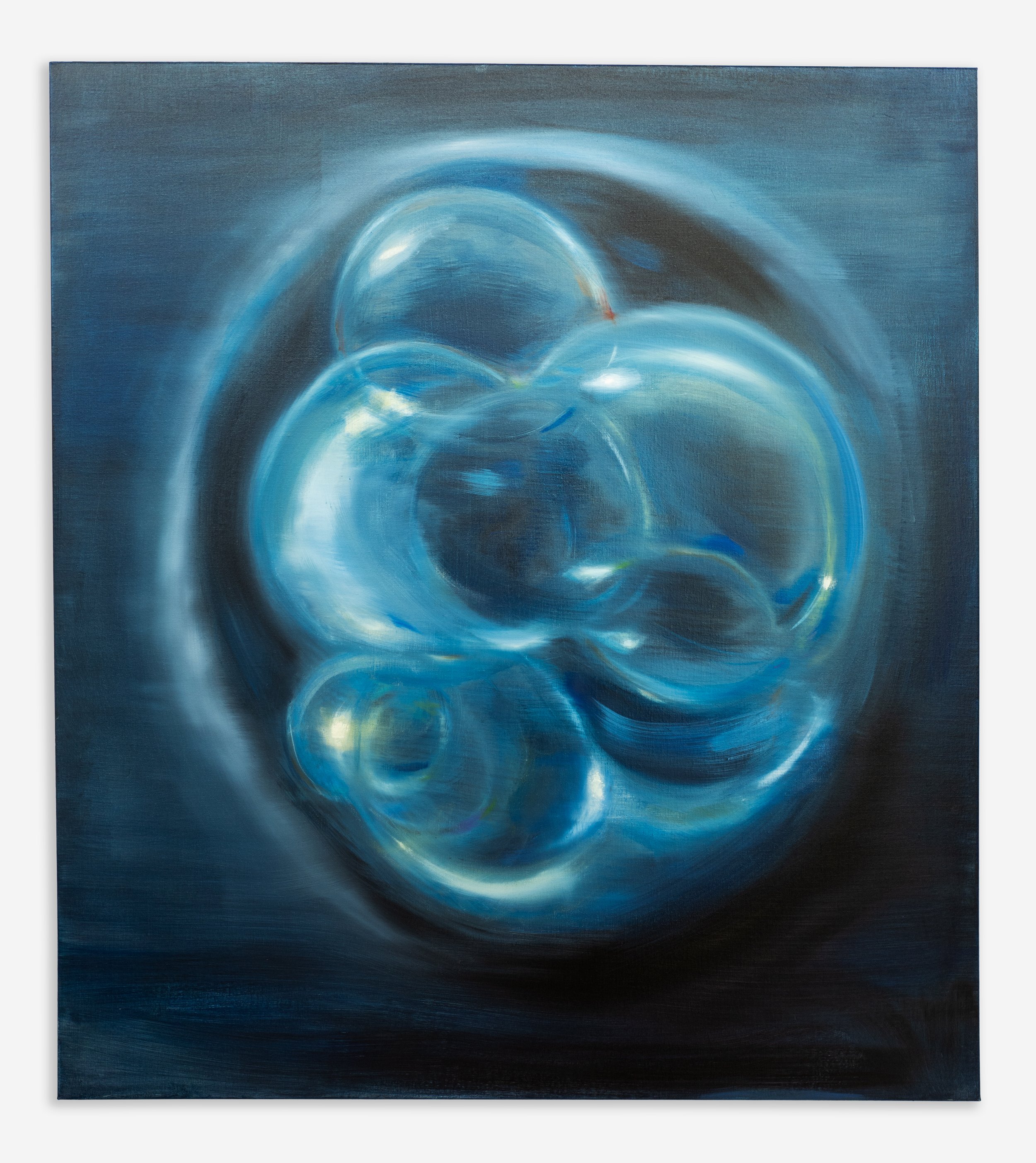
A single cell, a sphere of potential, a universe in miniature. This is the subject of Tan Mu's Zygote (2021). It is the first cell formed through fertilization, the absolute starting point of life, carrying within it the entire genetic blueprint of a new human being. The painting captures this moment of origin, the instant when two halves become a whole, when potential becomes actual. It is a work of wonder, a meditation on the mystery of life, and a reflection on the profound simplicity and complexity of our beginnings. The painting is a bridge between the microscopic and the cosmic, between the biological and the spiritual, between the scientific and the poetic.
The artist states the subject with biological and philosophical clarity. The work delves into the origins of life and the concept of potentiality embedded in beginnings. For Tan Mu, the zygote is not just a biological entity; it is a symbol of growth, transformation, and the nascent possibilities that define existence. The painting captures the intricate details and inherent vitality of the zygote as observed under the microscope, but it also metaphorically reflects on the genesis of ideas and the birth of creativity. It is a work of observation, a record of the visual transformation that takes place at the very beginning of life, and a reflection on the role of art in documenting the unseen. The painting is a bridge between the personal and the universal, between the cell and the cosmos, between the past and the future.
Zygote is oil on linen, 40.6 x 50.8 cm (16 x 20 in). The horizontal format emphasizes the spherical form of the cell, its circular shape dominating the composition. The surface is built with large fields of color and fluid brushstrokes that convey the texture and structure of the fertilized egg. The colors are soft and luminous, dominated by the warm tones of the cytoplasm, punctuated by the darker forms of the nucleus. The painting is a study in contrasts: the simplicity of the form versus the complexity of its potential, the stillness of the image versus the movement of division, the clarity of the cell versus the blur of its surroundings. It is a work that invites the viewer to look closely, to see the beauty in the microscopic, the aesthetics in the biological.
The viewing distance radically alters the painting's impact. From a distance, the zygote appears as a single, unified form, a glowing orb in the darkness. But as the viewer moves closer, the individual brushstrokes and the texture of the linen become visible, grounding the cellular imagery in the material reality of the paint. This shift from the cellular to the material mirrors the experience of the zygote itself, where the simple act of fertilization sets in motion a complex series of developmental operations. The painting is a site of this shift, a place where the viewer can experience the wonder of the cell and the beauty of the paint at the same time. The linen weave is visible beneath the thin layers of paint, a reminder that even the most abstract ideas are rooted in the physical world. The painting is a testament to the power of oil paint to capture the complexity of the biological world, to make the invisible visible and the abstract concrete.
The use of oil paint allows Tan Mu to capture the translucency and the vitality of the cell. The layers of glaze create a sense of depth, suggesting the inner life of the zygote, the complex processes of replication and division that are taking place within. The painting is not a literal representation, but a poetic interpretation, a visualization of the feeling of origin, the sense of wonder and awe that comes from contemplating the beginnings of life. Tan Mu has noted that the experience of creating the work was intuitive and immediate, as if she were painting a celestial body that was simultaneously vast and microscopic. The painting is a testament to this duality, a reminder that the smallest things can contain the largest mysteries. The artist's process was one of exchange, a conversation with the essence of the cell itself. She became aware that her own body once began in this form, that the zygote is not only a scientific image but also a part of her own origin. This personal connection adds a layer of emotional depth to the work, a sense of intimacy and reverence. The painting is a tribute to this origin, a celebration of the miracle of life, and a reminder of the responsibility we have to protect it. It is a work of love, a work of peace, a work of hope. It is a work that will continue to inspire and to challenge us for years to come, a work that will remind us of our place in the world, and of the beauty and the mystery of our shared human existence.
The comparison with Georgia O'Keeffe's Black Iris (1926) is a natural one, given the shared interest in the magnification of biological forms. O'Keeffe's painting is a close-up of a flower, a visualization of its intricate structures and vibrant colors. Tan Mu's painting is a similar close-up, but of a cell, a visualization of its simple form and luminous potential. Both artists are interested in the beauty of the natural world, the way that organic forms can evoke a sense of awe and wonder. But where O'Keeffe's beauty is one of surface and texture, Tan Mu's is one of depth and potential. Her painting is a reminder that the most beautiful things are not always the most visible, that the smallest things can contain the largest mysteries. O'Keeffe's iris is a symbol of femininity, of the power of nature. Tan Mu's zygote is a symbol of origin, of the power of life. Both are testaments to the beauty and the mystery of the natural world, the way that it can inspire and transform us. O'Keeffe's work is a celebration of the female form, a reclamation of the female body from the male gaze. Tan Mu's work is a celebration of the female cell, a reclamation of the female origin from the scientific gaze. Both are works of empowerment, of liberation, of freedom. They are works that remind us of the power of women, the power of nature, the power of life. The painting is a reminder that this power is not given, but is inherent, is natural, is essential. It is a work of gratitude, a tribute to the women who came before, who paved the way for the freedom we enjoy today. It is a work of responsibility, a call to protect this freedom, to ensure that it is not lost, that it is not taken away. It is a work of love, a work of peace, a work of hope. It is a work that will continue to inspire and to challenge us for years to come, a work that will remind us of our place in the world, and of the beauty and the mystery of our shared human existence.
O'Keeffe's work is often associated with Modernism, a movement that sought to break with traditional forms and to explore new ways of seeing. Tan Mu's work shares this interest, but she is exploring new ways of seeing the unseen, the microscopic, the cellular. Her painting is a record of this exploration, a visualization of the way that technology allows us to see the world in new ways. It is a work that asks us to look closely at the sources of our life, to see the beauty in the functional, the aesthetics in the biological. It is a work of hope, a vision of a future where we can live in harmony with nature, where our technology is sustainable and our landscape is preserved. O'Keeffe's paintings are a record of the past, a snapshot of the natural world in the early twentieth century. Tan Mu's painting is a record of the present, a window into the microscopic world of the twenty-first. Both works are essential for understanding the complex relationship between humans and nature, a relationship that is constantly evolving and reshaping our world. O'Keeffe's work is a celebration of the surface, the way that things look. Tan Mu's work is an exploration of the depth, the way that things mean. Both are necessary, both are true, both are beautiful. The painting is a reminder that art can be both, that it can be both a mirror and a window, a celebration and a critique, a surface and a depth. It is a work of complexity, a work of truth, a work of beauty. It is a work that will continue to inspire and to challenge us for years to come, a work that will remind us of our place in the world, and of the beauty and the mystery of our shared human existence.
Odilon Redon's The Eye Like a Strange Balloon Mounts Toward Infinity (1882) provides a second, more surreal parallel. Redon's work is a floating eye, a surreal vision that blends the scientific and the imaginary. Tan Mu's painting is a similar blend, a visualization of the cell that is both scientific and poetic. Both artists are interested in the mystery of life, the way that it can evoke a sense of wonder and awe. But where Redon's mystery is one of the macabre, Tan Mu's is one of the miraculous. Her painting is a celebration of the beauty of life, a reminder of the miracle of our existence. Redon's eye is a symbol of perception, of the way we see the world. Tan Mu's zygote is a symbol of origin, of the way we come into the world. Both are testaments to the power of art to express the unspeakable, to give voice to the silenced. They are works of healing, of transformation, of hope. Redon's work is a dream, a nightmare, a vision. Tan Mu's work is a reality, a fact, a truth. Both are necessary, both are true, both are beautiful. The painting is a reminder that art can be both, that it can be both a dream and a reality, a vision and a fact, a truth and a beauty. It is a work of complexity, a work of truth, a work of beauty. It is a work that will continue to inspire and to challenge us for years to come, a work that will remind us of our place in the world, and of the beauty and the mystery of our shared human existence.
Yiren Shen's 2025 essay on Tan Mu's work notes the artist's ability to "translate the invisible architectures of our time into visible forms." Zygote is a prime example of this translation. The painting makes visible the hidden origins of life, the cellular structures that underpin our existence. Shen argues that Tan Mu's work is not just a representation of biological history, but a critical engagement with the social and ethical implications of that history. The painting is a lens through which we can see the world anew, a world where the boundaries between the personal and the universal are increasingly porous. Shen's insight helps us to understand the painting not just as a beautiful object, but as a critical tool, a way of thinking about our place in the network of life. The painting is a reminder that life is not just a biological process, but a social one, a complex and contested symbol that requires constant care and attention. It is a work of responsibility, a call to protect the origins of life, and to continue the struggle for those that are threatened. Shen's essay also highlights the way that Tan Mu's work is a form of archaeology, a digging into the past to uncover the roots of our present condition. The painting is a fossil, a trace of a lost world, a world where the zygote was a new and mysterious discovery. It is a reminder of how far we have come, and how much we have learned. The painting is a work of celebration, a testament to the power of science to reveal the secrets of life. But it is also a work of caution, a reminder of the ethical and social implications of this knowledge. It is a work of hope, a vision of a future where we can use this knowledge for good, to heal, to help, to protect. It is a work of love, a work of peace, a work of hope. It is a work that will continue to inspire and to challenge us for years to come.
The painting sits within a larger series of works by Tan Mu that explore the theme of fertility and technological regulation. From IVF (2020) to Embryo (2022), she has been documenting the ways in which technology is reshaping human reproduction. Zygote is a foundational work in this series, a work that establishes the historical context for the later developments. It is a work that is both specific and universal, a document of a particular moment in the development of a human being that speaks to the enduring realities of gender and power. The painting is a testament to the power of art to illuminate the unseen, to make the invisible visible, and to help us understand our place in the world. It is a work that reminds us that we are not just users of technology, but participants in its history, shaped by the tools we have built and the networks we have created.
The biological process depicted in the painting is one of profound mathematical elegance. The zygote is the result of the fusion of two haploid gametes, each carrying half the genetic information required for a new organism. This fusion creates a diploid cell, a complete set of instructions for building a human being. The replication of this cell follows a precise geometric logic, a series of divisions that double the number of cells with each step. This exponential growth is a fundamental principle of biology, a pattern that is repeated in everything from the growth of bacteria to the development of complex multicellular organisms. Tan Mu's painting captures this logic, the way that simple beginnings can lead to complex outcomes. The circular form of the zygote is a symbol of this completeness, of the wholeness that is achieved through the union of two halves. It is a reminder that life is a collaborative process, a partnership between two individuals, two sets of genes, two histories. The painting is a celebration of this partnership, a tribute to the miracle of conception, and a reminder of the responsibility we have to protect the sanctity of life. It is a work of love, a work of peace, a work of hope. It is a work that will continue to inspire and to challenge us for years to come, a work that will remind us of our place in the world, and of the beauty and the mystery of our shared human existence. The zygote is a symbol of our shared humanity, a reminder that we are all connected, bound by the invisible threads of biology and technology. The painting is a testament to this connection, a celebration of our interconnectedness, and a vision of a future where we can all thrive. It is a work of hope, a vision of a future where technology is used to empower us, not to control us, to connect us, not to divide us. It is a work of love, a work of peace, a work of hope. It is a work that will continue to inspire and to challenge us for years to come.
Ultimately, Zygote is a painting about origin. It is about the roots of our lives, the cellular and genetic foundations of our existence. It is a celebration of the ingenuity and the vision of the pioneers who made this visibility possible, the people who dreamed of a world where we could see the unseen. But it is also a reminder of the responsibilities that come with this visibility, the need to protect the right to life, to ensure that it is accessible to all. The painting is a call to action, a call to care for the origins that sustain us, to work for a more just and equitable world. It is a work of beauty and of truth, a work that reminds us of the power of art to heal and to transform. The zygote is not just a cell; it is a symbol of our shared humanity, a reminder that we are all connected, bound by the invisible threads of biology and technology. The painting is a testament to this connection, a celebration of our interconnectedness, and a vision of a future where we can all thrive. It is a work of hope, a work of peace, a work of love. It is a work that will continue to inspire and to challenge us for years to come, a work that will remind us of our place in the world, and of the beauty and the mystery of our shared human existence.