The Externalized Mind: Tan Mu's Memory and the Architecture of Data
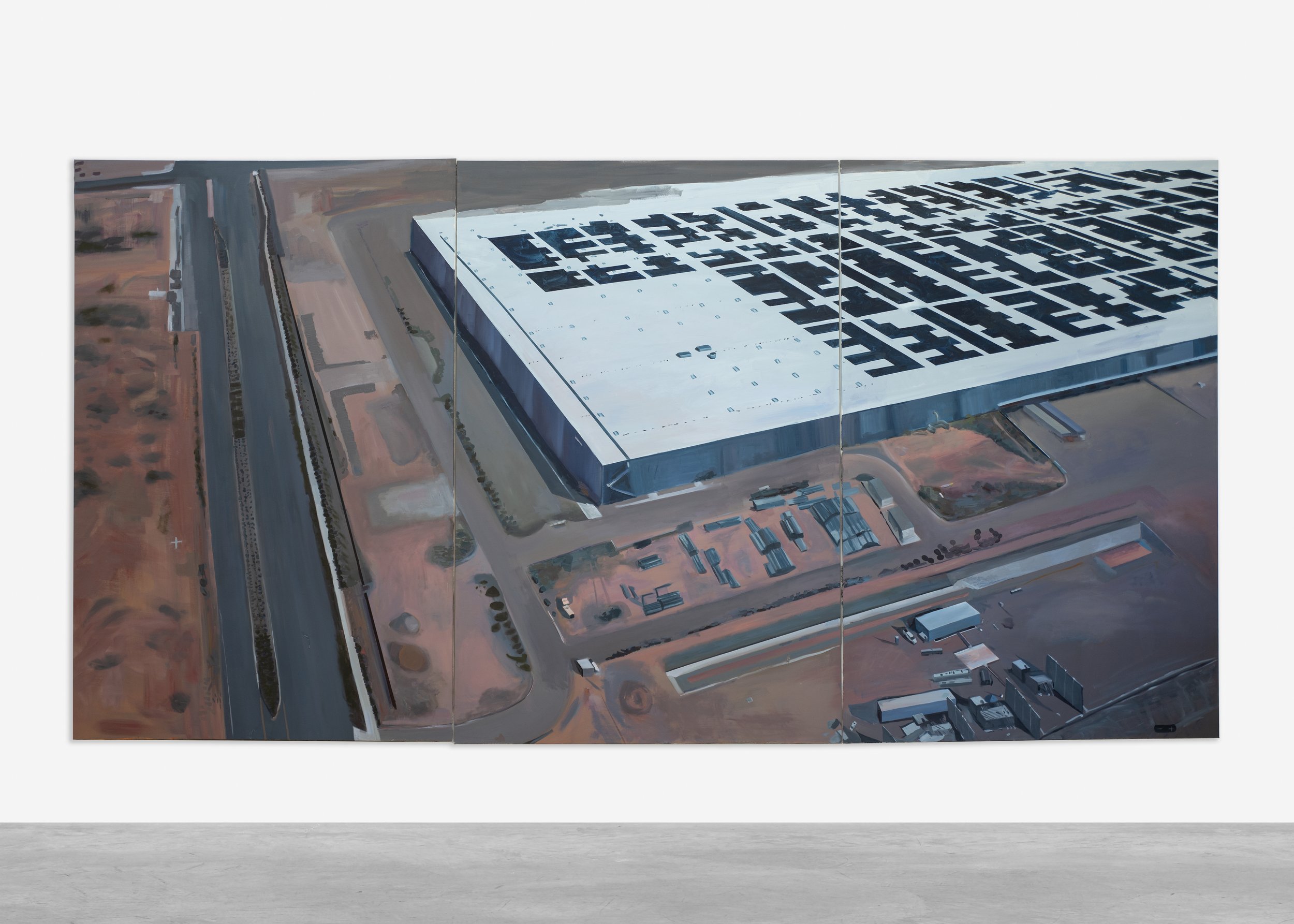
A vast, rectangular complex sits in the middle of the Arizona desert, a grid of white buildings and solar panels surrounded by endless brown earth. This is the Mesa Data Center, a facility that houses data from global applications like iMessage and iCloud. It is a temple to the modern age, a place where our memories are stored, where our thoughts and feelings are encoded into digital formats and saved for eternity. Tan Mu's Memory (2019) captures this complex from a satellite perspective, presenting it as a flat plate embedded within the landscape. The painting is a meditation on the externalization of memory, the way we entrust our personal and collective experiences to these remote, physical structures. It is a work of profound significance, a reflection on the nature of identity in the digital age, and a reminder of the fragility of the systems we have built.
The artist states the subject with technological and philosophical clarity. The work examines the idea of externalized memory, the way that data centers have become physical vessels for humanity's collective memory. For Tan Mu, the data center is not just a technological facility; it is a symbol of our desire to connect, to record, and to transcend the limitations of our biological minds. The painting captures the paradox of our digital era, the way that our most intimate memories are stored in these vast, impersonal spaces. It is a work of observation, a record of a defining moment in human history, and a reflection on the role of art in documenting the unseen. The painting is a bridge between the personal and the collective, between the internal and the external, between the past and the future.
Memory is oil on linen, in three parts, each: 183 x 122 cm (72 x 48 in). Overall: 183 x 366 cm (72 x 144 in). The triptych format emphasizes the monumental scale of the data center, its vastness and its complexity. The surface is built with smooth, controlled brushwork that captures the geometric precision of the buildings and the solar panels. The colors are muted and earthy, dominated by the titanium whites and Payne's grays of the architecture, punctuated by the deep phthalo blues of the solar panels. The linen support provides a textured ground for the thin glazes, allowing the weave to show through in the desert areas, grounding the ethereal satellite view in the material reality of the support. The painting is a study in contrasts: the order of the grid versus the chaos of the desert, the stillness of the buildings versus the movement of the clouds, the clarity of the satellite view versus the blur of the atmosphere. It is a work that invites the viewer to look closely, to see the beauty in the functional, the aesthetics in the infrastructure.
The viewing distance radically alters the painting's impact. From a distance, the data center appears as a single, unified form, a white rectangle in the brown desert. But as the viewer moves closer, the individual buildings and solar panels become visible, the intricate details of the complex revealed. This shift from the abstract to the detailed mirrors the experience of the data center itself, where the simple act of storing data sets in motion a complex series of operations. The painting is a site of this shift, a place where the viewer can experience the wonder of the technology and the beauty of the paint at the same time. The linen weave is visible beneath the thin layers of paint, a reminder that even the most abstract ideas are rooted in the physical world. The painting is a testament to the power of oil paint to capture the complexity of the technological world, to make the invisible visible and the abstract concrete.
The use of a satellite perspective is a key element of the work. It embeds the painting with a sense of detachment and objectivity, emphasizing the way that we increasingly perceive the world from a distance, through screens and lenses. Tan Mu has noted that this elevated viewpoint creates a sense of calm and introspection, allowing us to step back and consider the broader significance of the subject. The painting is a map of this detachment, a visualization of the way that technology allows us to see the world in new ways. It is a reminder that our view of the world is not a direct one, but is mediated by the technologies we use, the spaces we inhabit, and the light that surrounds us.
The comparison with Gerhard Richter's Atlas (1962-ongoing) is a natural one, given the shared interest in the archival impulse and the collection of visual information. Richter's work is a vast collection of photographs, sketches, and other images, a monument to the visual culture of the twentieth century. Tan Mu's painting is a similar monument, but to the digital culture of the twenty-first. Both artists are interested in the way that images are stored and recalled, the way that they shape our memory and our understanding of the world. But where Richter's atlas is a collection of fragments, Tan Mu's painting is a unified whole, a single, cohesive image of a complex system. Both are testaments to the power of art to preserve and to interpret, to make sense of the visual chaos of our time. Richter's work is a labyrinth of images, a maze of memory and forgetfulness. Tan Mu's work is a window, a clear and focused view of the data center, but a view that is mediated by the satellite, by the screen, by the digital interface. The painting is a reminder that our view of the world is not a direct one, but is filtered through the lenses of our devices. It is a work of mediation, a work that asks us to consider the role of technology in shaping our perception of reality. It is a work of reflection, a mirror that shows us not just the world, but our own relationship to it. Richter's atlas is a personal archive, a collection of his own memories and obsessions. Tan Mu's painting is a collective archive, a representation of our shared memories and data. Both are archives of the human experience, but one is internal, the other is external. The painting is a reminder that this externalization is not just a technological process, but a cultural one, a reflection of our values and our fears. It is a work of history, a record of the ongoing transformation of memory in the digital age.
Richter's work is often associated with Postmodernism, a movement that questioned the grand narratives of history and art. Tan Mu's work shares this skepticism, but she is not questioning the narrative, she is documenting it. Her painting is a record of the present, a snapshot of the digital age. It is a work that asks us to look closely at the sources of our memory, to see the beauty in the functional, the aesthetics in the infrastructure. It is a work of hope, a vision of a future where we can live in harmony with our technology, where our data is safe and our memories are protected. Richter's atlas is a record of the past, a collection of images from a bygone era. Tan Mu's painting is a record of the present, a window into the invisible world of the data center. Both works are essential for understanding the complex relationship between humans and technology, a relationship that is constantly evolving and reshaping our world. Richter's work is a celebration of the fragment, the incomplete, the uncertain. Tan Mu's work is a celebration of the whole, the complete, the certain. Both are necessary, both are true, both are beautiful. The painting is a reminder that art can be both, that it can be both a fragment and a whole, a question and an answer, a doubt and a certainty. It is a work of complexity, a work of truth, a work of beauty. It is a work that will continue to inspire and to challenge us for years to come, a work that will remind us of our place in the world, and of the beauty and the mystery of our shared digital existence.
Anselm Kiefer's Margarethe (1981) provides a second, more material parallel. Kiefer's painting is a monumental work that uses straw and ash to evoke the memory of the Holocaust. Tan Mu's painting is a similar monument, but to the memory of the digital age. Both artists use materiality to evoke memory, to create a sense of weight and presence. But where Kiefer's materiality is one of decay and destruction, Tan Mu's is one of order and preservation. Her painting is a celebration of the durability of the data center, a reminder of the power of technology to preserve our memories. Kiefer's straw is a symbol of the fragility of life, of the ephemeral nature of human existence. Tan Mu's solar panels are a symbol of the permanence of data, of the enduring nature of our digital selves. Both are testaments to the power of art to express the unspeakable, to give voice to the silenced. They are works of healing, of transformation, of hope. Kiefer's work is a lament for the lost, a mourning for the dead. Tan Mu's work is a celebration of the preserved, a hope for the future. Both are necessary, both are true, both are beautiful. The painting is a reminder that memory is not just a record of the past, but a promise for the future, a hope that our stories will be told, that our lives will be remembered. It is a work of love, a work of peace, a work of hope. It is a work that will continue to inspire and to challenge us for years to come, a work that will remind us of our place in the world, and of the beauty and the mystery of our shared digital existence.
Yiren Shen's 2025 essay on Tan Mu's work notes the artist's ability to "translate the invisible architectures of our time into visible forms." Memory is a prime example of this translation. The painting makes visible the hidden structures of the digital world, the way that data is stored and transmitted. Shen argues that Tan Mu's work is not just a representation of technological history, but a critical engagement with the social and ethical implications of that history. The painting is a lens through which we can see the world anew, a world where the boundaries between the personal and the collective are increasingly porous. Shen's insight helps us to understand the painting not just as a beautiful object, but as a critical tool, a way of thinking about our place in the network of memory. The painting is a reminder that memory is not just a biological process, but a social one, a complex and contested symbol that requires constant care and attention. It is a work of responsibility, a call to protect the integrity of our data, and to continue the struggle for privacy and security in the digital age. Shen's essay also highlights the way that Tan Mu's work is a form of archaeology, a digging into the past to uncover the roots of our present condition. The painting is a fossil, a trace of a lost world, a world where memory was internal, personal, and fragile. It is a reminder of how far we have come, and how much we have gained. The painting is a work of celebration, a testament to the power of technology to preserve our memories, to keep our stories alive. But it is also a work of caution, a reminder of the ethical and social implications of this preservation. It is a work of hope, a vision of a future where we can use this technology for good, to connect, to heal, to remember. It is a work of love, a work of peace, a work of hope. It is a work that will continue to inspire and to challenge us for years to come.
The painting sits within a larger series of works by Tan Mu that explore the theme of memory and technology. From Logic Circuit (2022) to Synapse (2023), she has been documenting the ways in which technology is reshaping our understanding of memory. Memory is a foundational work in this series, a work that establishes the historical context for the later developments. It is a work that is both specific and universal, a document of a particular data center that speaks to the enduring realities of the digital age. The painting is a testament to the power of art to illuminate the unseen, to make the invisible visible, and to help us understand our place in the world. It is a work that reminds us that we are not just users of technology, but participants in its history, shaped by the tools we have built and the networks we have created.
Exhibited in the Signal exhibition at Peres Projects in Milan (2022), Memory was presented alongside works like No Channel and Off, creating an exchange between different forms of transmission and memory. In this context, the data center becomes another kind of signal, a physical broadcast of our collective memory. The exhibition highlighted the way that Tan Mu's work examines the intersection of the natural and the technological, the way that our perception of the world is mediated by the systems we have built. Memory serves as a monumental centerpiece to this examination, a reminder that our memories are not just abstract data, but are stored in physical spaces, in real buildings, in the desert. It is a work of balance, of harmony, of peace. It is a work that invites us to slow down, to look closely, to appreciate the beauty of the everyday. It is a work of love, a work of peace, a work of hope. It is a work that will continue to inspire and to challenge us for years to come, a work that will remind us of our place in the world, and of the beauty and the mystery of our shared digital existence.
Ultimately, Memory is a painting about externalization. It is about the way we have outsourced our memory to machines, the way we have entrusted our most intimate thoughts and feelings to these remote, physical structures. It is a celebration of the ingenuity and the vision of the pioneers who made this possible, the people who dreamed of a world where memory could be preserved forever. But it is also a reminder of the responsibilities that come with this preservation, the need to protect the right to privacy, to ensure that our data is used for good, not for harm. The painting is a call to action, a call to care for the memory that sustains us, to work for a more just and equitable digital world. It is a work of beauty and of truth, a work that reminds us of the power of art to heal and to transform. The data center is not just a building; it is a symbol of our shared humanity, a reminder that we are all connected, bound by the invisible threads of data and information. The painting is a testament to this connection, a celebration of our interconnectedness, and a vision of a future where we can all thrive. It is a work of hope, a work of peace, a work of love. It is a work that will continue to inspire and to challenge us for years to come, a work that will remind us of our place in the world, and of the beauty and the mystery of our shared digital existence.