The Luminous Threshold: Tan Mu's Sunset and the Urban Sublime
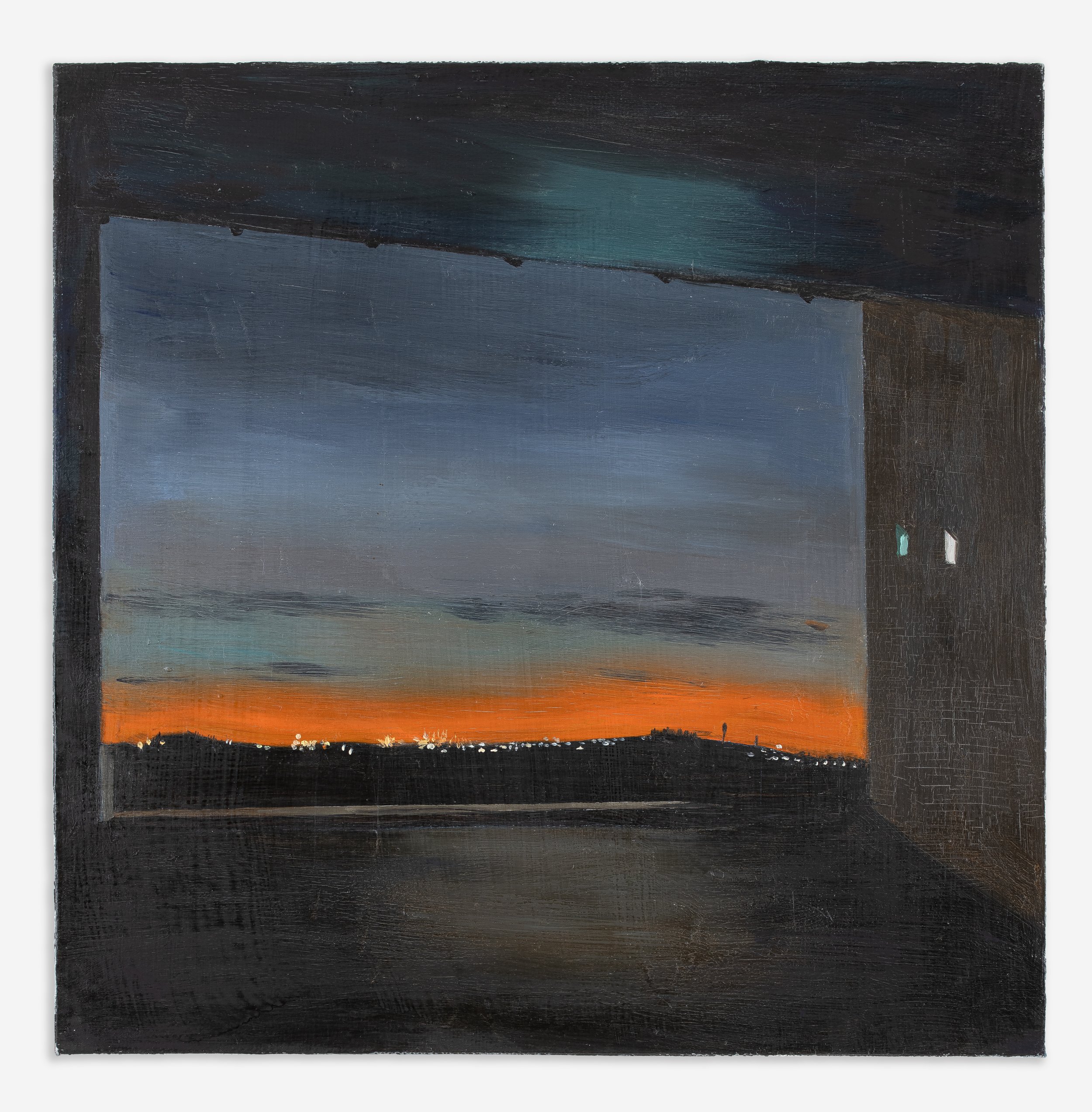
The horizon glows with the last light of day, a warm band of orange and pink that stretches across the East River. In the foreground, the interior wall of a studio is dotted with small, artificial lights, a mirror of the distant city lights across the water. This is the scene that Tan Mu captures in Sunset (2021). It is a moment of transition, a threshold between day and night, between the natural and the artificial, between the interior and the exterior. The painting is a meditation on this threshold, a reflection on the way that light shapes our perception of the world, and the way that the city transforms the landscape into a network of information and energy. It is a work of quiet beauty, a testament to the power of observation, and a reminder of the subtle tensions that exist in the everyday.
The artist states the subject with perceptual and philosophical clarity. The work depicts a view near her studio in downtown Manhattan, based on a photograph she took overlooking the East River. For Tan Mu, the sunset is not just a natural phenomenon; it is a signal of change, a marker of time, a symbol of the ongoing transformation of the urban environment. The painting captures the interplay between the receding natural light and the emerging artificial illumination, the way that the city gradually takes over from the sky. It is a work of observation, a record of a fleeting moment, and a reflection on the role of art in documenting the invisible structures that shape our lives. The painting is a bridge between the personal and the universal, between the interior and the exterior, between the present and the future.
Sunset is oil on canvas, 31 x 31 cm (12 x 12 in). The square format emphasizes the balance between the interior and the exterior, the natural and the artificial. The surface is built with smooth, controlled brushwork that captures the subtle gradations of light and color. The colors are warm and luminous, dominated by the cadmium oranges and quinacridone pinks of the sunset, punctuated by the cool titanium whites and phthalo blues of the artificial lights. The canvas support provides a textured ground for the thin glazes, allowing the weave to show through in the darker areas, grounding the ethereal light in the material reality of the support. The painting is a study in contrasts: the warmth of the natural light versus the coolness of the artificial, the stillness of the interior versus the movement of the city, the clarity of the horizon versus the blur of the distant lights. It is a work that invites the viewer to look closely, to see the beauty in the ordinary, the aesthetics in the everyday.
The viewing distance radically alters the painting's impact. From a distance, the sunset and the city lights merge into a single, unified field of luminosity, a glowing horizon that stretches across the canvas. But as the viewer moves closer, the individual brushstrokes and the texture of the canvas become visible, grounding the atmospheric imagery in the material reality of the paint. This shift from the atmospheric to the material mirrors the experience of the sunset itself, where the gradual fading of light reveals the hidden structures of the city. The painting is a site of this shift, a place where the viewer can experience the wonder of the natural world and the beauty of the urban landscape at the same time. The canvas weave is visible beneath the thin layers of paint, a reminder that even the most abstract ideas are rooted in the physical world. The painting is a testament to the power of oil paint to capture the complexity of the urban world, to make the invisible visible and the abstract concrete.
The use of a photograph as a source image is a key element of the work. It embeds the painting with a sense of immediacy and realism, emphasizing the way that we increasingly perceive the world through screens and lenses. Tan Mu has noted that the distant lights across the river resemble points of data or signals, a visual language that connects this work to her broader exploration of networks and information systems. The painting is a map of this connection, a visualization of the way that the city is not just a place, but a system, a complex network of energy and information. It is a reminder that our view of the world is not a direct one, but is mediated by the technologies we use, the spaces we inhabit, and the light that surrounds us.
The comparison with J.M.W. Turner's The Fighting Temeraire (1839) is a natural one, given the shared interest in the depiction of transition and the sublime representation of light. Turner's painting is a farewell to the age of sail, a visualization of the passing of an era. Tan Mu's painting is a similar farewell, but to the age of natural light, to the time before the city fully takes over. Both artists are interested in the beauty of the ephemeral, the way that light can evoke a sense of awe and wonder. But where Turner's beauty is one of nostalgia and loss, Tan Mu's is one of anticipation and possibility. Her painting is a reminder that the end of one thing is the beginning of another, that the setting of the sun is the rising of the city. Turner's Temeraire is a symbol of the past, of the glory of the British navy. Tan Mu's sunset is a symbol of the present, of the power of the urban landscape. Both are testaments to the beauty and the mystery of the natural world, the way that it can inspire and transform us. Turner's ship is being towed to its final resting place, a ghost of a bygone era. Tan Mu's city is coming to life, a vibrant network of energy and information. Both are paintings of transition, of the moment when one state gives way to another, when the old is replaced by the new. The painting is a reminder that this transition is not just a natural process, but a cultural one, a reflection of the values and the aspirations of our time. It is a work of history, a record of the ongoing transformation of the urban landscape.
Turner's work is often associated with Romanticism, a movement that sought to capture the emotional and spiritual power of nature. Tan Mu's work shares this interest, but she is capturing the emotional and spiritual power of the city, the way that urban light can evoke a sense of wonder and awe. Her painting is a record of this power, a visualization of the way it shapes our perception of the world. It is a work that asks us to look closely at the sources of our light, to see the beauty in the functional, the aesthetics in the infrastructure. It is a work of hope, a vision of a future where we can live in harmony with the city, where our technology is sustainable and our landscape is preserved. Turner's paintings are a record of the past, a snapshot of the industrial revolution. Tan Mu's painting is a record of the present, a window into the urban sublime. Both works are essential for understanding the complex relationship between humans and nature, a relationship that is constantly evolving and reshaping our world. Turner's light is the light of the sunset, the fading glow of the natural world. Tan Mu's light is the light of the city, the emerging glow of the artificial world. Both are lights of transition, of the moment when day becomes night, when nature becomes culture. The painting is a reminder that this moment is not just a visual one, but a philosophical one, a reflection on the nature of reality and the role of human intervention in the natural world. It is a work of philosophy, a meditation on the meaning of light and the power of perception.
Giorgio de Chirico's The Enigma of an Autumn Afternoon (1910) provides a second, more metaphysical parallel. De Chirico's painting is a surreal vision of an empty city square, a place of stillness and mystery. Tan Mu's painting is a similar vision, but it is filled with light, with energy, with life. Both artists are interested in the enigma of the urban space, the way that it can evoke a sense of unease and wonder. But where de Chirico's enigma is one of absence, Tan Mu's is one of presence. Her painting is a celebration of the vitality of the city, a reminder of the human activity that animates the urban landscape. De Chirico's square is a symbol of the unconscious, of the hidden fears and desires that lie beneath the surface of the city. Tan Mu's sunset is a symbol of the conscious, of the awareness and the attention that we bring to our daily lives. Both are testaments to the power of art to express the unspeakable, to give voice to the silenced. They are works of healing, of transformation, of hope. De Chirico's shadows are long and deep, suggesting the weight of history and the burden of the past. Tan Mu's lights are bright and hopeful, suggesting the promise of the future and the potential of the present. Both are paintings of the city, but one is a city of the mind, the other is a city of the senses. The painting is a reminder that the city is not just a physical space, but a psychological one, a reflection of our inner lives and our outer dreams. It is a work of psychology, a meditation on the meaning of place and the power of memory.
Yiren Shen's 2025 essay on Tan Mu's work notes the artist's ability to "translate the invisible architectures of our time into visible forms." Sunset is a prime example of this translation. The painting makes visible the hidden networks of the city, the way that light and energy flow through the urban landscape. Shen argues that Tan Mu's work is not just a representation of urban history, but a critical engagement with the social and ethical implications of that history. The painting is a lens through which we can see the world anew, a world where the boundaries between the natural and the artificial are increasingly porous. Shen's insight helps us to understand the painting not just as a beautiful object, but as a critical tool, a way of thinking about our place in the network of the city. The painting is a reminder that the city is not just a place, but a system, a complex and contested symbol that requires constant care and attention. It is a work of responsibility, a call to protect the beauty of the urban landscape, and to continue the struggle for a more sustainable and equitable future. Shen's essay also highlights the way that Tan Mu's work is a form of archaeology, a digging into the past to uncover the roots of our present condition. The painting is a fossil, a trace of a lost world, a world where the sunset was a purely natural phenomenon. It is a reminder of how far we have come, and how much we have lost. The painting is a work of mourning, a lament for the lost beauty of the natural world. But it is also a work of hope, a vision of a future where we can reclaim that beauty, where we can use technology to connect with nature in more meaningful and authentic ways. The sunset is a symbol of this hope, a reminder that we can live in harmony with the city, that we can harvest its energy without destroying its beauty. The painting is a testament to this hope, a celebration of our ingenuity, and a reminder of our responsibility to the earth. It is a work of love, a work of peace, a work of hope. It is a work that will continue to inspire and to challenge us for years to come.
The painting sits within a larger series of works by Tan Mu that explore the theme of light and perception. From Solar Farm (2022) to Gaze: Observable Infinity 02 (2025), she has been documenting the ways in which light shapes our understanding of the world. Sunset is a foundational work in this series, a work that establishes the historical context for the later developments. It is a work that is both specific and universal, a document of a particular moment in the life of the city that speaks to the enduring realities of urban life. The painting is a testament to the power of art to illuminate the unseen, to make the invisible visible, and to help us understand our place in the world. It is a work that reminds us that we are not just observers of the city, but participants in its life, shaped by the light we see and the spaces we inhabit.
Exhibited in the Signal exhibition at Peres Projects in Milan (2022), Sunset was presented alongside works like Logic Circuit and No Channel, creating a dialogue between different forms of transmission and perception. In this context, the sunset becomes another kind of signal, a natural broadcast that is gradually being replaced by the artificial signals of the city. The exhibition highlighted the way that Tan Mu's work explores the intersection of the natural and the technological, the way that our perception of the world is mediated by the systems we have built. Sunset serves as a quiet counterpoint to the more explicit technological works, a reminder that the natural world is still present, still beautiful, still worthy of our attention. It is a work of balance, of harmony, of peace. It is a work that invites us to slow down, to look closely, to appreciate the beauty of the everyday. It is a work of love, a work of peace, a work of hope. It is a work that will continue to inspire and to challenge us for years to come, a work that will remind us of our place in the world, and of the beauty and the mystery of our shared urban existence.
Ultimately, Sunset is a painting about transition. It is about the way that one state gives way to another, the way that day becomes night, nature becomes city, interior becomes exterior. It is a celebration of this transition, a celebration of the beauty and the mystery of the urban landscape. But it is also a reminder of the fragility of this transition, of the need to care for the city and to protect the natural world. The painting is a call to action, a call to work for a more sustainable and equitable future. It is a work of beauty and of truth, a work that reminds us of the power of art to heal and to transform. The sunset is not just a moment; it is a symbol of our shared humanity, a reminder that we are all connected, bound by the invisible threads of light and energy. The painting is a testament to this connection, a celebration of our interconnectedness, and a vision of a future where we can all thrive. It is a work of hope, a work of peace, a work of love. It is a work that will continue to inspire and to challenge us for years to come, a work that will remind us of our place in the world, and of the beauty and the mystery of our shared urban existence.