The First Glimpse: Tan Mu's Peek and the Birth of Planetary Sight
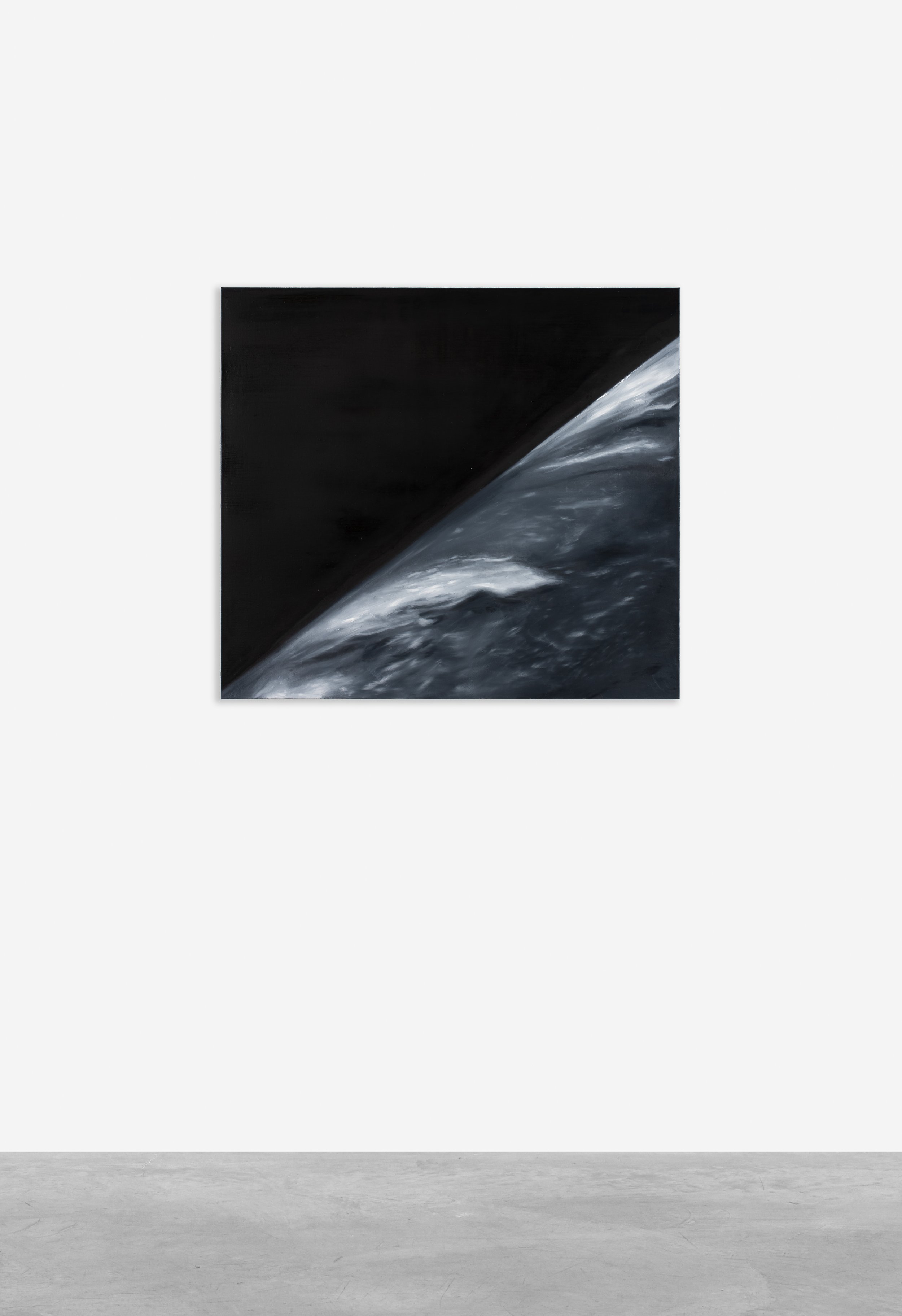
On October 24, 1946, a camera attached to a captured German V-2 rocket pointed its lens downward and took a photograph every 1.5 seconds as the missile arced sixty-five miles above the New Mexico desert. The resulting images were grainy, scratched, and partially ruined by the violence of reentry, but they contained something no human eye had ever witnessed from the inside: the curvature of the Earth against the black void of space. Tan Mu's Peek (2021) is a painting of this first glimpse. It recreates the hazy, black and white photograph as a large oil painting, translating a Cold War weapons test into a meditation on the origins of planetary consciousness. The painting is the starting point of her Horizon series, an ongoing investigation into how technology expands the range of human vision and reshapes our understanding of the planet we inhabit. It is a work that holds a paradox at its center: the same rockets designed to deliver destruction also delivered a view that would fundamentally change how humanity sees itself.
The artist states the subject with historical precision and conceptual clarity. The work reimagines the first photograph ever taken from space, captured by the V-2 No. 13 rocket launched from White Sands Missile Range in New Mexico. For Tan Mu, this image is not merely a historical artifact but the genesis of a new way of seeing, the moment when the satellite perspective became available to human consciousness. The painting is a homage to this foundational image, which she describes as the origin of her Horizon series. It examines the relationship between technology and perception, the way that mechanical instruments extend the human eye into realms previously inaccessible. The painting is a bridge between the military and the scientific, between the destructive and the revelatory, between the individual gaze and the planetary overview. It is a work that asks what it means to see from above, and what is lost when the ground disappears beneath us.
Peek is oil on linen, 91 x 102 cm (36 x 40 in). The nearly square format creates an expansive field that evokes the wide angle of the original rocket camera. The surface is built with layered glazes that mimic the grainy, overexposed quality of the 1946 photograph. The palette is dominated by muted grays, pale whites, and deep blacks, reproducing the limited tonal range of early photographic emulsion. Subtle warm undertones emerge in the lower portion of the canvas, suggesting the curvature of the Earth as it catches the edge of the atmosphere. The brushwork alternates between soft, atmospheric blending that recalls the haze of the upper atmosphere and sharper, more defined passages that suggest the mechanical precision of the camera lens. The painting is a study in the tension between the organic and the mechanical, between the softness of the sky and the hardness of the technology that captured it. It is a work that invites the viewer to lean in, to look for the details that the original photograph could barely resolve.
The 36 by 40 inch format is significant for its refusal of the monumental. Unlike the massive canvases of later Horizon works, Peek maintains an intimate scale that forces the viewer into close proximity with the image. This intimacy mirrors the way that the original photograph was received: not as a grand public revelation, but as a technical byproduct of a military test, viewed by a handful of engineers and scientists. The linen support provides a subtle texture that grounds the atmospheric imagery in the material reality of the painting process. The weave of the fabric is visible in the lighter areas, a reminder that this vision of the planet from above is itself mediated by a human hand and a physical surface. The paint is applied in thin, translucent layers that allow the ground to show through, creating a sense of luminosity that recalls the way light scatters through the atmosphere at extreme altitudes. The overall effect is one of quiet revelation, a moment of seeing that is both ordinary and extraordinary, both historical and present.
The comparison with Andreas Gursky's Rhine II (1999) is instructive, given the shared interest in the flattening of landscape through elevated perspective. Gursky's photograph strips the Rhine River of its depth and texture, reducing it to a series of horizontal bands that hover between abstraction and representation. Tan Mu's painting operates on a similar principle, but her flattening is not the product of digital manipulation but of physical distance. The Earth in Peek is flat because the camera was too far away to resolve topography, because the atmosphere obscured the details, because the technology of 1946 could only capture a ghost of the planet below. Both artists are interested in the way that elevation transforms landscape into pattern, the way that the removal of depth creates a new kind of visual information. But where Gursky's flatness is cold and clinical, Tan Mu's is warm and historical. Her painting carries the weight of a specific moment, a specific rocket, a specific failure that became a triumph. The flatness in Peek is not an aesthetic choice but a technological limitation, and it is this limitation that gives the painting its emotional charge.
Gursky's work is often associated with the Becher school of German photography, a tradition that emphasizes typological precision and the systematic documentation of industrial and natural forms. Tan Mu's work shares this documentary impulse, but her documentation is not systematic; it is singular. She does not photograph the Earth from space repeatedly to build a taxonomy; she paints one specific image that changed everything. This singularity gives the painting a historical weight that Gursky's serial approach deliberately avoids. The painting is not just a picture of the Earth; it is a picture of the first time the Earth was pictured from outside. This originary status transforms the work from a landscape into an event, from a view into a threshold. Gursky's river flows endlessly; Tan Mu's planet exists in a single, frozen moment of first contact. The painting is a monument to this moment, a celebration of the instant when the human gaze finally exceeded the horizon and saw, for the first time, the whole.
This tension between the endless and the singular is central to understanding what Peek achieves as a painting. Gursky's photographs derive their power from repetition, from the accumulation of similar views that reveal a pattern. Tan Mu's painting derives its power from exception, from the fact that this view had never existed before October 24, 1946. The painting is a record of an origin, a trace of the moment when the satellite perspective entered human consciousness for the first time. By choosing to paint this specific image rather than the countless satellite photographs that followed, Tan Mu emphasizes the fragility and the significance of the first glance. The graininess, the scratches, the overexposed edges are not flaws to be corrected but historical evidence to be preserved. They are the marks of a technology straining to exceed its limits, reaching for a view that its designers had not originally intended to capture. The painting honors this accidental beauty, this unintended consequence of military ambition, by translating the imperfections of the photograph into the language of oil paint, where every mark is a decision and every imperfection is a choice.
Vija Celmins' Night Sky 3 (2001) provides a second, more intimate parallel. Celmins' drawing is a meticulous rendering of the night sky, built with thousands of tiny marks that capture the precise arrangement of stars. Tan Mu's painting is a similar act of careful observation, but of the daylit Earth rather than the darkened sky. Both artists are interested in the relationship between the small mark and the vast subject, the way that the labor of the hand can approximate the scale of the cosmos. But where Celmins' sky is infinite and unbounded, Tan Mu's Earth is finite and contained. Her planet has edges, a horizon that marks the limit of the camera's view. This containment gives the painting a different emotional register, one that is less about awe and more about recognition. The Earth in Peek is not the abstract, beautiful void of Celmins' night sky; it is a specific, recognizable object, a home seen from the outside for the first time.
Celmins' practice is often described as a form of meditation, an obsessive attention to surface that transforms the act of drawing into a form of devotion. Tan Mu's painting shares this devotional quality, but her devotion is directed not at the natural world but at the technological image. She is painting a photograph, not a landscape, and this distinction is crucial. The painting is an act of translation, a movement from the mechanical to the handmade, from the captured to the created. By choosing to paint the first space photograph rather than the Earth itself, Tan Mu foregrounds the role of technology in shaping our perception of reality. We do not see the Earth directly; we see it through the lens of a camera attached to a rocket, through the grain of photographic emulsion, through the haze of the atmosphere. The painting is a record of all these mediations, a layered account of the many barriers that stand between the eye and the world. Celmins strips away the mediations to get closer to the thing itself; Tan Mu builds them up to show us that the thing itself is always already mediated.
Saul Appelbaum's 2025 essay on Tan Mu's BEK Forum exhibition introduces the concept of arbitration, arguing that her paintings unfold through a process of deciding, judging, and mediating between input and output. Peek is a powerful example of this arbitration. The input is the 1946 photograph, a grainy technical document produced by a military instrument. The output is a large, luminous oil painting that transforms this document into an object of contemplation. Between these two states lies a complex process of translation, selection, and interpretation that Appelbaum compares to the stochastic scores of Xenakis and the chance operations of Cage. Tan Mu does not simply reproduce the photograph; she arbitrates it, deciding which details to preserve and which to dissolve, which textures to render and which to let fall into abstraction. This arbitration is not a distortion of the original image but a deepening of it, a way of revealing the layers of meaning that the photograph contains but cannot express.
Appelbaum's framework helps us understand Peek as more than a painting of a historical photograph. It is a painting about the act of seeing itself, about the way that technology and art both mediate and transform our experience of the world. The V-2 rocket was an input, a destructive instrument that delivered a revelation. The painting is the output, a contemplative object that preserves the shock of that revelation for a new generation of viewers. Between the rocket and the canvas lies a vast stretch of time, technology, and human intention. By bridging this gap through the labor of painting, Tan Mu demonstrates that art is not a passive record of events but an active participant in the construction of meaning. The first photograph of the Earth from space did not just document a view; it created a new way of seeing, a new relationship between humanity and its home. Peek is a testament to this creation, a painting that holds the first glimpse of the whole world in a single, handmade frame.
What Appelbaum's concept of arbitration reveals, when applied to Peek, is the profound ethical dimension of Tan Mu's artistic choices. The original V-2 photograph was classified military data, a byproduct of weapons testing that happened to capture something beautiful. By choosing to paint this image, Tan Mu reclaims it from its military context and restores it to the domain of human wonder. This act of reclamation is not neutral; it is a political gesture, a refusal to let the technologies of war monopolize the most transformative visions. The painting insists that the first view of the Earth from space belongs not to the Pentagon but to everyone, that the image of the planet as a whole is a shared inheritance that art has a special responsibility to preserve and to transmit. In this sense, Peek is not just a painting about seeing; it is a painting about belonging, about the right to look at the world from above and to feel, for a moment, that it is yours.
The painting sits within a larger series of works that trace the expansion of human vision from the microscopic to the cosmic. From Embryo (2022), which examines the beginnings of life through the lens of the microscope, to Powehi (2022), which captures the first image of a black hole, Tan Mu has been mapping the frontiers of sight. Peek is the originary work in this trajectory, the painting that establishes the satellite perspective as a foundational mode of seeing. It is a work that is both specific and universal, a document of a particular rocket launch that speaks to the enduring human desire to see beyond the horizon. The painting is a testament to the power of technology to extend the human eye, to make the invisible visible, and to help us understand our place in the universe. It is a work that reminds us that we are not just observers of the planet, but participants in its story, shaped by the tools we build and the visions they enable.
The technical details of the original photograph are worth noting, as they shape the visual character of the painting in direct ways. The V-2 rocket carried a 35-millimeter DeVry motion picture camera loaded with standard black and white film. The camera was mounted in the nose cone and programmed to expose one frame every 1.5 seconds during the rocket's ascent and descent. The entire flight lasted approximately five minutes, during which the camera captured a rapid sequence of images that documented the Earth's surface falling away and the blackness of space emerging above. Most of the frames were destroyed on impact when the rocket crashed back into the desert at terminal velocity. The surviving images were recovered from the wreckage by technicians at White Sands, who recognized their significance even though the photographs were scratched, overexposed, and partially fogged by heat damage. These imperfections are not incidental to the meaning of the image; they are evidence of the violence through which the view was obtained, a reminder that every single expansion of human vision inevitably comes at a cost.
Ultimately, Peek is a painting about the first time humanity saw itself from the outside. It is about the shock of recognition that comes with seeing the whole, the vertigo of realizing that the ground beneath your feet is a sphere floating in darkness. It is a celebration of this vision, a celebration of the ingenuity and the curiosity that made it possible. But it is also a warning about the fragility of that vision, a reminder that the Earth is not infinite, that the view from above reveals not just beauty but vulnerability. The painting is a call to attention, a call to remember that the planet we see in the photograph is the same planet we walk on, the same planet we are changing. The first glimpse was a moment of wonder; the question now is whether we can sustain that wonder, whether we can hold the whole in our minds and act accordingly. The painting is a test of this capacity, a measure of our ability to see the Earth as it truly is: small, fragile, and irreplaceable. It is a work of beauty and of truth, a work that will continue to remind us of the first time we looked down and saw home.